Retatrutide and Medicare: Coverage, Costs and Trial Questions
Part D and Medicare Advantage: the same drug-coverage question
Standalone Part D supplies prescription coverage alongside Original Medicare. Many Medicare Advantage plans include Part D drug coverage within the plan. The drug’s investigational status is the same under either arrangement. [1,4]
For approved GLP-1 medicines, coverage depends on the prescribed indication and applicable benefit rules. Some indications qualify for ordinary Part D coverage. The weight-loss exclusion has not been broadly repealed; the Bridge creates a separate, limited route for eligible treatment. [2,3]
Ask the plan about the specific medicine, formulation and reason for treatment. A future approval would still leave the actual indication, formulary and coverage requirements to check. [1,2]
What the GLP-1 Bridge actually offers
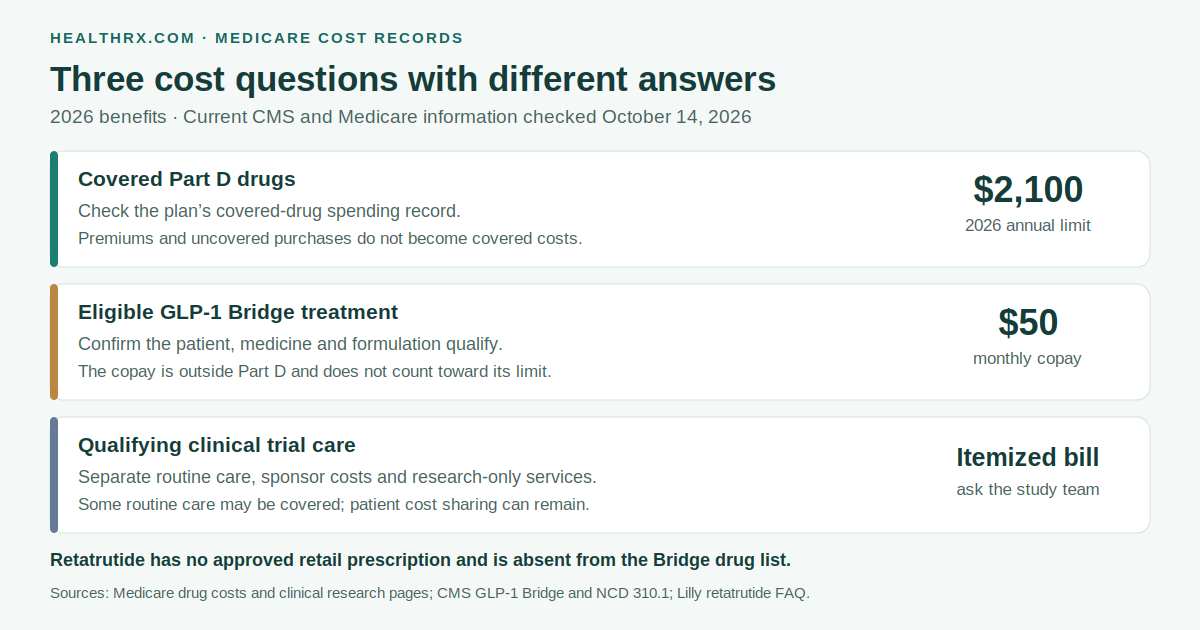
CMS’s Bridge runs from July 1, 2026, through December 31, 2027, outside the Part D benefit. Eligible participants pay $50 monthly, without a Part D deductible. That payment does not count toward Part D out-of-pocket spending, and Extra Help does not subsidize the Bridge copay. CMS’s manufacturer net-price figure is not a patient retail price. [3]
The current eligible list includes Foundayo, Wegovy injections and tablets, and Zepbound KwikPen—not Zepbound single-dose pens or vials. Retatrutide is absent. Eligibility requires provider prior authorization and clinical criteria involving age, lifestyle measures, BMI and, for some pathways, specified medical conditions. BMI alone does not establish eligibility. [2]
An indication covered under Part D must go through Part D, even if the person’s plan does not list the drug. A previous GLP-1 Part D fill in 2026 may affect Bridge eligibility. Have the prescriber check the full CMS criteria. [2]
| Coverage route | Actual question | Who decides | What cost record to request |
|---|---|---|---|
| Ordinary Part D | Is this approved drug covered for this indication? | Drug plan under Part D rules | Written coverage decision, authorization requirements and pharmacy estimate |
| GLP-1 Bridge | Does this person and listed formulation meet Bridge criteria? | Bridge authorization process using CMS criteria | Eligibility decision and monthly copay confirmation |
| Clinical trial care | Which routine services qualify, and which costs belong to the study? | Study billing team and Medicare or plan under applicable rules | Sponsor-payment list and itemized insurance-billing plan |
Keep a usable cost record
The 2026 out-of-pocket limit is $2,100 for covered Part D drugs. Premiums, uncovered purchases and Bridge copays do not become covered spending through that limit. The Medicare Prescription Payment Plan spreads payments across the year; it does not lower the total owed. [3,4]
Before paying for treatment available now, record:
- The drug name, formulation, prescribed indication and pharmacy.
- The plan’s coverage decision, prior authorization requirements and estimated patient charge.
- Whether the estimate reflects the deductible and current covered-drug spending.
- Any Extra Help or other assistance eligibility determination.
- The call date, representative’s name and confirmation number.
If coverage is denied, obtain the written reason. Ask the prescriber whether a coverage determination or formulary exception is appropriate, and follow the denial notice’s appeal instructions. An appeal does not itself make investigational retatrutide a covered retail prescription. [9]
Trial participation has its own billing questions
Medicare may cover routine visits, tests and other care in qualifying clinical trials. This does not establish coverage for every retatrutide study or participant. The investigational item, research-only data collection and items supplied free by the sponsor generally fall outside routine-cost coverage. Patient cost sharing can remain. [5,6]
Ask the coordinator and plan which services are billed to insurance, which the sponsor pays, and what happens if additional care is needed. Get answers before consenting. A listing is not an enrollment opening: Lilly’s TRIUMPH-6 page reports completed enrollment, and its design includes possible placebo assignment. [7]
Frequently asked questions
Does Medicare Part D or Medicare Advantage cover retatrutide?
Neither option currently covers an approved retail retatrutide prescription, because there is no approved product. Coverage for qualifying routine clinical trial care is a separate question. [1,6]
When will retatrutide be approved, and what will it cost?
Lilly has not established a launch date or commercial price. Published phase 3 results do not determine a future prescription’s insurance cost. [1]
Does Medicare cover GLP-1 drugs for weight loss in 2026?
The general Part D weight-loss exclusion remains. Eligible beneficiaries can access selected medicines through the separate GLP-1 Bridge. GLP-1 prescriptions for Part D-covered indications must use Part D rather than the Bridge. [2,3]
What is the Medicare GLP-1 Bridge?
It is a temporary CMS program outside Part D, running July 2026 through December 2027, with a $50 monthly copay for eligible treatment. Retatrutide is not on its eligible-drug list. [2,3]
Does the Part D out-of-pocket limit include retatrutide or Bridge copays?
The 2026 limit is $2,100 for covered Part D spending. An uncovered retatrutide purchase would not count, and Bridge copays are expressly excluded from Part D true out-of-pocket spending. [3,4]
Is there a manufacturer coupon for retatrutide?
There is no established commercial retatrutide coupon to include in a treatment budget. [1]
How can I lower the cost of treatment available now?
Request a plan-specific pharmacy estimate and ask about covered treatment options, Extra Help and applicable assistance programs. The Medicare Prescription Payment Plan can spread covered Part D payments over time, but it does not reduce the bill. [4]
How can a Medicare beneficiary look for a retatrutide clinical trial?
Use Lilly’s trial finder and confirm enrollment status directly with the study site. TRIUMPH-6 currently lists completed enrollment. Ask about eligibility, visits, placebo assignment and costs; a listing does not guarantee a place. [7]
Who pays for medical care during a clinical trial?
The sponsor may pay specified study costs; Medicare may cover qualifying routine care, with patient cost sharing. Ask the coordinator and plan for an itemized billing arrangement, including research-only services and sponsor-provided items. [5,6]
Is retatrutide better than tirzepatide or semaglutide?
Retatrutide activates GIP, GLP-1 and glucagon receptors; tirzepatide, the ingredient in Mounjaro, activates GIP and GLP-1 receptors. The cited retatrutide trial used placebo, so it cannot rank retatrutide against tirzepatide or semaglutide. Separate trials used different populations and follow-up. [8,11]
What side effects have retatrutide trials reported?
The published phase 2 study reported mostly mild-to-moderate gastrointestinal effects that varied with dose. Dose-dependent heart-rate increases peaked around week 24 and then declined. These findings do not provide a complete safety profile for every patient. [8]
Should I wait for retatrutide or discuss another treatment now?
Discuss available treatment, existing coverage and costs with your clinician. A projected launch date is a poor basis for postponing a decision about care needed now. [1,4]
Can a compounded product be covered as retatrutide?
A product sold under that description does not establish an approved retatrutide prescription or Medicare reimbursement. Its price is not evidence of Lilly’s future commercial price. [1]
What can I do if my Medicare drug plan denies coverage?
Request the written coverage determination. Your prescriber can support an appropriate exception request with a medical statement. Follow the current denial notice for appeal deadlines and procedures; approval is not guaranteed. [9]
What is the Treat and Reduce Obesity Act?
The introduced 2025 version of S. 1973 proposes changes to Medicare obesity-treatment coverage. Its introduced text does not establish the program rules that apply to a prescription today. Check the current CMS benefit and Bridge requirements when assessing costs. [10,2,3]
References
Sources checked October 14, 2026.
- Lilly: What to know about retatrutide
- CMS: Medicare GLP-1 Bridge information for Part D plans
- CMS: Medicare GLP-1 Bridge
- Medicare: Costs for Medicare drug coverage
- Medicare: Clinical research studies
- CMS: National Coverage Determination 310.1, Routine Costs in Clinical Trials
- Lilly: TRIUMPH-6 trial listing, NCT06859268
- Jastreboff et al.: Triple-Hormone-Receptor Agonist Retatrutide for Obesity—A Phase 2 Trial
- Medicare: Drug plan appeals
- GovInfo: S. 1973, Treat and Reduce Obesity Act of 2025, introduced version
- Tirzepatide Once Weekly for the Treatment of Obesity, SURMOUNT-1