Adderall XR With Food and Supplements: Identify the Interaction
At a glance
- Current label revision / April 2026
- Approved use / ADHD in adults and children age 6 and older
- With food / permitted with or without food
- High-fat meal / delayed peak timing; did not change extent of absorption
- Ascorbic acid / named as an acidifying agent that may lower blood levels; no label timing interval
- Alkalinizing agents / may increase blood levels; coadministration should be avoided
- Proton pump inhibitors / may shorten time to peak; monitor for a changed clinical effect
- St. John's wort / named among serotonergic drugs that can increase serotonin-syndrome risk
- Caffeine / not listed as a specific interaction and no label-defined safe cup or milligram limit
- MAO inhibitors / contraindicated during use and for 14 days after stopping the MAOI
Separate Label Instructions From Untested Timing Rules
| Common claim | What the current evidence establishes | What remains unproven or individualized |
|---|---|---|
| “Take vitamin C at least two hours after Adderall XR” | The label names ascorbic acid as an acidifying agent that can decrease amphetamine blood levels and says dosage may be adjusted based on clinical response [1] | The label gives no two-hour interval, vitamin C dose threshold, or trial showing that one interval restores exposure |
| “Avoid orange juice, grapefruit, soda, vinegar, tomatoes, and cranberry near the dose” | Urinary pH can affect amphetamine elimination, and controlled physiology studies confirm pH-sensitive kinetics [4,5] | The label does not list those foods or quantify the effect of ordinary servings; grapefruit-CYP3A4 rules do not automatically transfer to amphetamine |
| “All antacids increase absorption; separate them by two hours” | The label says gastrointestinal or urinary alkalinizing agents increase blood levels and that coadministration should be avoided [1] | It does not publish a universal spacing interval or say that spacing neutralizes the interaction; identify the exact active ingredient rather than the store category |
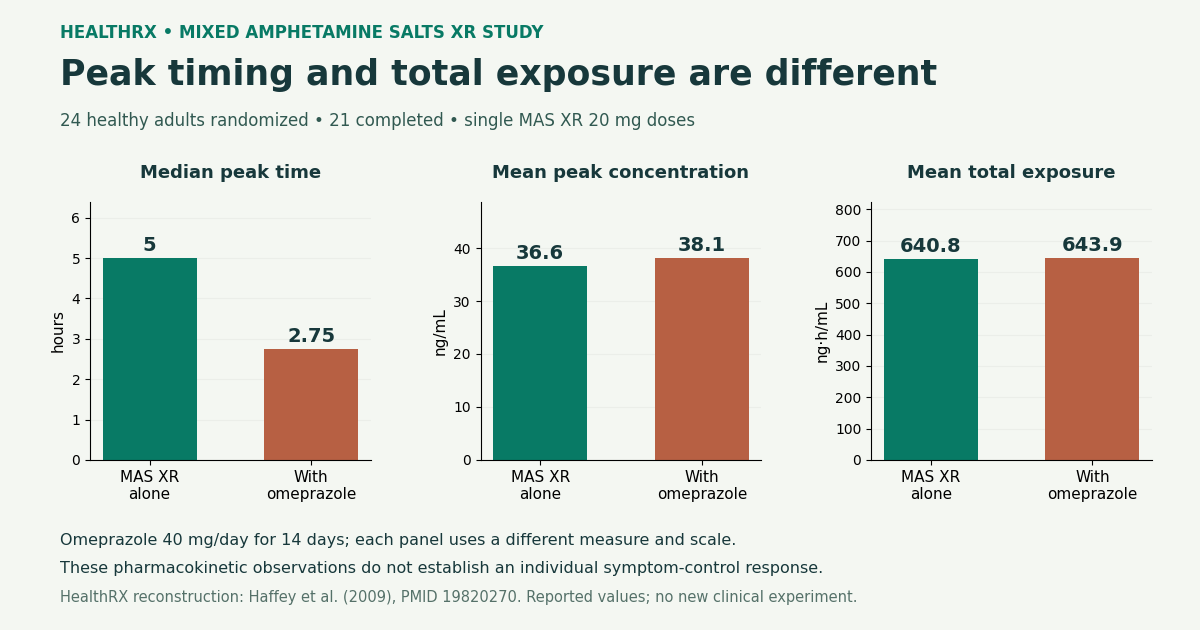
| “Proton pump inhibitors increase Adderall XR levels” | The label says PPIs decrease time to peak concentration and recommends monitoring for changes in effect [1] | In a 21-completer crossover study, omeprazole moved median peak timing earlier for mixed amphetamine salts XR but did not change total exposure or peak concentration on average [2] |
| “Adderall XR must be taken fasting or with a low-fat meal” | The label permits use with or without food. A high-fat meal delayed peak timing by about 2.5 to 2.7 hours but did not change extent of absorption [1] | Faster onset is not the same as better overall exposure, and the label does not prescribe a 30-to-60-minute fasting window |
| “One coffee is safe; more than 200 mg caffeine is dangerous” | Adderall XR can raise blood pressure and pulse, so all stimulant sources belong on the medication list [1] | The label does not list caffeine as a specific interaction or define a universal cup, milligram, pulse, or blood-pressure cutoff |
| “St. John's wort is an MAOI and therefore absolutely contraindicated” | The label lists St. John's wort among serotonergic drugs that can increase serotonin-syndrome risk [1] | The label does not classify it as the same contraindicated MAOI category; the action is medication review and monitoring, not a fabricated equivalence |
| “Fish oil, magnesium, melatonin, iron, or zinc are proven safe with Adderall XR” | None is named as a specific interaction in the April 2026 label [1] | Absence from the interaction table is not a product-specific safety trial. Formulation, dose, other ingredients, and the reason for use still matter |
Identify the exact ingredient and the outcome being measured. A peak-time change, a total-exposure change and a clinical symptom are different observations.
Food: Timing Changes Are Not the Same as Lost Exposure
The label says Adderall XR can be taken with or without food [1]. After a 30 mg dose, a high-fat meal moved the average time to peak concentration from 5.2 to 7.7 hours for d-amphetamine and from 5.6 to 8.3 hours for l-amphetamine. The extent of absorption did not change.
That distinction matters. A later peak may feel like a slower morning onset, but it does not mean the meal “blocked” the dose. A formulation study involving 41 healthy adults across its tested conditions likewise found the selected extended-release formulation had comparable rate and extent of absorption when taken fasted, after a high-fat breakfast, or sprinkled on applesauce [3]. Differences in methods and endpoints explain why a summary should preserve the exact label wording rather than promise a particular onset.
The capsule may be opened and the full contents sprinkled on applesauce when swallowing is difficult. The label says to swallow the mixture immediately, not chew it, not store it, and not divide the capsule contents [1].
Vitamin C and Acidifying Agents: What Is Actually Known
Amphetamine is a weak base. Changes in urinary pH can alter how much drug remains ionized and how much is reabsorbed or excreted. Human experimental work has demonstrated that acidification and alkalinization change amphetamine kinetics [4], and later mechanistic modeling reproduced potentially meaningful effects across urine-pH conditions [5].
The current label therefore names ascorbic acid as an example of an acidifying agent and says acidifying agents can lower blood levels and efficacy [1]. It does not provide a tested supplement dose, a 30% AUC reduction, a citrus-juice equivalence, or a two-hour solution.
If a person notices a repeatable change after starting vitamin C or another product, the useful response is not to double the stimulant or create a timing rule. Record the exact supplement, milligrams, formulation, time taken, Adderall XR time, meal context, and observed duration, then ask the prescriber or pharmacist whether the combination or dose needs review.
Alkalinizing Agents: Identify the Ingredient
The April 2026 label says gastrointestinal or urinary alkalinizing agents increase blood levels and potentiate amphetamine and that coadministration should be avoided [1]. This is stronger than “take two hours apart.” The label does not say a time gap eliminates the effect.
“Antacid” is not one ingredient. A reader should record the active ingredient and dose rather than assume every heartburn product, mineral supplement, or alkaline beverage produces the same systemic change. Deliberately using sodium bicarbonate or another product to amplify a stimulant is outside the prescribed regimen and can increase risk.
Proton Pump Inhibitors: Earlier Peak, Similar Total Exposure
The label handles PPIs separately from alkalinizing agents: it says time to maximum amphetamine concentration decreases and advises monitoring for a changed clinical effect [1].
In an open-label randomized four-period crossover study of healthy adults aged 18–45, 24 participants were randomized and 21 completed mixed amphetamine salts XR and lisdexamfetamine conditions with and without 14 days of omeprazole [2]. For mixed amphetamine salts XR, median time to peak moved from 5 hours to 2.75 hours with omeprazole. Mean maximum concentration and total exposure were essentially unchanged, while 57% to 62% of participants had a peak at least one hour earlier. That supports altered release timing and substantial person-to-person variability, without establishing a predictable change in symptom control for an individual patient.
Caffeine: Do Not Invent a Universal Threshold
The Adderall XR label warns that CNS stimulants can raise blood pressure and heart rate and recommends monitoring at appropriate intervals [1]. It does not name caffeine in the interaction table, state that one cup is safe, set a 200 mg limit, or say a resting pulse above 100 should be managed by changing caffeine before the prescription.
Caffeine sources also vary: coffee, tea, energy drinks, pre-workout powders, caffeine tablets, and multi-ingredient supplements may deliver different amounts and additional stimulants. Record the product, actual caffeine milligrams when known, timing, and symptoms. New palpitations, chest pain, fainting, severe headache, or other concerning symptoms require clinical evaluation rather than an online cup count.
St. John's Wort, Tryptophan, and MAO Inhibitors
The label names St. John's wort and tryptophan among serotonergic substances that can increase serotonin-syndrome risk when used with Adderall XR [1]. It recommends a benefit-risk decision, lower starting doses when clinically warranted, and monitoring during initiation or titration; it does not say every serotonergic agent is an MAOI.
Actual MAO inhibitors are a separate contraindication. Adderall XR must not be used with an MAOI or within 14 days after the MAOI is stopped because of hypertensive-crisis risk [1]. The label includes linezolid and intravenous methylene blue in that warning. A supplement list should therefore include herbal products by exact name, but the evidence category must remain accurate.
Interaction Observation Record
Use this record before concluding that food or a supplement changed the medication:
| Field | Record |
|---|---|
| Adderall product | XR or immediate release; brand or generic manufacturer; prescribed strength |
| Administration | intact capsule or applesauce; time; with or without food |
| Meal | start time, approximate fat content, and whether the pattern was unusual |
| Other product | exact brand, active ingredients, amount per serving, and servings |
| Timing | time of the other product relative to Adderall XR |
| Medication changes | PPI, antacid, urinary-pH medicine, serotonergic drug, or CYP2D6 inhibitor changes |
| Observed change | onset, duration, symptom control, appetite, sleep, pulse or blood pressure if already monitored |
| Repetition | one day or a repeatable pattern under similar conditions |
| Confounders | sleep, illness, missed meals, stress, menstrual cycle, or missed/late dose |
| Source checked | current pharmacy leaflet, April 2026 label, pharmacist, or prescriber |
| Confirmed action | continue, avoid, monitor, or adjust only as directed; who confirmed it and when |
This record does not diagnose an interaction. It makes the report reproducible and helps distinguish a formulation-timing change from food, another drug, sleep, illness, or normal day-to-day variation.
Evidence Boundaries
- Adderall XR and immediate-release Adderall are not interchangeable for food timing or release behavior.
- Lisdexamfetamine findings should not be copied onto mixed amphetamine salts XR; the omeprazole study found different timing patterns [2].
- A label interaction class does not prove that every food with an acidic taste changes urine pH enough to alter clinical response.
- A supplement study in ADHD does not establish pharmacokinetic safety with Adderall XR unless the combination and endpoints were actually tested.
- Do not change the prescribed dose to compensate for a suspected food or supplement effect without the prescriber.
Frequently asked questions
Does the current Adderall XR label require vitamin C to be separated by two hours?
Can Adderall XR be taken with food?
Should I avoid orange juice or grapefruit with Adderall XR?
Do proton pump inhibitors increase total Adderall XR exposure?
Can I take an antacid with Adderall XR if I separate it by two hours?
How much coffee is safe with Adderall XR?
Is St. John's wort an MAOI contraindication with Adderall XR?
Are fish oil, magnesium, iron, zinc, and melatonin proven interaction-free?
References
-
DailyMed. Adderall XR extended-release capsules, current U.S. prescribing information, revised April 2026. Current Adderall XR label
-
Haffey MB, et al. Effects of omeprazole on the pharmacokinetic profiles of lisdexamfetamine dimesylate and extended-release mixed amphetamine salts in adults. Postgraduate Medicine. 2009;121(5):11-19. PubMed 19820270
-
Tulloch SJ, Zhang Y, McLean A, Wolf KN. SLI381 (Adderall XR), a two-component, extended-release formulation of mixed amphetamine salts: bioavailability of three test formulations and comparison of fasted, fed, and sprinkled administration. Pharmacotherapy. 2002;22(11):1405-1415. PubMed 12432966
-
Wan SH, Matin SB, Azarnoff DL. Kinetics, salivary excretion of amphetamine isomers, and effect of urinary pH. Clinical Pharmacology & Therapeutics. 1978;23(5):585-590. PubMed 25157
-
Huang W, et al. Mechanistic PBPK modeling of urine pH effect on renal and systemic disposition of methamphetamine and amphetamine. Journal of Pharmacology and Experimental Therapeutics. 2020;373(3):488-501. PubMed 32198137