Missed Fosamax Dose: Use the Right Calendar for Your Prescription
A missed alendronate dose needs a calendar decision, not a catch-up total. First, read your prescription label: once-weekly and once-daily prescriptions have different missed-dose instructions. If the schedule is unclear, ask your pharmacist before taking another dose. [2]
Choose the instructions for your prescription
| Prescription schedule | What to do after a missed dose | What not to do |
|---|---|---|
| Once weekly | Take one dose the morning after you remember. Then return to your original weekly day. | Do not take two doses on one day. |
| Once daily | Skip the missed dose. Take one usual dose the next morning. | Do not take it later that day or double the next dose. |
These instructions follow the medication guidance; the calendar examples below show how to apply them. Do not add up missed tablets and take them together. [2]
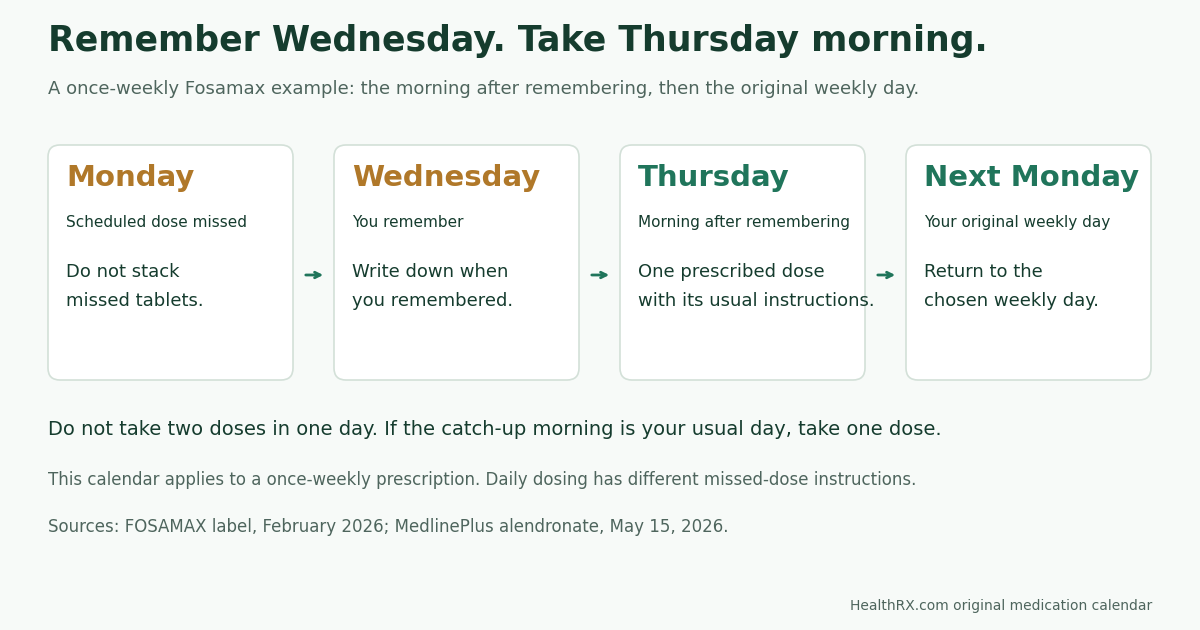
Monday–Wednesday–Thursday example: Your regular weekly dose is Monday. You miss it and remember on Wednesday. Take one dose Thursday morning, the morning after remembering. Then take your next dose on your chosen weekly day, Monday. Remembering on Wednesday does not mean taking it Wednesday. [2]
Sunday reminder example: You normally take your weekly dose Monday but remember the missed dose Sunday. The morning after remembering is Monday, which is also your usual day. Take one Monday dose, not two. [2]
Write the actual dose date on a calendar before setting the next reminder. Keep the usual weekly day visible so a catch-up dose does not accidentally become a new schedule.
Keep the morning administration rules
For an ordinary tablet, use a full glass of plain water, 6–8 ounces. Wait at least 30 minutes before food, other drinks, or other medicines. Stay upright for at least 30 minutes and until after your first food. Do not take it at bedtime. Solution and effervescent forms have different preparation instructions; check your specific product. [2]
An administration mistake does not tell you how much medicine was absorbed. Record what happened and ask the pharmacist about the next dose instead of calculating a replacement tablet. [2]
Stop taking alendronate and call your clinician before another dose if you develop new or worsening heartburn, painful or difficult swallowing, or chest pain. [1]
What the dosing and fracture studies measured
Alendronate slows bone breakdown. A trial comparing weekly and daily schedules tested bone-density outcomes; it did not establish that either schedule prevents forgetting in everyday life. [2][3] Fracture reduction was studied in FIT, including women with existing vertebral fractures, but that trial does not calculate the risk from one skipped week. [7]
Alendronate's long residence in bone is not a guarantee of continuing fracture protection or permission for repeated gaps. [1] Refill studies associate better adherence with fewer fractures, but pharmacy supply cannot show whether each tablet was swallowed or taken correctly. [4]
If missed doses keep happening
Bring a short record to your pharmacist or prescriber:
- Your prescription schedule and formulation.
- The last dose actually taken and the next calendar date you planned.
- How often doses are missed and why.
- Morning time constraints, other medicines, and any symptoms.
This helps identify barriers rather than simply counting tablets. Repeated gaps warrant a review of your treatment plan, fracture risk, and bone-density trends. The guideline does not set a missed-tablet count that automatically triggers testing. [5]
For high-risk postmenopausal women with low bone density on treatment, the Endocrine Society recommends spine and hip DXA monitoring every 1–3 years, individualized to the patient. Bone-turnover markers can help assess poor response or adherence, but cannot prove a particular dose was taken. [5] If oral dosing remains impractical, discuss alternatives; yearly zoledronic acid has fracture-outcome evidence, but still requires clinical assessment and follow-up. [6]
Frequently asked questions
What should I do if I miss my weekly Fosamax dose?
Take one dose the morning after you remember, then return to your original weekly day. If that morning is already your usual day, take only one dose. Never take two doses together. [2]
Can I take Fosamax at night if I forgot my morning dose?
No. Do not take alendronate at bedtime. For a weekly prescription, take it the morning after remembering; for a daily prescription, skip the missed dose and take your usual dose next morning. [2]
How does Fosamax work to prevent fractures?
Alendronate slows bone breakdown and increases bone density. Clinical trials also evaluated fracture reduction, including FIT in women with existing vertebral fractures. Those results do not predict the consequence of one missed dose. [2][7]
Will missing one dose of alendronate cause bone loss?
The cited trials do not quantify bone loss from one missed dose. Follow your prescription's missed-dose instructions rather than doubling up. Repeated gaps deserve a review because better adherence is associated with fewer fractures. [2][3][4][7]
How long does Fosamax stay in your bones?
The label estimates alendronate's terminal human half-life exceeds 10 years, reflecting release from the skeleton. That does not mean 10 years of guaranteed fracture protection or make repeated missed doses acceptable. [1]
What happens if I accidentally take two Fosamax tablets in one day?
Call your doctor promptly for overdose instructions. Do not make yourself vomit or lie down. Do not take another tablet as a correction; get advice about what to do next. [1]
Is weekly Fosamax better than daily Fosamax?
A randomized trial found comparable bone-density outcomes with the studied weekly and daily regimens. It was not a forgetting trial or proof of superior fracture prevention. Use the schedule on your prescription. [3]
Can I take Fosamax with coffee or juice instead of water?
No. Take an ordinary alendronate tablet with plain water, not coffee or juice. Other formulations have their own instructions. If you used the wrong drink, ask your pharmacist rather than taking a replacement tablet. [2]
What is the medication possession ratio and why does it matter?
Medication possession ratio estimates the proportion of time covered by dispensed medicine. One claims study associated better refill adherence with fewer fractures. It does not prove correct ingestion or establish your personal protection threshold. [4]
Should I get a bone density test if I have been missing doses?
One missed dose does not automatically require another DXA. Repeated gaps should prompt a treatment review. Monitoring is individualized; guidelines recommend DXA every 1–3 years for high-risk postmenopausal women with low bone density on treatment. [5]
When should I switch from oral Fosamax to IV zoledronic acid?
Discuss the options if oral dosing remains impractical or poorly tolerated. The zoledronic acid trial measured fracture outcomes against placebo; it did not determine when someone who misses alendronate should switch. A different treatment still needs an individual assessment and follow-up. [5,6]
Do I need to take calcium and vitamin D with alendronate?
Adequate calcium and vitamin D support treatment; supplements may be needed when dietary intake is insufficient. Doses should be individualized. Calcium and antacids interfere with alendronate absorption, so do not take them together. [1][5]
References
Sources checked October 14, 2026.
- Organon/FDA. FOSAMAX prescribing information, revised February 2026.
- MedlinePlus. Alendronate, current May 15, 2026.
- Schnitzer et al. Therapeutic equivalence of alendronate 70 mg once-weekly and alendronate 10 mg daily. 2000.
- Siris et al. Adherence to bisphosphonate therapy and fracture rates in osteoporotic women. 2006.
- Endocrine Society. Pharmacological Management of Osteoporosis in Postmenopausal Women: clinical practice guideline.
- Black et al. Once-yearly zoledronic acid for treatment of postmenopausal osteoporosis. 2007.
- Black et al. Randomised trial of effect of alendronate on risk of fracture in women with existing vertebral fractures. 1996.