
Does WellCare Cover Prolia in 2026? Part B, Part D, and Plan Checks
At a glance
- Usual administration / 60 mg subcutaneous injection by a healthcare provider every 6 months
- Possible benefit / Part B medical benefit when provider supplied; Part D when pharmacy supplied under qualifying circumstances
- Verified Part D example / Brand Prolia absent from WellCare Classic PDP file 26191; Conexxence and Stoboclo listed on Tier 4
- What varies / Plan, state, indication, site of care, network, authorization, cost sharing, and preferred denosumab product
- Time-sensitive issue / Avoid an unplanned gap or self-directed discontinuation
- Publication status / Medical review pending
Editorial evidence status: Rebuilt from current WellCare plan documents, CMS benefit rules, the FDA label, and primary denosumab evidence on August 29, 2026. A licensed clinician has not approved this revision. It remains in Medical/expert approval required status.
Start with the claim path, not the brand name
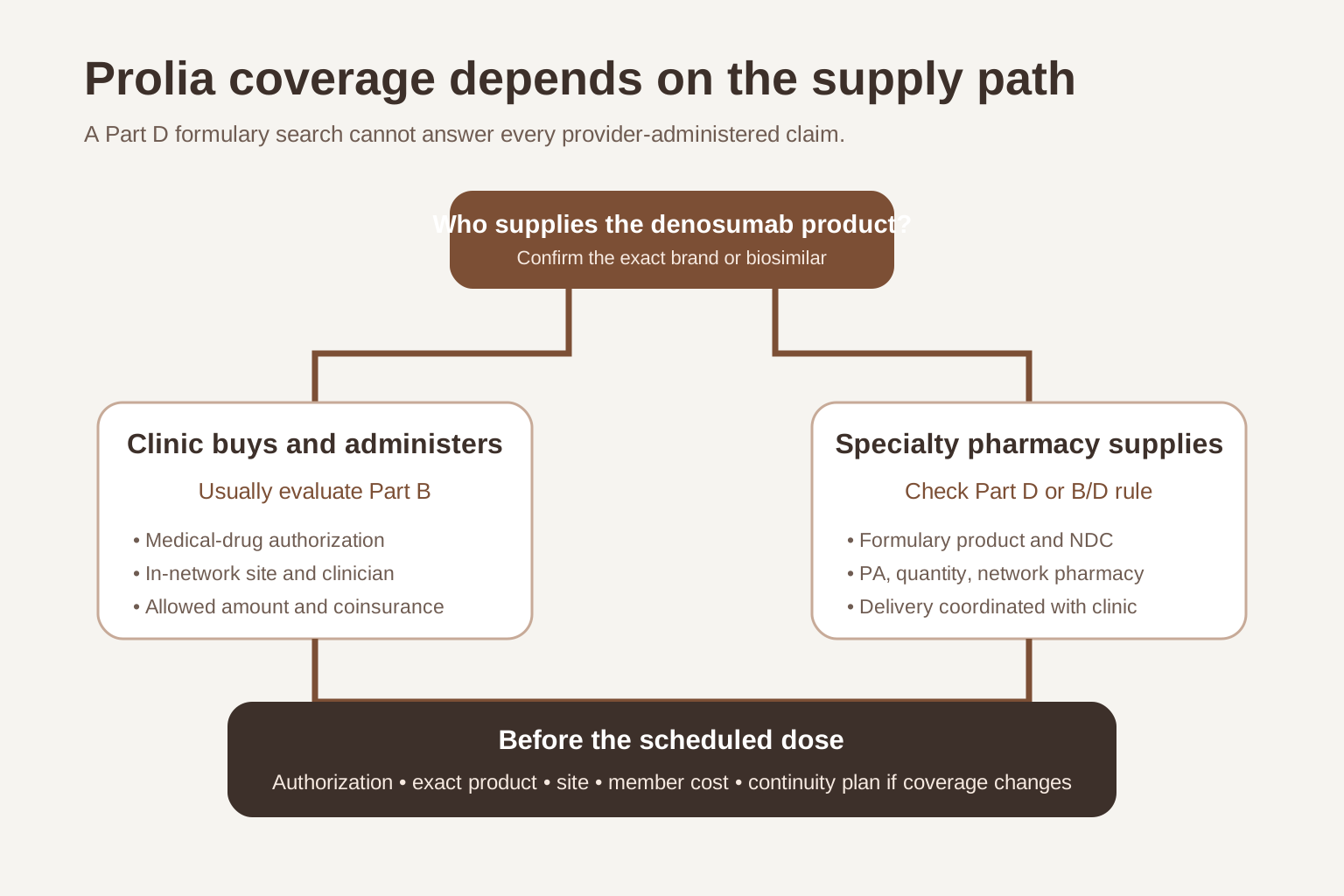
Prolia is administered by a healthcare provider. That creates two possible coverage paths:
- Provider buy-and-bill: the clinic acquires and injects the medicine, and the Medicare Advantage plan evaluates the claim under the Part B medical benefit.
- Specialty-pharmacy supply: a pharmacy dispenses the product for administration, and the plan may evaluate the drug under Part D or coordinate the Part B-versus-Part D decision.
The correct path depends on the member's plan and delivery arrangement. A Part D formulary search alone cannot rule out medical-benefit coverage. Conversely, a clinic's statement that it “takes WellCare” does not prove that the drug, site, and authorization are covered.
Figure 1. Benefit-path verification for Prolia or another denosumab product. HealthRX.com editorial synthesis of CMS benefit guidance, the August 2026 WellCare Classic formulary, and current FDA labeling. It is not a plan-specific benefit guarantee. Medical review is pending.
What one current WellCare formulary does—and does not—show
The WellCare Classic PDP formulary updated August 1, 2026 does not list brand Prolia. Its osteoporosis section lists Conexxence and Stoboclo, both denosumab biosimilars, on Tier 4 with a one-milliliter-per-180-day quantity limit. [1] FDA's biosimilar directory identifies both products as biosimilar to Prolia/Xgeva. [2]
That example supports three conclusions and no more:
| Supported conclusion | Unsupported leap |
|---|---|
| Brand and biosimilar status can differ | “WellCare never covers Prolia” |
| A listed biosimilar can still have quantity or other processing rules | “Tier 4 means this exact copay for everyone” |
| The Part D list is one part of the check | “Absence from the PDP list means no Part B coverage” |
The most current answer comes from the member's plan portal, Evidence of Coverage, medical-drug policy, and authorization response—not from a nationwide average.
The five questions to ask before the next injection
- Is the requested product Prolia or a named denosumab biosimilar?
- Will the clinic buy and bill it, or will a specialty pharmacy supply it?
- Is the claim evaluated under Part B or Part D for this plan and site?
- Is prior authorization, a preferred product, step therapy, or a site-of-care rule involved?
- What will the member owe at this in-network site after the deductible and plan cost sharing?
Ask the provider's benefits team to record the authorization number, approved product, dates, doses, and site. A verbal “covered” without those fields is not enough to protect against a denied claim or an avoidable delay.
Why continuity belongs in the coverage decision
Current FDA prescribing information states: “Patients should be transitioned to another antiresorptive agent if Prolia is discontinued.” [3]
That 11-word regulator quotation appears in the 2025 U.S. prescribing information, Highlights/Warnings 5.6, page 1; the full warning is developed in section 5.6, page 9. It does not imply FDA endorsement of HealthRX.com. It matters here because an insurance transition, site-of-care problem, or authorization delay can become clinically consequential when it produces an unplanned interruption.
The label says Prolia should be given once every six months and that a missed injection should be administered as soon as convenient, with future six-month intervals counted from the actual injection date. It also warns that new vertebral fractures occurred as early as seven months after the last dose in the clinical program. [3]
Do not respond to a denial by simply abandoning treatment or spacing doses yourself. Contact the prescriber promptly so the coverage pathway and clinical transition plan can be addressed together.
What a complete authorization package should establish
The controlling medical or pharmacy policy can vary, so this page does not invent a universal T-score cutoff or mandatory treatment sequence. A useful submission generally includes:
- the FDA-labeled indication;
- a dated DXA report and relevant fracture history;
- prior osteoporosis therapies, dates, response, intolerance, or contraindication;
- calcium, vitamin D, kidney disease, and CKD-MBD assessment when clinically relevant;
- requested product, dose, site, billing or NDC information;
- why the requested product and site are appropriate under the actual plan criterion;
- the next-dose date and continuity concern when the patient is already receiving denosumab.
The 2025 FDA label includes a boxed warning for severe hypocalcemia in patients with advanced chronic kidney disease, particularly those with CKD-MBD, and calls for evaluation and expert supervision in that population. [3] This is a safety and monitoring issue, not merely paperwork.
What the efficacy evidence can support
In the FREEDOM randomized trial, 7,868 postmenopausal women with osteoporosis received denosumab 60 mg every six months or placebo for 36 months. New radiographic vertebral fractures occurred in 2.3% of the denosumab group and 7.2% of placebo, an absolute reduction of 4.8 percentage points; hip fractures occurred in 0.7% and 1.2%, respectively. [4] [3]
Those results support the medicine's approved role. They do not prove that every member meets a specific WellCare policy or that denosumab is the best option for every patient. The authorization should connect the evidence to the individual's indication and risk.
If WellCare denies or delays the claim
Read the denial reason before choosing the response. A medical-benefit authorization denial, a Part D coverage determination, a rejected NDC, and an out-of-network site are different problems.
| Problem shown | Practical next move |
|---|---|
| Wrong benefit path | Ask the plan and clinic whether the claim belongs under medical or pharmacy benefits |
| Nonpreferred product | Ask whether a listed denosumab biosimilar is clinically and operationally appropriate, or whether an exception is needed |
| Missing clinical evidence | Submit the plan's requested DXA, history, labs, and rationale |
| Site-of-care or network issue | Identify an authorized in-network administration site before moving the appointment |
| Unfavorable Part D decision | Follow the coverage-determination and redetermination instructions and deadlines |
| Timing approaches the next dose | Escalate to the prescriber and plan; do not self-discontinue |
CMS defines a Part D coverage determination to include decisions about formulary status, prior authorization, step therapy, quantity limits, and disputed cost sharing. [5] Medical-benefit appeals follow the Medicare Advantage organization-determination pathway instead. The denial notice should identify the applicable process.
What cost estimates cannot tell you
List price, Medicare payment, plan allowed amount, and member out-of-pocket cost are different numbers. The member's cost can depend on the benefit, provider contract, deductible, coinsurance, maximum out-of-pocket rules, and assistance eligibility. A page that promises a universal $0 copay or fixed percentage without the exact plan documents is manufacturing certainty.
Commercially insured people may have manufacturer assistance options that do not apply to federal health-program beneficiaries. Medicare and Medicaid members should ask the plan, State Health Insurance Assistance Program, or a qualified benefits counselor about lawful assistance rather than assuming a commercial copay card is available.
Frequently asked questions
Does WellCare cover Prolia in 2026?
Is Prolia covered under Part B or Part D?
What if a WellCare authorization delay approaches my next dose?
Does a WellCare formulary's omission of Prolia prove no coverage?
References
- WellCare. WellCare Classic (PDP) 2026 Formulary, HPMS file 26191. Updated August 1, 2026. See pp. I–XIII and formulary p. 109 (PDF p. 123). 2026 WellCare Classic formulary
- U.S. Food and Drug Administration. Biosimilar Product Information. Current list accessed August 29, 2026; entries for Conexxence and Stoboclo identify Prolia/Xgeva as reference products. FDA biosimilar directory
- U.S. Food and Drug Administration. Prolia (denosumab) prescribing information. Revised 2025. See Highlights and sections 2.3, 5.1, and 5.6, pp. 1, 4, 8–9. Prolia prescribing information
- Cummings SR, San Martin J, McClung MR, Siris ES, Eastell R, Reid IR, Delmas P, Zoog HB, Austin M, Wang A, Kutilek S, Adami S, Zanchetta J, Libanati C, Siddhanti S, Christiansen C, FREEDOM Trial. Denosumab for prevention of fractures in postmenopausal women with osteoporosis. N Engl J Med. 2009 Aug 20;361(8):756-65. doi:10.1056/nejmoa0809493. PMID:19671655. NCT:NCT00089791. PubMed record
- Centers for Medicare & Medicaid Services. Coverage Determinations. Updated September 10, 2024. Part D coverage determinations