Can Amlodipine Cause Swelling? How to Read the Pattern
Evidence status: This article was updated against the current U.S. Norvasc label, the 2024 ESC hypertension guideline, and randomized edema studies. Medical review of this update is pending.
At a glance
- Direct answer / Yes; peripheral edema is one of amlodipine's most common adverse effects
- Label trial rate at 5 mg / 3.0% versus 0.6% with placebo
- Label trial rate at 10 mg / 10.8% versus 0.6% with placebo
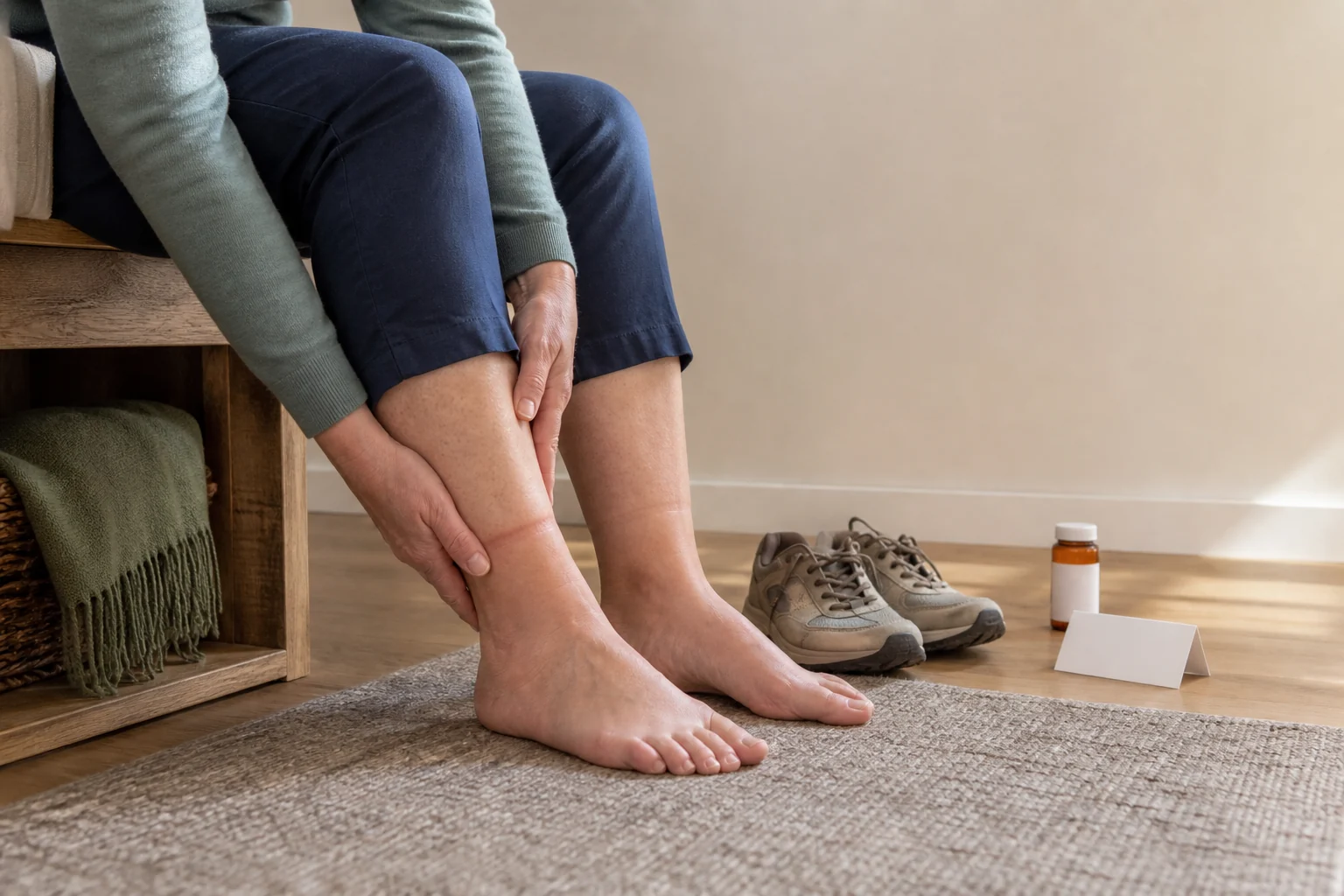
- Typical location / Ankles, feet, and lower legs
- Typical pattern / Often bilateral and more noticeable after being upright
- Mechanism / More dilation before the capillary than after it, increasing local filtration pressure
- Important distinction / Local dependent edema is not automatically heart or kidney failure—but those causes can coexist
- Time-of-day fix / Moving amlodipine to night is not proven to prevent edema
- Medication options to discuss / Dose reduction, a different drug, or a clinician-selected combination
- Urgent mismatch / One-sided painful swelling, breathlessness, chest pain, or facial/tongue swelling
Yes—even 5 mg can cause ankle swelling
The cleanest answer comes from the controlled-trial table in the U.S. Norvasc prescribing information [1]:
| Daily dose in the label trials | Participants | Reported edema | Placebo rate |
|---|---|---|---|
| 2.5 mg | 275 | 1.8% | 0.6% |
| 5 mg | 296 | 3.0% | 0.6% |
| 10 mg | 268 | 10.8% | 0.6% |
These figures answer two common search questions at once. Five milligrams can cause swelling, and the risk rose substantially at 10 mg in these trials. They are not a personal probability calculator. Trial detection methods, treatment duration, age, sex, posture, heat, venous disease, and how aggressively swelling is sought can produce different rates in practice.
The same label reported edema more often among women receiving amlodipine than men (14.6% versus 5.6% in pooled controlled-trial data), but that comparison was not randomized by sex and should not be treated as proof that sex alone determines risk [1].
Why a blood-pressure medicine makes the ankles puffy
Amlodipine relaxes arterioles—the small vessels delivering blood into capillary beds. The venous side does not dilate to the same degree. That mismatch raises hydrostatic pressure inside the capillaries, encouraging fluid to move into the surrounding tissue [2]. Gravity makes the lower legs the obvious collection point after hours of sitting or standing.
This explains a pattern many people notice:
- socks leave a deeper line late in the day;
- shoes feel tighter in the evening;
- both ankles or lower legs are involved;
- the swelling is less obvious after lying down overnight; and
- it begins or becomes more noticeable after starting amlodipine or increasing the dose.
The mechanism also explains why “water retention” is an incomplete description. There is real fluid in the tissue, but the primary problem is where local pressure moves it, not necessarily an expansion of total body sodium and water. A person taking amlodipine can still have heart failure, kidney disease, venous insufficiency, or another cause of edema at the same time. Medication history is a clue, not a diagnosis.
For the underlying vascular pharmacology, see how amlodipine works and why its long half-life matters.
Does the pattern fit? A mismatch matrix
The valuable question is not merely “Could this be amlodipine?” It is “Does the pattern fit well enough that another cause is not being missed?”
| Pattern | Fit with uncomplicated amlodipine edema | What to do with the mismatch |
|---|---|---|
| Gradual puffiness in both ankles, worse after standing, beginning after a start or dose increase | Reasonably compatible | Contact the prescriber to review severity, timing, dose, blood pressure, and alternatives |
| Swelling mostly in one leg, especially with calf pain, warmth, or redness | Poor fit | Prompt evaluation is important because a clot, infection, injury, or venous obstruction may look this way |
| Ankle swelling plus shortness of breath, trouble lying flat, chest pain, or rapid weight gain | Poor fit | Seek urgent assessment for cardiac, pulmonary, kidney, or other systemic causes |
| Face, lips, tongue, or throat swelling; trouble swallowing or breathing | Not ordinary dependent edema | Emergency evaluation is needed for possible angioedema or another serious reaction |
| Swelling with a new rash, blistering, severe pain, or skin breakdown | Not a routine “watch and wait” pattern | Obtain timely clinical assessment |
| Long-standing asymmetric swelling with varicose veins or skin color change | Mixed pattern | Amlodipine may amplify underlying venous disease; the cause still needs sorting out |
This matrix is intentionally asymmetric: the familiar bilateral pattern can support a medication hypothesis, but it cannot make red flags safe.
Is amlodipine swelling dangerous?
Uncomplicated amlodipine-related dependent edema is usually uncomfortable rather than an organ-failure signal. It can still matter. Tight shoes, aching, reduced walking, fragile skin, and frustration can undermine treatment adherence. Severe or persistent edema deserves a medication review even when it is not an emergency.
The more important safety issue is misclassification. New edema is not automatically benign because amlodipine appears on the medication list. Heart failure, a blood clot, kidney or liver disease, infection, lymphedema, and chronic venous insufficiency can produce overlapping appearances.
The 2024 ESC hypertension guideline includes ankle swelling among common symptomatic adverse effects of blood-pressure medicines and emphasizes tolerability when selecting and intensifying therapy [3]. That is a reminder that side effects belong in the treatment decision; they are not a test of willpower.
What can a prescriber change?
There is no single best response because the goal is to reduce swelling without losing safe blood-pressure control. The options are not interchangeable.
1. Confirm the pattern and severity
Useful details include when the swelling began, whether a dose changed, one leg versus both, morning versus evening appearance, pain/redness, breathing symptoms, weight trend, and other new medicines. Photographs taken at comparable times and a record of validated home blood-pressure readings may show the tradeoff better than memory alone.
2. Consider a lower amlodipine dose
The label's dose-response pattern makes dose reduction biologically and empirically plausible [1]. Whether it is appropriate depends on the indication and the resulting blood pressure. Lowering the dose without a replacement plan can trade swollen ankles for uncontrolled hypertension.
3. Consider a different antihypertensive strategy
The 2024 ESC guideline favors low-dose combination therapy for many patients because it can achieve blood-pressure control while monitoring tolerability before pushing components to maximum doses [3]. A clinician may choose a different drug class or a lower amlodipine dose within a combination, depending on kidney function, potassium, cardiovascular disease, pregnancy, prior reactions, and the rest of the regimen.
4. Consider an ACE inhibitor or ARB combination—but not as a DIY antidote
Renin-angiotensin system blockers can dilate the post-capillary side and partially rebalance pressure. In a meta-analysis of 25 randomized trials involving 17,206 people, adding an ACE inhibitor or ARB to a calcium-channel blocker was associated with 38% less peripheral edema than calcium-channel-blocker monotherapy (RR 0.62; 95% CI, 0.53–0.74) [4]. The ACE inhibitor versus ARB comparison was indirect, and the average follow-up was only 9.2 weeks.
A small crossover study made the mechanism visible by measuring ankle-foot volume and tissue pressure. Its authors concluded:
“ACE-inhibitors partially counteract the microcirculatory changes responsible for Ca-antagonists-induced oedema formation.”
Locator: Fogari et al., PubMed abstract, final sentence, PMID 12624612 [5]. Boundary: only 32 adults completed four-week periods of amlodipine 5 mg, benazepril 10 mg, and their combination. This does not authorize adding an ACE inhibitor, does not cover every combination, and does not establish long-term outcomes.
ACE inhibitors and ARBs have their own contraindications, monitoring needs, and interaction risks. They are not over-the-counter edema treatments.
5. Use physical measures as adjuncts, not proof of cause
Leg elevation, walking breaks, reducing long uninterrupted periods upright, and clinician-approved compression may improve dependent swelling. These measures can also help venous edema, so improvement does not prove amlodipine was the only cause. Compression is not appropriate for everyone, particularly when arterial circulation is impaired; fit and pressure matter.
Why a diuretic may be the wrong first reflex
Because amlodipine edema is driven largely by capillary pressure rather than classic volume expansion, adding a diuretic may remove circulating volume without correcting the arteriolar-venous mismatch [2]. That can create electrolyte, kidney, or low-pressure problems while leaving the ankles disappointing.
This does not mean diuretics are “ineffective” in every patient with edema. They are important when another diagnosis causes true volume overload, and they may be part of a hypertension regimen for independent reasons. The point is diagnostic: do not treat every swollen ankle as excess total-body water.
Does taking amlodipine at night reduce ankle swelling?
There is no good evidence that simply moving the dose to bedtime prevents amlodipine edema. Amlodipine has a terminal half-life of about 30 to 50 hours and reaches steady-state blood levels after 7 to 8 days of daily use [1]. Its exposure spans day and night; it does not switch off before morning.
The visible swelling may still improve overnight because lying flat reduces gravitational pooling. That is a posture effect, not proof that evening dosing solved the vascular mechanism. A timing change may help adherence or other symptoms, but it should not be sold as an edema cure.
How long does swelling take to go away?
There is no reliable universal countdown. Amlodipine leaves the body gradually because of its long half-life. If the dose is reduced or the drug is changed, uncomplicated dependent edema often recedes over days, but it can take longer—and persistence raises the possibility of venous disease or another cause.
Claims that every case clears in exactly three, seven, or fourteen days are more precise than the evidence. The timeline depends on dose, duration, age, liver clearance, baseline venous function, other medicines, and whether amlodipine was the only contributor.
Do not stop amlodipine solely to run an at-home diagnostic experiment. There is no classic rebound syndrome like clonidine withdrawal, but removing an effective antihypertensive can leave blood pressure uncontrolled. The prescriber can decide whether the safest test is a dose change, substitution, combination adjustment, or evaluation for another diagnosis.
What information makes the appointment more useful?
Bring a small “swelling record” rather than just the word edema:
- amlodipine dose and date started;
- date of the most recent dose change;
- one ankle or both;
- morning versus evening appearance;
- whether a thumb press leaves an indentation;
- pain, warmth, redness, breathlessness, chest symptoms, or facial swelling;
- recent weight trend;
- home blood-pressure readings; and
- every prescription, over-the-counter medicine, and supplement.
This separates three decisions that are often muddled together: Is it dangerous? Is amlodipine contributing? What preserves blood-pressure control with better tolerability?
HealthRX.com's amlodipine monitoring guide, adult dosing evidence, and drug-interaction guide provide context for that conversation.
Bottom line
Amlodipine can cause swelling, including at 5 mg, and the risk is clearly dose-related in the label trials. The classic pattern is bilateral ankle or lower-leg puffiness that becomes more obvious while upright. That pattern is consistent with local capillary pressure—not proof of heart failure and not proof that the medicine is harmless.
The best response is not automatically a diuretic, bedtime dosing, or abrupt discontinuation. It is to match the pattern, screen for mismatches, and choose a blood-pressure plan that the person can both tolerate and safely continue.
Frequently asked questions
Can amlodipine cause ankle and leg swelling?
Can 5 mg of amlodipine cause swelling?
Is leg swelling from amlodipine dangerous?
Why does amlodipine cause swelling?
Will a water pill fix amlodipine swelling?
Does taking amlodipine at night reduce ankle swelling?
How long after changing amlodipine does swelling go away?
Can amlodipine cause swelling in only one leg?
Should I stop amlodipine if my ankles swell?
References
-
U.S. National Library of Medicine. DailyMed: NORVASC (amlodipine besylate) tablets, full prescribing information. Sections 6.1 and 12.3. https://dailymed.nlm.nih.gov/dailymed/drugInfo.cfm?setid=b00570ff-4081-4514-b45b-eb6f753450f5
-
Sica DA. Calcium channel blocker-related periperal edema: can it be resolved?. Journal of clinical hypertension (Greenwich, Conn.). 2003;5(4):291-4, 297. doi:10.1111/j.1524-6175.2003.02402.x. PMID:12939574. PMCID:PMC8099365. https://pubmed.ncbi.nlm.nih.gov/12939574/
-
McEvoy JW, McCarthy CP, Bruno RM, et al. 2024 ESC Guidelines for the management of elevated blood pressure and hypertension. European Heart Journal. 2024;45(38):3912-4018. doi:10.1093/eurheartj/ehae178. PMID:39210715. Sections 8.3.5 and 8.7.1.1. PubMed
-
Makani H, Bangalore S, Romero J, Wever-Pinzon O, Messerli FH. Effect of renin-angiotensin system blockade on calcium channel blocker-associated peripheral edema. The American journal of medicine. 2011;124(2):128-35. doi:10.1016/j.amjmed.2010.08.007. PMID:21295192. https://pubmed.ncbi.nlm.nih.gov/21295192/
-
Fogari R, Malamani GD, Zoppi A, et al. Effect of benazepril addition to amlodipine on ankle oedema and subcutaneous tissue pressure in hypertensive patients. Journal of human hypertension. 2003;17(3):207-12. doi:10.1038/sj.jhh.1001533. PMID:12624612. https://pubmed.ncbi.nlm.nih.gov/12624612/