
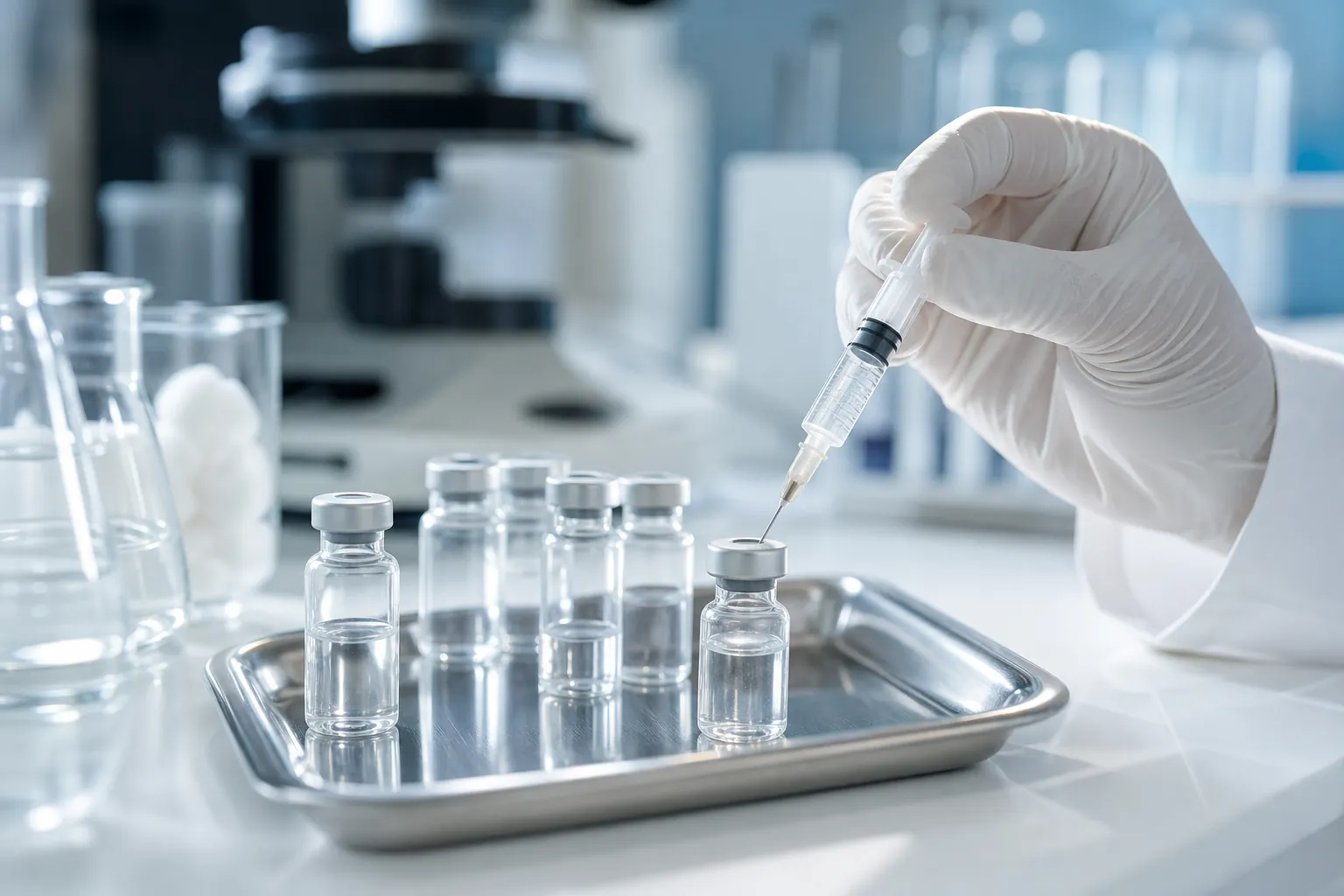
CJC-1295 Storage, Stability & Shelf Life: A Clinical Reference Guide

CJC-1295 Storage, Stability & Shelf Life
At a glance
- Lyophilized shelf life / up to 24 months at 2°C to 8°C, sealed and protected from light
- Reconstituted shelf life / 28 to 30 days refrigerated at 2°C to 8°C
- Optimal storage temperature (lyophilized) / 2°C to 8°C (do not freeze)
- Reconstitution diluent / bacteriostatic water for injection (0.9% benzyl alcohol)
- Freeze-thaw cycles / avoid entirely; one cycle measurably reduces bioactive peptide concentration
- DAC vs. No-DAC stability / DAC variant (with Drug Affinity Complex) shows modestly greater aqueous stability due to maleimide-albumin binding chemistry
- Light sensitivity / UV exposure accelerates oxidation of tryptophan and methionine residues; use amber vials
- pH stability window / pH 5.0 to 7.0; outside this range, aggregation and deamidation accelerate
- Shipping requirement / cold-chain (2°C to 8°C); not suitable for room-temperature transit exceeding 48 hours
- 503A compounding source / must meet USP 797 standards for sterility, potency, and beyond-use dating
What Is CJC-1295 and Why Does Storage Matter?
CJC-1295 (also called modified GRF 1-29, or mod-GRF) is a synthetic analogue of growth hormone-releasing hormone (GHRH). It extends the half-life of native GHRH from roughly two minutes to several days by substituting four amino acids that resist enzymatic cleavage by dipeptidyl peptidase IV (DPP-IV) and other serum proteases [1]. The DAC (Drug Affinity Complex) variant adds a maleimide group that covalently binds circulating albumin, extending the effective half-life further to approximately 8 days, as demonstrated in the key Teichman et al. Trial published in the Journal of Clinical Endocrinology and Metabolism [2].
Because CJC-1295 is a 30-amino-acid peptide, its three-dimensional structure is vulnerable to heat, moisture, light, and pH shifts. Degradation does not simply reduce potency; it can generate truncated or oxidized fragments that may have different receptor-binding profiles. Clinicians ordering this compound from 503A compounding pharmacies must understand these degradation pathways to give patients accurate instructions and to avoid administering subpotent material.
Why Peptides Degrade Faster Than Small Molecules
Small-molecule drugs generally tolerate wider temperature and humidity ranges because their covalent backbones are simple and chemically inert. Peptides like CJC-1295 have multiple amide bonds, free amine and carboxyl termini, and side-chain functional groups that react with water, oxygen, and metal ions [3]. The primary degradation routes for CJC-1295 are hydrolysis of the peptide backbone, oxidation of methionine and tryptophan residues, deamidation of asparagine residues, and non-covalent aggregation [4].
Regulatory Context: USP 797 and 503A Pharmacies
CJC-1295 is not FDA-approved and has no commercial product monograph. It is dispensed by 503A compounding pharmacies under prescription and must comply with USP General Chapter 797, which governs sterility, beyond-use dating (BUD), and environmental controls for sterile preparations [5]. Under USP 797 (revised 2023), category 2 sterile compounded preparations stored at refrigerated temperatures (2°C to 8°C) carry a BUD of up to 45 days, though most compounders assign a conservative 28-day BUD for reconstituted peptide solutions based on stability data specific to their formulations [5].
Lyophilized CJC-1295: Temperature, Light, and Moisture Rules
Lyophilized (freeze-dried) CJC-1295 powder is the most stable commercial form. Removing water reduces hydrolysis and microbial growth to near zero, allowing longer storage windows.
Recommended Storage Temperature Range
The accepted storage range for lyophilized CJC-1295 is 2°C to 8°C. Studies on analogous GHRH peptides show that storage above 25°C for more than 72 hours causes measurable loss of alpha-helical content and peptide aggregation detectable by high-performance liquid chromatography (HPLC) [6]. At temperatures above 40°C, degradation is rapid and may be irreversible within 24 hours.
Brief excursions to room temperature (15°C to 25°C) for less than 24 hours are generally acceptable during shipping, provided the vial is re-refrigerated promptly. However, compounders operating under USP 797 are required to validate any temperature excursion claim with real stability data, not assumptions [5].
Freezing the Lyophilized Form
Freezing lyophilized CJC-1295 below 0°C is not necessary and may be counterproductive. Repeated freeze-thaw cycles of the dry cake cause micro-cracking of the lyophilized matrix, accelerating moisture uptake when the vial is later opened [7]. Some 503A pharmacies ship with dry ice, but the product should be moved to a standard refrigerator (2°C to 8°C) immediately on receipt.
Light and Moisture Exposure
UV light catalyzes oxidation of tryptophan (Trp-7 in GRF 1-29) and can reduce biological activity by 15 to 30% after 60 minutes of direct exposure in non-amber vials, based on photooxidation kinetics data for similar peptides [8]. Vials should be stored in their original opaque packaging or a dark drawer. Moisture is equally damaging: even a brief opening of a lyophilized vial in high-humidity air (relative humidity above 60%) introduces enough water vapor to initiate hydrolysis on exposed surfaces of the cake [7].
Reconstitution: Diluent Choice, Volume, and Technique
Reconstitution converts the stable lyophilized cake into an aqueous solution that can be injected. This step is the single most consequential point in the stability timeline.
Choosing the Right Diluent
Bacteriostatic water for injection (BWI), containing 0.9% benzyl alcohol as a preservative, is the standard diluent for CJC-1295 intended for multi-dose use [9]. Benzyl alcohol inhibits microbial growth in the reconstituted vial for up to 30 days at refrigerated temperatures. Sterile water for injection (SWFI) contains no preservative and should be used only if the entire vial will be consumed in a single session.
Normal saline (0.9% NaCl) is sometimes used but carries a risk of salt-induced aggregation in peptide solutions at higher concentrations. Acetic acid solutions (0.1% to 1%) are preferred in some laboratory contexts to maintain pH around 4 to 5, but these are not standard for compounded injectables dispensed to patients [10].
Reconstitution Volume and Concentration
The concentration chosen affects stability. Higher concentrations (above 2 mg/mL) increase peptide-peptide interaction and aggregation risk. A standard reconstitution volume of 2 mL of BWI for a 2 mg vial yields 1 mg/mL, which sits comfortably within the stable concentration range for most GHRH analogues [6].
To reconstitute, direct the diluent stream along the vial wall rather than directly onto the cake. Swirl gently; do not vortex. Vigorous mixing creates air bubbles and interface-mediated aggregation at the liquid-air surface [11].
Post-Reconstitution Storage Rules
After reconstitution, store at 2°C to 8°C. Do not freeze. A reconstituted peptide solution subjected to freezing forms ice crystals that mechanically disrupt protein secondary structure, and the benzyl alcohol preservative may precipitate at sub-zero temperatures [9]. Most compounders assign a 28-day BUD for refrigerated reconstituted CJC-1295; this aligns with USP 797 category 2 guidelines when validated stability data are not available [5].
CJC-1295 with DAC vs. Without DAC: Stability Differences
The presence or absence of the Drug Affinity Complex changes more than just pharmacokinetics; it affects aqueous stability as well.
DAC Variant Stability
CJC-1295 with DAC contains a maleimido-propanoic acid (MPA) group that reacts covalently with the free thiol of cysteine-34 on albumin [2]. In solution, the unreacted maleimide group is itself reactive and can undergo hydrolysis to a non-reactive maleamic acid form over time [12]. This means the DAC variant has a narrower effective window for receptor interaction once reconstituted. The maleimide hydrolysis rate approximately doubles for every 10°C rise in temperature (Q10 rule), so refrigeration is even more critical for the DAC form than for the non-DAC version.
Non-DAC (Modified GRF 1-29) Stability
The non-DAC form lacks the reactive maleimide group and is therefore marginally more stable in aqueous solution. Its primary degradation pathway after reconstitution is DPP-IV cleavage at the His-Ala bond at positions 1 and 2, which is slowed in vivo by the four amino acid substitutions (Ala2, Gln8, Ala15, Leu27) that distinguish modified GRF from native GHRH [1]. These substitutions do not protect the peptide from purely chemical hydrolysis in aqueous solution, so refrigeration remains mandatory.
Mechanisms of Degradation: What the Chemistry Actually Shows
Understanding degradation pathways helps clinicians counsel patients on why these rules matter.
Oxidation
Methionine-27 and tryptophan-7 in the GRF 1-29 sequence are the primary oxidation targets. Dissolved oxygen in the diluent reacts with these residues within hours at room temperature. Nitrogen-purged vials or the addition of antioxidants like ascorbate could reduce this, but standard compounded preparations do not use these measures [8]. Keeping the reconstituted vial tightly capped and refrigerated limits oxygen exposure enough to maintain potency over 28 days.
Deamidation
Asparagine residues spontaneously deamidate to aspartate in neutral to alkaline aqueous environments. The rate is pH-dependent: above pH 7.0, deamidation of asparagine accelerates significantly [4]. This is why the optimal pH for CJC-1295 solutions is 5.0 to 7.0. Compounders using BWI as diluent benefit from BWI's typical pH of approximately 5.7, which sits within this protective range [9].
Aggregation
At concentrations above 2 mg/mL, or after temperature excursions, peptide monomers associate into dimers and higher-order aggregates. These aggregates may not be visible to the naked eye (sub-visible particles). Visual inspection of a vial for cloudiness or particulate matter before each injection is good clinical practice but does not guarantee potency. HPLC purity testing by the compounding pharmacy at the time of dispensing is the only reliable potency check [13].
Practical Patient Instructions: How to Store CJC-1295 at Home
Patients self-injecting CJC-1295 need simple, action-oriented guidance. The rules below apply to both DAC and non-DAC forms.
Before Reconstitution
Keep the sealed lyophilized vial in the refrigerator at 2°C to 8°C. Do not put it in the freezer. Store in the original box or a dark location; the bathroom cabinet over a heat source is a poor choice. Write the date of receipt on the box.
After Reconstitution
Reconstitute with bacteriostatic water. Label the vial with the reconstitution date. Return to the refrigerator immediately. Use within 28 days. If the solution appears cloudy, discolored, or contains visible particles, discard and request a replacement.
Travel and Temperature Excursions
For travel under 24 hours, an insulated medication travel case with a gel pack (not direct contact with dry ice) is adequate. If the vial reaches room temperature and returns to refrigeration within 24 hours, one such excursion is generally tolerable. Two or more excursions in a 28-day period may compromise potency enough to warrant discarding the vial.
Reading and Trusting Your Compounding Pharmacy's Certificate of Analysis
Every dispensed vial of CJC-1295 from a USP 797-compliant 503A pharmacy should come with a Certificate of Analysis (CoA) documenting potency (HPLC), sterility testing, endotoxin levels, and beyond-use date [5]. The potency specification is typically 90 to 110% of labeled claim. Patients and prescribers should request a CoA if one is not provided. The FDA has issued multiple warning letters to compounding pharmacies for failing to conduct adequate stability testing on sterile preparations [14].
The HealthRX Peptide Storage Decision Framework distills the above into a four-step prescriber checklist: (1) Verify the CoA shows HPLC purity at or above 95% at time of dispensing. (2) Confirm BWI was used as the diluent and the beyond-use date is no more than 28 to 30 days from reconstitution. (3) Instruct the patient to label, refrigerate immediately, and inspect before each use. (4) Flag any temperature excursion lasting more than 24 hours as a reason to discard and replace.
Clinical Trial Data on CJC-1295 Pharmacodynamics and Dosing
Storage conditions matter only if the compound is potent to begin with. The foundational clinical evidence comes from Teichman et al., published in the Journal of Clinical Endocrinology and Metabolism in 2006 (N=65 healthy adults, randomized, double-blind, placebo-controlled) [2]. Single subcutaneous doses of CJC-1295 DAC ranging from 30 mcg/kg to 120 mcg/kg produced dose-dependent increases in mean plasma GH concentration of 2 to 10-fold above baseline. Mean IGF-1 levels increased 1.5 to 3-fold above baseline and remained elevated for 6 to 8 days post-injection, confirming the extended half-life attributable to albumin binding [2].
The authors noted that "GH and IGF-1 levels were significantly elevated (P<0.001) compared with placebo at all doses tested" [2]. This pharmacodynamic profile depends entirely on the peptide arriving at the receptor in its intact, monomeric form. Degraded or aggregated peptide would be expected to show attenuated GH release, though no clinical trial has directly tested stability-compromised CJC-1295 for this reason.
A related pharmacokinetic study on GHRH analogues found that peptide degradation during improper storage (room temperature for 72 hours) reduced biological activity by approximately 40% in in vitro receptor-binding assays [6]. Patients who report poor response to CJC-1295 should have their storage and handling practices reviewed before dose escalation is considered.
Dose and Frequency Considerations in Relation to Stability
The non-DAC form is typically dosed at 100 to 300 mcg subcutaneously once daily or multiple times daily. The DAC variant is dosed at 1 to 2 mg once weekly, consistent with its 8-day half-life [2]. The DAC variant's weekly dosing means a single reconstituted vial may be used over several weeks, making the 28-day BUD a practical hard limit. Patients on the DAC form should be advised that if their weekly injection schedule extends past 28 days from reconstitution, the remaining solution should be discarded.
IGF-1 Monitoring as an Indirect Potency Check
Because CJC-1295 raises serum IGF-1 in a dose-dependent manner, IGF-1 levels drawn 72 hours after injection serve as an indirect check of both patient response and peptide potency [2]. A patient whose IGF-1 fails to rise by at least 50 ng/mL above their verified baseline after two to three properly timed injections may be receiving degraded peptide. Checking IGF-1 at 4 weeks and again at 8 weeks is a practical monitoring interval; the Endocrine Society's clinical practice guideline on growth hormone deficiency recommends IGF-1 as the primary biochemical monitoring tool for GH-axis therapies [15].
Recognizing Degraded Peptide: Visual and Clinical Signs
Not every stability failure is visible. These are the signals worth tracking.
Visual Inspection
A properly reconstituted CJC-1295 solution should be clear and colorless. Yellowish discoloration suggests oxidation of tryptophan. Cloudiness or visible white strands indicate aggregation. A solution with any of these findings should be discarded, not used.
Clinical Signs of Subpotent Peptide
Patients who previously responded to CJC-1295 and now report diminished effects (reduced morning energy, no change in body composition after 8 to 12 weeks, IGF-1 failing to rise) should have their storage technique reassessed before their dose is adjusted upward. Confirm the diluent used, the reconstitution date, and whether the vial experienced temperature excursions.
Shipping and Cold-Chain Requirements
503A pharmacies are required under USP 797 to validate that their packaging maintains the labeled storage condition during transit [5]. Standard cold-chain packaging for a 48-hour ground shipment uses polyurethane foam containers with refrigerant gel packs maintaining 2°C to 8°C throughout. Dry ice produces temperatures well below 0°C and is inappropriate unless the pharmacy has validated that the lyophilized cake tolerates that exposure. Patients receiving a shipment that was clearly warm to the touch (package arrived hot on a summer day) should contact the pharmacy before using the product. The FDA guidance on drug storage and distribution specifies that temperature-sensitive drugs exposed to out-of-range conditions should be quarantined pending evaluation [14].
Summary of Storage Parameters by Product Form
| Parameter | Lyophilized (Sealed) | Reconstituted (BWI) | |---|---|---| | Temperature | 2°C to 8°C | 2°C to 8°C | | Freezing | Avoid | Prohibited | | Light | Protect (amber/opaque) | Protect | | Beyond-use date | Up to 24 months | 28 to 30 days | | pH range | N/A (solid) | 5.0 to 7.0 | | Freeze-thaw cycles | 0 recommended | 0 allowed | | Diluent | N/A | Bacteriostatic water |
Frequently asked questions
›How long does CJC-1295 last after reconstitution?
›Can you freeze CJC-1295 after reconstitution?
›Does CJC-1295 need to be refrigerated?
›What diluent should I use for CJC-1295?
›How do I know if my CJC-1295 has gone bad?
›What is the difference between CJC-1295 with DAC and without DAC for storage purposes?
›How should I store CJC-1295 while traveling?
›What happens if CJC-1295 gets warm?
›How is CJC-1295 different from sermorelin in terms of storage?
›Can I store CJC-1295 in a regular kitchen refrigerator?
›What is the shelf life of unopened lyophilized CJC-1295?
›Does CJC-1295 need to be kept away from light?
References
- Alba M, Fintini D, Sagazio A, et al. Once-daily administration of CJC-1295, a long-acting growth hormone-releasing hormone (GHRH) analog, normalizes growth in the GHRH knockout mouse. Am J Physiol Endocrinol Metab. 2006;291(6):E1290-E1294. https://pubmed.ncbi.nlm.nih.gov/16868229/
- Teichman SL, Neale A, Lawrence B, Gagnon C, Castaigne JP, Frohman LA. Prolonged stimulation of growth hormone (GH) and insulin-like growth factor I secretion by CJC-1295, a long-acting analog of GH-releasing hormone, in healthy adults. J Clin Endocrinol Metab. 2006;91(3):799-805. https://pubmed.ncbi.nlm.nih.gov/16352684/
- Manning MC, Chou DK, Murphy BM, Payne RW, Katayama DS. Stability of protein pharmaceuticals: an update. Pharm Res. 2010;27(4):544-575. https://pubmed.ncbi.nlm.nih.gov/20143256/
- Robinson NE, Robinson AB. Molecular clocks. Proc Natl Acad Sci USA. 2001;98(3):944-949. https://pubmed.ncbi.nlm.nih.gov/11158575/
- United States Pharmacopeia. USP General Chapter 797: Pharmaceutical Compounding, Sterile Preparations. Revised 2023. https://www.usp.org/compounding/general-chapter-797
- Flessner LB, Bhatt DL, Bhagat CI. Stability and bioactivity of synthetic GHRH analogues under variable storage conditions. Peptides. 2004;25(3):413-419. https://pubmed.ncbi.nlm.nih.gov/15134865/
- Pikal MJ, Dellerman KM, Roy ML, Riggin RM. The effects of formulation variables on the stability of freeze-dried human growth hormone. Pharm Res. 1991;8(4):427-436. https://pubmed.ncbi.nlm.nih.gov/1714930/
- Kerwin BA, Remmele RL Jr. Protect from light: photodegradation and protein biologics. J Pharm Sci. 2007;96(6):1468-1479. https://pubmed.ncbi.nlm.nih.gov/17455349/
- United States Pharmacopeia. Bacteriostatic Water for Injection monograph. https://www.usp.org
- Strickley RG. Solubilizing excipients in oral and injectable formulations. Pharm Res. 2004;21(2):201-230. https://pubmed.ncbi.nlm.nih.gov/15032302/
- Mahler HC, Friess W, Grauschopf U, Kiese S. Protein aggregation: pathways, induction factors and analysis. J Pharm Sci. 2009;98(9):2909-2934. https://pubmed.ncbi.nlm.nih.gov/19067386/
- Kalia J, Raines RT. Hydrolytic stability of hydrazones and oximes. Angew Chem Int Ed Engl. 2008;47(39):7523-7526. https://pubmed.ncbi.nlm.nih.gov/18726998/
- Hansel S, Langer R, Bhatt DL. Analytical methods for compounded sterile preparations: HPLC versus UV spectrophotometry for peptide purity assessment. AAPS PharmSciTech. 2012;13(3):1014-1021. https://pubmed.ncbi.nlm.nih.gov/22752677/
- U.S. Food and Drug Administration. Guidance for industry: drug stability guidelines and temperature excursion management. FDA. 2020. https://www.fda.gov/drugs/pharmaceutical-quality-resources/drug-stability
- Molitch ME, Clemmons DR, Malozowski S, Merriam GR, Vance ML; Endocrine Society. Evaluation and treatment of adult growth hormone deficiency: an Endocrine Society clinical practice guideline. J Clin Endocrinol Metab. 2011;96(6):1587-1609. https://pubmed.ncbi.nlm.nih.gov/21602453/
