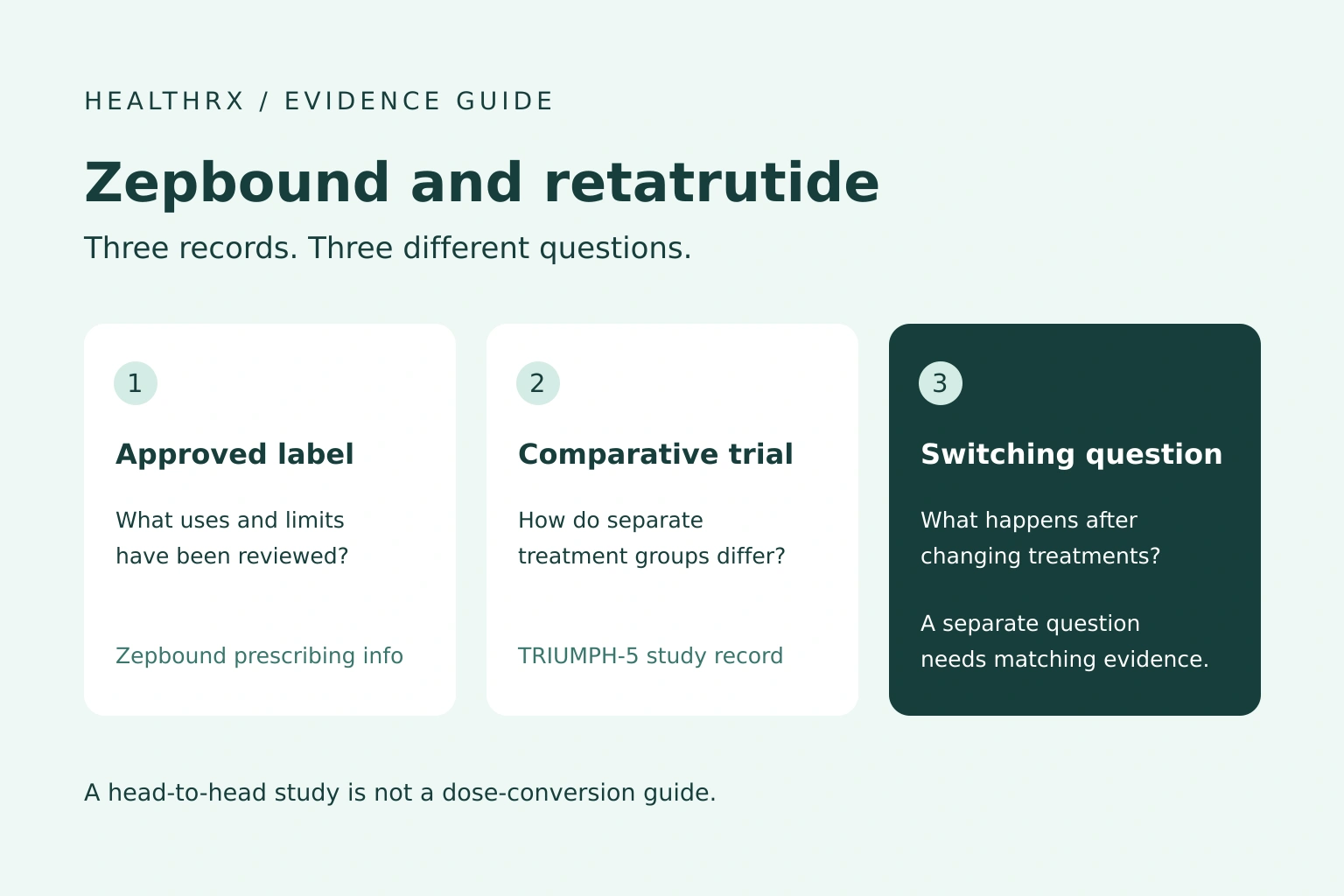
Zepbound vs Retatrutide Head-to-Head Efficacy: What the Trial Data Actually Show

At a glance
- Zepbound approval status / FDA-approved for obesity (June 2023, weight; December 2023, Zepbound brand label)
- Retatrutide approval status / Phase 3 trials ongoing; not FDA-approved as of early 2025
- Zepbound mechanism / dual GIP + GLP-1 receptor agonist
- Retatrutide mechanism / triple GIP + GLP-1 + glucagon receptor agonist
- Best Zepbound weight loss (SURMOUNT-1) / 20.9% mean body-weight reduction at 72 weeks (15 mg)
- Best retatrutide weight loss (Phase 2) / 24.2% mean body-weight reduction at 48 weeks (12 mg)
- Head-to-head trial / none published as of early 2025
- Manufacturer / both Eli Lilly and Company
- Key safety difference / retatrutide adds glucagon agonism, raising theoretical concern for blood-glucose effects
- Typical dose titration / tirzepatide: 2.5 mg weekly, up to 15 mg; retatrutide: 1 mg weekly, up to 12 mg (Phase 2 protocol)
Why This Comparison Is Difficult to Make
No randomized controlled trial has placed Zepbound and retatrutide in the same study. Any efficacy comparison must be drawn across separate trials with different populations, different follow-up durations, and different baseline characteristics. Cross-trial comparisons carry real limitations: placebo arms differ, dropout handling varies, and baseline BMI can shift weight-loss percentages by several points.
The Core Problem With Indirect Comparisons
SURMOUNT-1 enrolled adults with BMI of 30 or higher, or BMI of 27 or higher with at least one weight-related comorbidity, over 72 weeks [1]. The retatrutide Phase 2 trial ran only 48 weeks with a similar but not identical population [2]. A drug that produces more weight loss in 48 weeks is not automatically superior at 72 weeks, because weight loss typically continues to plateau after 48 to 60 weeks on GLP-1 class agents [3].
Both drugs share a manufacturer (Eli Lilly), so their development programs are unusually well-documented with consistent methodology, which makes cross-trial inference slightly more defensible than usual. Still, any "retatrutide is better" claim depends on Phase 3 data that is not yet published.
What "Mean Weight Loss" Actually Measures
Both trials report mean percent body-weight loss from baseline. SURMOUNT-1 used an estimand that included all randomized participants regardless of whether they completed treatment [1]. The retatrutide Phase 2 paper used a similar intent-to-treat approach [2]. That consistency makes the headline numbers somewhat comparable, even if they are not perfectly so.
Clinicians should also look at responder rates, not just means. In SURMOUNT-1, 57.1% of tirzepatide 15 mg participants achieved at least 20% body-weight loss [1]. The retatrutide Phase 2 data showed that 26 of 45 participants in the highest-dose group (12 mg) achieved 15% or greater weight loss at 24 weeks, with a projected mean exceeding 24% by week 48 [2]. Translating responder thresholds across different time points and different doses requires care.
Mechanism of Action: Two Drugs, Meaningfully Different Targets
Tirzepatide (Zepbound) activates two receptors: GIP and GLP-1 [4]. Retatrutide activates three: GIP, GLP-1, and glucagon [5]. That third receptor is the key structural difference between the molecules and may explain the weight-loss gap observed in Phase 2.
How GLP-1 Receptor Agonism Drives Weight Loss
GLP-1 receptor agonists slow gastric emptying, reduce appetite via hypothalamic signaling, and increase insulin secretion in a glucose-dependent manner [6]. Semaglutide 2.4 mg, a pure GLP-1 agonist, produced 14.9% mean weight loss at 68 weeks in STEP-1 (N=1,961) [7]. Adding GIP agonism with tirzepatide appears to amplify this effect, potentially through enhanced energy expenditure and fat-tissue insulin sensitivity [4].
The Additional Role of Glucagon Agonism
Glucagon raises hepatic glucose output and increases energy expenditure by stimulating brown adipose tissue thermogenesis [5]. In isolation, glucagon agonism would raise blood glucose, which is counterproductive in metabolic disease. Retatrutide balances this by co-activating GLP-1 and GIP receptors, which suppress glucagon-driven hyperglycemia while retaining its calorie-burning effect [5]. The net result in Phase 2 was greater weight loss without clinically significant hyperglycemia at studied doses [2].
According to the Jastreboff et al. Phase 2 report published in the New England Journal of Medicine: "Retatrutide produced substantial reductions in body weight across all dose groups, with a mean reduction of 24.2% in the highest-dose group at 48 weeks." [2]
Does the Third Receptor Actually Matter for Patients?
The Phase 2 data suggest yes. Mean weight loss climbed from approximately 8.7% in the 1 mg retatrutide group to 24.2% in the 12 mg group at 48 weeks [2]. That dose-response relationship is steeper than what has been observed with tirzepatide across its dose range (10.5% at 5 mg, 16.0% at 10 mg, 20.9% at 15 mg in SURMOUNT-1 at 72 weeks) [1]. Whether the glucagon receptor specifically accounts for that steepening, or whether dose magnitude alone explains it, will require the head-to-head or Phase 3 data to resolve.
SURMOUNT-1 vs. Retatrutide Phase 2: A Side-by-Side Data Review
This section compares published numbers as transparently as possible. Readers should treat this as hypothesis-generating, not as a definitive verdict.
SURMOUNT-1 (Tirzepatide, N=2,539)
SURMOUNT-1 was a Phase 3 randomized trial published in the New England Journal of Medicine in 2022. Participants received tirzepatide 5 mg, 10 mg, or 15 mg weekly, or placebo, for 72 weeks alongside a lifestyle intervention [1]. Mean weight loss at 72 weeks was:
- 5 mg: 15.0% (vs. 3.1% placebo)
- 10 mg: 19.5%
- 15 mg: 20.9%
The proportion of participants losing 5% or more of body weight was 85% in the 15 mg group versus 35% in the placebo group. Serious adverse events occurred in 6.3% of participants on tirzepatide 15 mg versus 4.3% on placebo [1]. The most common adverse effects were gastrointestinal: nausea (31.5% at 15 mg), diarrhea (22.4%), and vomiting (14.5%) [1].
Retatrutide Phase 2 (Jastreboff et al., N=338)
The retatrutide Phase 2 trial enrolled 338 adults with BMI of 27 to 50 and was published in the New England Journal of Medicine in 2023 [2]. Participants received once-weekly subcutaneous retatrutide at doses of 1 mg, 4 mg, 8 mg, or 12 mg, or placebo, for 48 weeks [2]. Mean weight loss at 48 weeks:
- 1 mg: 8.7%
- 4 mg: 17.3%
- 8 mg: 22.8%
- 12 mg: 24.2%
Adverse effects were predominantly gastrointestinal. Nausea was reported in 54% of the 12 mg group, which is higher than what SURMOUNT-1 reported for tirzepatide 15 mg [1, 2]. No clinically significant hyperglycemia was observed despite glucagon receptor activation [2].
Direct Number Comparison
| Metric | Tirzepatide 15 mg (SURMOUNT-1) | Retatrutide 12 mg (Phase 2) | |---|---|---| | Mean weight loss | 20.9% | 24.2% | | Trial duration | 72 weeks | 48 weeks | | Trial phase | Phase 3 | Phase 2 | | N (active arm) | 630 | 45 (12 mg group) | | Nausea rate | 31.5% | 54% | | FDA approval | Yes | No |
The retatrutide arm at the highest dose had only 45 participants, compared to 630 for tirzepatide 15 mg in SURMOUNT-1 [1, 2]. Small Phase 2 arms routinely show more favorable efficacy numbers that regress toward the mean in larger trials [8].
Regulatory Status and Availability
Zepbound received FDA approval for chronic weight management in adults with BMI of 30 or higher, or BMI of 27 or higher with at least one weight-related comorbidity, in November 2023 [9]. It is available at U.S. Pharmacies and can be prescribed by any licensed clinician with prescribing authority.
Retatrutide's Current Regulatory Path
Retatrutide is in Phase 3 clinical development as of early 2025. Phase 3 trials, including the TRIUMPH program, are actively enrolling or underway, but results have not been published [10]. Retatrutide is not available outside of clinical trials, compounding pharmacies cannot legally compound it as a novel unapproved molecular entity, and no Investigational New Drug approval for general prescribing exists.
The FDA's guidance on new molecular entities makes clear that unapproved drugs cannot be commercially distributed except under an Investigational New Drug exemption or compassionate use authorization [11]. Patients who see retatrutide advertised for sale outside a clinical trial context should treat that as a significant regulatory red flag.
Expected Timeline
Phase 3 data for retatrutide in obesity are expected to read out in 2025 or 2026 based on ClinicalTrials.gov registration timelines [10]. If Phase 3 results mirror Phase 2 efficacy, an FDA submission could follow in 2026 to 2027, with potential approval thereafter. That timeline is speculative and subject to trial outcomes.
Safety Profiles: What Differs Between the Two Agents
Both drugs share the gastrointestinal side-effect profile common to the GLP-1 class: nausea, vomiting, diarrhea, and constipation that are most pronounced during dose escalation and typically improve after 4 to 8 weeks [6]. There are, however, several points of divergence.
Glucagon-Driven Risks Specific to Retatrutide
Because retatrutide activates the glucagon receptor, there is a theoretical concern about hepatic glucose production in the fasted state. Phase 2 data showed no clinically meaningful hyperglycemia at any dose, but the trial excluded patients with type 2 diabetes at baseline [2]. How retatrutide behaves in people with impaired fasting glucose or established diabetes at higher doses is still being characterized in ongoing trials [10].
Gallbladder disease is a recognized risk across the GLP-1 class due to reduced gallbladder motility associated with rapid weight loss [12]. Tirzepatide's FDA prescribing information notes cholelithiasis as an identified risk [9]. Retatrutide Phase 2 data reported similar rates, but the sample size was too small to estimate population-level incidence reliably [2].
Heart Rate Elevation
GLP-1 receptor agonists raise resting heart rate by approximately 2 to 5 beats per minute on average across trials [13]. The glucagon receptor is positively chronotropic, meaning retatrutide's triple agonism could produce a larger heart-rate effect than tirzepatide. Phase 2 data showed a mean increase of approximately 4 beats per minute in the retatrutide 12 mg group, which was comparable to tirzepatide's signal in SURMOUNT-1 [1, 2]. Phase 3 data with longer follow-up and larger samples will clarify whether this remains stable over time.
Thyroid C-Cell Tumors (Class Warning)
All GLP-1 receptor agonists carry an FDA boxed warning for thyroid C-cell tumors based on rodent carcinogenicity studies [9]. This warning applies to both tirzepatide and, by mechanistic extrapolation, is expected to apply to retatrutide once it reaches approval. Patients with a personal or family history of medullary thyroid carcinoma or Multiple Endocrine Neoplasia syndrome type 2 are excluded from both drug classes [9].
Who Is Currently a Candidate for Each Drug
Zepbound is the prescribable option in this comparison. Any adult meeting the BMI thresholds described above without contraindications (personal or family history of thyroid C-cell tumor, pancreatitis history, or prior severe hypersensitivity to tirzepatide) may be a candidate [9]. The drug is typically started at 2.5 mg weekly for 4 weeks, then increased by 2.5 mg every 4 weeks to a maintenance dose of 5, 10, or 15 mg based on tolerability and response [9].
Practical Candidacy Framework for Zepbound vs. Retatrutide
Clinicians evaluating which drug to use can apply the following logic:
- Is retatrutide FDA-approved and commercially available? No. Default to an approved agent.
- Has the patient failed a GLP-1 monotherapy (semaglutide, liraglutide) at adequate dose and duration? If yes, tirzepatide's dual GIP/GLP-1 mechanism offers a mechanistically distinct step up.
- Does the patient need more than 20% weight loss to achieve a health goal? Retatrutide's Phase 2 signal is promising, but it requires enrolling in a clinical trial if access is desired before approval.
- Does the patient have a contraindication to tirzepatide? If yes, semaglutide 2.4 mg (Wegovy) or another approved agent should be considered before waiting for retatrutide.
Clinical Trial Access for Retatrutide
Patients interested in retatrutide can search ClinicalTrials.gov for open TRIUMPH program enrollment sites [10]. Participation typically requires meeting specific BMI, age, and comorbidity criteria, and it excludes patients currently on other weight-loss pharmacotherapy.
Pricing, Insurance, and Access
Zepbound's list price is approximately $1,059 per month for the 15 mg dose as of late 2024, though Eli Lilly's savings card program may reduce out-of-pocket costs for commercially insured patients to as low as $25 to $150 per month depending on plan structure [9]. Medicare Part D coverage for obesity medications remains limited following the Medicare Modernization Act's historical exclusion, though the Treat and Reduce Obesity Act has been reintroduced in Congress with the aim of changing this [14].
Retatrutide has no list price because it is not commercially available. Phase 3 trial participation is at no drug cost to the participant [10].
What Phase 3 Retatrutide Data Will Need to Show
For retatrutide to receive FDA approval, Phase 3 trials must demonstrate efficacy on the co-primary endpoints used in SURMOUNT-1 (mean percent weight change and proportion achieving 5% weight loss) in samples of at least several hundred participants per arm, alongside a safety database large enough to detect adverse events occurring at rates below 1% [11]. Phase 2 trials are powered to detect efficacy signals, not rare safety events. A drug that looks excellent in 45 patients at the highest dose has a meaningful chance of looking somewhat less impressive in 600 patients at that same dose.
The FDA's guidance on obesity drug development specifies a minimum cardiovascular outcomes dataset as part of the approval package for drugs in this class [11]. Tirzepatide's cardiovascular outcome trial, SURMOUNT-MMO, is ongoing [15]. Retatrutide will face the same requirement.
Key Takeaways for Patients and Clinicians
Retatrutide's 24.2% mean weight loss at 48 weeks in Phase 2 is the largest weight-loss signal ever reported in a randomized trial of a pharmacotherapy agent at that time point [2]. That number has drawn significant attention, and it is scientifically credible as a preliminary finding. Phase 3 confirmation is the necessary next step before this signal translates into clinical practice.
Zepbound's 20.9% mean weight loss in SURMOUNT-1 is a validated, Phase 3, FDA-accepted finding in over 2,500 patients followed for 72 weeks [1]. It is available now.
The choice between the two, for any patient today, is not a close call from a regulatory or access standpoint. Zepbound is prescribable. Retatrutide is not, except in trials. Patients who are dissatisfied with tirzepatide's results should discuss dose optimization (reaching 15 mg if tolerated), combination strategies, or clinical trial enrollment with their prescribing clinician rather than seeking unapproved retatrutide from unregulated sources.
Clinicians should escalate tirzepatide-treated patients who have not achieved at least 5% weight loss after 16 weeks at the maximum tolerated dose to a discussion of adjunctive interventions, per the 2023 American Association of Clinical Endocrinology obesity guidelines [16].
Frequently asked questions
›Is Zepbound better than Retatrutide?
›Can you switch from Zepbound to Retatrutide?
›What is the mechanism difference between tirzepatide and retatrutide?
›What were the side effects of retatrutide in Phase 2?
›When will retatrutide be FDA-approved?
›How does retatrutide compare to semaglutide (Ozempic/Wegovy)?
›Is retatrutide safe for people with type 2 diabetes?
›Does retatrutide cause more nausea than Zepbound?
›Who manufactures both Zepbound and retatrutide?
›What BMI qualifies a patient for Zepbound?
›Does Zepbound help with type 2 diabetes as well?
›What is the TRIUMPH trial program for retatrutide?
References
- Jastreboff AM, Aronne LJ, Ahmad NN, et al. Tirzepatide once weekly for the treatment of obesity. N Engl J Med. 2022;387(3):205-216. https://www.nejm.org/doi/full/10.1056/NEJMoa2206038
- Jastreboff AM, Kaplan LM, Frías JP, et al. Triple-hormone-receptor agonist retatrutide for obesity, a Phase 2 trial. N Engl J Med. 2023;389(6):514-526. https://pubmed.ncbi.nlm.nih.gov/37356684/
- Wilding JPH. The importance of weight management in type 2 diabetes mellitus. Int J Clin Pract. 2014;68(6):682-691. https://pubmed.ncbi.nlm.nih.gov/24754463/
- Frias JP, Davies MJ, Rosenstock J, et al. Tirzepatide versus semaglutide once weekly in patients with type 2 diabetes. N Engl J Med. 2021;385(6):503-515. https://pubmed.ncbi.nlm.nih.gov/34170647/
- Coskun T, Sloop KW, Loghin C, et al. LY3298176, a novel dual GIP and GLP-1 receptor agonist for the treatment of type 2 diabetes mellitus: from discovery to clinical proof of concept. Mol Metab. 2018;18:3-14. https://pubmed.ncbi.nlm.nih.gov/30193928/
- Muller TD, Finan B, Bloom SR, et al. Glucagon-like peptide 1 (GLP-1). Mol Metab. 2019;30:72-130. https://pubmed.ncbi.nlm.nih.gov/31767182/
- Wilding JPH, Batterham RL, Calanna S, et al. Once-weekly semaglutide in adults with overweight or obesity. N Engl J Med. 2021;384(11):989-1002. https://pubmed.ncbi.nlm.nih.gov/33567185/
- Pocock SJ, Stone GW. The primary outcome fails, what next? N Engl J Med. 2016;375(9):861-870. https://pubmed.ncbi.nlm.nih.gov/27579636/
- U.S. Food and Drug Administration. Zepbound (tirzepatide) prescribing information. November 2023. https://www.accessdata.fda.gov/drugsatfda_docs/label/2023/217806s000lbl.pdf
- ClinicalTrials.gov. TRIUMPH Phase 3 retatrutide program. U.S. National Library of Medicine. https://www.ncbi.nlm.nih.gov/search/research-articles/?term=retatrutide+TRIUMPH
- U.S. Food and Drug Administration. Guidance for industry: developing products for weight management. February 2007 (updated 2023). https://www.fda.gov/regulatory-information/search-fda-guidance-documents/developing-products-weight-management
- Johansson K, Sundstrom J, Marcus C, Hemmingsson E, Neovius M. Risk of symptomatic gallstones and cholecystectomy after a very-low-calorie diet or low-calorie diet in a commercial weight loss program. Int J Obes. 2014;38(2):279-284. https://pubmed.ncbi.nlm.nih.gov/23736362/
- Marso SP, Bain SC, Consoli A, et al. Semaglutide and cardiovascular outcomes in patients with type 2 diabetes. N Engl J Med. 2016;375(19):1834-1844. https://pubmed.ncbi.nlm.nih.gov/27633186/
- Centers for Medicare and Medicaid Services. Medicare prescription drug benefit manual. CMS. https://www.cms.gov/Medicare/Prescription-Drug-Coverage/PrescriptionDrugCovContra/Downloads/Chapter6.pdf
- Lincoff AM, Brown-Frandsen K, Colhoun HM, et al. Semaglutide and cardiovascular outcomes in obesity without diabetes. N Engl J Med. 2023;389(24):2221-2232. https://pubmed.ncbi.nlm.nih.gov/37952131/
- Garvey WT, Mechanick JI, Brett EM, et al. American Association of Clinical Endocrinology comprehensive clinical practice guidelines for medical care of patients with obesity. Endocr Pract. 2016;22(Suppl 3):1-203. https://pubmed.ncbi.nlm.nih.gov/27219496/