Can You Switch from Zepbound to Retatrutide?
Evidence checked September 15, 2026. Medical review of this revision is pending. The historical medical-review date has been preserved.
At a glance
- Switching / no approved retatrutide replacement or dose-conversion schedule
- Taking both / not supported by the Zepbound label
- Direct comparison / TRIUMPH-5 is active, not recruiting; no registry results posted at this check
- Weight-loss headlines / results from separate trials do not establish a benefit from switching
- Cost / no approved U.S. retatrutide retail product to compare with a Zepbound prescription
- HealthRX.com availability / HealthRX.com does not offer retatrutide
Can I switch from Zepbound to retatrutide now?
There is no ordinary FDA-approved prescribing pathway for that switch. FDA states that retatrutide is not part of an approved drug and cannot be used in compounding under federal law. A seller calling it a research peptide or a compounded alternative does not change that status. FDA status
Clinical-trial participation is a separate question. A study team determines eligibility and treatment under its protocol; an online conversion chart cannot establish either. Ask about an actual registered study before making changes to current treatment. A trial's screening restrictions are research enrollment rules, not a washout schedule to copy.
The practical questions are therefore: why are you considering a change, what approved options can your prescriber evaluate, and is there a suitable study actually accepting participants? These questions remain useful even when the answer about retatrutide access is no.
Can you take Zepbound and retatrutide together?
The Zepbound prescribing information does not recommend coadministration with another tirzepatide product or any GLP-1 receptor agonist. Retatrutide acts at GLP-1 as well as GIP and glucagon receptors. More receptor targets do not establish that combining these medicines adds benefit or is safe. Zepbound label, Lilly's retatrutide overview
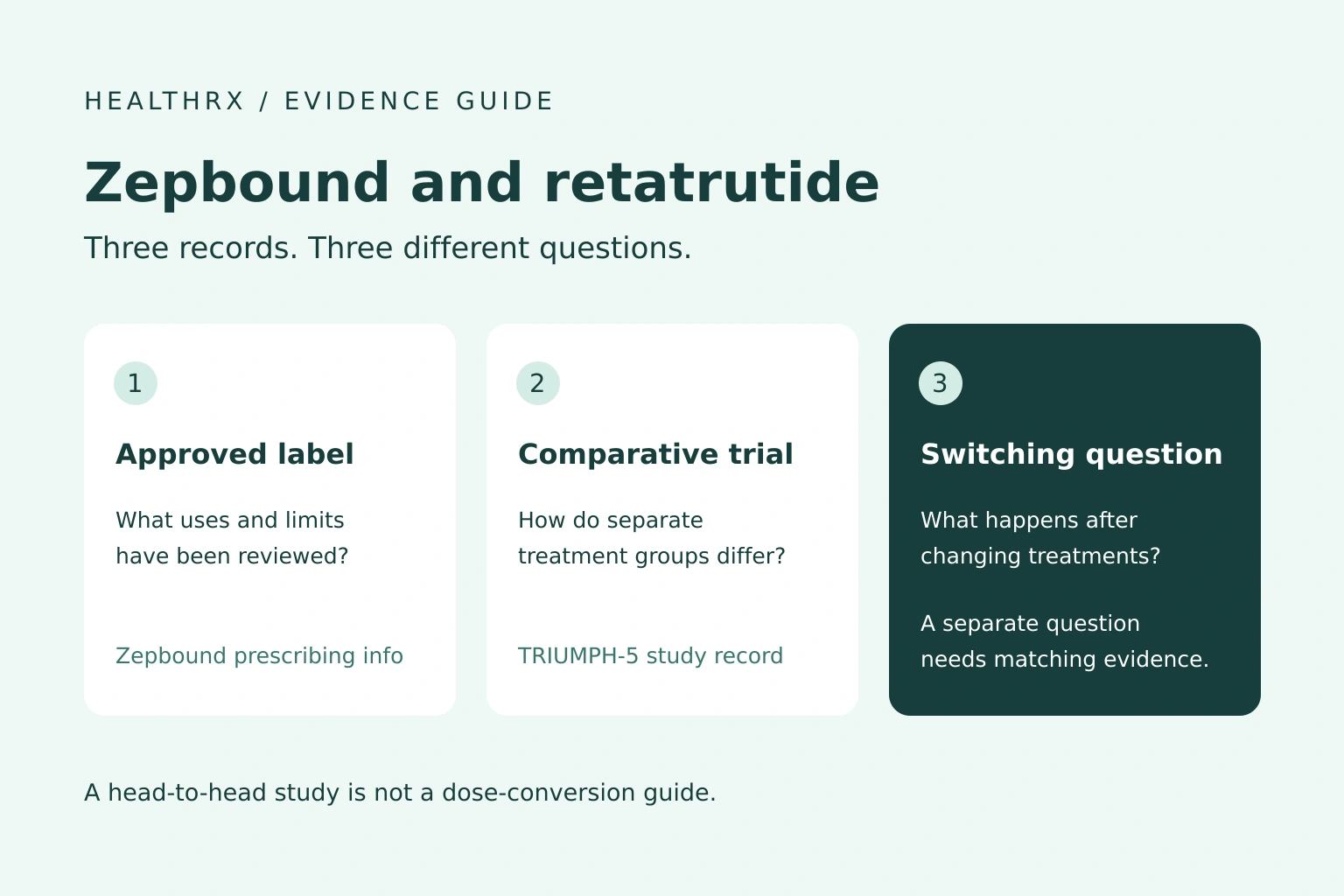
TRIUMPH-5 assigns participants to separate retatrutide and tirzepatide groups. It is not a trial of the two taken together. Its design cannot support a stacking schedule. Trial record
Would retatrutide produce more weight loss after Zepbound?
The available records cited here do not establish that switching a person already taking Zepbound to retatrutide produces additional weight loss. That is a treatment-sequence question. A trial comparing two starting treatments answers a different question.
The published phase 2 retatrutide obesity trial enrolled 338 adults and compared retatrutide with placebo over 48 weeks. It did not compare retatrutide with Zepbound and did not test a Zepbound-to-retatrutide switching program. Its weight-loss findings cannot be turned into an estimate of what a current Zepbound patient would lose after changing drugs. NEJM phase 2 study
The research program has progressed beyond phase 2: Lilly's July 2026 overview discusses phase 3 announcements. Those announcements are sponsor reports, and their existence does not mean a switching benefit has been demonstrated. Sponsor overview
What TRIUMPH-5 can tell us
TRIUMPH-5, NCT06662383, is a randomized phase 3 study comparing retatrutide with tirzepatide in adults with obesity. At our check, its registry showed active, not recruiting, and no results posted. The record was last updated July 20, 2026. Registry and status
Even future head-to-head results will need to be read against the enrolled population and study design before applying them to someone who has already used Zepbound.
Would side effects be better after switching?
A switch cannot be promised to resolve intolerance. Zepbound's label lists gastrointestinal adverse reactions including nausea, diarrhea, vomiting and constipation. The retatrutide phase 2 trial also reported gastrointestinal events, mostly mild to moderate and related to dose. These are observations from different study settings, not a prediction for an individual transition. Zepbound label, Phase 2 study
A useful discussion with your prescriber starts with the symptom you want to address: what happened, when it began, whether it followed a treatment change, and how it affects eating, drinking or daily activities. A side-effect percentage copied from another trial does not answer whether that symptom would improve with a different treatment.
What if Zepbound is not working for me?
"Not working" can mean several different things: little change from the beginning, a plateau after weight loss, symptoms that make treatment difficult, interrupted access, or an unaffordable prescription. Retatrutide is not an established rescue treatment for those situations.
Use this question sheet to make the next appointment more specific. It organizes a discussion; it is not a rule for stopping, escalating or combining medicines.
| Your main concern | Information to bring | Question for your prescriber |
|---|---|---|
| Little weight change | Your weight trend and treatment timeline | What outcome and review period are appropriate for my situation? |
| A plateau | The change before the plateau and how long it has lasted | How should we assess my progress and goals now? |
| Side effects | Symptoms, timing and impact on daily life | What needs assessment before considering a treatment change? |
| Supply or cost | Missed fills, insurance decisions and actual pharmacy quotes | Which approved options are realistically accessible to me? |
| Interest in research | The study identifier and current recruiting status | Could this study fit my history, and who can assess eligibility? |
These are different problems, so they should not automatically lead to the same next step. Bring the concern that matters to you instead of treating a larger trial average as a personal treatment plan.
How do cost and access compare?
There is no approved U.S. retatrutide retail product with a price that can be compared like-for-like with a Zepbound prescription. An online seller's quote is not a price for an FDA-approved alternative. HealthRX.com does not offer retatrutide.
For Zepbound, check the manufacturer's current pricing and eligibility terms, then confirm your actual pharmacy and insurance costs. The useful comparison is your out-of-pocket amount for the specified product and fill, not an advertised starting price. Current manufacturer pricing
For research participation, ask the study team what is supplied and what visits, travel or other costs participants might face. The presence of a site on a registry does not mean it is enrolling. You can review the HealthRX.com U.S. trial-site tracker, then verify details with the named study team.
Frequently asked questions
Is there a Zepbound-to-retatrutide dose conversion?
There is no FDA-approved retatrutide dose-conversion schedule. Do not use a research protocol, seller chart or anecdote as a prescription conversion.
Is TRIUMPH-5 a switching or combination study?
It compares separate retatrutide and tirzepatide treatment groups. That does not establish a protocol for switching from Zepbound or using both drugs together.
Does a higher weight-loss result in another trial mean I should switch?
No. Separate-trial averages do not establish your likely response after a switch. The study population, comparator and treatment history must match the question being asked.
References
- U.S. Food and Drug Administration. FDA's Concerns with Unapproved GLP-1 Drugs Used for Weight Loss. Checked September 15, 2026. FDA
- Eli Lilly and Company. Zepbound U.S. Prescribing Information. Revised August 2026. Prescribing information
- ClinicalTrials.gov. A Study of Retatrutide (LY3437943) Compared to Tirzepatide (LY3298176) in Adults Who Have Obesity. NCT06662383, TRIUMPH-5. Updated July 20, 2026; checked September 15, 2026. Registry
- Jastreboff AM, Kaplan LM, Frias JP, et al. Triple-Hormone-Receptor Agonist Retatrutide for Obesity - A Phase 2 Trial. New England Journal of Medicine. 2023;389:514-526. DOI:10.1056/NEJMoa2301972. PMID:37366315. Publisher
- Eli Lilly and Company. What to Know About Retatrutide. July 2026 update; sponsor information, checked September 15, 2026. Overview
- Eli Lilly and Company. Zepbound Pricing Information. Checked September 15, 2026; terms may change. Pricing