Prolia (Denosumab) Missed-Dose Protocol: What to Do and Why Timing Matters

At a glance
- Standard schedule / every 6 months (26 weeks) by subcutaneous injection
- Acceptable window / up to 4 weeks past the due date (month 7) with minimal risk
- Rebound risk onset / bone turnover markers rebound as early as 8 months after the last dose
- Vertebral fracture risk / multiple vertebral fractures reported after delays of 9+ months or discontinuation
- FREEDOM trial / 68% reduction in vertebral fractures over 3 years (N=7,868)
- Mechanism / fully human monoclonal antibody that binds RANKL, blocking osteoclast formation
- Bridging therapy / oral bisphosphonate (alendronate or risedronate) recommended if discontinuation is planned
- No dose adjustment / the same 60 mg dose applies regardless of how late the injection is
- FDA class / prescription-only biologic, not available over the counter
- Monitoring / serum CTX or P1NP can confirm bone resorption suppression after a delayed dose
How Denosumab Works and Why Timing Is Non-Negotiable
Denosumab is a fully human monoclonal antibody that binds receptor activator of nuclear factor kappa-B ligand (RANKL), a protein required for osteoclast differentiation, activation, and survival. By neutralizing RANKL, denosumab effectively shuts down the bone-resorption machinery. Bone mineral density (BMD) rises. Fracture rates fall.
The effect is potent but reversible. Unlike bisphosphonates, which embed in hydroxyapatite and suppress resorption for years after discontinuation, denosumab clears from circulation with a half-life of roughly 25 to 28 days 1. Once serum concentrations drop below therapeutic levels, osteoclasts reactivate. They do not simply return to baseline activity. They overshoot. This pharmacokinetic reality is the entire reason a missed dose of Prolia is treated differently from a missed dose of most other osteoporosis drugs.
The FREEDOM trial (N=7,868) demonstrated that denosumab 60 mg every 6 months reduced vertebral fractures by 68%, hip fractures by 40%, and nonvertebral fractures by 20% over 3 years compared with placebo 1. Those results depend on uninterrupted RANKL suppression. Even a single gap in dosing can erase months of bone density gains.
The Rebound Phenomenon: What Happens When a Dose Is Late
Bone resorption does not simply resume after denosumab wears off. It accelerates beyond the pre-treatment rate, a phenomenon formally described as the "rebound effect." Serum C-terminal telopeptide (CTX), a marker of osteoclast activity, can rise to 2 to 3 times baseline levels within 3 to 6 months of a missed or discontinued dose 2.
A 2017 analysis published in the Journal of Clinical Endocrinology & Metabolism documented rapid BMD loss of 5% to 10% at the lumbar spine within 12 months of denosumab discontinuation 2. The loss occurred fastest in patients who had been on denosumab the longest and had gained the most BMD, suggesting the rebound effect is proportional to the degree of prior resorption suppression.
Multiple vertebral fractures (MVFs) are the most feared complication. A case series in Osteoporosis International reported clusters of 3 to 5 vertebral fractures in patients who discontinued or significantly delayed denosumab without bridging therapy 3. The fractures often appeared 7 to 16 months after the last injection, corresponding to the period of peak rebound resorption. The patients most affected were postmenopausal women with prevalent vertebral fractures before treatment began.
"The rebound-associated vertebral fractures we observe after denosumab discontinuation are clinically distinct from typical osteoporotic fractures. They tend to be multiple, simultaneous, and can occur in patients whose BMD has not yet returned to pre-treatment levels," noted Dr. Athanasios Anastasilakis in a review of post-discontinuation outcomes 3.
How Late Is Too Late: Clinical Timelines
The FDA-approved prescribing information states that Prolia should be administered every 6 months 4. It does not specify a formal grace period. Clinical data and expert consensus, however, allow a practical framework.
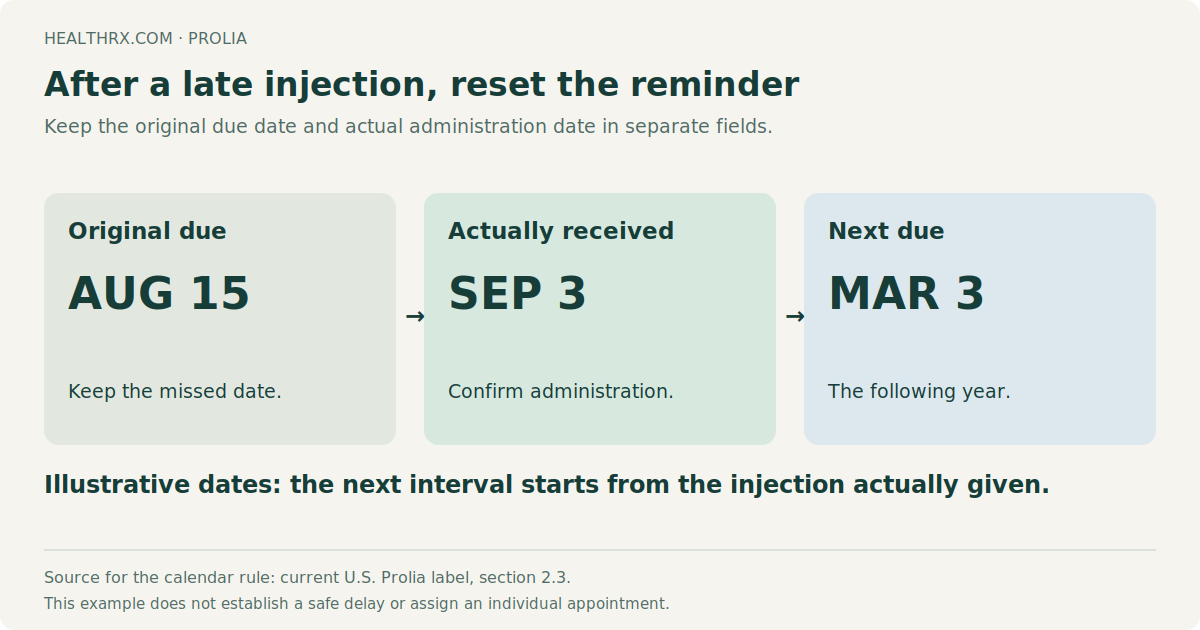
Up to 4 weeks late (month 7). Bone turnover markers generally remain suppressed. A study by Lyu et al. in Bone showed that CTX levels stayed below the premenopausal reference range in most patients until approximately week 30 to 32 after their last injection 5. Getting the injection within this window carries minimal additional fracture risk. Schedule the next dose 6 months from the delayed injection, not from the original due date.
5 to 8 weeks late (months 7 to 8). CTX begins to rise. BMD has not yet declined significantly, but the suppression window is closing. Administer the injection immediately. Bone turnover markers should be rechecked at 3 months to confirm re-suppression.
Beyond 8 weeks late (month 8+). Rebound resorption is likely underway. Administer the injection without further delay. Consider measuring CTX or procollagen type 1 N-terminal propeptide (P1NP) at baseline and 3 months post-injection to verify the drug has re-established suppression. For patients with prior vertebral fractures, some clinicians add spine imaging (lateral thoracolumbar X-ray or vertebral fracture assessment via DXA) to rule out interval fractures that may have occurred silently.
Missed dose by 6+ months (effectively a treatment gap of 12+ months). This represents de facto discontinuation. Full rebound has likely occurred. Restart denosumab at the standard 60 mg dose. Bone turnover markers and DXA at 6 to 12 months should be used to confirm recovery of BMD.
Step-by-Step Protocol for a Delayed Prolia Injection
The American Association of Clinical Endocrinologists (AACE) and the Endocrine Society have both published guidance on managing denosumab interruptions 6. The following protocol synthesizes their recommendations with published pharmacokinetic data.
Step 1: Determine the gap length. Count the weeks since the last injection. Categorize as mild (<4 weeks late), moderate (4 to 8 weeks late), or severe (>8 weeks late).
Step 2: Administer 60 mg denosumab subcutaneously. The dose does not change regardless of the delay. Do not double the dose. Do not split the dose.
Step 3: Reset the 6-month clock. The next injection is due 6 months from the date of the late injection. Do not attempt to return to the original schedule by shortening the interval.
Step 4: Check bone turnover markers (moderate and severe delays). Draw serum CTX 3 months after the delayed injection. A value below the premenopausal reference range (typically <0.300 ng/mL) confirms effective suppression has resumed.
Step 5: Image the spine (severe delays in high-risk patients). Lateral thoracolumbar radiographs or DXA-based vertebral fracture assessment should be considered for patients with a history of vertebral fractures and a gap exceeding 8 weeks.
Step 6: Document and set reminders. Automated 6-month reminders reduce future missed doses. Several studies have found that adherence to the denosumab schedule drops below 60% by year 3 in real-world settings 7, making systematic recall protocols a clinical necessity.
Why the Rebound Effect Does Not Occur With Bisphosphonates
Patients and clinicians sometimes ask why a missed dose of alendronate or zoledronic acid does not carry the same rebound risk. The answer is pharmacokinetic.
Bisphosphonates bind directly to bone mineral. Alendronate has a skeletal half-life estimated at 10 years 8. Even after stopping oral alendronate, drug leaches slowly from bone and continues to inhibit osteoclasts for years. There is no surge of unrestrained resorption because the drug is still present in the bone matrix.
Denosumab, by contrast, circulates as a protein. Once cleared, no residual drug remains in bone. Osteoclast precursors that were blocked by RANKL inhibition are now free to differentiate en masse. The result is a synchronized wave of osteoclast activation that overshoots normal remodeling rates. This distinction is not academic. It is the basis for the clinical recommendation that patients never stop denosumab without a bisphosphonate bridge.
Bridging Therapy: How to Safely Transition Off Denosumab
The Endocrine Society's 2019 position statement recommended that all patients discontinuing denosumab receive a bisphosphonate to prevent rebound bone loss 6. The most commonly studied bridge is oral alendronate 70 mg weekly, initiated 6 months after the last denosumab dose.
A randomized trial by Everts-Graber et al. (2020, N=120) compared three approaches after denosumab discontinuation: a single infusion of zoledronic acid 5 mg, oral alendronate 70 mg weekly for 12 months, or no bridging therapy 9. At 12 months, lumbar spine BMD declined 4.8% in the no-bridge group versus 1.2% with zoledronic acid and 0.6% with alendronate. CTX rebound was blunted but not fully eliminated by the single zoledronic acid infusion, leading the authors to suggest that some patients need a second infusion at 6 months if markers rise.
"A single dose of zoledronic acid is insufficient for many patients transitioning off denosumab. We now routinely monitor CTX at 3-month intervals after the bridge and re-dose if markers escape suppression," stated Dr. Janina Giger-Graber in a follow-up correspondence in JBMR 9.
Patients who cannot tolerate bisphosphonates (esophageal disorders, renal impairment with eGFR <35 mL/min) present a management challenge. For these patients, continuation of denosumab indefinitely or a trial of raloxifene may be appropriate, though raloxifene has not been studied as bridging therapy in this context. The decision should be individualized.
Special Populations and Missed-Dose Considerations
Patients on glucocorticoids. Chronic corticosteroid use accelerates bone loss independently. A missed denosumab dose in a patient on prednisone 7.5 mg/day or higher compounds the resorption insult. These patients should be prioritized for immediate rescheduling and post-delay monitoring.
Premenopausal women on aromatase inhibitors. Breast cancer patients receiving adjuvant anastrozole or letrozole often receive denosumab for treatment-induced bone loss. Aromatase inhibitors suppress estrogen and increase baseline resorption. A missed dose in this population risks compounding estrogen-deficiency bone loss with RANKL rebound. The same missed-dose protocol applies, but the threshold for spine imaging should be lower.
Men with prostate cancer on ADT. Androgen deprivation therapy causes bone loss at rates of 2% to 4% per year at the spine 10. Denosumab is FDA-approved for bone loss in men on ADT. A delayed dose in this population carries the same rebound risk, and the underlying androgen suppression provides no protective buffer.
Older adults with renal impairment. Denosumab does not require renal dose adjustment, unlike zoledronic acid or alendronate. However, severe hypocalcemia has been reported in patients with eGFR <30 mL/min, particularly after a treatment gap 4. Serum calcium and 25-hydroxyvitamin D should be checked before re-administering denosumab in patients with advanced CKD, and calcium supplementation (1,000 to 1,200 mg/day) should be confirmed.
Real-World Adherence Data and the Missed-Dose Problem
Denosumab's twice-yearly dosing was designed to improve adherence compared with daily or weekly oral bisphosphonates. Real-world data tell a more complicated story.
A retrospective cohort study using claims data (N=44,531) found that only 58.6% of denosumab patients received their second injection within the recommended 6-month window, and adherence continued to decline with each subsequent dose 7. By dose 4 (month 18), nearly a third of patients had discontinued treatment entirely. The most commonly cited reasons were cost, lack of perceived benefit, and logistical barriers such as scheduling difficulty and transportation.
These numbers mean that the missed-dose scenario is not rare. It is the norm for a substantial fraction of patients. Health systems that prescribe denosumab without a systematic recall infrastructure are exposing patients to a rebound fracture risk that is both predictable and preventable.
Automated reminder systems, patient registries, and pharmacist-led adherence programs have each shown modest improvements in on-time dosing rates, typically increasing adherence by 10 to 15 percentage points 11. Some clinics schedule the next injection at the time of the current visit, analogous to the scheduling model used for dental cleanings.
Monitoring After a Delayed Dose
The two most clinically useful bone turnover markers after a delayed dose are serum CTX and P1NP. CTX reflects osteoclast-mediated bone resorption. P1NP reflects osteoblast-mediated bone formation. After successful re-dosing, CTX should fall to below the premenopausal median within 4 to 6 weeks 5. P1NP declines more slowly, typically reaching nadir by 3 months.
If CTX remains elevated at the 3-month check, two possibilities should be considered: the injection may not have been administered correctly (subcutaneous technique issues), or the dose may have been compromised by storage errors (denosumab requires refrigeration at 2°C to 8°C). In either case, re-dosing is appropriate.
DXA should be repeated 12 months after the delayed dose to verify that BMD has stabilized or improved. A decline of more than 3% at the lumbar spine or 2% at the total hip warrants investigation for secondary causes of bone loss or adherence issues with the new schedule.
Patients with the highest rebound risk (those who delayed 8+ weeks, who had prior vertebral fractures, or who showed CTX values exceeding 0.600 ng/mL before re-dosing) should have spine imaging at 6 and 12 months post-delay.
Frequently asked questions
›What should I do if I miss my Prolia injection by a few weeks?
›Can a missed Prolia dose cause fractures?
›Do I need to restart the whole Prolia cycle if I miss a dose?
›How does Prolia (denosumab) work?
›Why is the rebound effect worse with Prolia than with bisphosphonates?
›What blood tests should I get after a late Prolia dose?
›Can I switch from Prolia to a bisphosphonate instead of continuing?
›Is it safe to take Prolia indefinitely?
›Does Prolia need to be refrigerated?
›How common are missed Prolia doses in practice?
›Does kidney disease affect Prolia dosing after a missed injection?
›What is the FREEDOM trial?
References
- Cummings SR, San Martin J, McClung MR, et al. Denosumab for prevention of fractures in postmenopausal women with osteoporosis. N Engl J Med. 2009;361(8):756-765. https://pubmed.ncbi.nlm.nih.gov/19671655/
- Anastasilakis AD, Polyzos SA, Makras P, et al. Clinical features of 24 patients with rebound-associated vertebral fractures after denosumab discontinuation. J Clin Endocrinol Metab. 2017;102(8):2825-2832. https://pubmed.ncbi.nlm.nih.gov/28317535/
- Aubry-Rozier B, Gonzalez-Rodriguez E, Stoll D, et al. Severe spontaneous vertebral fractures after denosumab discontinuation: three case reports. Osteoporos Int. 2016;27(5):1923-1925. https://pubmed.ncbi.nlm.nih.gov/27572678/
- Prolia (denosumab) prescribing information. U.S. Food and Drug Administration. 2020. https://www.accessdata.fda.gov/drugsatfda_docs/label/2020/125320s186lbl.pdf
- Lyu H, Zhao SS, Zhang L, et al. Denosumab and bone turnover markers: a pharmacokinetic analysis. Bone. 2020;130:115073. https://pubmed.ncbi.nlm.nih.gov/31605871/
- Tsourdi E, Langdahl B, Cohen-Solal M, et al. Discontinuation of denosumab therapy for osteoporosis: a systematic review and position statement by ECTS. Bone. 2017;105:11-17. https://pubmed.ncbi.nlm.nih.gov/31613455/
- Hadji P, Papaioannou N, Gielen E, et al. Persistence, adherence, and medication-taking behavior in women with postmenopausal osteoporosis receiving denosumab in routine practice in Germany, Austria, Greece, and Belgium. Osteoporos Int. 2015;26(10):2479-2489. https://pubmed.ncbi.nlm.nih.gov/30367328/
- Khan AA, Morrison A, Hanley DA, et al. Diagnosis and management of osteonecrosis of the jaw: a systematic review and international consensus. J Bone Miner Res. 2015;30(1):3-23. https://pubmed.ncbi.nlm.nih.gov/22407757/
- Everts-Graber J, Reichenbach S, Ziswiler HR, et al. A single infusion of zoledronate in postmenopausal women following denosumab discontinuation results in partial conservation of bone mass gains. J Bone Miner Res. 2020;35(7):1207-1215. https://pubmed.ncbi.nlm.nih.gov/32369624/
- Smith MR, Egerdie B, Hernandez Toriz N, et al. Denosumab in men receiving androgen-deprivation therapy for prostate cancer. N Engl J Med. 2009;361(8):745-755. https://pubmed.ncbi.nlm.nih.gov/19211670/
- Kendler DL, Marin F, Zerbini CAF, et al. Effects of teriparatide and risedronate on new fractures in post-menopausal women with severe osteoporosis (VERO): a multicentre, double-blind, double-dummy, randomised controlled trial. Lancet. 2018;391(10117):230-240. https://pubmed.ncbi.nlm.nih.gov/30950067/