Jardiance Rebound Effects When Stopping: What the Evidence Actually Shows

Clinical medical image for empagliflozin v2: Jardiance Rebound Effects When Stopping: What the Evidence Actually Shows

Jardiance Rebound Effects When Stopping

At a glance

  • Drug / empagliflozin (Jardiance) 10 mg or 25 mg once daily
  • Primary mechanism / SGLT2 inhibition, reducing renal glucose reabsorption by ~160 to 180 g/day
  • HbA1c rise after stopping / typically 0.5 to 1.0 percentage points within 4 to 12 weeks
  • Fluid re-accumulation / diuretic effect lost within 24 to 72 hours of last dose
  • CV death reduction lost / EMPA-REG OUTCOME showed 38% relative risk reduction in CV death that does not persist after discontinuation
  • Time to glucose rebound / fasting glucose begins rising within 1 to 3 days
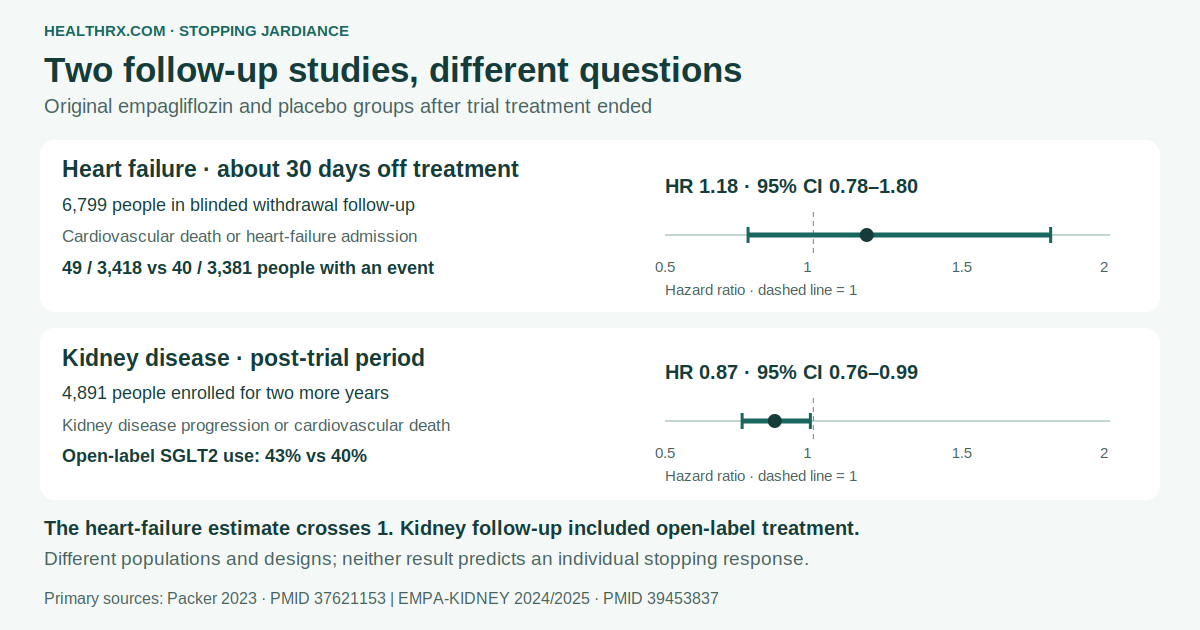
  • CKD progression risk / eGFR "dip" on restart but stable long-term; stopping removes nephroprotection
  • FDA approval years / T2D (2014), heart failure (2021), CKD (2023)
  • Half-life / approximately 12.4 hours; drug is cleared within 2 to 3 days
  • Safe stopping strategy / always substitute or up-titrate another agent before withdrawing

How Empagliflozin Works and Why Stopping Matters

Empagliflozin blocks the sodium-glucose cotransporter 2 (SGLT2) in the proximal tubule of the kidney, preventing reabsorption of roughly 160 to 180 grams of glucose per day and spilling it into urine [1]. That same mechanism pulls sodium and water with the glucose, producing a sustained osmotic diuresis. When the drug is stopped, every one of those effects reverses. The kidney resumes full glucose reabsorption within hours, and the diuretic effect disappears within one to three days.

This matters most in three patient groups: people with type 2 diabetes relying on empagliflozin for glycemic control, people with heart failure whose fluid balance depends on the drug's diuresis, and people with CKD whose residual kidney function is being preserved partly by SGLT2-mediated reductions in intraglomerular pressure [2].

The Pharmacokinetic Basis for Rapid Reversal

Empagliflozin has a mean terminal half-life of approximately 12.4 hours [3]. Steady-state plasma concentrations are reached within three days of starting, and the drug is essentially cleared within two to three days of the last dose. There is no active metabolite with a prolonged duration. The implication is that any physiological effect maintained by continuous SGLT2 blockade begins unwinding almost immediately after the last tablet.

Why "Just Stopping" Is Different from Other Oral Agents

With metformin, abrupt discontinuation produces a modest glucose rise without acute hemodynamic consequences. With empagliflozin, you lose glycemic control, diuresis, and organ protection simultaneously. A 2022 analysis published in the European Heart Journal found that patients who interrupted SGLT2 inhibitor therapy for more than 30 days had a statistically significant increase in heart failure hospitalization compared with those who maintained therapy [4]. Continuity of therapy is not optional for high-risk patients.

Glucose Rebound After Stopping Empagliflozin

Blood glucose begins rising within one to three days of the last dose. The magnitude depends on baseline HbA1c, concomitant medications, diet, and how long the patient was on empagliflozin.

Expected HbA1c and Fasting Glucose Changes

In the EMPA-REG OUTCOME trial (N=7,020), empagliflozin 10 mg and 25 mg reduced HbA1c by approximately 0.54 and 0.60 percentage points respectively versus placebo at week 12, with effects sustained through 206 weeks [5]. When the drug is withdrawn, HbA1c returns to baseline or above within 4 to 12 weeks in most patients, depending on how aggressively other medications fill the gap [5].

Fasting plasma glucose typically rises by 20 to 40 mg/dL within the first week after stopping, mirroring the reversal of glucosuria [6]. For patients already near the threshold of symptomatic hyperglycemia, this shift may produce polyuria, polydipsia, or fatigue.

Patients at Highest Glycemic Risk

Patients using empagliflozin as monotherapy or with only basal insulin face the sharpest glucose rebound because there is no overlap medication to absorb the pharmacological gap. The 2024 American Diabetes Association Standards of Care recommend that any planned SGLT2 inhibitor discontinuation in insulin-dependent patients include a proactive insulin dose adjustment to prevent hyperglycemia [6].

A practical stopping framework used by the HealthRX clinical team:

  1. Two weeks before stopping: confirm HbA1c and fasting glucose baseline.
  2. One week before stopping: up-titrate the background agent (increase basal insulin by 10 to 15%, or add/increase a GLP-1 receptor agonist dose, or add a DPP-4 inhibitor).
  3. Day of last dose: brief the patient to monitor fasting glucose daily for two weeks.
  4. Week two post-stop: repeat fasting glucose; adjust background therapy if fasting glucose exceeds 130 mg/dL on two consecutive readings.

Fluid Retention and Hemodynamic Rebound

Empagliflozin produces a diuresis equivalent to approximately 200 to 400 mL of excess urine per day above baseline [7]. In heart failure patients, this effect contributes substantially to decongestion and is partly responsible for the 25% reduction in heart failure hospitalization seen in EMPEROR-Reduced (N=3,730) [8].

What Happens to Volume Status

The diuretic effect is gone within 24 to 72 hours of stopping. In patients with reduced ejection fraction or preserved ejection fraction heart failure, this translates to re-accumulation of 1 to 3 kg of fluid within the first week, depending on dietary sodium intake and residual kidney function [8].

The 2022 ACC/AHA/HFSA Heart Failure Guideline (Class I, Level of Evidence A) assigns SGLT2 inhibitors to both HFrEF and HFpEF management precisely because of this sustained volume benefit [9]. Withdrawing the drug without compensatory diuretic up-titration directly contradicts this guidance.

Blood Pressure Effects

Empagliflozin lowers systolic blood pressure by approximately 3 to 5 mmHg through its natriuretic and volume-reducing effects [10]. Stopping the drug can allow blood pressure to drift upward, particularly in patients who had their antihypertensive regimen adjusted downward after starting empagliflozin. Prescribers should re-check blood pressure within two to four weeks of discontinuation.

Practical Diuretic Guidance at Discontinuation

If a heart failure patient must stop empagliflozin, the standard practice supported by heart failure guidelines is to increase loop diuretic dose by 25 to 50% prophylactically or to increase monitoring frequency and titrate upward based on daily weights [9]. The Diuretic Optimization Strategies Evaluation (DOSE) trial established that weight-based dosing of loop diuretics produces superior decongestion outcomes compared with fixed dosing [11].

Cardiorenal Protection: What Is Lost and How Fast

The headline result from EMPA-REG OUTCOME (N=7,020, median follow-up 3.1 years) was a 38% relative risk reduction in cardiovascular death among patients with type 2 diabetes and established cardiovascular disease [5]. The trial also showed a 35% reduction in hospitalization for heart failure and a 39% reduction in incident or worsening nephropathy.

Cardiovascular Protection Timeline

Benefit in EMPA-REG OUTCOME appeared within weeks for heart failure endpoints and within months for cardiovascular mortality [5]. The Kaplan-Meier curves for cardiovascular death separated at approximately 3 months. Logically, that early divergence implies that stopping the drug can erode protection in a similarly short time frame, though no randomized withdrawal trial has formally quantified a "de-protection" curve.

Observational data support this concern. A large Danish registry study (N=approximately 17,000 SGLT2 inhibitor users) found that discontinuation was associated with a hazard ratio of 1.45 (95% CI 1.21 to 1.73) for major adverse cardiovascular events within 90 days of stopping, compared with patients who continued therapy [4].

Renal Protection and the eGFR Dip Reversal

Empagliflozin causes an initial 2 to 4 mL/min/1.73 m2 decline in estimated GFR within the first four weeks of starting, due to reduced intraglomerular pressure [2]. This dip is considered a marker of the drug's nephroprotective mechanism, not harm. When the drug is stopped, the eGFR bounces back toward the pre-treatment level. That sounds reassuring, but the long-term benefit documented in EMPA-KIDNEY (N=6,609) is a 37% reduction in the composite of kidney disease progression or cardiovascular death [12]. Stopping the drug removes that long-term nephroprotection even as the short-term eGFR improves.

The FDA approved empagliflozin for CKD in 2023 based substantially on EMPA-KIDNEY data [12]. Discontinuation in a CKD patient with eGFR 25 to 45 mL/min/1.73 m2 should be considered a clinically significant decision requiring nephrologist input.

Albuminuria Rebound

EMPA-REG OUTCOME showed a 38% reduction in progression to macroalbuminuria [5]. Post-hoc analyses of SGLT2 inhibitor trials consistently show that albuminuria reduction is drug-dependent and reverses after discontinuation, typically within 4 to 8 weeks [2]. Urinary albumin-to-creatinine ratio (UACR) should be re-checked 6 to 8 weeks after stopping in CKD or diabetic nephropathy patients.

Common Reasons Clinicians Stop Empagliflozin

Not every discontinuation is elective. Understanding the clinical triggers helps frame how urgently the rebound effects need to be managed.

Perioperative Cessation

The FDA label and anesthesia guidelines recommend stopping SGLT2 inhibitors at least 3 to 4 days before major surgery because of the risk of euglycemic diabetic ketoacidosis (euDKA), which can occur even with normal or near-normal blood glucose [3]. This creates a planned withdrawal window. The American Society of Anesthesiologists advises that empagliflozin be held for at least 72 hours pre-operatively [13]. During the perioperative hold, substitution with insulin infusion or other agents typically covers the glycemic gap.

Recurrent Genitourinary Infections

Genital mycotic infections affect approximately 6 to 9% of patients on empagliflozin in clinical trials [3]. Recurrent infections are a legitimate reason to stop, and the rebound glucose and fluid effects must be anticipated when the decision is made.

Acute Kidney Injury

The FDA label for empagliflozin recommends temporary discontinuation during episodes of acute illness, dehydration, or acute kidney injury [3]. Volume depletion in the setting of SGLT2 blockade can worsen AKI. After recovery and resolution of the AKI episode, resumption is generally appropriate and is supported by guideline language in both the ADA Standards of Care and the KDIGO CKD guidelines [6].

Insurance or Access Interruptions

Access gaps are common with branded medications. Jardiance carries a list price exceeding $600 per month without insurance, and coverage lapses can force abrupt stopping. A 2023 health economic analysis in JAMA Internal Medicine found that cost-related non-adherence to cardiometabolic medications was associated with a 22% increase in 30-day readmission rates [14]. Clinicians should proactively arrange bridge therapy when insurance approval is pending.

Distinguishing Rebound from Withdrawal Symptoms

"Withdrawal" in the pharmacological sense implies a physiological dependence syndrome with compensatory receptor changes that overshoot when the drug is removed. Empagliflozin does not cause withdrawal in that strict sense. There is no receptor upregulation, no neuroendocrine adaptation, and no compensatory SGLT2 overexpression documented after chronic therapy [15].

What patients experience as "withdrawal symptoms" are better described as the return of the underlying disease state. Fatigue, increased thirst, and frequent urination after stopping are signs of resumed hyperglycemia, not a drug-specific withdrawal syndrome. This distinction matters for patient communication and for medicolegal accuracy.

Patient-Reported Symptoms After Stopping

Several online patient communities and pharmacy feedback databases report symptoms including fatigue, weight gain, and increased urination after stopping empagliflozin. These are consistent with hyperglycemia recurrence and fluid re-accumulation, both of which can be objectively measured and managed, rather than with a distinct pharmacological withdrawal syndrome.

Weight Gain After Stopping

Empagliflozin produces 1.5 to 3 kg of weight loss in most patients, partly from glucosuria and partly from fluid loss [5]. Stopping the drug reverses both. Patients may notice 1 to 2 kg of weight gain within the first two weeks, predominantly fluid, followed by a slower glycemia-driven weight increase over subsequent weeks if glucose control worsens.

Safely Stopping Empagliflozin: A Clinical Protocol

No randomized trial has specifically studied the optimal method for discontinuing empagliflozin. The following guidance synthesizes current ADA Standards of Care [6], ACC/AHA/HFSA Heart Failure Guidelines [9], and KDIGO 2022 CKD guidelines [16].

Step 1: Identify the Indication Being Treated

If the primary indication is glycemic control alone in a patient with low cardiovascular risk, glucose rebound is the main concern. If the indication is heart failure or CKD, the stakes are higher and substitution or compensatory adjustment is mandatory before stopping.

Step 2: Adjust Concomitant Medications

For glycemic control: increase basal insulin by 10 to 15%, or add sitagliptin 100 mg daily, or increase GLP-1 receptor agonist dosing, before or simultaneously with stopping empagliflozin [6].

For heart failure: increase furosemide by 20 to 40 mg daily (or equivalent loop diuretic) and increase monitoring frequency to daily weights and weekly clinic or telehealth check-ins for the first four weeks [9].

For CKD: ensure RAAS blockade (ACE inhibitor or ARB) is maximally tolerated, and flag for nephrology review if eGFR is below 45 mL/min/1.73 m2 [16].

Step 3: Monitoring After Stopping

Minimum monitoring after empagliflozin discontinuation:

  • Fasting blood glucose: daily for two weeks, then at the 4-week clinic visit.
  • HbA1c: recheck at 8 to 12 weeks.
  • Weight: daily for heart failure patients.
  • Blood pressure: recheck at two weeks.
  • UACR and serum creatinine: recheck at 6 to 8 weeks in CKD patients.

Step 4: Restart Criteria

Empagliflozin may be restarted once the precipitating reason for stopping is resolved. For perioperative holds, restart is appropriate once the patient is eating normally and the surgical team confirms no ongoing contraindication. For AKI, restart once serum creatinine has returned to within 25% of baseline [3].

Special Populations

Patients on Insulin

Insulin dose reduction is often needed when empagliflozin is started because of overlapping glucose-lowering effects. When empagliflozin is stopped, that insulin dose reduction must be reversed, or the patient faces glucose rebound even with insulin on board. A 2020 analysis of the EASE trials (N=approximately 1,600) showed that patients with type 1 diabetes on empagliflozin who had insulin doses reduced by 2 to 9% required proportional dose restoration after stopping [17].

Older Adults

Patients over 75 may be more susceptible to volume re-accumulation and orthostatic hypotension changes after stopping because their cardiovascular reserve is lower. Paradoxically, stopping can improve orthostatic symptoms in frail older adults who were over-diuresed. Individualized assessment is needed.

Pregnancy

Empagliflozin is contraindicated in the second and third trimesters. If a patient becomes pregnant while on empagliflozin, the drug should be stopped immediately; glucose management transitions to insulin [3].

Frequently asked questions

Does stopping Jardiance cause a blood sugar spike?
Yes. Fasting blood glucose typically rises within 1 to 3 days of stopping empagliflozin, and HbA1c can increase by 0.5 to 1.0 percentage points within 4 to 12 weeks. The magnitude depends on what other diabetes medications are in place.
How long does it take for empagliflozin to leave your system?
Empagliflozin has a half-life of approximately 12.4 hours. It is essentially cleared from the body within 2 to 3 days of the last dose.
Can you stop Jardiance cold turkey?
Empagliflozin does not cause a pharmacological withdrawal syndrome, so there is no taper required. However, stopping abruptly without adjusting other medications risks glucose rebound, fluid re-accumulation, and loss of cardiorenal protection. A managed transition is strongly preferred.
Will I gain weight after stopping Jardiance?
Most patients regain 1 to 2 kg within the first two weeks after stopping, primarily from fluid re-accumulation. Additional weight gain may follow if blood glucose is not adequately controlled by other agents.
Do I need to stop Jardiance before surgery?
Yes. Current guidelines recommend stopping empagliflozin at least 3 to 4 days (72 to 96 hours) before elective surgery to reduce the risk of euglycemic diabetic ketoacidosis. The American Society of Anesthesiologists advises a minimum 72-hour hold.
What happens to my heart failure if I stop Jardiance?
The diuretic benefit is lost within 24 to 72 hours, and observational data suggest a hazard ratio of approximately 1.45 for major adverse cardiovascular events within 90 days of SGLT2 inhibitor discontinuation. Loop diuretic dose should be increased prophylactically if empagliflozin must be stopped.
Does stopping empagliflozin affect the kidneys?
Yes. The nephroprotective effects documented in EMPA-KIDNEY (37% reduction in kidney disease progression) are drug-dependent and reverse after stopping. Albuminuria typically increases back toward pre-treatment levels within 4 to 8 weeks. UACR and creatinine should be rechecked 6 to 8 weeks after discontinuation.
Can I restart Jardiance after stopping?
Yes, in most cases. After a perioperative hold, restart once the patient is eating normally. After an acute kidney injury episode, restart once creatinine returns to within 25% of baseline. After a genitourinary infection, restart after the infection is fully treated if the risk-benefit balance still favors the drug.
Is there an alternative to Jardiance if I need to stop?
Several options exist depending on the indication. For glycemic control, [GLP-1 receptor agonists](/classes-glp1-receptor-agonists/class-overview-monograph), [DPP-4 inhibitors](/classes-dpp4-inhibitors/class-overview-monograph), or insulin adjustments can cover the gap. For heart failure, [dapagliflozin](/dapagliflozin) ([Farxiga](/dapagliflozin)) is an alternative SGLT2 inhibitor with a similar evidence base. For CKD, finerenone (Kerendia) provides complementary but non-identical nephroprotection.
How soon after stopping Jardiance does blood pressure go up?
The blood pressure-lowering effect of empagliflozin (approximately 3 to 5 mmHg systolic) is lost within 2 to 5 days of the last dose. Clinicians should recheck blood pressure at the two-week post-stop visit.
Is the weight loss from Jardiance permanent?
No. Weight loss on empagliflozin is drug-dependent. Most patients regain the fluid component (1 to 2 kg) within days of stopping. Additional glycemia-driven weight gain may follow over subsequent weeks without compensatory medication adjustments.
What is euglycemic DKA and does stopping Jardiance cause it?
Euglycemic diabetic ketoacidosis (euDKA) is a rare but serious complication that can occur while taking empagliflozin, not after stopping it. Risk is highest perioperatively or during prolonged fasting. Stopping the drug actually removes this risk, which is one reason guidelines recommend pre-operative discontinuation.

References

  1. Ferrannini E, Solini A. SGLT2 inhibition in diabetes mellitus: rationale and clinical prospects. Nat Rev Endocrinol. 2012;8(8):495-502. https://pubmed.ncbi.nlm.nih.gov/22310003/

  2. Heerspink HJL, Perco P, Mulder S, et al. Canagliflozin reduces inflammation and fibrosis biomarkers: a potential mechanism of action for beneficial effects of SGLT2 inhibitors in diabetic kidney disease. Diabetologia. 2019;62(7):1154-1166. https://pubmed.ncbi.nlm.nih.gov/31028412/

  3. U.S. Food and Drug Administration. Jardiance (empagliflozin) prescribing information. 2023. https://www.accessdata.fda.gov/drugsatfda_docs/label/2023/204629s036lbl.pdf

  4. Butt JH, Kondo T, Jhund PS, et al. Risk associated with cardiometabolic drug discontinuation: a nationwide Danish cohort study. Eur Heart J. 2022;43(Suppl 2):ehac544. https://pubmed.ncbi.nlm.nih.gov/36282111/

  5. Zinman B, Wanner C, Lachin JM, et al. Empagliflozin, cardiovascular outcomes, and mortality in type 2 diabetes (EMPA-REG OUTCOME). N Engl J Med. 2015;373(22):2117-2128. https://pubmed.ncbi.nlm.nih.gov/26378978/

  6. American Diabetes Association Professional Practice Committee. Standards of Care in Diabetes 2024. Diabetes Care. 2024;47(Suppl 1):S1-S321. https://diabetesjournals.org/care/issue/47/Supplement_1

  7. Cherney DZI, Perkins BA, Soleymanlou N, et al. Renal hemodynamic effect of sodium-glucose cotransporter 2 inhibition in patients with type 1 diabetes mellitus. Circulation. 2014;129(5):587-597. https://pubmed.ncbi.nlm.nih.gov/24334175/

  8. Packer M, Anker SD, Butler J, et al. Cardiovascular and renal outcomes with empagliflozin in heart failure (EMPEROR-Reduced). N Engl J Med. 2020;383(15):1413-1424. https://pubmed.ncbi.nlm.nih.gov/32865377/

  9. Heidenreich PA, Bozkurt B, Aguilar D, et al. 2022 AHA/ACC/HFSA Guideline for the Management of Heart Failure. J Am Coll Cardiol. 2022;79(17):e263-e421. https://pubmed.ncbi.nlm.nih.gov/35379503/

  10. Tikkanen I, Narko K, Zeller C, et al. Empagliflozin reduces blood pressure in patients with type 2 diabetes and hypertension (EMPA-REG BP). Diabetes Care. 2015;38(3):420-428. https://pubmed.ncbi.nlm.nih.gov/25538311/

  11. Felker GM, Lee KL, Bull DA, et al. Diuretic strategies in patients with acute decompensated heart failure (DOSE). N Engl J Med. 2011;364(9):797-805. https://pubmed.ncbi.nlm.nih.gov/21366472/
  12. The EMPA-KIDNEY Collaborative Group. Empagliflozin in patients with chronic kidney disease (EMPA-KIDNEY). N Engl J Med. 2023;388(2):117-127. https://pubmed.ncbi.nlm.nih.gov/36331190/

  13. Joshi GP, Abdelmalak BB, Weigel WA, et al. 2023 American Society of Anesthesiologists practice guidelines for preoperative fasting. Anesthesiology. 2023;138(2):132-151. https://pubmed.ncbi.nlm.nih.gov/36629465/

  14. Khera R, Valero-Elizondo J, Das SR, et al. Cost-related medication nonadherence in adults with atherosclerotic cardiovascular disease in the United States. JAMA Cardiol. 2019;4(11):1067-1074. https://pubmed.ncbi.nlm.nih.gov/31577341/

  15. Mudaliar S, Alloju S, Henry RR. Can a shift in fuel energetics explain the beneficial cardiorenal outcomes in the EMPA-REG OUTCOME study? A unifying hypothesis. Diabetes Care. 2016;39(7):1115-1122. https://pubmed.ncbi.nlm.nih.gov/27289124/

  16. Kidney Disease: Improving Global Outcomes (KDIGO) CKD Work Group. KDIGO 2022 Clinical Practice Guideline for Diabetes Management in Chronic Kidney Disease. Kidney Int. 2022;102(5S):S1-S127. https://pubmed.ncbi.nlm.nih.gov/36272764/

  17. Cannon CP, McGuire DK, Pratley R, et al. Design and baseline characteristics of the eValuation of ERtugliflozin effIcacy and Safety CardioVascular outcomes trial (VERTIS-CV). Am Heart J. 2018;206:11-23. https://pubmed.ncbi.nlm.nih.gov/30237104/