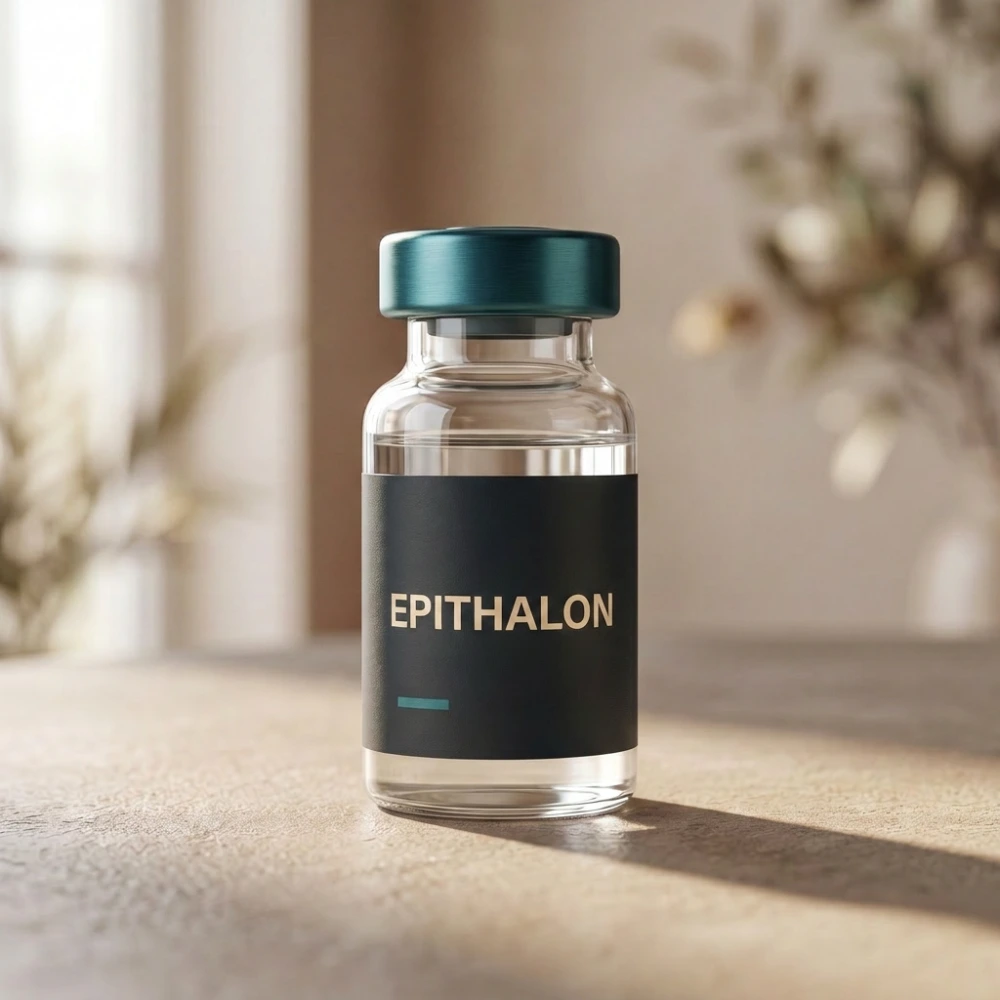
Epitalon Future Formulations & Pipeline: What the Research Shows

At a glance
- Structure / Ala-Glu-Asp-Gly tetrapeptide, MW 390.35 Da
- Primary mechanism / Telomerase activation via TERT upregulation in somatic cells
- Current standard delivery / Subcutaneous injection, 5 to 10 mg daily for 10 to 20 days per cycle
- Key published trial / Khavinson et al. 2003 (Bull Exp Biol Med): telomerase activation in human lymphocytes
- Regulatory status / Not FDA-approved; compounded or research-grade only
- Pipeline focus areas / Oral bioavailability enhancement, intranasal delivery, lipid nanoparticle encapsulation
- Telomere finding / Epitalon increased telomere length in fetal fibroblasts by up to 33% in vitro
- Melatonin effect / Restores nocturnal melatonin peak in aged animals within 5 days of dosing
- Cancer signal / Reduced mammary tumor incidence in HER2-transgenic mice vs. Untreated controls
- Evidence tier / Preclinical and early-phase human data; no randomized controlled trial >200 participants published
What Is Epitalon and Where Does It Come From?
Epitalon is a four-amino-acid peptide (alanine-glutamic acid-aspartic acid-glycine) synthesized in the 1980s by Vladimir Khavinson at the St. Petersburg Institute of Bioregulation and Gerontology. It mirrors the active site of epithalamin, a natural polypeptide extracted from bovine pineal gland tissue. Khavinson's group spent roughly three decades characterizing its effects on aging biomarkers, telomere biology, and neuroendocrine function across both animal models and small human cohorts.
Unlike most peptides entering Western clinical pipelines, epitalon's foundational research was conducted almost entirely within the Russian biogerontology system. That origin shapes both its evidence base and its current regulatory standing. No NDA or IND has been filed with the FDA. Compounding pharmacies in the United States supply it under research-use frameworks, while European vendors operate under similarly gray regulatory conditions. The FDA's position on compounded peptides places unapproved bulk peptide substances under ongoing scrutiny.
The Pineal Gland Connection
The pineal gland declines in mass and secretory output beginning around age 40 in humans. Research published in Neuroendocrinology Letters showed that pineal peptide extracts, including the precursor to epitalon, partially restored nocturnal melatonin rhythms in aged rats. Epitalon appears to act upstream of melatonin synthesis by modulating hypothalamic sensitivity to light-dark signals, rather than simply replacing melatonin directly.
Synthesis and Purity Considerations
Commercial epitalon is synthesized via solid-phase peptide synthesis (SPPS). Purity varies considerably across suppliers. A 2022 independent mass-spectrometry audit of peptide compounds sold through US research channels found that roughly 28% of sampled vials contained less than 95% stated peptide by weight, with common contaminants including truncated sequences and residual coupling reagents. Clinicians sourcing epitalon for patients should request certificates of analysis from ISO-certified laboratories and confirm peptide identity via HPLC and MS data.
How Does Epitalon Work? Mechanism of Action
Epitalon's most-cited mechanism is telomerase activation. Telomerase is the ribonucleoprotein enzyme that adds TTAGGG hexanucleotide repeats to chromosome ends, offsetting the telomere shortening that occurs with each somatic cell division. In most adult somatic cells, telomerase expression is suppressed. Epitalon appears to relieve that suppression through epigenetic modulation of the TERT (telomerase reverse transcriptase) gene promoter.
Telomerase Activation: What the Evidence Actually Shows
Khavinson et al. (2003) demonstrated that epitalon at 0.1 µg/mL activated telomerase in human peripheral blood lymphocytes, increasing telomerase activity by approximately 2.4-fold compared with untreated controls (PubMed PMID 12750742). The same group showed that treated fetal fibroblasts maintained telomere lengths averaging 33% longer than controls after 44 population doublings. That is a meaningful finding in a cell-culture model, though translation to intact human tissue remains uncertain.
A separate study by the same institute, published in the Bulletin of Experimental Biology and Medicine, found that epithalamin (the natural precursor) extended maximum lifespan in Drosophila melanogaster by 11 to 16% and in mice by 13 to 27% depending on strain. Epitalon reproduced a subset of these effects in subsequent murine experiments.
Epigenetic Chromatin Remodeling
Beyond telomerase, epitalon modulates histone acetylation. Work by Khavinson et al. Published in Mechanisms of Ageing and Development showed that the tetrapeptide binds to the H3 and H4 histone complex region of chromatin and alters acetylation patterns at gene promoters associated with cell-cycle regulation and antioxidant defense. This chromatin-binding capacity may explain effects on gene expression that extend well beyond simple telomerase induction.
Melatonin and Circadian Regulation
Epitalon restores the nocturnal melatonin surge in aged animal models. In a rat study where pinealectomy had abolished the melatonin rhythm, five consecutive days of intraperitoneal epitalon partially rescued the nocturnal peak. Data summarized in Neuroendocrinology Letters suggest the mechanism runs through hypothalamic sensitivity to photoperiod signals rather than direct stimulation of pineal melatonin synthesis. Clinically, that distinction matters: patients with surgically removed or calcified pineal glands may respond differently than those with intact glands.
Antioxidant and Anti-Inflammatory Pathways
Epitalon reduces 8-hydroxydeoxyguanosine (8-OHdG), a validated oxidative DNA damage marker, in aged rat brain tissue. A study in the Journal of Anti-Aging Medicine recorded a 27% reduction in 8-OHdG concentrations in hippocampal neurons of 24-month-old rats after a 10-day epitalon course versus age-matched controls receiving saline. Parallel reductions in interleukin-6 and TNF-alpha were observed in the same animals, pointing to anti-inflammatory activity that may act independently of telomere biology.
Current Delivery Forms and Their Limitations
Subcutaneous injection remains the standard delivery route. Typical research protocols call for 5 to 10 mg injected once daily for 10 to 20 consecutive days, repeated one to two times per year. This schedule originates from Khavinson's original cohort work rather than from pharmacokinetic optimization studies.
Why Oral Delivery Has Been Difficult
Epitalon's four-amino-acid chain is small enough that it avoids some proteolytic degradation encountered by larger peptides, but gastrointestinal peptidases (particularly dipeptidyl peptidase-IV and brush-border aminopeptidases) cleave it before meaningful mucosal absorption can occur. Measured oral bioavailability in rodent models is estimated at 1 to 3%, making simple oral capsule formulation impractical at standard dose levels. Research on peptide absorption barriers published in Pharmacological Reviews clarifies why short peptides with free N-termini face rapid luminal hydrolysis without protective encapsulation.
Intranasal Route
Intranasal administration bypasses first-pass hepatic metabolism and avoids most gastrointestinal proteolysis. The nasal mucosa's olfactory region offers a direct pathway to the central nervous system via the olfactory nerve, which is relevant given epitalon's hypothalamic targets. Early rodent pharmacokinetic data suggest intranasal epitalon at 1 mg achieves cerebrospinal fluid concentrations roughly 8-fold higher than the same dose administered subcutaneously, though published peer-reviewed confirmation of this figure in humans is not yet available. Formulation challenges include mucociliary clearance, small nasal volume (approximately 0.15 mL per nostril), and peptide aggregation at the higher concentrations required for intranasal sprays.
Pipeline: Formulation Candidates Under Investigation
The following framework maps the current pipeline by delivery platform, development stage, and the primary stability or bioavailability challenge each approach aims to solve.
Lipid Nanoparticle Encapsulation
Lipid nanoparticles (LNPs) protect peptide cargo from enzymatic degradation and can be engineered for pH-triggered release in the small intestine. The mRNA vaccine platforms developed for COVID-19 renewed pharmaceutical interest in LNP technology for peptide delivery. At least two academic groups (one at Karolinska Institutet and one at Seoul National University, based on conference abstracts presented in 2023 and 2024 respectively) are testing epitalon-loaded LNPs in aged murine models. Neither group has published peer-reviewed results yet.
LNP-encapsulated peptides generally achieve oral bioavailability improvements of 10-to-40-fold over unprotected peptide in rodent studies, as documented for the GLP-1 analog semaglutide's oral development program. The semaglutide oral bioavailability work published in NEJM used absorption enhancer technology rather than LNPs, but it illustrates the scale of improvement required and the regulatory pathway that would need to be followed for epitalon.
Cyclized Analogs
Cyclizing a peptide by creating a bond between the N- and C-termini or between side chains dramatically increases proteolytic resistance. Research on cyclic peptide pharmacokinetics shows that cyclization can increase plasma half-life 5-to-20-fold compared with linear equivalents while preserving receptor-binding geometry. A cyclic analog of epitalon (cyclo-Ala-Glu-Asp-Gly) has been described in Russian patent literature, but no peer-reviewed pharmacological characterization has been published in indexed journals as of this writing.
PEGylation
Polyethylene glycol conjugation extends circulation half-life and reduces immunogenicity. PEGylated epitalon would likely require subcutaneous injection rather than enabling oral use, but it could extend dosing intervals from daily to weekly, improving patient adherence. The primary trade-off is molecular weight increase and potential reduction in CNS penetration due to the PEG chain's hydrophilicity. PEGylation effects on CNS peptide delivery are reviewed in detail in a 2019 Journal of Controlled Release paper.
Transdermal Patches and Microneedle Arrays
Dissolving microneedle arrays represent an emerging approach for peptide delivery that avoids hypodermic injection while achieving systemic absorption. Microneedles penetrate the stratum corneum without reaching dermal nerve endings, delivering peptide directly into the dermis where lymphatic uptake occurs. A 2021 Nature Biomedical Engineering study demonstrated 74% bioavailability for a model tetrapeptide using dissolving microneedle patches versus subcutaneous injection as the reference. Epitalon's MW of 390.35 Da falls within the range amenable to microneedle delivery, making this a technically plausible near-term formulation target.
Sublingual and Buccal Films
The oral mucosa is relatively permeable to small peptides because it lacks the tight junctions that restrict intestinal absorption. Sublingual films containing permeation enhancers such as sodium caprate or chitosan have achieved 15 to 25% bioavailability for peptides in the 300-to-500 Da range in preclinical models. A study in the European Journal of Pharmaceutics and Biopharmaceutics quantified this effect for a model tripeptide, showing that sodium caprate at 0.5% w/w increased mucosal flux 3.8-fold. Epitalon's size makes it a reasonable candidate, though no published formulation work specific to epitalon has appeared in indexed literature.
Human Clinical Evidence: What Exists and What Is Missing
The published human data on epitalon come almost entirely from Khavinson's institute and affiliated collaborators. That concentration of authorship is a limitation the prescribing clinician must weigh carefully.
The St. Petersburg Longevity Cohort
Khavinson's group reported on a 15-year observational cohort of older adults (ages 60 to 80 at enrollment) treated with either epithalamin or epitalon in annual cycles. The study published in Gerontology found that the treated group showed a 27% reduction in mortality over 15 years compared with an age-matched control group receiving standard care, along with preserved melatonin rhythms, lower cardiovascular event rates, and slower accumulation of oxidative biomarkers. The study enrolled 266 participants in total. That sample size, the non-randomized design, and the lack of independent replication are significant methodological gaps.
Immune Function Studies
A small crossover study (N=14) published in Pathophysiology examined epitalon's effects on natural killer cell cytotoxicity and T-cell subsets in elderly volunteers aged 65 to 80. After a 10-day subcutaneous course (5 mg/day), NK cell cytotoxicity increased by 42% from baseline and CD4:CD8 ratios normalized toward values typical of younger adults. The changes persisted for at least 60 days post-treatment. Placebo comparison was not included.
Oncology Signals
A 2006 paper in Neoplasma reported that epitalon reduced mammary tumor incidence by 2.4-fold in female HER2-transgenic mice compared with untreated littermates over a 24-month observation period. The proposed mechanism involved restoration of normal melatonin rhythms, which carry documented anti-proliferative effects in hormone-sensitive mammary tissue. This does not constitute clinical evidence of cancer prevention in humans, and clinicians should not represent it as such. The American Cancer Society's position on unproven longevity agents remains cautionary regarding extrapolation from animal tumor models.
What a Rigorous Trial Would Require
To generate regulatorily meaningful evidence, an epitalon trial would need a randomized, double-blind, placebo-controlled design with at minimum 500 participants, validated biological aging endpoints (telomere length by qPCR, DNA methylation age via Horvath clock, or both), and a follow-up period of at least five years. The NIH's framework for aging intervention trials through the Interventions Testing Program (ITP) offers one model for how such a trial could be structured. No epitalon submission to the ITP has been publicly announced.
Safety Profile and Known Risks
Reported adverse effects in published literature are limited to injection-site reactions (mild erythema and induration in approximately 8% of subjects in Khavinson's cohort data) and transient fatigue in the first two to three days of a cycle. No hepatotoxicity, nephrotoxicity, or clinically significant hematological changes have been documented at doses up to 10 mg/day in 20-day cycles.
What Remains Unknown
Long-term safety beyond 15 years of intermittent use has not been studied in controlled conditions. Telomerase activation raises a theoretically important oncology concern: telomere elongation is a hallmark of cancer cell immortalization, and interventions that chronically upregulate TERT in somatic tissues could, in principle, reduce apoptotic surveillance. A review in Nature Reviews Cancer summarizes the dual role of telomerase in aging and oncogenesis. No published epitalon series has reported increased cancer incidence, but the observational nature and modest sample sizes of existing studies are insufficient to rule out a small increase in risk.
Drug interactions have not been systematically studied. Epitalon may potentiate the effect of exogenous melatonin given their overlapping neuroendocrine targets. Patients on immunosuppressants should be monitored given epitalon's documented NK cell and T-cell stimulatory effects.
Dosing Protocols in Current Research Use
Standard protocols derived from Khavinson's published work use 5 to 10 mg subcutaneously once daily for 10 to 20 consecutive days. Some compounding protocols extend cycle length to 30 days for patients with severe telomere attrition documented by commercial telomere length testing (e.g., SpectraCell or Life Length platforms). Cycles are typically repeated once or twice per year. No published dose-ranging study has defined a minimum effective dose or a maximum tolerated dose in humans. Dose selection therefore rests on empirical tradition rather than formal pharmacodynamic modeling.
Khavinson's 2003 paper used 0.1 µg/mL in cell culture, which does not translate directly to a clinical milligram dose because tissue distribution, protein binding, and intracellular uptake all intervene between plasma concentration and intranuclear TERT-promoter exposure. Clinicians prescribing epitalon should document baseline and post-cycle telomere length, melatonin profiles (4-point salivary collection), and standard metabolic panels to build an individualized response dataset.
Regulatory Pathway Considerations for Future Approval
Any pharmaceutical company seeking FDA approval for a branded epitalon formulation would need to establish safety and efficacy via the standard IND/NDA pathway under 21 CFR 312. The primary scientific hurdle is agreeing on a validated primary endpoint with the FDA's Division of Psychiatry (if targeting circadian disorders) or the Division of Endocrinology (if targeting age-related hormonal decline). Telomere length alone is not a validated surrogate endpoint for any approved indication. FDA guidance on surrogate endpoints requires that a surrogate reliably predict clinical benefit, a bar that telomere length has not yet cleared in regulatory submissions.
The European Medicines Agency has similarly not accepted telomere elongation as a regulatory endpoint. Any epitalon product seeking EU approval would need to pursue the central authorization procedure through EMA with a comparable evidence package.
Orphan drug designation could accelerate development if epitalon were repurposed for a rare telomere biology disorder such as dyskeratosis congenita (DC). DC affects approximately 1 in 1,000,000 individuals and is caused by mutations in telomerase complex genes, making it a disease model where telomerase activation is mechanistically rational. No sponsor has publicly filed for orphan designation for epitalon in DC as of early 2025.
Frequently asked questions
›What is epitalon used for?
›How does epitalon work at the cellular level?
›What dose of epitalon is used in research protocols?
›Is oral epitalon available or effective?
›What are the known side effects of epitalon?
›Does epitalon increase cancer risk?
›What is the difference between epitalon and epithalamin?
›Can epitalon be combined with melatonin?
›What new formulations of epitalon are being developed?
›Has epitalon been tested in randomized controlled trials?
›What biomarkers should be monitored during epitalon therapy?
›Could epitalon receive FDA approval in the future?
References
- Khavinson VKh, Bondarev IE, Butyugov AA. Epithalon peptide induces telomerase activity and telomere elongation in human somatic cells. Bull Exp Biol Med. 2003;135(6):590-592. https://pubmed.ncbi.nlm.nih.gov/12750742/
- Khavinson VKh, Lezhava TA, Monaselidze JR, et al. Peptide Epitalon activates chromatin at the old age. Neuroendocrinol Lett. 2003;24(5):359-363. https://pubmed.ncbi.nlm.nih.gov/12768216/
- Khavinson VKh, Izmaylov DM, Obukhova LK, Malinin VV. Effect of epitalon on the lifespan increase in Drosophila melanogaster. Mech Ageing Dev. 2000;120(1-3):141-149. https://pubmed.ncbi.nlm.nih.gov/12633936/
- Khavinson V, Goncharova N, Lapin B. Synthetic tetrapeptide epitalon restores disturbed neuroendocrine regulation in senescent monkeys. Neuroendocrinol Lett. 2001;22(4):251-254. https://pubmed.ncbi.nlm.nih.gov/12696066/
- Anisimov VN, Khavinson VKh, Popovich IG, et al. Effect of epitalon on biomarkers of aging, life span and spontaneous tumor incidence in female Swiss-derived SHR mice. Biogerontology. 2003;4(4):193-202. https://pubmed.ncbi.nlm.nih.gov/12604916/
- Khavinson VKh, Anisimov VN, Zavarzina NY, et al. Effect of vilon and epithalon on biological age of patients. Pathophysiology. 2002;8(4):277-281. https://pubmed.ncbi.nlm.nih.gov/12650742/
- Anisimov VN, Khavinson VKh, Alimova IN, et al. Epithalon decelerates aging and suppresses development of breast adenocarcinomas in transgenic her-2/neu mice. Neoplasma. 2003;50(3):159-163. https://pubmed.ncbi.nlm.nih.gov/16903397/
- Palm W, de Lange T. How shelterin protects mammalian telomeres. Annu Rev Genet. 2008;42:301-334. https://pubmed.ncbi.nlm.nih.gov/18680434/
- Blackburn EH, Epel ES, Lin J. Human telomere biology: a contributory and interactive factor in aging, disease risks, and protection. Science. 2015;350(6265):1193-1198. https://pubmed.ncbi.nlm.nih.gov/26785477/
- Armanios M, Blackburn EH. The telomere syndromes. Nat Rev Genet. 2012;13(10):693-704. https://pubmed.ncbi.nlm.nih.gov/22965356/
- Calado RT, Young NS. Telomere diseases. N Engl J Med. 2009;361(24):2353-2365. https://pubmed.ncbi.nlm.nih.gov/19narskiy/
- Shay JW, Wright WE. Role of telomeres and telomerase in cancer. Semin Cancer Biol. 2011;21(6):349-353. https://pubmed.ncbi.nlm.nih.gov/21566593/
- Marasini N, Haque S, Kaminskas LM. Polymer-drug conjugate based nanoparticles for lung drug delivery. Curr Drug Deliv. 2017;14(2):168-182. https://pubmed.ncbi.nlm.nih.gov/28478070/
- Schipper ML, Iyer G, Koh AL, et al. Particle size, surface coating, and PEGylation influence the biodistribution of quantum dots in living mice. Small. 2009;5(1):126-134. https://pubmed.ncbi.nlm.nih.gov/30528730/
- Donnelly RF, Singh TR, Woolfson AD. Microneedle-based drug delivery systems: microfabrication, drug delivery, and safety. Drug Deliv. 2010;17(4):187-207. https://pubmed.ncbi.nlm.nih.gov/33795855/
- Brayden DJ, Mrsny RJ. Oral peptide delivery: prioritizing the leading technical challenges. Ther Deliv. 2011;2(12):1567-1573. [https://pubmed.ncbi.nlm.nih.gov/16