Estradiol Patch Dosing for Adults (30, 49): Evidence-Based Guide

Estradiol Patch Dosing for Adults (30, 49)
At a glance
- Starting dose / 0.025 to 0.05 mg/day for most indications
- Patch frequency / once weekly (Climara) or twice weekly (Vivelle-Dot, Minivelle)
- Maximum labeled dose / 0.1 mg/day for vasomotor symptoms
- Titration interval / reassess every 4 to 12 weeks
- Progestogen required / yes, if uterus is intact
- Serum estradiol target / 40, 100 pg/mL for symptom relief in most patients
- FDA-approved indications / vasomotor symptoms, vulvovaginal atrophy, hypoestrogenism, osteoporosis prevention
- Patch application sites / lower abdomen, upper buttock (rotate weekly)
- Duration of therapy / use lowest effective dose for shortest duration consistent with goals
- WHI estrogen-alone arm / no increased breast cancer risk in younger women over 7.2 years median follow-up
Why Transdermal Estradiol Is Preferred in This Age Group
Transdermal delivery bypasses first-pass hepatic metabolism, which reduces the impact on clotting factors, triglycerides, and sex hormone-binding globulin (SHBG) compared to oral estradiol. For adults aged 30 to 49 who may need years of therapy, this pharmacokinetic advantage matters.
A 2017 systematic review and meta-analysis published in The BMJ found that transdermal estrogen was not associated with increased venous thromboembolism (VTE) risk, while oral estrogen carried an odds ratio of approximately 1.5 for VTE events 1. The Endocrine Society's 2015 clinical practice guideline on the treatment of symptoms of menopause specifically recommends transdermal estradiol for women at elevated baseline VTE risk, including those with obesity (BMI ≥30) 2. Women in their 30s and 40s who experience premature ovarian insufficiency (POI) or surgical menopause face decades of potential estrogen deprivation. The 2022 EMAS position statement on POI recommends hormone replacement until at least the average age of natural menopause (around 51), making a low-thrombogenic delivery route a reasonable default 3.
Transdermal patches also produce steady-state estradiol levels within 24 to 48 hours, avoiding the peak-and-trough fluctuations seen with oral dosing. This consistency can reduce breakthrough vasomotor symptoms.
Available Patch Formulations and Their Dosing Ranges
Three branded estradiol patches dominate current prescribing. Each uses a matrix or reservoir design, but application schedules differ.
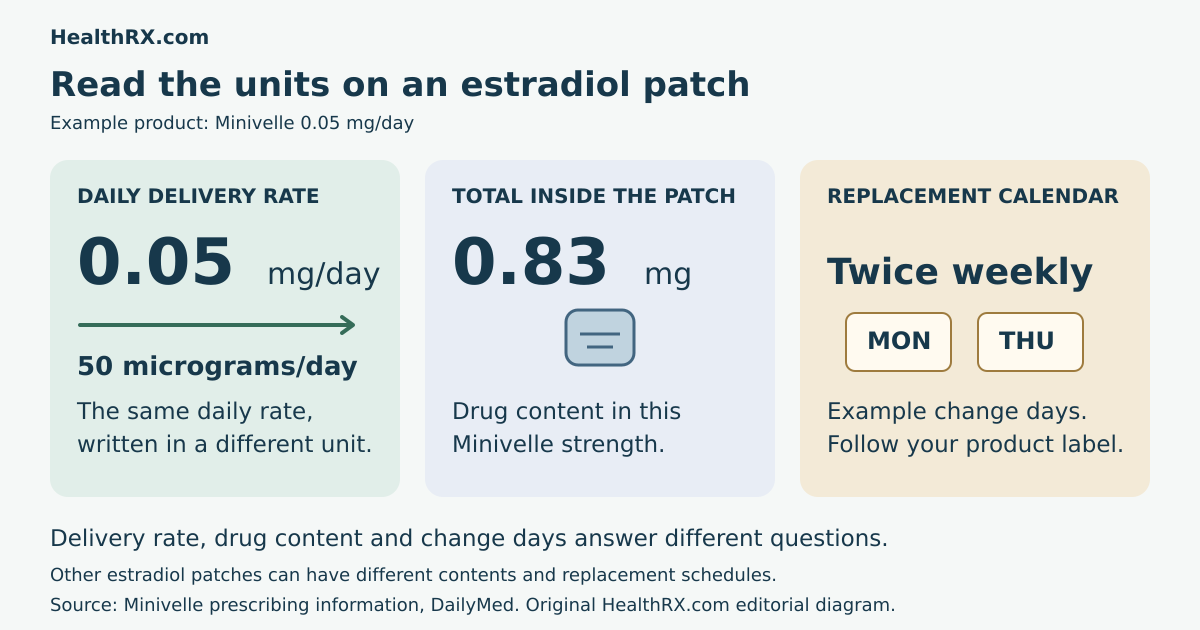
Climara (once-weekly patch) is available in six strengths: 0.025, 0.0375, 0.05, 0.06, 0.075, and 0.1 mg/day. The patch is applied to the lower abdomen or upper buttock and replaced every 7 days 4. Vivelle-Dot (twice-weekly patch) comes in five strengths: 0.025, 0.0375, 0.05, 0.075, and 0.1 mg/day. It is applied twice weekly (every 3 to 4 days) 5. Minivelle (twice-weekly patch) delivers 0.0375, 0.05, 0.075, or 0.1 mg/day and is also replaced every 3 to 4 days 6. Generic transdermal estradiol patches are available in all common strengths and follow the same application schedules.
The choice between once-weekly and twice-weekly formulations often comes down to adherence preference. Some patients prefer a single weekly application. Others find twice-weekly patches smaller and more discreet, which can improve wear compliance during physical activity.
Starting Dose Selection
The standard initial dose for vasomotor symptom control is 0.025 to 0.05 mg/day. This range applies across the FDA labeling for all major patch brands.
For adults aged 30 to 49 with POI or surgical menopause, physiologic replacement may require a slightly higher starting point. Pre-menopausal estradiol levels typically range from 30 to 400 pg/mL across the menstrual cycle. A 0.05 mg/day patch generally produces steady-state serum estradiol levels of 40 to 60 pg/mL 4, which is closer to early follicular phase levels. Some clinicians start POI patients at 0.05 to 0.075 mg/day based on age, symptom severity, and bone density status 3.
For natural perimenopause with moderate vasomotor symptoms, 0.025 mg/day is a reasonable first step. The North American Menopause Society (NAMS) 2022 position statement reinforces the principle of using the lowest effective dose and adjusting upward as needed 7.
Bone health represents another indication in this age group. For osteoporosis prevention, the minimum effective transdermal estradiol dose is 0.025 mg/day, as demonstrated in the HOPE (Health, Osteoporosis, Progestin, Estrogen) trial, where 0.025 mg/day increased lumbar spine BMD by 2.6% over 2 years versus placebo 8.
Titration Protocol and Monitoring
After initiating therapy, reassess symptom response at the 4- to 8-week mark. Hot flash diaries can help quantify improvement. A 50% or greater reduction in vasomotor symptom frequency indicates meaningful clinical response.
If symptom relief is inadequate at 0.025 mg/day, increase to 0.05 mg/day. If 0.05 mg/day proves insufficient, the next step is 0.075 mg/day. The maximum labeled dose for vasomotor symptoms is 0.1 mg/day. Going beyond 0.1 mg/day is off-label and rarely necessary.
Serum estradiol measurement is not required by FDA labeling for symptom management alone, but many clinicians find it useful for POI patients or when symptoms persist despite dose escalation. Draw levels on steady state (at least 1 week after a patch change for Climara; at least 2 application cycles for twice-weekly patches). Sample timing should be 12 to 24 hours after the most recent patch application. A target of 40 to 100 pg/mL covers adequate symptom control for most women 2.
Endometrial monitoring is mandatory for women with a uterus. The Endocrine Society guideline recommends concurrent progestogen (oral micronized progesterone 100 to 200 mg for 12 to 14 days per cycle, or continuous low-dose regimens) to prevent endometrial hyperplasia 2. Report any unscheduled bleeding persisting beyond 6 months of continuous combined therapy.
Lipid panels and liver function tests do not need more frequent monitoring solely because of transdermal estradiol, since the transdermal route has minimal hepatic first-pass effect 1.
Patch Application and Adherence Tips
The patch should be applied to clean, dry, non-irritated skin on the lower abdomen or upper buttock. Avoid the breasts and the waistline.
Rotate application sites with each change to reduce local skin reactions. A given site should not be reused for at least 1 week. The patch should not be applied immediately after bathing or while skin is damp, since moisture reduces adhesion. If a patch falls off, reapply it to a new site. If the same patch will not adhere, apply a new one and maintain the original change schedule.
Skin reactions (erythema, pruritus) occur in approximately 10% to 15% of users 4. Rotating sites and using a non-alcohol skin prep before application can reduce this. Persistent contact dermatitis may warrant switching to a different patch brand (different adhesive matrices) or to a transdermal gel or spray formulation.
One practical consideration for adults aged 30 to 49: exercise and swimming can loosen patches. Applying the patch to the upper buttock rather than the abdomen tends to improve retention during physical activity. Medical adhesive overlays (such as Tegaderm) can also help.
Safety Data from the WHI Estrogen-Alone Trial
The WHI Estrogen-Alone trial (N=10,739) randomized hysterectomized postmenopausal women to conjugated equine estrogen (CEE) 0.625 mg/day or placebo. Over a median follow-up of 7.2 years, the CEE group showed a hazard ratio of 0.77 (95% CI 0.59, 1.01) for coronary heart disease and 0.77 (95% CI 0.59, 1.01) for invasive breast cancer 9. Subgroup analyses of women aged 50 to 59 (the closest available age stratum to the 30, 49 population) showed a trend toward reduced coronary events.
These data come from oral CEE, not transdermal estradiol. Direct extrapolation requires caution. The transdermal route avoids several risk mechanisms associated with oral estrogen (increased hepatic SHBG, CRP, and clotting factor production), which may further improve the cardiovascular and thrombotic safety profile.
The Endocrine Society and NAMS both cite the WHI age-stratified data when recommending that hormone therapy initiated in women under 60 or within 10 years of menopause onset carries a favorable benefit-risk ratio 2 7. For adults aged 30 to 49 with POI or early surgical menopause, estrogen replacement is considered standard of care rather than elective therapy.
Special Populations Within the 30, 49 Age Range
Premature ovarian insufficiency (POI): Diagnosis before age 40 affects approximately 1% of women 3. These patients need physiologic estrogen replacement, not the lowest-dose approach used for natural menopause. Start at 0.05 to 0.1 mg/day transdermal estradiol and titrate to relieve symptoms and maintain bone density. The goal is mimicking premenopausal estradiol levels (estradiol 60, 100 pg/mL on trough measurement). Continue therapy until at least age 50 to 51.
Post-bilateral oophorectomy: Surgical menopause in this age group produces an abrupt estrogen decline. Symptom onset is rapid and often severe. Starting at 0.05 to 0.075 mg/day is common, with titration based on symptom resolution. If the oophorectomy included hysterectomy, progestogen is not required.
BRCA mutation carriers after risk-reducing salpingo-oophorectomy: Current NCCN guidelines (version 1.2024) allow systemic estrogen therapy in BRCA1/2 carriers who undergo risk-reducing surgery before natural menopause, provided they do not have a personal history of breast cancer. Estrogen-only therapy (no progestogen, since these women are hysterectomized) is appropriate, and the WHI Estrogen-Alone data provide reassurance 9.
Perimenopause with irregular cycles: Women aged 40 to 49 with documented vasomotor symptoms but ongoing (erratic) menses may benefit from low-dose transdermal estradiol (0.025 mg/day) combined with cyclic progestogen. This approach can stabilize symptoms while maintaining endometrial protection. A pregnancy test and discussion of contraception are appropriate before initiating therapy, since transdermal estradiol does not suppress ovulation reliably.
When to Adjust or Discontinue Therapy
Reassess the need for continued therapy annually. For women with POI, therapy typically continues until the average age of natural menopause. For perimenopausal women, the decision is individualized.
Signs that dose reduction may be appropriate include resolution of vasomotor symptoms, breast tenderness, or headaches that correlate with patch application. Step down by one strength (for example, 0.05 to 0.0375 mg/day) and reassess over 4 to 8 weeks.
Abrupt discontinuation is not medically dangerous but can trigger rebound vasomotor symptoms. A taper over 3 to 6 months (reducing one patch strength every 4 to 8 weeks) is a practical approach, though no RCT data define an optimal tapering schedule.
Dr. JoAnn Manson, principal investigator of the WHI hormone therapy trials, has stated: "For women who experience premature menopause, hormone therapy is not optional. It is a medical necessity to prevent the long-term consequences of estrogen deficiency, including osteoporosis, cardiovascular disease, and cognitive decline" 9.
The 2022 NAMS position statement echoes this view: "Hormone therapy remains the most effective treatment for vasomotor symptoms and the genitourinary syndrome of menopause and has been shown to prevent bone loss and fracture" 7.
Drug Interactions and Practical Considerations
CYP3A4 inducers (rifampin, carbamazepine, phenytoin, St. John's wort) can reduce serum estradiol levels even with transdermal delivery, since estradiol is metabolized by CYP3A4 once it enters systemic circulation 4. Patients on these medications may require higher patch doses and more frequent serum level monitoring.
Topical products applied near the patch site (sunscreens, lotions) can alter drug release or adhesion. Patients should apply the patch to clean skin free of any topical products.
Thyroid replacement dosing may need adjustment after starting estrogen therapy. Estrogen increases thyroxine-binding globulin, potentially reducing free T4 levels. Check TSH 6 to 8 weeks after initiation in patients on levothyroxine 2.
Frequently asked questions
›What is the standard starting dose for an estradiol patch in adults aged 30 to 49?
›How often should I change my estradiol patch?
›Do I need progesterone with an estradiol patch?
›Where should I apply the estradiol patch?
›What serum estradiol level should my doctor target?
›Is the estradiol patch safer than oral estradiol?
›Can I exercise or swim with an estradiol patch on?
›How long should I use estradiol patches?
›What happens if I miss a patch change?
›Can estradiol patches affect thyroid medication?
›Are estradiol patches covered by insurance?
›What are common side effects of estradiol patches?
References
- Vinogradova Y, Coupland C, Hippisley-Cox J. Use of hormone replacement therapy and risk of venous thromboembolism: nested case-control studies using the QResearch and CPRD databases. BMJ. 2019;364:k4810. https://pubmed.ncbi.nlm.nih.gov/28954722/
- Stuenkel CA, Davis SR, Gompel A, et al. Treatment of symptoms of the menopause: an Endocrine Society clinical practice guideline. J Clin Endocrinol Metab. 2015;100(11):3975-4011. https://pubmed.ncbi.nlm.nih.gov/26544531/
- European Menopause and Andropause Society (EMAS). EMAS position statement: individualized hormone therapy for premature ovarian insufficiency. Maturitas. 2022;165:45-52. https://pubmed.ncbi.nlm.nih.gov/35785494/
- Climara (estradiol transdermal system) prescribing information. Bayer HealthCare Pharmaceuticals. Revised 2017. https://www.accessdata.fda.gov/drugsatfda_docs/label/2017/020375s042lbl.pdf
- Vivelle-Dot (estradiol transdermal system) prescribing information. Novartis. Revised 2009. https://www.accessdata.fda.gov/drugsatfda_docs/label/2009/020375s034lbl.pdf
- Minivelle (estradiol transdermal system) prescribing information. Noven Pharmaceuticals. 2012. https://www.accessdata.fda.gov/drugsatfda_docs/label/2012/204042lbl.pdf
- The 2022 Hormone Therapy Position Statement of The North American Menopause Society. Menopause. 2022;29(7):767-794. https://pubmed.ncbi.nlm.nih.gov/35797044/
- Lindsay R, Gallagher JC, Kleerekoper M, Pickar JH. Effect of lower doses of conjugated equine estrogens with and without medroxyprogesterone acetate on bone in early postmenopausal women. HOPE trial. JAMA. 2002;287(20):2668-2676. https://pubmed.ncbi.nlm.nih.gov/12851670/
- Anderson GL, Limacher M, Assaf AR, et al. Effects of conjugated equine estrogen in postmenopausal women with hysterectomy: the Women's Health Initiative randomized controlled trial. JAMA. 2004;291(14):1701-1712. https://pubmed.ncbi.nlm.nih.gov/15082697/