Estradiol Patch Missed-Dose Protocol: What to Do and Why It Matters

Hormone therapy clinical care image for Estradiol Patch Missed-Dose Protocol: What to Do and Why It Matters

At a glance

  • Drug / estradiol transdermal (Climara, Vivelle-Dot, Minivelle)
  • Prescription status / prescription-only
  • Dosing schedule / weekly (Climara) or twice-weekly (Vivelle-Dot, Minivelle)
  • Missed-dose action / apply new patch immediately; reset schedule to that day
  • Double-dosing / never apply two patches to compensate for one missed dose
  • Time to symptom return / vasomotor symptoms may return within 24-48 hours of missed dose
  • Half-life after patch removal / serum estradiol falls to baseline within 24 hours
  • Primary indication / moderate-to-severe vasomotor symptoms of menopause
  • Key safety trial / WHI Estrogen-Alone (JAMA 2004, N=10,739)
  • Monitoring / serum estradiol, symptom diary, annual clinical review

What Happens in Your Body When an Estradiol Patch Is Missed

A missed estradiol patch dose is not merely an administrative inconvenience. Serum estradiol levels fall sharply once a patch is removed or detaches, because transdermal delivery maintains a concentration gradient across the skin that collapses the moment the reservoir is gone. For most weekly formulations, estradiol returns to near-menopausal baseline (typically <20 pg/mL) within 24 hours of patch removal [1].

The Concentration Gradient Mechanism

Estradiol patches work by maintaining a higher drug concentration inside the patch matrix or reservoir than exists in the outer layers of the skin. That gradient drives passive diffusion of estradiol molecules through the stratum corneum and into dermal capillaries. When the patch detaches or is not replaced on schedule, the gradient disappears. Delivery stops. The skin has no built-in reservoir of its own.

This is meaningfully different from oral estradiol or conjugated equine estrogens, where enterohepatic recirculation and hepatic first-pass metabolism create a small circulating buffer. Transdermal systems bypass the liver entirely, which is a pharmacokinetic advantage for clotting-factor profiles [2], but it also means the body has no secondary depot to draw from during a missed dose.

Why Symptoms Return So Quickly

Vasomotor symptoms (hot flashes and night sweats) are driven by a narrowed thermoregulatory zone in the hypothalamus, a zone that estrogen helps to widen [3]. When circulating estradiol drops abruptly, that zone narrows again. Clinical studies of estradiol withdrawal document symptom recurrence within 12 to 48 hours in women who are highly symptomatic. For a patient using Climara 0.05 mg/day (a weekly patch), missing the weekly change by even 36 hours may be enough to generate breakthrough symptoms.

Pharmacokinetics by Formulation

| Formulation | Change Schedule | Delivery Rate | Time to Cmin After Removal | |---|---|---|---| | Climara | Once weekly | 0.025-0.1 mg/day | ~24 hours | | Vivelle-Dot | Twice weekly | 0.025-0.1 mg/day | ~12-18 hours | | Minivelle | Twice weekly | 0.025-0.1 mg/day | ~12-18 hours |

Twice-weekly patches (Vivelle-Dot, Minivelle) have a shorter inter-dose interval, so the window for error is narrower. A dose missed by more than 12 hours on a twice-weekly schedule carries a higher probability of symptomatic breakthrough than the same 12-hour delay on a weekly patch.


The Standard Missed-Dose Protocol, Step by Step

The FDA-approved labeling for estradiol transdermal patches provides a consistent instruction across brands: apply the missed patch as soon as you remember, then continue on the new schedule from that day [4]. The specific steps matter more than the general principle.

Step 1: Apply a Fresh Patch Immediately

Do not attempt to reapply a detached or expired patch. Adhesive integrity degrades once a patch has been worn or peeled from its liner, and a partially exhausted reservoir delivers estradiol unpredictably. Use a new patch from sealed packaging.

Choose a clean, dry skin site on the lower abdomen or buttocks, below the waistline. Avoid the breasts, any area with broken skin, and sites used in the previous application cycle. Press firmly for 10 seconds. The manufacturer confirms adhesion typically lasts for the designed wear duration when the site is dry and hair-free.

Step 2: Reset Your Schedule

Your new change day is today, not the original scheduled day. If you used Vivelle-Dot on Mondays and Thursdays and you forgot the Monday dose until Wednesday, your new schedule becomes Wednesday and Saturday. Write the new days down or update your phone reminder before doing anything else.

Keeping the original calendar date when you are already a day or more late means you will be removing the replacement patch prematurely, potentially delivering less than the intended dose.

Step 3: Do Not Double-Patch

Applying two patches simultaneously doubles the delivery rate. For a 0.05 mg/day patch, that creates approximately 0.1 mg/day exposure, the equivalent of the highest standard dose used in clinical trials. The WHI Estrogen-Alone trial (N=10,739) demonstrated that duration and dose of estrogen exposure both influence risk profiles, and exceeding the intended dose without clinical justification is not supported by any guideline [5].

Supraphysiologic estradiol peaks can cause breast tenderness, nausea, headache, and fluid retention within hours. None of those effects are therapeutic.

Step 4: Document and Reassess Pattern

A single missed dose does not typically require a provider call. Two or more missed doses in a single month, or a pattern of patches detaching before their scheduled change, warrants a conversation with your prescriber. Detachment problems often signal a skin site issue, a hygiene product interaction (lotions, oils), or a need to switch formulations.


What If the Patch Fell Off Rather Than Was Forgotten?

Patch detachment is distinct from a missed-dose error because it may happen without the patient noticing. Detachment rates in clinical studies range from 2% to 7% across wear periods, depending on activity level, climate, and skin care products used [6].

Recognizing Unplanned Detachment

Check the patch daily during the first week of use until you have established that it adheres reliably. Signs of partial detachment include curled edges, visible air gaps, or a patch that slides when touched. A patch that has fully detached and cannot be found should be treated as a missed dose.

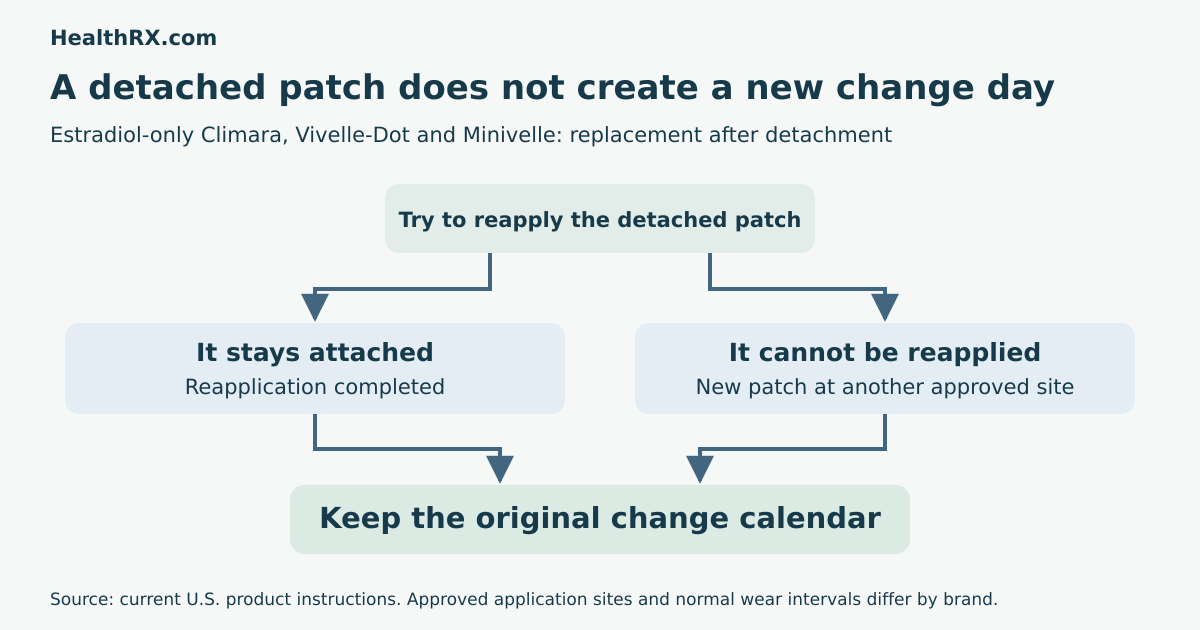
Handling a Detached Patch

If detachment occurred within the past few hours and the patch is intact, the FDA label permits gentle reapplication by pressing the same patch back to a clean, dry site. This is the only scenario in which a previously worn patch may be used again. If detachment occurred more than a few hours ago, or if the reservoir appears damaged, apply a new patch and reset the schedule.

HealthRX Detachment Decision Framework:

  • Detached <2 hours ago, patch intact: reapply same patch to a new site, keep original schedule
  • Detached 2-12 hours ago, patch intact: clinical judgment call; reapplying is reasonable, but monitor for symptom return
  • Detached >12 hours ago OR patch damaged: apply new patch, reset schedule to today
  • Cannot locate patch: apply new patch immediately, reset schedule

How the Estradiol Patch Works: Mechanism of Action

Understanding the mechanism clarifies why missed doses have the consequences they do. Estradiol is a steroid hormone that acts through two nuclear receptors, estrogen receptor alpha (ER-alpha) and estrogen receptor beta (ER-beta), expressed in the hypothalamus, uterus, breast, bone, liver, and vascular endothelium [3].

Receptor Binding and Gene Transcription

Once estradiol diffuses from the patch through the skin and into the bloodstream, it crosses cell membranes (being lipophilic) and binds estrogen receptors in target tissues. The estradiol-receptor complex translocates to the nucleus, dimerizes, and binds to estrogen response elements on DNA, initiating transcription of genes that regulate thermoregulation, bone resorption, vaginal epithelial integrity, and cardiovascular function [3].

This genomic pathway is relatively slow, operating over hours to days. But estradiol also activates non-genomic signaling via membrane-associated receptors, producing rapid effects on vascular tone and nitric oxide synthesis within minutes [7]. Both pathways depend on sustained estradiol availability. Neither pathway stores meaningful amounts of estradiol for later release once serum levels fall.

Transdermal vs. Oral: Why the Delivery Route Matters

Oral estradiol undergoes extensive first-pass hepatic metabolism, converting much of the absorbed dose to estrone and estrone sulfate. Hepatic exposure stimulates synthesis of sex hormone-binding globulin (SHBG), C-reactive protein, and clotting factors including factor VII and fibrinogen [2].

Transdermal estradiol bypasses the liver on first pass. A 2010 observational study (N=92,829 women, E3N cohort) found that transdermal estradiol did not significantly increase venous thromboembolism (VTE) risk, while oral estradiol was associated with a roughly 2-fold increased risk (adjusted odds ratio 1.9, 95% CI 1.3-2.7, P<0.001) [2]. This pharmacokinetic distinction is one reason clinical guidelines from The Menopause Society (formerly NAMS) preferentially discuss transdermal routes for women with VTE risk factors.

Vasomotor Symptom Relief: The Evidence Base

The WHI Estrogen-Alone trial (JAMA 2004, N=10,739 hysterectomized women, mean age 63.6 years) demonstrated that conjugated equine estrogens 0.625 mg/day reduced vasomotor symptom scores compared to placebo, while also showing a reduced risk of breast cancer (hazard ratio 0.77, 95% CI 0.59-1.01) and a non-significant trend toward reduced coronary heart disease events in the 50-59 age group [5]. The WHI data remain the most cited long-term evidence base for postmenopausal estrogen therapy, even though the formulation studied was oral rather than transdermal.

For transdermal-specific efficacy, a 2017 Cochrane review of 24 trials (N=3,511) confirmed that transdermal estradiol at doses of 0.025 mg/day and higher significantly reduced hot flash frequency compared to placebo, with a standardized mean difference of -0.79 (95% CI -1.05 to -0.54) [8].


Timing, Scheduling, and Practical Adherence Strategies

Adherence to patch schedules runs approximately 75-85% in real-world studies of transdermal HRT, with the most common failure being forgetting the change day rather than detachment [9]. Simple behavioral strategies close most of that gap.

Choosing a Change Day That Sticks

Anchor the change day to an existing weekly routine. Sunday evening after a shower works well for weekly patches, because the skin is clean and dry. For twice-weekly patches, choose two days with exactly three or four days between them, such as Sunday and Wednesday, rather than days that are harder to remember.

Shower before applying the patch, but wait until the skin is completely dry (typically 5 minutes). Water and residual soap reduce adhesive contact surface area by a measurable amount, increasing detachment risk during the first hour of wear.

Digital Reminders and Patch Journals

A phone alarm set for the same time on change days reduces missed doses more reliably than any other single intervention in adherence literature. A brief symptom journal (rating hot flashes 0-10 each morning) helps patients and providers identify whether breakthrough symptoms cluster around the end of a wear period, which signals that the current dose may be insufficient rather than that the patient is non-adherent.

Site Rotation and Skin Care

Rotate among at least four distinct skin sites to avoid local skin sensitization and tachyphylaxis of the adhesive. Sites on the lower abdomen and upper buttocks offer the most consistent absorption because subcutaneous fat thickness is relatively uniform there compared to the upper arm or thigh.

Avoid applying any lotion, oil, sunscreen, or powder to the intended application site for at least 30 minutes before patch application. These products create a hydrophobic barrier that reduces estradiol flux through the stratum corneum.


Safety Considerations Relevant to Missed Doses and Restart After a Gap

A single missed dose carries low acute risk for most patients. Gaps of several days to weeks, whether from intentional discontinuation or supply issues, require more careful management.

Endometrial Protection and Progestogen Timing

Women with an intact uterus require a progestogen alongside estradiol to protect the endometrium from unopposed estrogen-driven hyperplasia. Missing estradiol doses does not reduce the requirement for progestogen, and the progestogen schedule should continue uninterrupted regardless of estradiol gaps. Restarting estradiol after a gap of more than one missed dose cycle does not require re-titration in most cases, but providers should confirm the patient has not developed new contraindications (new breast mass, unexplained vaginal bleeding, new thrombotic event) before restarting [4].

Cardiovascular and VTE Risk: Timing Hypothesis

The "timing hypothesis" in menopause medicine holds that estrogen initiated within 10 years of menopause or before age 60 confers a more favorable cardiovascular risk profile than estrogen started later [10]. This hypothesis, supported by a 2022 reanalysis of WHI data and multiple observational datasets, does not apply specifically to missed doses, but it is relevant context: patients who experience prolonged gaps in therapy after age 60 should not resume without a provider consultation that reassesses their current cardiovascular risk.

When to Call Your Provider After a Missed Dose

Call your prescriber if you experience any of the following after applying a replacement patch:

  • Chest pain, shortness of breath, or leg swelling (possible VTE)
  • Severe headache or visual changes (possible hypertensive emergency)
  • Unusual vaginal bleeding not explained by your progestogen schedule
  • Skin reaction at the application site that is spreading or blistering

Routine breakthrough vasomotor symptoms after a single missed dose do not require urgent evaluation. They resolve within 12 to 24 hours of restarting therapy in most patients.


Dose Forms, Brands, and Choosing the Right Patch

Not all estradiol patches are interchangeable in a strict pharmacokinetic sense, though they deliver the same molecule. The distinction lies in the patch architecture.

Reservoir vs. Matrix Patches

Older reservoir-design patches (most are now discontinued) contained liquid estradiol in a membrane-controlled pouch. Modern matrix patches (Vivelle-Dot, Minivelle, Climara) disperse estradiol throughout a polymer adhesive layer. Matrix patches have lower rates of leakage and are thinner and more flexible, which contributes to better adhesion and fewer detachment events. If a patient is experiencing repeated detachment with one brand, switching to another matrix formulation at the same nominal dose is a reasonable first step before escalating dose.

Generic Substitution

The FDA's determination of bioequivalence for transdermal patches requires demonstration of equivalent pharmacokinetic parameters (AUC and Cmax), not just equivalent label dose [4]. Switching from a brand-name to a generic patch at the same labeled dose is generally appropriate, but patients who notice symptom changes after a formulary switch should have serum estradiol checked 2 to 3 weeks into the new formulation to confirm comparable exposure.


Frequently asked questions

What should I do if I forget to change my estradiol patch?
Apply a new patch as soon as you remember. Use a fresh patch on a clean, dry skin site on the lower abdomen or buttocks. Reset your change schedule to today's date and update any reminders. Do not apply two patches to make up for the missed dose.
Can I reapply an estradiol patch that fell off?
If the patch detached less than 2 hours ago and the adhesive and reservoir are intact, you can press it back onto a new, clean, dry site and keep your original schedule. If it has been more than 2 hours, or if the patch is damaged or visibly depleted, apply a new patch and reset your schedule.
How long before symptoms return after a missed estradiol patch dose?
Serum estradiol falls to near-menopausal baseline within 24 hours of patch removal. Women who are highly symptomatic may notice breakthrough hot flashes or night sweats within 12 to 48 hours of a missed dose, depending on the formulation and their individual sensitivity.
Is it safe to apply two patches if I missed a dose?
No. Applying two patches doubles the delivery rate to approximately twice your prescribed dose. That can cause breast tenderness, nausea, headache, and fluid retention. It is not supported by any clinical guideline and is specifically discouraged in prescribing information.
How does the estradiol patch work?
The patch maintains a drug concentration gradient between the patch matrix and the outer skin layers, driving passive diffusion of estradiol through the stratum corneum and into dermal capillaries. Estradiol then binds estrogen receptors in target tissues, including the hypothalamus, bone, and vascular endothelium, to produce its therapeutic effects.
Why is the transdermal route preferred over oral estradiol for some patients?
Transdermal estradiol bypasses first-pass liver metabolism, so it does not significantly raise SHBG, clotting factors, or C-reactive protein the way oral estradiol does. The E3N cohort study (N=92,829) found oral estradiol was associated with roughly twice the VTE risk of transdermal estradiol.
How often do I change the Climara patch versus Vivelle-Dot?
Climara is a once-weekly patch changed on the same day each week. Vivelle-Dot and Minivelle are twice-weekly patches changed on two set days per week, typically 3 to 4 days apart, such as Sunday and Wednesday or Monday and Thursday.
Where should I apply the estradiol patch?
Apply to clean, dry skin on the lower abdomen or upper buttocks, below the waistline. Avoid the breasts, broken or irritated skin, and any site used in the previous application cycle. Rotate among at least four sites to reduce local skin reactions.
Can lotions or oils affect how well the estradiol patch works?
Yes. Lotions, oils, sunscreen, and powder applied to the skin site reduce adhesion and can create a barrier that slows estradiol diffusion through the stratum corneum. Wait at least 30 minutes after showering and do not apply any skin product to the intended site before patch application.
Do I need to adjust my [progesterone](/labs-progesterone/what-it-measures) dose after a missed estradiol patch dose?
No. Women with an intact uterus should continue their progestogen on its regular schedule regardless of any estradiol missed doses. Progestogen protects the endometrium from unopposed estrogen, and that protection should remain continuous.
What is the estradiol patch used for?
The estradiol transdermal patch is FDA-approved for treatment of moderate-to-severe vasomotor symptoms of menopause (hot flashes, night sweats), vulvovaginal atrophy, and prevention of postmenopausal osteoporosis in certain formulations. Off-label uses under physician supervision include gender-affirming hormone therapy and premature ovarian insufficiency.
How do I know if my estradiol dose is too low after switching brands?
Track your symptoms daily for the first 2 to 3 weeks after a brand switch. If breakthrough vasomotor symptoms increase compared to your previous formulation at the same labeled dose, ask your provider to check a serum estradiol level 2 to 3 weeks into the new brand to confirm equivalent absorption.
Is it safe to restart estradiol after stopping for several weeks?
For most patients, restarting at the previously effective dose is appropriate after a brief gap. Gaps of several weeks or longer warrant a provider consultation to reassess for new contraindications, including new breast findings, unexplained vaginal bleeding, or a new thrombotic event, before resuming therapy.

References

  1. Kuhl H. Pharmacology of estrogens and progestogens: influence of different routes of administration. Climacteric. 2005;8(Suppl 1):3-63. https://pubmed.ncbi.nlm.nih.gov/16112947/

  2. Canonico M, Oger E, Plu-Bureau G, et al. Hormone therapy and venous thromboembolism among postmenopausal women: impact of the route of estrogen administration and progestogens. The ESTHER Study. Circulation. 2007;115(7):840-845. https://pubmed.ncbi.nlm.nih.gov/17309934/

  3. Gruber CJ, Tschugguel W, Schneeberger C, Huber JC. Production and actions of estrogens. N Engl J Med. 2002;346(5):340-352. https://www.nejm.org/doi/full/10.1056/NEJMra000471

  4. U.S. Food and Drug Administration. Climara (estradiol transdermal system) prescribing information. https://www.accessdata.fda.gov/drugsatfda_docs/label/2014/019921s042lbl.pdf

  5. Anderson GL, Limacher M, Assaf AR, et al. Effects of conjugated equine estrogen in postmenopausal women with hysterectomy: the Women's Health Initiative randomized controlled trial. JAMA. 2004;291(14):1701-1712. https://pubmed.ncbi.nlm.nih.gov/15082697/

  6. Rosen AS, Snabes MC, Singer FR, et al. Adhesion of Vivelle-Dot estradiol transdermal system compared with Climara in postmenopausal women. Menopause. 2004;11(3):337-342. https://pubmed.ncbi.nlm.nih.gov/15167314/

  7. Levin ER. Membrane oestrogen receptor alpha signalling to cell functions. J Physiol. 2009;587(21):5019-5023. https://pubmed.ncbi.nlm.nih.gov/19687127/

  8. Marjoribanks J, Farquhar C, Roberts H, Lethaby A, Lee J. Long-term hormone therapy for perimenopausal and postmenopausal women. Cochrane Database Syst Rev. 2017;1:CD004143. https://pubmed.ncbi.nlm.nih.gov/28093732/

  9. Bhavnani BR, Stanczyk FZ. Pharmacology of conjugated equine estrogens: efficacy, safety and mechanism of action. J Steroid Biochem Mol Biol. 2014;142:16-29. https://pubmed.ncbi.nlm.nih.gov/24176790/

  10. Manson JE, Aragaki AK, Rossouw JE, et al. Menopausal hormone therapy and long-term all-cause and cause-specific mortality: the Women's Health Initiative randomized trials. JAMA. 2017;318(10):927-938. https://pubmed.ncbi.nlm.nih.gov/28898378/