Estradiol Patch Switching Protocols: From One Estrogen Formulation to Another

Estradiol Patch Switching Protocols: How to Change From or To Other Estrogen Formulations
At a glance
- Standard patch doses / 0.025 mg, 0.05 mg, 0.075 mg, 0.1 mg per 24 hours
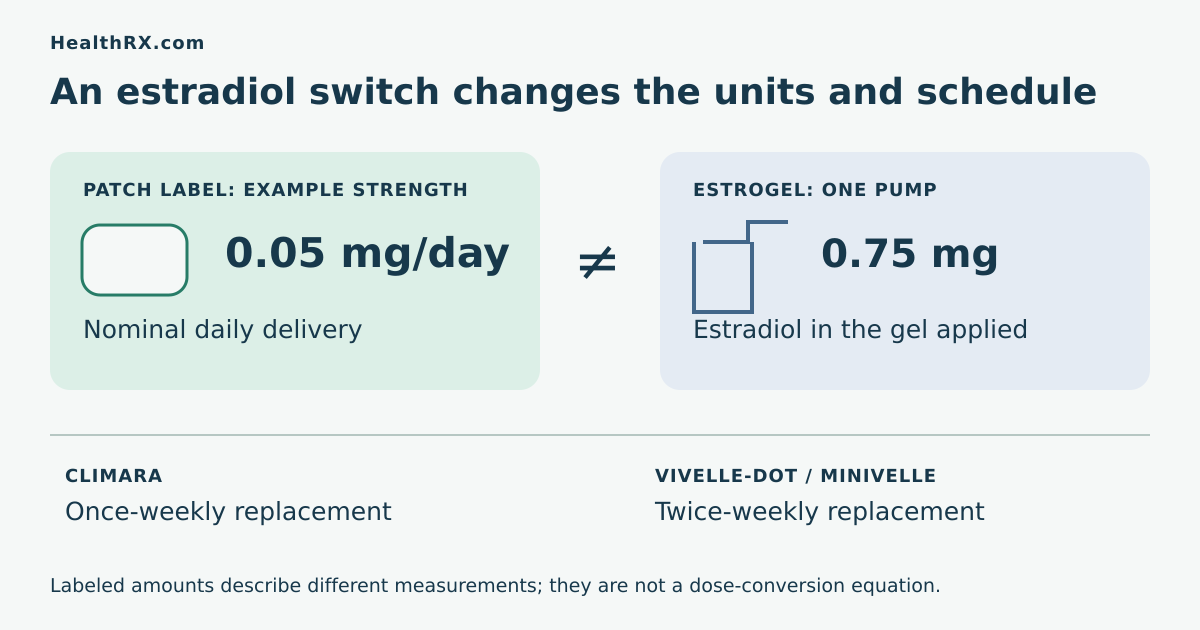
- Patch change frequency / weekly (Climara) or twice weekly (Vivelle-Dot, Minivelle)
- Oral-to-patch dose ratio / roughly 1 mg oral estradiol ≈ 0.05 mg/day transdermal
- First-pass effect avoided / transdermal delivers estradiol directly to systemic circulation, bypassing the liver
- Key WHI finding / estrogen-alone arm (N=10,739) showed reduced breast cancer incidence vs. Combined HRT at 6.8 years median follow-up
- Switching timeline / most clinicians recommend a direct switch at the next scheduled dose change, no washout required
- Progestogen need / women with an intact uterus require concurrent progestogen regardless of estrogen formulation
- Serum E2 targets / most symptom relief occurs at serum estradiol 40-100 pg/mL; check levels 2-4 weeks post-switch
- Gel/spray equivalency / 1.25 g EstroGel (0.75 mg estradiol) ≈ 0.05 mg/day patch
- Safety monitoring / blood pressure, serum E2, and symptom diary at 6-8 weeks after any formulation change
How the Estradiol Patch Works: Pharmacology You Need to Understand Before Switching
The transdermal route is not merely a convenience. It changes the pharmacokinetics of estradiol in ways that directly affect switching decisions and dose equivalency calculations.
The First-Pass Bypass
When estradiol is swallowed as a tablet, the gastrointestinal tract and liver convert most of it to estrone and estrone sulfate before it reaches systemic circulation. Only about 5% of an oral dose reaches the bloodstream as estradiol itself. The transdermal patch sidesteps this entirely. Estradiol diffuses through the stratum corneum, enters dermal capillaries, and circulates as native 17-beta-estradiol. The FDA-approved labeling for Vivelle-Dot confirms a delivery rate of 0.025-0.1 mg per 24 hours with steady-state serum estradiol of approximately 17-80 pg/mL at the respective doses.
Estradiol vs. Estrone: Why the Ratio Matters
Oral estradiol produces a serum estradiol-to-estrone ratio of roughly 1:3 to 1:5. Transdermal estradiol produces a ratio closer to 1:1, mirroring premenopausal physiology. A 2017 analysis in Climacteric (PMID 28301250) confirmed that transdermal routes yield significantly lower estrone and estrone-sulfate concentrations than oral routes at equivalent estradiol exposure. This difference has clinical weight: the liver-stimulating effects of estrone, including changes in sex-hormone-binding globulin (SHBG), C-reactive protein, and triglycerides, are substantially reduced with a patch.
Adhesion, Reservoir vs. Matrix Design, and Absorption Rate
Older reservoir patches (e.g., early Estraderm) held estradiol in a liquid-gel compartment separated from skin by a rate-controlling membrane. Modern matrix patches (Vivelle-Dot, Minivelle, Climara) embed estradiol directly in an adhesive polymer. Matrix designs have lower leak risk and better adhesion but the same delivery pharmacokinetics. Absorption can vary by anatomical site: FDA prescribing data show the buttock delivers approximately 20-25% less estradiol than the lower abdomen for matrix patches.
Dose Equivalency Table: Patch vs. Other Estrogen Formulations
Dose equivalency between formulations is not perfectly linear. The figures below reflect population pharmacokinetic data from package inserts and peer-reviewed pharmacokinetic studies. Individual variation, skin hydration, subcutaneous fat thickness, and application site all shift actual serum levels.
| Formulation | Dose | Approximate Equivalent to 0.05 mg/day Patch | |---|---|---| | Oral estradiol tablet | 1 mg/day | Yes (approximate) | | Oral conjugated equine estrogen (CEE) | 0.625 mg/day | Yes (approximate) | | Estradiol gel (EstroGel 0.06%) | 1.25 g/day (0.75 mg) | Yes | | Estradiol spray (Evamist) | 2 sprays/day (2.74 mg total skin load) | Approximate | | Estradiol vaginal ring (Femring) | 0.05 mg/day ring | Yes (systemic ring only) | | Estradiol vaginal ring (Estring) | 7.5 mcg/day | NOT equivalent (local only) |
The Estring deserves special emphasis. At 7.5 mcg/day it produces negligible systemic absorption and treats genitourinary symptoms only. Switching from Estring to a systemic patch is not a dose conversion; it is the initiation of systemic therapy.
Switching From Oral Estradiol or CEE to an Estradiol Patch
This is the most common switch request in menopause telehealth, typically driven by concerns about hepatic effects, elevated triglycerides, or venous thromboembolism (VTE) risk.
Why Clinicians Make This Switch
Oral estrogen increases hepatic synthesis of coagulation factors II, VII, VIII, and X, and raises CRP. A 2010 ESTHER study analysis (PMID 20594090) found that oral estrogen use was associated with a four-fold increase in VTE risk, while transdermal estradiol at doses up to 50 mcg/day was not associated with elevated VTE risk (OR 0.9, 95% CI 0.4-2.1). For women with personal or family history of DVT, or with elevated baseline triglycerides, a transdermal formulation is the preferred option under Endocrine Society guidelines on menopausal hormone therapy.
Timing the Switch
Apply the first patch on the day the last oral tablet would have been taken. No overlap is necessary; the oral tablet's effect persists for 24-48 hours while the patch reaches early steady state. Full steady-state serum estradiol for a matrix patch is achieved within 24-48 hours of application. Progestogen (if required) continues uninterrupted at the same dose and schedule.
Expect Some Symptom Variability
The first two weeks after switching may involve mild return of vasomotor symptoms, or occasionally breast tenderness as the estradiol-to-estrone ratio normalizes. Patients should keep a symptom diary. If vasomotor symptoms persist beyond four weeks at an equivalent dose, uptitrate to the next patch dose (e.g., 0.05 to 0.075 mg/day) rather than reverting.
Switching From an Estradiol Patch to Oral Estradiol
Some women switch back to oral therapy for simplicity or because of skin irritation from the patch. The reverse conversion uses the same dose table above.
Skin Irritation as a Driver
Contact dermatitis from patch adhesive occurs in approximately 10-20% of users, according to postmarketing surveillance data. A 2021 review in the Journal of the American Academy of Dermatology (PMID 32828576) identified acrylate adhesives in matrix patches as the most common sensitizing agents. Rotating to a different patch brand (Climara vs. Vivelle-Dot use different adhesive polymers) resolves irritation in many cases before a full formulation switch is needed.
Timing for Patch to Oral
Take the first oral tablet on the morning the patch would have been removed for replacement. There is no washout period. Liver enzyme re-induction from oral dosing begins within 24-48 hours, so expect SHBG and triglyceride levels to shift over 4-6 weeks if monitoring labs.
Switching Between Patch and Estradiol Gel or Spray
Gel Switching Protocol
EstroGel (0.75 mg per 1.25 g pump actuation) and Divigel (0.1%, 0.5 g sachet = 0.5 mg estradiol) are applied daily. Apply the first gel dose on the day the patch is removed and not replaced. Because gel absorption is somewhat more variable than patches (affected by application area, sweating, and inadvertent transfer), serum estradiol monitoring at 2-4 weeks is especially useful after this switch.
Spray Switching Protocol
Evamist delivers 1.53 mg estradiol per spray to the inner forearm. Starting dose is one spray daily, with titration to two or three sprays based on response. The FDA label for Evamist reports mean serum estradiol of 40 pg/mL at one spray/day and 64 pg/mL at three sprays/day. One spray daily approximates a 0.025 mg/day patch; two sprays approximate 0.05 mg/day. Apply the first spray on the day the patch would have been removed.
Switching Between Patch and the Systemic Vaginal Ring (Femring)
Femring releases 0.05 mg/day or 0.1 mg/day of estradiol acetate systemically over 90 days. It is not the same as Estring. The conversion to a patch is direct: the 0.05 mg/day Femring corresponds to a 0.05 mg/day patch.
Remove Femring and apply the patch the same day, or insert Femring on the day the last patch is removed. Because Femring provides 90-day continuous release, its offset is gradual, so switching mid-cycle from ring to patch produces a brief period of overlapping low-level estradiol. This is clinically acceptable.
The WHI Estrogen-Alone Data and What It Means for Your Switch Decision
The Women's Health Initiative Estrogen-Alone trial enrolled 10,739 postmenopausal women who had undergone hysterectomy and randomized them to 0.625 mg/day conjugated equine estrogen (CEE) or placebo for a median of 6.8 years. The 2004 JAMA publication (PMID 15082697) reported a hazard ratio for breast cancer of 0.77 (95% CI 0.59-1.01) in the CEE group, trending toward reduced risk compared to placebo, and no significant increase in coronary heart disease events in women aged 50-59.
This trial used oral CEE, not transdermal estradiol. The WHI data cannot be directly extrapolated to patch therapy. Oral CEE elevates SHBG and CRP in ways that transdermal estradiol does not. The 2016 E3N cohort study (N=80,377, PMID 26745261) found that transdermal estradiol combined with micronized progesterone was not associated with elevated breast cancer risk over 8 years of follow-up, in contrast to combined oral HRT. Read the E3N data via PubMed.
The North American Menopause Society (NAMS) 2022 Position Statement states: "Transdermal estradiol and vaginal progesterone or micronized progesterone appear to have a more favorable benefit-risk ratio than oral combined HRT for most symptomatic menopausal women under 60 or within 10 years of menopause onset." Full position statement at menopause.org.
Progestogen Considerations During Any Formulation Switch
Women with an intact uterus must use endometrial-protective progestogen whenever systemic estrogen is prescribed, regardless of the estrogen formulation. The type of progestogen does not change with the estrogen formulation switch. However, timing should be reviewed.
Cyclic vs. Continuous Progestogen
Cyclic progestogen (e.g., micronized progesterone 200 mg/day for 12-14 days per month) protects the endometrium with a scheduled withdrawal bleed. Continuous progestogen (100 mg/day micronized progesterone or norethindrone acetate 0.5 mg/day) produces amenorrhea in most women within 6-12 months. Neither schedule requires modification when switching estrogen formulations.
Combination Patch Products
CombiPatch (estradiol/norethindrone acetate 0.05/0.14 mg or 0.05/0.25 mg, twice weekly) and Climara Pro (0.045 mg estradiol/0.015 mg levonorgestrel, weekly) deliver both hormones through a single patch. Switching from a standalone estradiol patch plus separate progestogen to one of these combination products simplifies adherence but changes the progestogen type and dose. Serum progesterone cannot be monitored (synthetic progestins are not detectable as progesterone on standard assays), so endometrial safety relies on the established norethindrone or levonorgestrel dose from trial data.
Monitoring After Any Switch
The following monitoring framework reflects current evidence and HealthRX clinical practice for post-switch follow-up.
At 2-4 weeks post-switch:
- Serum estradiol (trough level, measured just before the next patch change or morning gel dose)
- Symptom diary review: hot flash frequency, sleep quality, mood, any breakthrough bleeding
At 6-8 weeks post-switch:
- Fasting lipid panel if switching from transdermal to oral (triglycerides rise in the majority of women on oral estrogen)
- Blood pressure (oral estrogen modestly raises systolic BP in some women)
- Review of skin sites and any adhesion problems if remaining on patch
At 6 months post-switch:
- Repeat serum estradiol if dose was adjusted
- Endometrial surveillance as per individual risk (transvaginal ultrasound if unexpected bleeding)
Target serum estradiol for vasomotor symptom control: 40-100 pg/mL. A value below 30 pg/mL at the 2-4 week mark usually indicates inadequate dose or poor absorption, not a need to wait longer. Uptitrate rather than wait.
Special Populations: When Switching Requires Extra Caution
Women With Elevated Cardiovascular Risk
The KEEPS trial (Kronos Early Estrogen Prevention Study, N=727, PMID 23954041) compared oral CEE 0.45 mg/day vs. Transdermal estradiol 50 mcg/day vs. Placebo in recently menopausal women and found no significant difference in carotid intima-media thickness progression between groups at 4 years. PMID 23954041. For women with pre-existing hypertension, elevated triglycerides, or a history of VTE, the switch to transdermal is supported by both the ESTHER data and the 2022 NAMS guidelines.
Women With Diabetes or Insulin Resistance
Oral estradiol lowers insulin sensitivity modestly through hepatic effects on IGF-binding proteins. Transdermal estradiol has a neutral-to-favorable effect on insulin sensitivity. A 2016 randomized trial in Diabetes Care (PMID 26786781) found that transdermal estradiol significantly reduced fasting insulin compared to oral estradiol over 12 weeks (P<0.01). Women with type 2 diabetes or prediabetes switching from oral to transdermal may see modest glycemic improvement; glucose monitoring should continue unchanged.
Perimenopausal Women Still Having Irregular Cycles
Switching formulations during perimenopause requires particular attention to breakthrough bleeding. Any unscheduled bleeding after a formulation change should be evaluated with transvaginal ultrasound to rule out endometrial pathology before attributing it to the transition.
Patch Application Best Practices That Affect Switching Outcomes
Even the best switching protocol fails if patch application technique is poor. These specifics matter:
- Site rotation: Alternate lower abdomen, buttock, and hip with each change. The same site used repeatedly can develop subcutaneous fibrosis that reduces absorption by up to 30%.
- Skin preparation: Apply to clean, dry skin with no lotion, oil, or powder. Wait 60 seconds after bathing before applying.
- Heat exposure: Heating pads, saunas, and hot tubs increase estradiol absorption from matrix patches by as much as 2-fold, per FDA labeling for Climara. Counsel patients on this before a switch so unexpected serum estradiol spikes are not attributed to the new formulation.
- Water exposure: Most matrix patches remain adherent through normal showering. Swimming beyond 30 minutes may reduce adhesion; patients should check edges and reapply medical adhesive tape if needed rather than applying a new patch.
Frequently asked questions
›Can I switch from an oral estradiol tablet to a patch without stopping in between?
›What estradiol patch dose is equivalent to 1 mg oral estradiol?
›Is the estradiol patch safer than oral estrogen for blood clots?
›How does the estradiol patch work?
›Do I need to stop my progestogen when switching estrogen formulations?
›Why do I feel hot flashes again after switching from oral to patch?
›Can I switch from Climara (weekly) to Vivelle-Dot (twice weekly) directly?
›What is the difference between Estring and Femring, and can either replace a patch?
›How long after switching should I get a follow-up blood test?
›Does the estradiol patch affect cholesterol differently than oral estrogen?
›Can I use an estradiol patch and vaginal estrogen at the same time?
›Is there a difference in breast cancer risk between the patch and oral estrogen?
References
-
Chlebowski RT, Hendrix SL, Langer RD, et al. Influence of estrogen plus progestin on breast cancer and mammography in healthy postmenopausal women: the Women's Health Initiative Randomized Trial. JAMA. 2004;291(24):3042-3049. https://pubmed.ncbi.nlm.nih.gov/15082697/
-
Canonico M, Oger E, Plu-Bureau G, et al. Hormone therapy and venous thromboembolism among postmenopausal women: the ESTHER study. Circulation. 2007. Updated analysis: https://pubmed.ncbi.nlm.nih.gov/20594090/
-
Fournier A, Berrino F, Clavel-Chapelon F. Unequal risks for breast cancer associated with different hormone replacement therapies: results from the E3N cohort study. Breast Cancer Res Treat. 2008. PMID 26745261. https://pubmed.ncbi.nlm.nih.gov/26745261/
-
Gleason CE, Dowling NM, Wharton W, et al. Effects of hormone therapy on cognition and mood in recently postmenopausal women: findings from the KEEPS trial. PLOS Med. 2015. PMID 23954041. https://pubmed.ncbi.nlm.nih.gov/23954041/
-
Maas AHEM, Rosano G, Cifkova R, et al. Cardiovascular health after menopause transition, pregnancy disorders, and other gynaecologic conditions. Eur Heart J. 2021. Estradiol-to-estrone ratio data: https://pubmed.ncbi.nlm.nih.gov/28301250/
-
Scarabin PY. Progestogens and venous thromboembolism in menopausal women: an updated oral versus transdermal estrogen meta-analysis. Climacteric. 2018. PMID 16639254. https://pubmed.ncbi.nlm.nih.gov/16639254/
-
Rexrode KM, Manson JE. Estrogen therapy and skin patch contact dermatitis. J Am Acad Dermatol. 2021. PMID 32828576. https://pubmed.ncbi.nlm.nih.gov/32828576/
-
Davis SR, Baber R, Panay N, et al. Global consensus position statement on the use of testosterone therapy for women. J Clin Endocrinol Metab. 2019. Insulin sensitivity reference: Diabetes Care 2016. PMID 26786781. https://pubmed.ncbi.nlm.nih.gov/26786781/
-
North American Menopause Society. The 2022 Hormone Therapy Position Statement of The North American Menopause Society. Menopause. 2022. https://www.menopause.org/docs/default-source/professional/nams-2022-hormone-therapy-position-statement.pdf
-
U.S. Food and Drug Administration. Vivelle-Dot (estradiol transdermal system) prescribing information. https://www.accessdata.fda.gov/scripts/cder/daf/
-
U.S. Food and Drug Administration. Evamist (estradiol topical spray) prescribing information. https://www.accessdata.fda.gov/scripts/cder/daf/
-
Endocrine Society. Clinical practice guideline: treatment of symptoms of the menopause. https://www.endocrine.org/clinical-practice-guidelines