Zetia Food & Supplement Interactions: What to Eat, Avoid, and Time Carefully

Clinical medical image for ezetimibe: Zetia Food & Supplement Interactions: What to Eat, Avoid, and Time Carefully

At a glance

  • Standard dose / 10 mg oral tablet once daily
  • LDL-C reduction / 18 to 20% as monotherapy; up to 25% added to a statin
  • Mechanism target / NPC1L1 cholesterol transporter in small-intestinal brush border
  • Food effect / no clinically significant change in AUC with a high-fat meal
  • Key interaction / cholestyramine reduces ezetimibe AUC by ~55%; separate doses by 4 hours
  • Fiber timing / large psyllium doses taken simultaneously may blunt absorption; take ezetimibe 30 to 60 minutes before fiber
  • Plant sterols / additive LDL lowering when timed correctly; no pharmacokinetic antagonism if not taken simultaneously
  • Fish oil (EPA/DHA) / no pharmacokinetic interaction; may be combined freely
  • Red yeast rice / pharmacodynamic overlap with statin-like monacolins; monitor for myopathy
  • Key trial / IMPROVE-IT (N=18,144) showed 6.4% relative MACE reduction adding ezetimibe to simvastatin post-ACS

How Ezetimibe Works: The NPC1L1 Mechanism

Ezetimibe selectively inhibits NPC1L1, a sterol transporter embedded in the apical membrane of enterocytes lining the small intestine. By blocking NPC1L1, ezetimibe reduces the transfer of both dietary and biliary cholesterol from the intestinal lumen into the enterocyte, cutting cholesterol delivery to the liver by roughly 50% [1]. The liver responds by upregulating LDL receptors, which clears circulating LDL particles from the bloodstream.

Why the Gut Location Matters for Interactions

Because ezetimibe works entirely at the intestinal brush border before systemic absorption matters much, anything that physically traps the drug in the gut or competes for the same absorption window can reduce its effect. This is the core reason food-and-supplement timing rules exist for this drug.

Pharmacokinetics in Brief

After oral dosing, ezetimibe is rapidly glucuronidated to ezetimibe-glucuronide, the active enterohepatic-cycling form. Peak plasma concentrations (Tmax) occur at 1 to 2 hours for ezetimibe and 4 to 12 hours for ezetimibe-glucuronide [2]. The long effective half-life of approximately 22 hours means once-daily dosing works regardless of time of day, and a single delayed or missed dose does not create a rebound cholesterol spike.

A high-fat meal increases the Cmax of ezetimibe by roughly 38% but does not change overall AUC, and this magnitude of Cmax shift is not considered clinically significant per the FDA prescribing information [2]. Patients can take ezetimibe with or without food.

Does Food Affect Ezetimibe Absorption?

No clinically meaningful food effect on ezetimibe efficacy has been established. The FDA-approved labeling states that ezetimibe may be taken with or without food, and pharmacokinetic studies confirm that total drug exposure (AUC) is unchanged regardless of meal composition [2].

High-Fat Meals

A crossover pharmacokinetic study showed that a high-fat meal raised ezetimibe Cmax by approximately 38% without changing AUC [2]. This Cmax elevation does not translate into greater LDL lowering or increased adverse effects. Patients on atorvastatin-ezetimibe combination therapy can take the pill at any meal without adjusting expectations.

Grapefruit Juice

Grapefruit juice inhibits CYP3A4 and several intestinal transporters. Ezetimibe is not metabolized by CYP3A4; its primary pathway is UGT1A3-mediated glucuronidation. No documented pharmacokinetic interaction between grapefruit juice and ezetimibe exists in the published literature [3]. Patients who take a statin alongside ezetimibe should still check statin-specific grapefruit restrictions (lovastatin and simvastatin carry significant grapefruit warnings; atorvastatin carries a minor one).

Alcohol

No direct pharmacokinetic interaction between moderate alcohol intake and ezetimibe has been reported. Heavy alcohol use raises triglycerides and may worsen the hepatic lipid profile that ezetimibe is prescribed to improve, but that is a metabolic effect, not a drug interaction.

Bile-Acid Sequestrants: The Most Important Interaction

Taking ezetimibe at the same time as a bile-acid sequestrant (cholestyramine, colestipol, colesevelam) is the one food-and-supplement-adjacent interaction that carries a formal FDA warning. Cholestyramine reduces the AUC of ezetimibe by approximately 55% [2].

Mechanism of the Interaction

Bile-acid sequestrants are nonabsorbable resins that bind bile acids and a wide range of drugs and lipids in the intestinal lumen. Ezetimibe and its glucuronide undergo enterohepatic cycling, meaning the drug is secreted into bile, returned to the intestine, and reabsorbed. Cholestyramine traps ezetimibe in the resin matrix, preventing that reabsorption and cutting total exposure nearly in half [4].

Clinical Guidance on Timing

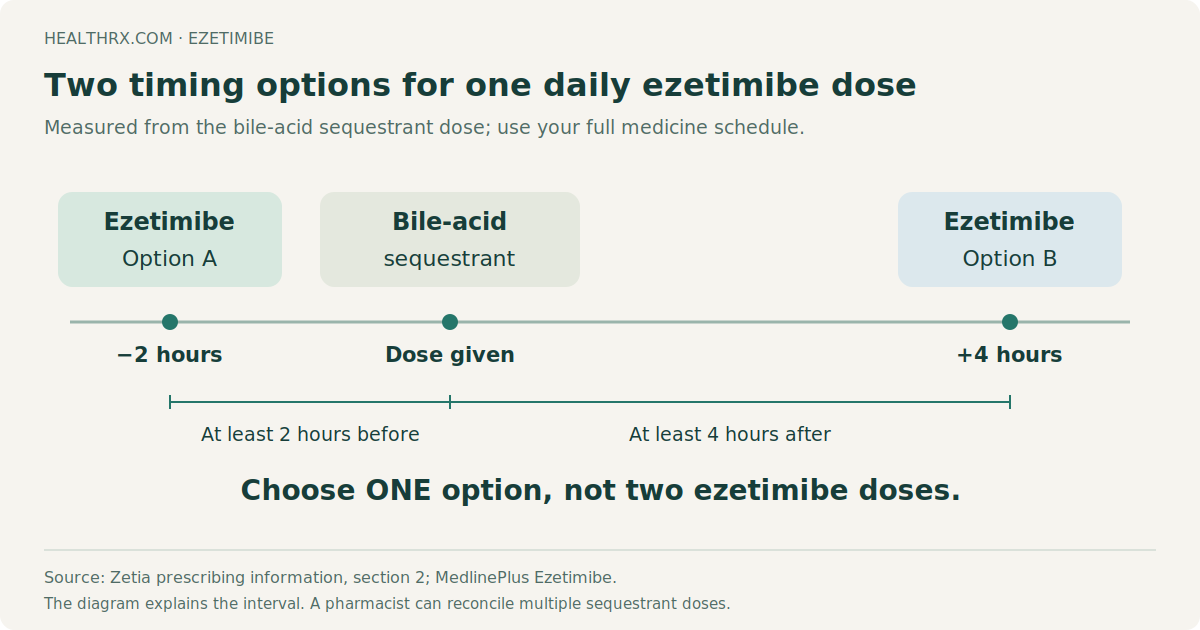
The FDA label specifies that ezetimibe should be taken either 2 hours before or 4 hours after a bile-acid sequestrant [2]. In practice, most clinicians prefer the "2 hours before" rule because morning statin-plus-ezetimibe dosing is already well established, and cholestyramine is often taken with meals.

Colesevelam (Welchol) has a different binding profile than cholestyramine and has not shown the same degree of ezetimibe trapping in available data, but formal separation is still prudent given the mechanistic overlap [4].

Soluble Fiber and Psyllium Supplements

Soluble fiber (psyllium, beta-glucan, pectin) lowers LDL-C through a bile-acid-binding mechanism similar in principle to cholestyramine, though far less potent. A meta-analysis of 28 trials found psyllium supplementation reduced LDL-C by a mean of 5.0 mg/dL [5]. When psyllium is taken simultaneously with ezetimibe, the viscous gel formed in the intestinal lumen may physically limit drug-enterocyte contact.

Evidence for Fiber-Ezetimibe Timing

No dedicated pharmacokinetic trial has examined psyllium-ezetimibe coadministration at therapeutic psyllium doses (10 to 15 g/day). The interaction is inferred from psyllium's documented binding of other drugs (digoxin, lithium, warfarin) and from the structural similarity of the interaction mechanism to bile-acid sequestrant binding [6]. Given the low risk of separating doses and the potential for a clinically meaningful reduction in ezetimibe AUC, the pragmatic recommendation is to take ezetimibe 30 to 60 minutes before a psyllium supplement or a fiber-heavy meal.

Additive LDL-Lowering When Timed Correctly

Psyllium and ezetimibe work by complementary mechanisms. Psyllium reduces bile acid reabsorption, stimulating hepatic conversion of cholesterol to new bile acids. Ezetimibe reduces intestinal cholesterol uptake directly. When timed correctly (ezetimibe first, psyllium second), the combination may produce additive LDL reduction of 25 to 30% beyond diet alone.

Plant Sterols and Stanols

Plant sterols (phytosterols) compete with cholesterol for intestinal absorption at the NPC1L1 and related transporters, reducing LDL-C by 8 to 10% at doses of 2 g/day [7]. Because plant sterols and ezetimibe act at overlapping but not identical sites in the enterocyte uptake pathway, the theoretical concern is that high phytosterol concentrations could occupy NPC1L1 and displace ezetimibe's binding.

What the Data Show

A randomized crossover trial (N=30) found that the combination of ezetimibe 10 mg plus plant sterols 2 g/day reduced LDL-C by 27%, compared with 17% for ezetimibe alone and 9% for plant sterols alone, suggesting additive rather than antagonistic effects [8]. The combination is safe and appears to be complementary when the two are not taken in exactly the same swallow.

Practical Recommendation

Take ezetimibe at least 30 minutes before consuming a plant-sterol-enriched food (fortified margarine, sterol-enriched orange juice, supplements). This separation preserves NPC1L1 occupancy by ezetimibe before the sterol bolus arrives.

Fish Oil (Omega-3 Fatty Acids)

Fish oil (EPA and DHA) at doses of 2 to 4 g/day primarily lowers triglycerides (by 20 to 30% at 4 g/day) through reduced hepatic VLDL production, a mechanism entirely separate from NPC1L1 [9]. No pharmacokinetic interaction between fish oil and ezetimibe has been identified.

Combination Therapy Evidence

The REDUCE-IT trial (N=8,179) demonstrated that icosapentaenoic acid (EPA) 4 g/day reduced major cardiovascular events by 25% in statin-treated patients with elevated triglycerides [9]. Although REDUCE-IT did not specifically study ezetimibe co-administration, the pharmacodynamic profiles are complementary: ezetimibe targets LDL-C, and high-dose EPA targets residual triglyceride-driven risk.

Patients can combine ezetimibe with prescription omega-3 preparations (icosapentaenoic acid, omega-3-acid ethyl esters) or over-the-counter fish oil without dose separation or monitoring beyond a routine lipid panel.

Red Yeast Rice

Red yeast rice (RYR) contains monacolins, naturally occurring compounds that include monacolin K, which is chemically identical to lovastatin [10]. Taking RYR alongside ezetimibe creates pharmacodynamic overlap with a statin, not a pharmacokinetic interaction with ezetimibe itself.

Myopathy Risk

Because monacolin K inhibits HMG-CoA reductase, the combination of RYR plus ezetimibe effectively replicates a low-dose statin plus ezetimibe regimen, with all the associated myopathy risk but without the quality-control standards of pharmaceutical manufacturing. RYR products vary widely in monacolin content, from 0.1 mg to more than 10 mg per capsule [10]. Patients who report muscle pain while on ezetimibe and RYR should have creatine kinase measured.

FDA Position

The FDA has stated that RYR products containing more than trace amounts of monacolin K are unapproved drugs and cannot be legally marketed as dietary supplements in the United States [10]. Clinicians prescribing ezetimibe should ask about RYR use specifically, as patients often do not disclose supplement use unprompted.

Coenzyme Q10 (CoQ10)

CoQ10 supplementation is widely used by patients on lipid-lowering therapy, particularly those with statin-associated muscle symptoms. Ezetimibe does not inhibit HMG-CoA reductase and does not reduce CoQ10 synthesis. No pharmacokinetic interaction between CoQ10 and ezetimibe has been reported, and no clinical trial has shown that CoQ10 alters ezetimibe's LDL-lowering efficacy [11].

CoQ10 may be taken at any time relative to ezetimibe without concern for interaction.

Berberine

Berberine, a plant alkaloid taken for blood glucose and lipid management, lowers LDL-C by approximately 20 to 25% through PCSK9 inhibition and LDL-receptor upregulation, a mechanism distinct from NPC1L1 blockade [12]. Berberine inhibits CYP3A4 and P-glycoprotein, but ezetimibe is not a significant substrate of either pathway.

The combination of berberine and ezetimibe is pharmacodynamically additive in small trials, but no large randomized controlled trial has established the safety and efficacy of this combination at scale [12]. Patients taking berberine with ezetimibe should have LDL-C monitored at 6 to 8 weeks to assess additive response.

Niacin (Nicotinic Acid)

Extended-release niacin (niacin ER) at doses of 1 to 2 g/day reduces LDL-C by 15 to 20% and raises HDL-C by 15 to 35%, complementing ezetimibe's LDL reduction. No pharmacokinetic interaction between niacin and ezetimibe has been documented.

The AIM-HIGH trial (N=3,414) found that adding niacin ER to simvastatin-ezetimibe combination therapy did not reduce cardiovascular events further despite favorable lipid changes, suggesting that the LDL-reducing combination of simvastatin plus ezetimibe already captured most achievable benefit in that population [13]. This finding does not prohibit niacin-ezetimibe co-use but does temper expectations for additive clinical benefit.

Ezetimibe and the IMPROVE-IT Trial: Clinical Context

The cardiovascular evidence for ezetimibe rests on the IMPROVE-IT trial, published in the New England Journal of Medicine in 2015. IMPROVE-IT enrolled 18,144 patients within 10 days of an acute coronary syndrome and randomized them to simvastatin 40 mg plus ezetimibe 10 mg versus simvastatin 40 mg alone [14].

Over a median follow-up of 6 years, the combination arm achieved a mean LDL-C of 53.7 mg/dL versus 69.5 mg/dL in the monotherapy arm. The primary composite endpoint (cardiovascular death, major coronary event, or stroke) occurred in 32.7% of the combination group versus 34.7% of the simvastatin-alone group, a 6.4% relative risk reduction (P<0.016) [14].

The ACC/AHA 2018 cholesterol guideline states: "In patients with clinical ASCVD, if LDL-C remains 70 mg/dL or higher on maximally tolerated statin therapy, it is reasonable to add ezetimibe" [15]. This formal guideline endorsement makes ezetimibe the first add-on agent recommended before considering PCSK9 inhibitors.

Practical Dosing Schedule: Combining Ezetimibe With Common Supplements

The table below integrates the interaction data above into a morning-to-evening timing guide for the most common supplement combinations.

| Time | Agent | Rationale | |------|-------|-----------| | 7:00 AM | Ezetimibe 10 mg | Empty or light-breakfast state; 30-min lead before fiber | | 7:30 AM | Psyllium 5 to 10 g in water | Separated from ezetimibe to preserve NPC1L1 access | | With breakfast | Fish oil / EPA capsules | No separation needed | | With breakfast | CoQ10 100 to 200 mg | No interaction; fat-soluble, best with food | | 12:00 PM (if prescribed) | Bile-acid sequestrant | Minimum 2 h after or 4 h before ezetimibe | | Evening | Berberine (if used) | Separate pharmacodynamic pathway; monitor LDL-C | | Evening | Plant-sterol-enriched foods | Any time 60+ min after ezetimibe |

Note: If the patient takes a statin in the evening (e.g., rosuvastatin, simvastatin), ezetimibe may be moved to evening as well without compromising efficacy. Bile-acid sequestrant timing rules apply regardless of when ezetimibe is shifted.

Monitoring After Starting Ezetimibe With Supplements

A fasting lipid panel should be checked 6 to 8 weeks after initiating ezetimibe to confirm target LDL-C reduction. If the observed LDL-C drop is less than 15% from baseline, clinicians should review the medication record for concurrent bile-acid sequestrant use, high-dose fiber supplements, or undisclosed RYR use, each of which can blunt the expected response.

Liver Function Testing

Ezetimibe does not require routine liver function monitoring per the FDA label. The IMPROVE-IT trial found no significant difference in hepatic adverse events between the simvastatin-ezetimibe and simvastatin-alone groups across 6 years [14]. Liver enzymes should be rechecked if the patient reports new right-upper-quadrant discomfort or if heavy alcohol use begins.

Creatine Kinase

Ezetimibe alone does not cause myopathy. When combined with a statin or with RYR, the myopathy risk tracks with the statin component. A baseline CK is reasonable before adding ezetimibe to a high-intensity statin in a patient already reporting muscle fatigue.

Frequently asked questions

Can I take ezetimibe with food?
Yes. A high-fat meal raises ezetimibe peak concentration (Cmax) by about 38% but does not change total drug exposure (AUC), so the LDL-lowering effect is unchanged. Take it with or without food, whichever improves adherence.
Does grapefruit juice interact with ezetimibe?
No documented interaction exists. Ezetimibe is glucuronidated, not metabolized by CYP3A4, which is the enzyme that grapefruit juice inhibits. Grapefruit restrictions apply to lovastatin and simvastatin, not ezetimibe.
How far apart should I take ezetimibe and cholestyramine?
Take ezetimibe at least 2 hours before or 4 hours after cholestyramine. Cholestyramine reduces ezetimibe AUC by approximately 55%, which can substantially reduce LDL-lowering efficacy.
Can I take fish oil with ezetimibe?
Yes, freely. Fish oil and ezetimibe work by different mechanisms and have no pharmacokinetic interaction. Fish oil primarily lowers triglycerides; ezetimibe primarily lowers LDL-C. The combination is safe and complementary.
Does red yeast rice interact with ezetimibe?
Not pharmacokinetically, but red yeast rice contains monacolin K, which is chemically identical to lovastatin. Taking it with ezetimibe replicates an unregulated low-dose statin plus ezetimibe regimen, with myopathy risk and variable potency. Ask your doctor before combining them.
Should I separate ezetimibe and psyllium fiber?
A 30-to-60-minute gap is prudent. Psyllium forms a viscous gel that may physically limit ezetimibe's contact with intestinal NPC1L1 receptors. Take ezetimibe first, then psyllium with a full glass of water.
Can plant sterols be combined with ezetimibe?
Yes, with timing. A randomized trial (N=30) found ezetimibe plus 2 g/day plant sterols reduced LDL-C by 27%, versus 17% for ezetimibe alone. Take ezetimibe at least 30 minutes before plant-sterol-enriched foods to maximize efficacy.
What time of day should I take ezetimibe?
Any time of day works. Unlike some statins (which have modest circadian advantages taken at night), ezetimibe's 22-hour effective half-life means the clock does not affect LDL lowering. Pick a time that you will remember consistently.
How does ezetimibe work differently from statins?
Statins inhibit HMG-CoA reductase in the liver, reducing the liver's own cholesterol synthesis. Ezetimibe blocks NPC1L1 in the small intestine, reducing how much dietary and biliary cholesterol enters the body. The mechanisms are complementary, which is why their combination produces additive LDL reduction.
Is CoQ10 supplementation needed with ezetimibe?
No. Ezetimibe does not inhibit HMG-CoA reductase and does not lower CoQ10 synthesis. CoQ10 depletion is a statin-related concern, not an ezetimibe concern. Taking CoQ10 does no harm but is not mechanistically indicated for ezetimibe alone.
What was the IMPROVE-IT trial and why does it matter?
IMPROVE-IT (N=18,144) was a landmark trial published in NEJM in 2015. It showed that adding ezetimibe 10 mg to simvastatin 40 mg after an acute coronary syndrome reduced the composite cardiovascular endpoint by 6.4% relative to simvastatin alone over 6 years. It was the first trial to prove that lowering LDL below 70 mg/dL with a non-statin agent translates into fewer cardiovascular events.
Can I take berberine and ezetimibe together?
The combination is pharmacodynamically additive in small studies, and no pharmacokinetic interaction has been identified. Berberine inhibits CYP3A4 and P-glycoprotein, but ezetimibe is not a significant substrate of either. Get a lipid panel 6 to 8 weeks after combining them to confirm the added LDL response.
Does alcohol interact with ezetimibe?
No direct pharmacokinetic interaction between moderate alcohol and ezetimibe is documented. Heavy alcohol use worsens the lipid profile (especially triglycerides) that ezetimibe is meant to address, so limiting alcohol supports the treatment goal, but it does not change how ezetimibe is absorbed or metabolized.

References

  1. Altmann SW, Davis HR Jr, Zhu LJ, et al. Niemann-Pick C1 Like 1 protein is critical for intestinal cholesterol absorption. Science. 2004;303(5661):1201-1204. https://pubmed.ncbi.nlm.nih.gov/14976318/
  2. U.S. Food and Drug Administration. Zetia (ezetimibe) prescribing information. Revised 2022. https://www.accessdata.fda.gov/drugsatfda_docs/label/2022/021445s038lbl.pdf
  3. Kosoglou T, Statkevich P, Johnson-Levonas AO, et al. Ezetimibe: a review of its metabolism, pharmacokinetics and drug interactions. Clin Pharmacokinet. 2005;44(5):467-494. https://pubmed.ncbi.nlm.nih.gov/15871631/
  4. Zhu Y, Liao HL. Applications of red yeast rice to the biology of cardiovascular diseases. Curr Atheroscler Rep. 2016;18(7):39. https://pubmed.ncbi.nlm.nih.gov/27216533/
  5. Gibb RD, McRorie JW Jr, Russell DA, Hasselblad V, D'Alessio DA. Psyllium fiber improves glycemic control proportional to loss of glycemic control: a meta-analysis of data in euglycemic subjects, patients at risk of type 2 diabetes mellitus, and patients being treated for type 2 diabetes mellitus. Am J Clin Nutr. 2015;102(6):1604-1614. https://pubmed.ncbi.nlm.nih.gov/26561625/
  6. Moreyra AE, Wilson AC, Koraym A. Effect of combining psyllium fiber with simvastatin in lowering cholesterol. Arch Intern Med. 2005;165(10):1161-1166. https://pubmed.ncbi.nlm.nih.gov/15911731/
  7. Demonty I, Ras RT, van der Knaap HC, et al. Continuous dose-response relationship of the LDL-cholesterol-lowering effect of phytosterol intake. J Nutr. 2009;139(2):271-284. https://pubmed.ncbi.nlm.nih.gov/19091798/
  8. Kassis AN, Jones PJ. Combination of plant sterols and ezetimibe reduces LDL cholesterol in a dose-additive manner. Atherosclerosis. 2006;188(2):425-432. https://pubmed.ncbi.nlm.nih.gov/16375903/
  9. Bhatt DL, Steg PG, Miller M, et al. Cardiovascular risk reduction with icosapentaenoic acid for hypertriglyceridemia. N Engl J Med. 2019;380(1):11-22. https://pubmed.ncbi.nlm.nih.gov/30415628/
  10. U.S. Food and Drug Administration. FDA advises consumers to avoid red yeast rice products promoted to lower cholesterol. 2022. https://www.fda.gov/food/dietary-supplement-products-ingredients/red-yeast-rice
  11. Bhagavan HN, Chopra RK. Coenzyme Q10: absorption, tissue uptake, metabolism and pharmacokinetics. Free Radic Res. 2006;40(5):445-453. https://pubmed.ncbi.nlm.nih.gov/16551570/
  12. Cicero AF, Baggioni A. Berberine and its role in chronic disease. Adv Exp Med Biol. 2016;928:27-45. https://pubmed.ncbi.nlm.nih.gov/27671816/
  13. AIM-HIGH Investigators; Boden WE, Probstfield JL, Anderson T, et al. Niacin in patients with low HDL cholesterol levels receiving intensive statin therapy. N Engl J Med. 2011;365(24):2255-2267. https://pubmed.ncbi.nlm.nih.gov/22085343/
  14. Cannon CP, Blazing MA, Giugliano RP, et al. Ezetimibe added to statin therapy after acute coronary syndromes. N Engl J Med. 2015;372(25):2387-2397. https://pubmed.ncbi.nlm.nih.gov/26039521/
  15. Grundy SM, Stone NJ, Bailey AL, et al. 2018 AHA/ACC guideline on the management of blood cholesterol. J Am Coll Cardiol. 2019;73(24):e285-e350. https://pubmed.ncbi.nlm.nih.gov/30423393/