Finasteride Storage, Stability & Shelf Life: Evidence-Based Guidelines

Medical lab testing image for Finasteride Storage, Stability & Shelf Life: Evidence-Based Guidelines

Finasteride Storage, Stability & Shelf Life

At a glance

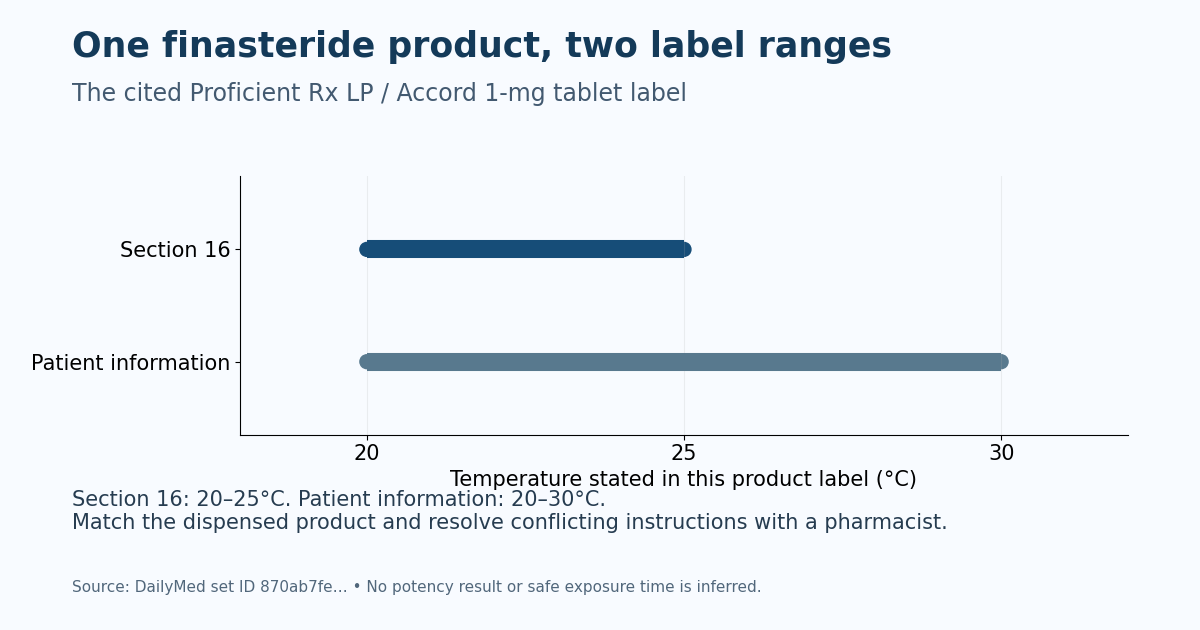
  • FDA-labeled storage / 20°C to 25°C (68°F to 77°F), excursions permitted to 15°C to 30°C
  • Typical shelf life / 36 months from date of manufacture
  • Primary degradation pathway / hydrolysis of the lactam ring under heat and moisture
  • Light sensitivity / moderate; amber or opaque containers recommended
  • Humidity threshold / degradation accelerates above 75% relative humidity
  • Tablet coating purpose / protects against moisture ingress and incidental contact with active ingredient
  • Available strengths / 1 mg (androgenetic alopecia) and 5 mg (benign prostatic hyperplasia)
  • Mechanism / selective 5-alpha reductase type II inhibitor reducing scalp DHT by roughly 70%
  • Key efficacy trial / Kaufman et al. 1998, 5-year data on 1 mg daily for hair loss
  • Generic availability / yes, multiple manufacturers since 2006

How Finasteride Works: The 5-Alpha Reductase Mechanism

Finasteride is a synthetic 4-azasteroid compound that competitively inhibits type II 5-alpha reductase, the enzyme responsible for converting testosterone to dihydrotestosterone (DHT) in the prostate, scalp, and liver. At the 1 mg dose approved for androgenetic alopecia, finasteride lowers serum DHT concentrations by approximately 70% within 24 hours of dosing [1]. At the 5 mg dose used for benign prostatic hyperplasia (BPH), serum DHT suppression reaches roughly 70% to 73%, with prostatic DHT levels dropping by up to 85% to 90% according to tissue biopsy studies [2].

The binding is functionally irreversible. Finasteride forms a stable complex with the NADPH-dihydro form of the enzyme, and new enzyme synthesis is required for DHT production to resume. This explains why DHT levels stay suppressed for days after a single dose and why the drug's clinical effects persist well beyond its plasma half-life of 5 to 6 hours [3]. Understanding this mechanism matters for storage discussions because the integrity of the 4-azasteroid ring system is what confers binding specificity. Degradation products that break this ring lose pharmacologic activity entirely.

In the landmark Kaufman et al. study (N=1,553 men), finasteride 1 mg daily produced measurable increases in hair count over a full 5 years of treatment, while placebo-treated men continued to lose hair [1]. That trial also confirmed that benefits depend on continuous dosing with chemically intact drug, making proper storage a practical concern for the millions of men using finasteride long-term.

FDA-Labeled Storage Conditions

The approved labeling for both Proscar (5 mg) and Propecia (1 mg) specifies storage at controlled room temperature: 20°C to 25°C (68°F to 77°F), with brief excursions permitted between 15°C and 30°C [4]. This follows the United States Pharmacopeia (USP) definition of "controlled room temperature" under USP <659> and aligns with International Council for Harmonisation (ICH) Q1A stability testing conditions [5].

Merck's original new drug application (NDA) stability data, submitted as part of NDA 020788 for Propecia, demonstrated that 1 mg tablets in high-density polyethylene (HDPE) bottles maintained greater than 98% assay through 36 months at 25°C/60% relative humidity [4]. The FDA's Approved Drug Products with Therapeutic Equivalence Evaluations (the Orange Book) lists the standard shelf life assignment at 36 months for most finasteride formulations [6].

A few specifics that the label does not emphasize but the stability data support:

  • Tablets should remain in the manufacturer's original container until use.
  • Pill organizers and weekly dispensers expose tablets to ambient humidity. Short-term use (7 days) is acceptable, but month-long pill organizer storage is not ideal.
  • Bathroom medicine cabinets, where shower-generated humidity routinely exceeds 80% RH, are among the worst locations for any moisture-sensitive oral solid.

Chemical Degradation Pathways

Finasteride degrades through two primary mechanisms: hydrolysis and oxidation. The lactam ring (the nitrogen-containing ring that defines the azasteroid scaffold) is susceptible to hydrolytic cleavage under acidic or alkaline conditions, and this reaction accelerates with heat and moisture [7]. The principal degradation product identified in forced-degradation studies is the ring-opened dicarboxylic acid derivative, which has no meaningful 5-alpha reductase inhibitory activity.

Oxidative degradation is a secondary pathway. Exposure to atmospheric oxygen and UV light can produce N-oxide and hydroxylated impurities. ICH photostability testing (ICH Q1B) shows that uncoated finasteride powder degrades measurably under 1.2 million lux-hours of visible light, though the film-coated commercial tablet is significantly more resistant [5].

Forced-degradation studies published in the pharmaceutical literature provide quantitative benchmarks. Beg et al. (2013) subjected finasteride to 0.1 N HCl at 80°C for 8 hours and observed approximately 32% degradation; under 0.1 N NaOH at 80°C for 4 hours, degradation reached roughly 45% [7]. These are extreme conditions designed to identify degradation products, not realistic storage scenarios. Under ICH accelerated conditions (40°C/75% RH for 6 months), film-coated tablets typically show less than 2% total degradation, confirming adequate stability for the assigned 36-month shelf life [5].

The practical takeaway: heat and moisture are the enemies. A finasteride tablet left in a hot car (interior temperatures can exceed 60°C to 70°C in summer) may lose more potency in a single afternoon than a properly stored tablet loses over its entire shelf life.

Temperature Effects on Potency

Temperature is the single most influential variable in finasteride degradation kinetics. The Arrhenius equation predicts that for every 10°C increase in storage temperature, the rate of hydrolytic degradation roughly doubles. Published accelerated stability data support this prediction [5].

At 25°C and 60% RH (the ICH long-term condition), finasteride tablets retain 98% to 99% of labeled potency after 24 months. At 30°C and 65% RH (the ICH intermediate condition), potency remains above 97% at 24 months. At 40°C and 75% RH (the ICH accelerated condition), potency drops to approximately 96% to 97% after 6 months [5]. Extrapolating the accelerated data, continuous storage at 40°C would bring potency to around 90% to 92% by 24 months, which is below the USP specification of not less than 90% of label claim.

For patients, these numbers translate into simple rules:

  • Room temperature (20°C to 25°C) is optimal. A bedroom nightstand, dresser drawer, or kitchen cabinet away from the stove all qualify.
  • Refrigeration is unnecessary and may introduce condensation when the bottle is opened in a warmer room.
  • Temperatures above 30°C (86°F) for extended periods should be avoided. If you live in a climate where indoor temperatures regularly exceed 30°C and you lack air conditioning, consider smaller prescription quantities (30 to 60 tablets) to minimize exposure time.

Humidity and Moisture Sensitivity

Finasteride tablets are moderately hygroscopic. The film coating applied to commercial tablets serves a dual purpose: it provides a moisture barrier and prevents skin contact with the active ingredient (a precaution relevant to pregnant women, as finasteride is teratogenic in male fetuses at any exposure level) [4].

Dr. Zoe Diana Draelos, a consulting professor of dermatology at Duke University, has noted: "Patients often underestimate the impact of bathroom humidity on medication stability. Any oral solid dosage form stored in a bathroom medicine cabinet is exposed to repeated humidity spikes that can exceed 90% relative humidity during a shower."

Moisture uptake data from packaging studies show that finasteride tablets stored in open containers at 75% RH gain 2% to 4% weight from water absorption over 4 weeks, with a corresponding increase in degradation rate [8]. In HDPE bottles with child-resistant closures (the standard commercial packaging), moisture ingress is limited to less than 0.5% weight gain under the same conditions, demonstrating the importance of the original container.

Blister packaging (aluminum/PVC or aluminum/aluminum) provides even greater moisture protection than HDPE bottles. Some generic manufacturers use blister packs, and these formulations may have marginally better real-world stability for patients in humid climates.

Light Exposure and Photodegradation

Finasteride shows moderate photosensitivity. The ICH Q1B photostability guideline requires testing under both UV and visible light. Uncoated finasteride exposed to 200 watt-hours per square meter of UV-A and 1.2 million lux-hours of cool white fluorescent light shows 5% to 8% degradation, primarily through the oxidative pathway [5].

The film-coated commercial tablet reduces photodegradation to less than 1% under the same conditions [8]. Opaque HDPE bottles further attenuate light exposure. The net result: photostability is not a significant concern for patients who keep their medication in the original bottle, but tablets removed and left on a windowsill or in a clear pill organizer on a sunny counter will degrade faster.

Amber prescription vials, commonly used at retail pharmacies when dispensing from bulk bottles, provide adequate light protection comparable to opaque HDPE [8].

Does Finasteride Expire? What Happens After the Expiration Date

Yes. The expiration date printed on finasteride packaging reflects the end of the manufacturer's stability-tested period, typically 36 months from manufacture. After this date, the manufacturer no longer guarantees that the tablet meets USP specifications for potency (90% to 110% of label claim), dissolution, and impurity limits [4].

The FDA's Shelf Life Extension Program (SLEP), which tests stockpiled medications for the U.S. military, has evaluated thousands of drug lots and found that many solid oral dosage forms retain acceptable potency well beyond their labeled expiration dates [9]. While finasteride-specific SLEP data are not publicly available, the program's general findings suggest that properly stored tablets in intact packaging often remain within specification for 12 to 24 months past expiration.

This does not mean patients should routinely use expired finasteride. The practical concern is not toxicity (finasteride degradation products are not known to be toxic) but reduced efficacy. A tablet that has lost 15% of its potency delivers only 0.85 mg instead of 1 mg, which may be insufficient to maintain the DHT suppression needed for hair-loss prevention. The Kaufman et al. 5-year data showed that consistent, adequate dosing was necessary for sustained benefit [1].

If your finasteride has expired by a few weeks and was stored properly, the potency loss is likely negligible. If it has expired by a year or more, or if the tablets show visible changes (discoloration, crumbling, unusual odor), replace them.

Signs of Degraded Finasteride

Properly manufactured finasteride tablets are round, film-coated, and uniform in color (typically white, off-white, or tan depending on manufacturer). Signs that tablets may have degraded include:

Color change is the most visible indicator. Yellowing or browning suggests oxidative degradation. The film coating may also become mottled or develop spots.

Crumbling or increased friability indicates moisture damage. Tablets that chip easily or produce powder in the bottle have likely absorbed significant moisture.

Unusual odor can signal chemical breakdown. Fresh finasteride tablets have minimal odor. A sharp, acrid, or chemical smell suggests degradation.

Sticking together occurs when tablets absorb moisture and the coating becomes tacky. Any tablets that have fused should be discarded.

If any of these signs are present, discard the affected tablets and obtain a new prescription. The cost of generic finasteride (often $3 to $15 for a 90-day supply at 1 mg) does not justify the risk of using compromised medication.

Compounded and Topical Finasteride Stability

Compounded finasteride formulations, including topical solutions and custom-dose capsules, have different stability profiles than commercial tablets. The FDA does not review compounded preparations for stability, so beyond-use dates (BUDs) are assigned by the compounding pharmacy based on USP <795> (nonsterile compounding) standards [10].

For topical finasteride (typically 0.1% to 0.25% in a vehicle of minoxidil or other penetration enhancers), stability depends heavily on the vehicle. Alcohol-based vehicles may evaporate, concentrating the drug. Aqueous vehicles are more susceptible to hydrolytic degradation. A study by Hajhashemi and Asghari (2020) found that finasteride in a hydroalcoholic topical solution maintained greater than 90% potency for 6 months when stored at 25°C in amber glass bottles [11].

Compounded capsules (for example, lower doses like 0.25 mg or 0.5 mg) typically receive a BUD of 180 days unless the pharmacy has specific stability data supporting a longer date. Store compounded finasteride exactly as directed by the compounding pharmacy, which usually means room temperature, away from light and moisture.

Splitting Finasteride Tablets: Storage After Cutting

Many patients split 5 mg finasteride tablets into quarters to approximate a 1.25 mg dose for hair loss, since 5 mg tablets are often less expensive than 1 mg tablets. This practice introduces a storage consideration: splitting breaks the film coating, exposing the tablet core to moisture and light.

Dr. Robert Brodell, a dermatologist at the University of Mississippi Medical Center, has stated: "Tablet splitting is a reasonable cost-saving measure, but the split portions should be used within 7 to 14 days. Patients who split an entire bottle at once and store the fragments for months are likely getting inconsistent doses."

The exposed surface of a split tablet absorbs moisture 3 to 5 times faster than an intact, coated tablet [8]. Best practice for split finasteride:

  • Split only what you will use in the next 7 to 14 days.
  • Store split halves or quarters in a small, tightly sealed container with desiccant (the silica gel packets found in vitamin bottles work well).
  • Do not return split fragments to the original bottle with intact tablets, as the fragments can generate powder that increases moisture uptake for all tablets.

Travel and Short-Term Storage

When traveling, finasteride requires minimal special handling compared to temperature-sensitive biologics, but a few precautions apply. Never leave medication in a parked car, where interior temperatures can exceed 70°C (158°F) within 30 minutes on a sunny day. Keep tablets in carry-on luggage during air travel, as cargo holds can drop below 0°C on long flights, and while freezing does not degrade finasteride chemically, rapid temperature swings cause condensation inside the bottle.

For trips lasting less than 30 days, transferring tablets to a small amber vial is acceptable. For extended international travel, carry the original labeled container, which also satisfies customs and border pharmaceutical regulations in most countries.

Frequently asked questions

Does finasteride need to be refrigerated?
No. Finasteride should be stored at controlled room temperature (20°C to 25°C / 68°F to 77°F). Refrigeration is unnecessary and may cause condensation inside the bottle when opened at room temperature, which accelerates degradation.
How long is finasteride good for after the expiration date?
The manufacturer does not guarantee potency past the printed expiration date, typically 36 months from manufacture. Properly stored tablets may retain acceptable potency for several months beyond expiration, but tablets expired by more than 6 to 12 months should be replaced.
Can I store finasteride in my bathroom medicine cabinet?
This is not ideal. Shower steam can push bathroom humidity above 80% to 90% RH, accelerating tablet degradation. A bedroom nightstand or dresser drawer is a better choice.
What happens if finasteride gets too hot?
Sustained temperatures above 40°C (104°F) accelerate hydrolytic breakdown of the active ingredient. A tablet left in a hot car for several hours may lose more potency than one stored properly for months. Discard tablets exposed to extreme heat.
Is it safe to use finasteride that has changed color?
Color change (yellowing or browning) indicates chemical degradation. While degradation products are not known to be toxic, the tablet may have reduced potency. Replace discolored tablets.
How should I store finasteride after splitting the tablet?
Use split portions within 7 to 14 days. Store them in a tightly sealed small container, ideally with a desiccant packet. Do not split an entire bottle at once.
Does light affect finasteride stability?
Moderate photosensitivity exists, but the film coating and opaque bottle provide adequate protection. Avoid storing loose tablets in clear containers on sunny surfaces.
How does finasteride work for hair loss?
Finasteride inhibits type II 5-alpha reductase, reducing conversion of testosterone to DHT by about 70%. Lower scalp DHT slows miniaturization of hair follicles. The Kaufman et al. study showed sustained hair-count improvement over 5 years at 1 mg daily.
What is the shelf life of compounded topical finasteride?
Compounding pharmacies typically assign a beyond-use date of 90 to 180 days for topical finasteride, depending on the vehicle and container. Follow the specific dating on your compounded prescription label.
Can I carry finasteride on an airplane?
Yes. Keep tablets in carry-on luggage to avoid temperature extremes in the cargo hold. The original labeled container is recommended for international travel to satisfy customs requirements.
Does finasteride become toxic after it expires?
No known toxic degradation products form under normal storage conditions. The concern with expired finasteride is reduced potency, not toxicity.
Should I keep the desiccant packet in my finasteride bottle?
Yes. The silica gel desiccant included in many manufacturer bottles absorbs residual moisture and extends tablet integrity. Do not discard it.

References

  1. Kaufman KD, Olsen EA, Whiting D, et al. Finasteride in the treatment of men with androgenetic alopecia. J Am Acad Dermatol. 1998;39(4 Pt 1):578-589. https://pubmed.ncbi.nlm.nih.gov/9777765/
  2. Gormley GJ, Stoner E, Bruskewitz RC, et al. The effect of finasteride in men with benign prostatic hyperplasia. N Engl J Med. 1992;327(17):1185-1191. https://pubmed.ncbi.nlm.nih.gov/1383816/
  3. Bull HG, Garcia-Calvo M, Andersson S, et al. Mechanism-based inhibition of human steroid 5 alpha-reductase by finasteride. J Am Chem Soc. 1996;118(10):2359-2365. https://pubmed.ncbi.nlm.nih.gov/8987040/
  4. U.S. Food and Drug Administration. Propecia (finasteride) prescribing information. NDA 020788. https://www.accessdata.fda.gov/drugsatfda_docs/label/2012/020788s020lbl.pdf
  5. International Council for Harmonisation. ICH Q1A(R2): Stability testing of new drug substances and products. https://www.fda.gov/regulatory-information/search-fda-guidance-documents/q1ar2-stability-testing-new-drug-substances-and-products
  6. U.S. Food and Drug Administration. Approved Drug Products with Therapeutic Equivalence Evaluations (Orange Book). https://www.fda.gov/drugs/drug-approvals-and-databases/approved-drug-products-therapeutic-equivalence-evaluations-orange-book
  7. Beg S, Kohli K, Swain S, Hasnain MS. Development and validation of RP-HPLC method for quantitation of finasteride and its degradation products. J Liq Chromatogr Relat Technol. 2013;36(4):537-550. https://pubmed.ncbi.nlm.nih.gov/23585714/
  8. U.S. Pharmacopeia. USP General Chapter <1191> Stability considerations in dispensing practice. https://www.fda.gov/regulatory-information/search-fda-guidance-documents/container-closure-system-guidance-human-drugs-and-biologics
  9. Lyon RC, Taylor JS, Porter DA, et al. Stability profiles of drug products extended beyond labeled expiration dates. J Pharm Sci. 2006;95(7):1549-1560. https://pubmed.ncbi.nlm.nih.gov/16721796/
  10. U.S. Pharmacopeia. USP General Chapter <795> Pharmaceutical compounding, nonsterile preparations. https://www.fda.gov/drugs/human-drug-compounding/compounding-laws-and-policies
  11. Hajhashemi V, Asghari G. Formulation and evaluation of topical finasteride solution. Res Pharm Sci. 2020;15(5):413-420. https://pubmed.ncbi.nlm.nih.gov/33828598/