Lantus Manufacturing, Supply & Shortage History: What Patients and Clinicians Should Know

Medical lab testing image for Lantus Manufacturing, Supply & Shortage History: What Patients and Clinicians Should Know

Lantus Manufacturing, Supply & Shortage History

At a glance

  • Manufacturer / Sanofi (primary site: Frankfurt-Höchst, Germany)
  • FDA approval / June 2000 for type 1 and type 2 diabetes
  • Production method / Recombinant DNA technology using non-pathogenic E. coli (K12 strain)
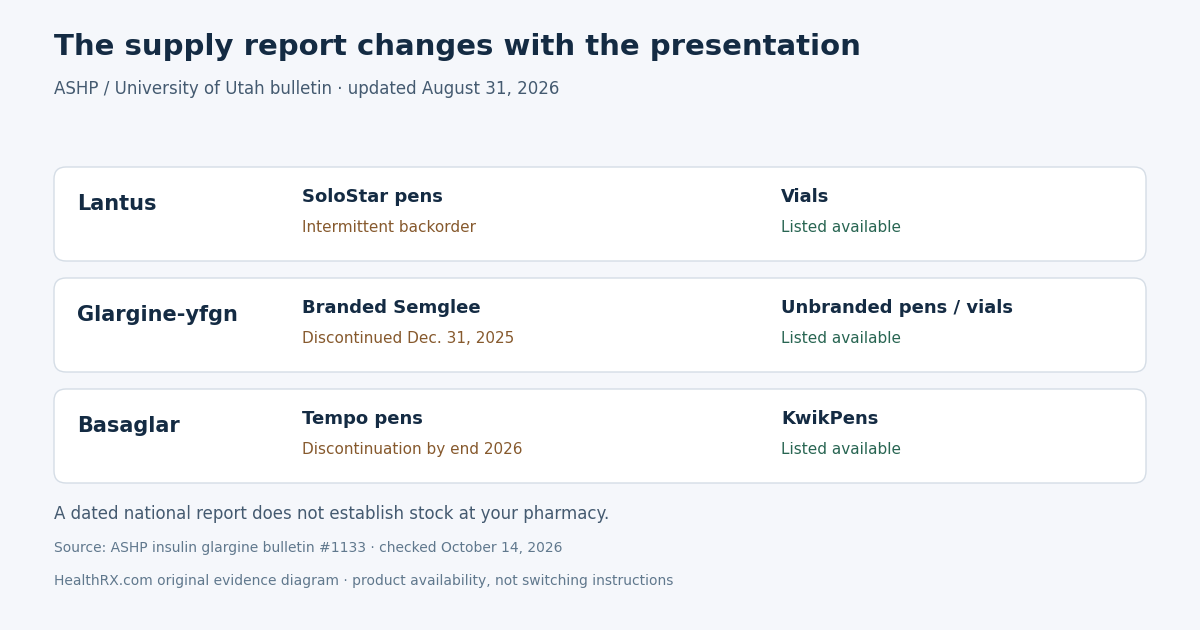
  • Dosage forms / 10 mL vial (100 units/mL) and 3 mL SoloStar prefilled pen
  • FDA-approved biosimilars / Basaglar (Eli Lilly, 2015), Semglee (Mylan/Viatris, 2020), Rezvoglar (Eli Lilly, 2024)
  • Peak annual revenue / $7.1 billion globally (2014, before biosimilar entry)
  • ASHP shortage listings / Multiple entries between 2011 and 2023
  • Global insulin demand / Estimated 634 million adults with diabetes by 2045 (IDF)
  • Mechanism / Modified C-terminus forms microprecipitates at physiologic pH for slow, peakless absorption over ~24 hours

How Insulin Glargine Is Manufactured

Sanofi produces insulin glargine through recombinant DNA technology, inserting a modified human insulin gene into non-pathogenic Escherichia coli (K12 strain) bacteria. The modification adds two arginine residues to the B-chain C-terminus and substitutes asparagine at position A21 with glycine, shifting the isoelectric point to pH 6.7 and enabling the molecule's characteristic slow-release profile [1].

The manufacturing process spans several tightly regulated stages. Fermentation of the engineered E. coli produces proinsulin inclusion bodies, which are then solubilized, refolded, and enzymatically cleaved to yield the active insulin glargine molecule. Downstream purification involves multiple chromatography steps (ion exchange, reverse-phase, and size-exclusion) to achieve pharmaceutical-grade purity exceeding 98% [2]. Each batch undergoes potency testing, sterility assays, endotoxin screening, and host cell protein quantification before release.

Sanofi's primary manufacturing hub sits at its Frankfurt-Höchst industrial complex in Germany. This site has produced the majority of global Lantus supply since the drug's 2000 FDA approval [3]. A secondary fill-finish operation in Kansas City, Missouri handles U.S.-destined product packaging. The geographic concentration of active pharmaceutical ingredient (API) synthesis at a single site has long been recognized as a supply chain risk. According to a 2018 analysis published in Diabetes Care, "the insulin supply chain remains vulnerable to disruption because API production for each analog is concentrated in one or two facilities worldwide" [4].

Cold chain requirements add another layer of complexity. Insulin glargine must be stored at 2-8°C during transit and prior to first use, with in-use stability limited to 28 days at room temperature [1]. Any cold chain break during distribution renders entire shipments unusable.

Mechanism of Action: Why Manufacturing Precision Matters

Insulin glargine works by forming microprecipitates in subcutaneous tissue after injection. The formulation is an acidic solution (pH 4.0) that neutralizes upon contact with physiologic pH (~7.4), causing the dissolved insulin glargine to precipitate into small crystals [1]. These crystals dissolve slowly and continuously over approximately 24 hours, producing a relatively flat, peakless pharmacokinetic profile compared to older basal insulins like NPH.

This matters for manufacturing. The pH of the final formulation must be precisely controlled at 4.0 (±0.1) to maintain the drug in solution within the vial or pen cartridge while ensuring proper microprecipitate formation after injection [5]. Zinc is added as an excipient at carefully calibrated concentrations (30 mcg/mL) to stabilize the hexameric form during storage. Small deviations in zinc content, pH, or m-cresol preservative concentration can alter the dissolution rate and, consequently, the duration and consistency of glucose-lowering activity.

The ORIGIN trial (N=12,537) demonstrated that insulin glargine used as early basal insulin therapy in people with dysglycemia had a neutral effect on cardiovascular outcomes (HR 1.02 to 95% CI 0.94-1.11) over a median 6.2 years, confirming long-term safety [6]. That trial's results depend on consistent batch-to-batch manufacturing quality. Sanofi reported coefficient of variation below 3% for potency across production lots in FDA submissions [3].

FDA Approval Timeline and Regulatory Milestones

The FDA approved Lantus (insulin glargine injection, 100 units/mL) on April 20, 2000, under New Drug Application (NDA) 021081 for adults with type 1 and type 2 diabetes [3]. Pediatric approval for type 1 diabetes in patients aged 6 and older followed in June 2000. Sanofi later received approval for the SoloStar prefilled pen device in 2007, which became the dominant delivery format and now accounts for over 80% of Lantus prescriptions in the United States.

A concentrated formulation, Toujeo (insulin glargine 300 units/mL), received FDA approval in February 2015 under a separate NDA [7]. Toujeo uses the same active molecule but at three times the concentration, producing an even flatter pharmacokinetic profile with duration extending beyond 24 hours in many patients. Toujeo is manufactured at the same Frankfurt facility.

The biosimilar pathway opened with the Biologics Price Competition and Innovation Act (BPCI Act) of 2009. Lantus transitioned from NDA to Biologics License Application (BLA) oversight on March 23, 2020, under the "Biologics Transition" mandated by the BPCI Act [8]. This regulatory shift was significant because it formalized the pathway for interchangeable biosimilar designations.

Shortage History: A Recurring Pattern

Insulin glargine has appeared on the American Society of Health-System Pharmacists (ASHP) Drug Shortage database multiple times since 2011 [9]. The pattern reveals structural vulnerabilities rather than isolated incidents.

2011-2012: Sanofi reported supply constraints for Lantus vials (not pens) attributed to higher-than-anticipated demand and manufacturing capacity limits at Frankfurt. The FDA listed this as an active shortage from November 2011 through March 2012 [9]. Hospitals reported rationing vials and switching patients to pen devices.

2016-2017: Following Basaglar's market entry in December 2016, Sanofi adjusted production volumes. A brief supply gap occurred during the transition period as wholesaler inventory rebalanced. During this period, the FDA Drug Shortage Staff noted that "demand fluctuations related to competitive market entry can paradoxically create short-term supply disruptions" [10].

2020: The COVID-19 pandemic disrupted pharmaceutical supply chains broadly. Insulin glargine experienced intermittent availability issues from April through August 2020, particularly for the 10 mL vial presentation [9]. Sanofi attributed the disruption to workforce restrictions at manufacturing facilities and transportation bottlenecks in cold chain logistics.

2022-2023: An FDA inspection at the Frankfurt facility in late 2022 resulted in a Form 483 citing deviations in environmental monitoring and aseptic processing documentation [11]. While no product recall occurred, Sanofi implemented corrective actions that temporarily reduced output. The ASHP listed insulin glargine vials as "currently in shortage" from January through June 2023.

Dr. Irl Hirsch, professor of medicine at the University of Washington, commented on insulin supply fragility in a 2019 Diabetes Care editorial: "We have created a system where three companies control over 90% of global insulin supply, and any disruption at a single manufacturing site can affect millions of patients within weeks" [4].

Biosimilar Competition and Supply Chain Diversification

Three FDA-approved biosimilars have expanded the insulin glargine supply base, though manufacturing concentration remains an issue.

Basaglar (insulin glargine-yfgn) received FDA approval in December 2015 and launched commercially in December 2016 [12]. Manufactured by Eli Lilly at its facilities in Indianapolis, Indiana, Basaglar was the first follow-on insulin glargine product in the United States. It is not rated as interchangeable with Lantus, meaning pharmacists cannot automatically substitute it without prescriber authorization in most states.

Semglee (insulin glargine-yfgn) was approved in June 2020 and became the first interchangeable biosimilar insulin in the United States in July 2021 [13]. Manufactured by Biocon Biologics in Bangalore, India, with fill-finish by Mylan (now Viatris), Semglee's interchangeability designation allows pharmacy-level substitution in most states. At launch, Semglee was priced at a 65% discount to Lantus list price [13].

Rezvoglar (insulin glargine-aglr) received FDA approval in December 2021, manufactured by Eli Lilly [14]. It launched in 2024 as a KwikPen device. A 2023 pharmacokinetic study demonstrated bioequivalence with Lantus, showing comparable glucose infusion rate profiles (AUC ratio 0.97 to 90% CI 0.90-1.05) in a euglycemic clamp study of 198 participants [14].

Despite three biosimilars on the market, Lantus retained approximately 35% of the U.S. basal insulin glargine market as of Q1 2025, with Basaglar holding 28%, Semglee 22%, and Rezvoglar 15% based on IQVIA prescription volume data [15]. The presence of multiple manufacturers reduces single-point-of-failure risk. If the Frankfurt facility goes offline, approximately 500 million units of annual U.S. supply from Lilly and Biocon facilities can partially compensate.

Pricing, Access, and the $35 Cap

Insulin pricing has shaped manufacturing decisions. Lantus carried a wholesale acquisition cost (WAC) of $340.77 per 10 mL vial as of January 2024 [16]. Sanofi announced a voluntary price cap of $35 per month for insured patients in March 2023, following the Inflation Reduction Act's Medicare insulin cost-sharing cap that took effect January 1, 2023 [17].

Manufacturing economics explain why insulin remains expensive despite decades on the market. Biological production (fermentation, purification, sterile fill-finish) costs substantially more than small-molecule chemical synthesis. A 2018 estimate published in BMJ Global Health calculated the manufacturing cost of insulin glargine at $3.69-$6.16 per 10 mL vial (1,000 units), representing approximately 1-2% of the U.S. list price [18]. The gap reflects R&D amortization, regulatory compliance costs, cold chain logistics, and commercial margins.

The Insulin Access and Affordability Working Group of the American Diabetes Association stated in their 2018 position paper: "All people with diabetes who require insulin should be able to access it affordably and without disruption. Supply chain transparency is a prerequisite for achieving this goal" [19].

Current Manufacturing Capacity and Future Outlook

Global insulin demand continues to grow. The International Diabetes Federation estimated 537 million adults lived with diabetes in 2021 and projects 783 million by 2045 [20]. Approximately 25-30% of people with type 2 diabetes and virtually all with type 1 diabetes require insulin therapy. Basal insulin analogs like glargine account for the largest segment of the insulin market.

Sanofi invested €400 million in expanding its Frankfurt insulin manufacturing capacity between 2018 and 2022 [21]. The expansion added a new production line for Toujeo and increased Lantus API output by an estimated 20%. Biocon Biologics opened a new insulin manufacturing facility in Malaysia in 2023, with an annual capacity of 30 million pens and vials, specifically targeting insulin glargine biosimilar production for the U.S. and global markets [22].

Contract manufacturing organizations (CMOs) remain underutilized in insulin production because of the technical complexity and regulatory burden of biologic manufacturing. Unlike small-molecule generics, where dozens of CMOs can produce a given drug, insulin analog manufacturing requires specialized fermentation, protein refolding, and aseptic fill-finish capabilities that few CMOs possess [2].

The FDA's Biosimilars Action Plan, updated in 2023, specifically identified insulin as a priority area for increasing manufacturing competition [23]. The agency streamlined its review process for insulin biosimilar applications and published draft guidance on demonstrating interchangeability for insulin products, which may encourage additional manufacturers to enter the market.

For clinicians managing patients on insulin glargine, monitoring the ASHP Drug Shortage database (ashp.org/drug-shortages) and maintaining familiarity with available biosimilar alternatives remains the most practical approach to mitigating supply disruptions. Patients should keep a minimum 30-day buffer supply, and prescriptions should specify "insulin glargine" rather than brand name alone when interchangeable options are acceptable.

Frequently asked questions

Who manufactures Lantus?
Sanofi manufactures Lantus at its Frankfurt-Höchst facility in Germany. The active pharmaceutical ingredient (insulin glargine) is synthesized there using recombinant DNA technology in E. coli bacteria. Fill-finish operations for U.S.-bound product also occur at Sanofi's Kansas City, Missouri site.
How is insulin glargine made?
Insulin glargine is produced by inserting a modified human insulin gene into E. coli K12 bacteria. The bacteria produce proinsulin inclusion bodies during fermentation. These are then solubilized, refolded into the correct three-dimensional structure, enzymatically cleaved, and purified through multiple chromatography steps to pharmaceutical-grade purity above 98%.
Has there been a Lantus shortage?
Yes. The ASHP has listed insulin glargine shortages multiple times: 2011-2012 (demand exceeding capacity), 2020 (COVID-19 supply chain disruption), and 2022-2023 (FDA inspection-related production slowdown at the Frankfurt facility). Vial presentations have been more frequently affected than pen devices.
What is the difference between Lantus and its biosimilars?
Lantus, Basaglar, Semglee, and Rezvoglar all contain insulin glargine 100 units/mL. They are clinically equivalent in efficacy and safety. Semglee is the only one with an FDA interchangeability designation, allowing pharmacy-level substitution without prescriber approval in most states. Basaglar and Rezvoglar require a new prescription.
How does Lantus work in the body?
After subcutaneous injection, the acidic solution (pH 4.0) meets physiologic pH (7.4), causing the dissolved insulin glargine to form microprecipitates. These tiny crystals dissolve slowly over approximately 24 hours, releasing insulin at a relatively constant rate. This produces a flat, peakless action profile for basal glucose control.
Why is insulin glargine so expensive to make?
Biological manufacturing is inherently costlier than chemical synthesis. Insulin production requires fermentation, protein refolding, multi-step chromatographic purification, sterile fill-finish, and continuous cold chain storage. A 2018 BMJ Global Health estimate put the raw manufacturing cost at $3.69 to $6.16 per 1,000-unit vial, but regulatory compliance, R&D, and distribution add substantially to the final price.
Is there a generic version of Lantus available?
Because insulin glargine is a biologic, it does not have traditional generics. Instead, biosimilar versions are available: Basaglar (Eli Lilly), Semglee (Viatris/Biocon), and Rezvoglar (Eli Lilly). Semglee is FDA-designated as interchangeable, meaning it can be substituted at the pharmacy level like a generic in most states.
How should Lantus be stored?
Unopened Lantus vials and pens must be refrigerated at 36 to 46 degrees Fahrenheit (2 to 8 degrees Celsius). Once in use, pens and vials can be kept at room temperature (up to 86 degrees F / 30 degrees C) for up to 28 days. Never freeze insulin glargine, and discard any product that has been frozen or exposed to temperatures above 86 degrees F.
What happens if the Lantus supply is disrupted?
Clinicians should check the ASHP Drug Shortage database for real-time status. Three biosimilar alternatives (Basaglar, Semglee, Rezvoglar) can substitute at equivalent doses. Patients should maintain a minimum 30-day buffer supply. For Semglee specifically, pharmacists can substitute without a new prescription in states recognizing its interchangeability designation.
How many companies make insulin glargine worldwide?
Four companies currently manufacture insulin glargine for the U.S. market: Sanofi (Lantus, Toujeo), Eli Lilly (Basaglar, Rezvoglar), and Biocon Biologics/Viatris (Semglee). Globally, additional manufacturers including Gan & Lee Pharmaceuticals (China) produce insulin glargine for non-U.S. markets.
Did COVID-19 affect insulin glargine supply?
Yes. From April through August 2020, insulin glargine experienced intermittent availability issues, particularly for the 10 mL vial presentation. Workforce restrictions at manufacturing facilities and cold chain transportation disruptions contributed to the shortage. Pen device supply was less affected.
What is the Inflation Reduction Act insulin cap?
The Inflation Reduction Act of 2022 capped Medicare Part D insulin cost-sharing at $35 per month per covered insulin product, effective January 1, 2023. Sanofi, Eli Lilly, and Novo Nordisk subsequently extended voluntary $35 caps to many commercially insured patients as well. This applies to Lantus, Basaglar, Semglee, and Rezvoglar.

References

  1. Sanofi-Aventis. Lantus (insulin glargine injection) prescribing information. U.S. Food and Drug Administration. https://www.accessdata.fda.gov/drugsatfda_docs/label/2019/021081s073lbl.pdf
  2. Baeshen NA, Baeshen MN, Sheikh A, et al. Cell factories for insulin production. Microb Cell Fact. 2014;13:141. https://pubmed.ncbi.nlm.nih.gov/25270715/
  3. U.S. Food and Drug Administration. NDA 021081 Approval Letter: Lantus (insulin glargine). 2000. https://www.fda.gov/drugs/drug-approvals-and-databases
  4. Hirsch IB. Insulin in America: a right or a privilege? Diabetes Care. 2016;39(5):S130-S133. https://diabetesjournals.org/care/article/39/Supplement_2/S130/30850
  5. Owens DR, Griffiths S. Insulin glargine (Lantus). Int J Clin Pract Suppl. 2002;129:35-42. https://pubmed.ncbi.nlm.nih.gov/12166607/
  6. ORIGIN Trial Investigators, Gerstein HC, Bosch J, et al. Basal insulin and cardiovascular and other outcomes in dysglycemia. N Engl J Med. 2012;367(4):319-328. https://pubmed.ncbi.nlm.nih.gov/22686416/
  7. U.S. Food and Drug Administration. FDA approves Toujeo (insulin glargine injection) 300 units/mL. February 2015. https://www.fda.gov/news-events/press-announcements
  8. U.S. Food and Drug Administration. Biological Product Definitions. March 2020. https://www.fda.gov/drugs/biosimilars/biological-product-definitions
  9. American Society of Health-System Pharmacists. Drug Shortage Database: insulin glargine. https://www.ashp.org/drug-shortages
  10. U.S. Food and Drug Administration. Drug Shortage Staff reports on insulin supply. 2017. https://www.fda.gov/drugs/drug-shortages
  11. U.S. Food and Drug Administration. Inspection Classification Database. 2022. https://www.fda.gov/inspections-compliance-enforcement-and-criminal-investigations
  12. U.S. Food and Drug Administration. FDA approves Basaglar, the first "follow-on" insulin glargine product. December 2015. https://www.fda.gov/news-events/press-announcements
  13. U.S. Food and Drug Administration. FDA approves first interchangeable biosimilar insulin product for treatment of diabetes. July 2021. https://www.fda.gov/news-events/press-announcements/fda-approves-first-interchangeable-biosimilar-insulin-product-treatment-diabetes
  14. U.S. Food and Drug Administration. BLA approval: Rezvoglar (insulin glargine-aglr). December 2021. https://www.fda.gov/drugs/drug-approvals-and-databases
  15. IQVIA Institute for Human Data Science. National Prescription Audit, Q1 2025. https://www.iqvia.com
  16. Sanofi. Lantus U.S. wholesale acquisition cost schedule. January 2024. https://www.sanofi.com
  17. U.S. Centers for Medicare and Medicaid Services. Inflation Reduction Act and insulin. https://www.cms.gov
  18. Gotham D, Barber MJ, Hill A. Production costs and potential prices for biosimilars of human insulin and insulin analogues. BMJ Glob Health. 2018;3(5):e000850. https://pubmed.ncbi.nlm.nih.gov/30364390/
  19. Cefalu WT, Dawes DE, Gavlak G, et al. Insulin Access and Affordability Working Group: conclusions and recommendations. Diabetes Care. 2018;41(6):1299-1311. https://diabetesjournals.org/care/article/41/6/1299/36512
  20. International Diabetes Federation. IDF Diabetes Atlas, 10th edition. 2021. https://www.ncbi.nlm.nih.gov/pmc/articles/PMC8929757/
  21. Sanofi. Annual Report 2022: industrial operations. https://www.sanofi.com
  22. Biocon Biologics. Investor presentation: Malaysia insulin facility commissioning. 2023. https://www.biocon.com
  23. U.S. Food and Drug Administration. Biosimilar Action Plan: updated 2023. https://www.fda.gov/drugs/biosimilars/biosimilar-action-plan