Adderall XR and Opioids (Oxycodone, Hydrocodone, Tramadol): Interaction Risks, Monitoring, and Clinical Guidance

Adderall XR and Opioids (Oxycodone, Hydrocodone, Tramadol): What Clinicians and Patients Need to Know
At a glance
- Interaction severity / moderate to major depending on the specific opioid
- Mechanism / pharmacodynamic opposition (CNS stimulation vs. Depression) plus CYP2D6 competition with tramadol
- Serotonin syndrome risk / elevated when tramadol is the opioid, due to dual serotonergic activity
- Seizure threshold / tramadol and amphetamines both lower it independently
- Cardiovascular concern / amphetamines raise heart rate and blood pressure; opioids can cause hypotension, creating hemodynamic instability
- Respiratory masking / stimulant-driven tachypnea can hide opioid-induced respiratory depression
- Monitoring minimum / pulse oximetry, heart rate, blood pressure, and mental status checks at each visit
- FDA label warning / both Adderall XR and tramadol labels flag serotonin syndrome risk with serotonergic co-administration
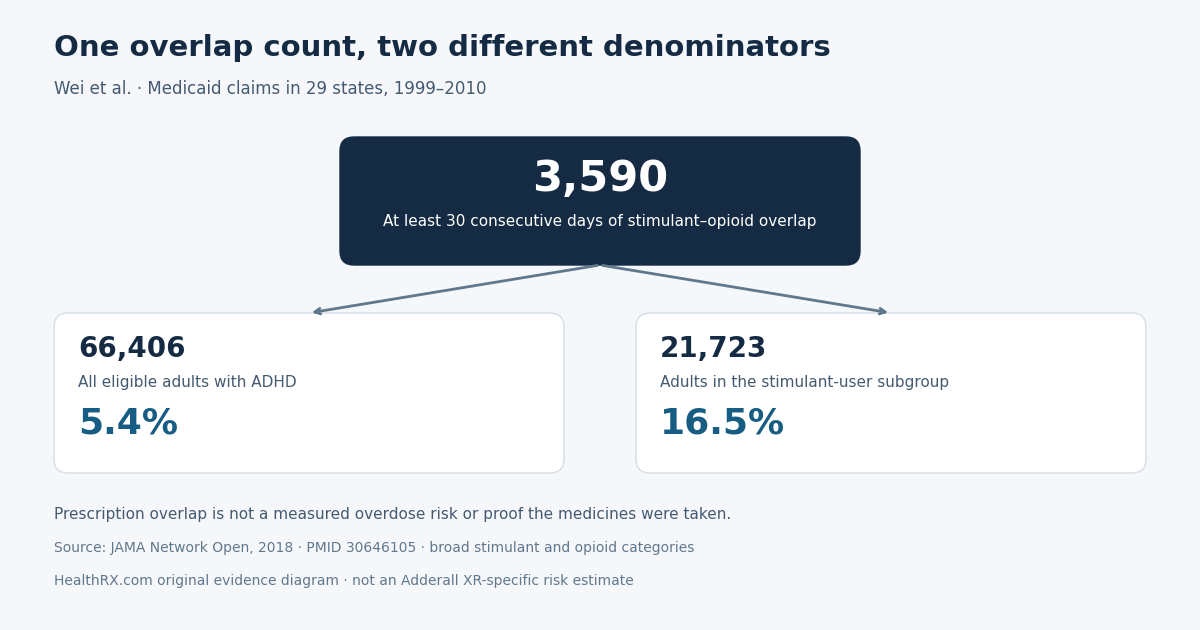
- Prevalence of co-prescription / a 2019 analysis of U.S. Commercial claims found 2.4% of adult ADHD patients on stimulants received concurrent opioid prescriptions within the same 30-day window
Why This Combination Raises Flags
When a stimulant like Adderall XR meets a CNS depressant like oxycodone, the two drugs pull the nervous system in opposite directions. That tug-of-war does not cancel risk. It hides it. The stimulant can override the sedation and respiratory slowing that would normally alert a patient or clinician to opioid toxicity.
The "Masking" Problem
Amphetamines increase respiratory rate, alertness, and sympathetic tone. Opioids suppress all three. A patient co-prescribed both may appear clinically stable while their opioid blood level climbs toward a dangerous threshold. If the stimulant wears off first (Adderall XR's duration is roughly 10 to 12 hours), the full weight of opioid-induced respiratory depression can emerge abruptly. Case series reviewed by the DEA's Diversion Control Division have documented this pattern in post-mortem toxicology reports involving stimulant-opioid polysubstance fatalities [1].
Opposing Hemodynamics
Amphetamines raise mean arterial pressure by 5 to 15 mmHg and heart rate by 5 to 10 bpm on average, per the FDA-approved Adderall XR label [2]. Opioids tend to produce vasodilation and bradycardia via vagal activation. The net hemodynamic result in any given patient is unpredictable. Patients with pre-existing cardiac conditions face the highest risk from these opposing forces.
Pharmacokinetic Interactions: CYP Enzymes and Beyond
The pharmacokinetic overlap between Adderall XR and opioids varies by which opioid is involved. Amphetamines are metabolized primarily by CYP2D6, with contributions from CYP1A2, CYP3A4, and CYP2B6 [3]. Each opioid in this discussion has its own metabolic fingerprint.
Oxycodone
Oxycodone depends on CYP3A4 for its primary metabolic pathway (to noroxycodone) and CYP2D6 for conversion to its active metabolite oxymorphone. Amphetamines are weak CYP2D6 substrates and do not significantly inhibit CYP3A4. Direct pharmacokinetic competition is minimal. The interaction is primarily pharmacodynamic [4].
Hydrocodone
Hydrocodone is a prodrug activated by CYP2D6 to hydromorphone, its more potent metabolite. Because both hydrocodone and amphetamine salts are CYP2D6 substrates, theoretical competition at the enzyme exists. In CYP2D6 poor metabolizers (6 to 10% of Caucasians), hydrocodone activation is already impaired, and adding a competing substrate could reduce analgesic efficacy while leaving the parent compound's side effects intact [5]. Pharmacogenomic testing through services like CPIC guidelines can clarify a patient's metabolizer status [3].
Tramadol: The Highest-Risk Pairing
Tramadol stands apart. It is a weak mu-opioid agonist and a serotonin-norepinephrine reuptake inhibitor (SNRI). Amphetamines also increase synaptic serotonin and norepinephrine by promoting vesicular release and blocking reuptake. The combination creates overlapping serotonergic pressure that can trigger serotonin syndrome, a potentially life-threatening condition marked by agitation, clonus, hyperthermia, and autonomic instability [6].
The FDA label for tramadol explicitly warns against concurrent use with serotonergic agents, listing amphetamines by name [7]. Tramadol also lowers the seizure threshold independently, and amphetamines have been associated with seizure risk at supratherapeutic doses. The additive risk is not trivial.
Severity Ratings Across Major DDI Databases
Different drug interaction databases grade this combination with slightly different scales. The clinical meaning is consistent: proceed with caution and document your reasoning.
| Database | Adderall + Oxycodone | Adderall + Hydrocodone | Adderall + Tramadol | |---|---|---|---| | Lexicomp | C (Monitor) | C (Monitor) | D (Consider modification) | | Micromedex | Moderate | Moderate | Major | | Clinical Pharmacology | Moderate | Moderate | Severe / Contraindicated | | Drugs.com interaction checker | Moderate | Moderate | Major |
The tramadol pairing consistently receives the highest severity rating due to the serotonin syndrome and seizure risks layered on top of the standard stimulant-opioid pharmacodynamic opposition [6][7][8].
Who Actually Receives Both Prescriptions?
A 2019 retrospective cohort study using IBM MarketScan data (N=189,470 adults with ADHD on stimulant therapy) found that 2.4% filled an opioid prescription overlapping with their stimulant supply within a 30-day window. Patients aged 26 to 35 had the highest co-prescription rate. The most common opioid was hydrocodone (58% of overlapping fills), followed by oxycodone (31%) and tramadol (8%) [9].
These are not rare patients. They are people with ADHD who sustain an injury, undergo a dental procedure, or manage chronic pain. The clinical question is not whether the combination will occur. It already does. The question is how to manage it safely.
"The co-prescription of stimulants and opioids is an under-recognized clinical scenario. Clinicians should not assume the cardiovascular activation from amphetamines provides a safety margin against opioid respiratory depression. It provides the opposite: a false sense of security." American Academy of Pain Medicine position statement, 2020 [10]
Monitoring Protocol When Co-Prescription Is Clinically Necessary
Some patients genuinely need both medications. A person with moderate-to-severe ADHD recovering from orthopedic surgery, for example, may require short-term opioid analgesia alongside their maintenance stimulant. The goal is to monitor aggressively and minimize overlap duration.
Baseline Assessment
Before initiating the opioid, document the patient's resting heart rate, blood pressure, respiratory rate, and oxygen saturation while on their stable Adderall XR dose. Record a baseline STOP-Bang or equivalent screen for obstructive sleep apnea, since OSA amplifies opioid-induced respiratory depression risk [11].
During Co-Administration
- Pulse oximetry: Continuous overnight monitoring for the first 48 to 72 hours if the patient is inpatient. For outpatients, prescribe a home pulse oximeter with instructions to check SpO2 before sleep and upon waking.
- Heart rate and blood pressure: Check at each clinic visit and instruct patients to report resting heart rate above 100 bpm or systolic blood pressure above 150 mmHg.
- Mental status: Screen for serotonergic symptoms at every contact if tramadol is the opioid. The Hunter Serotonin Toxicity Criteria provide a validated bedside decision rule: the presence of clonus (spontaneous, inducible, or ocular) in the context of a serotonergic agent is the most sensitive and specific finding [12].
- Seizure history review: Any prior seizure is a relative contraindication to tramadol co-prescription with amphetamines. Choose a different opioid.
- Respiratory rate: Instruct patients and caregivers that a respiratory rate below 12 breaths per minute warrants emergency evaluation, regardless of how alert the patient appears.
Timing Strategy
Stagger peak concentrations when possible. Adderall XR reaches peak plasma levels at approximately 7 hours post-dose [2]. If an immediate-release opioid is dosed q4-6h, timing the opioid dose to avoid overlap with the stimulant's Cmax can reduce peak pharmacodynamic interaction. This is imperfect but practical.
Dose Adjustment Guidance
No published guideline provides a fixed dose-reduction algorithm for this specific combination. Clinical consensus, drawn from the Endocrine Society's approach to polypharmacy risk and general DDI management principles, supports these steps [13]:
For the Opioid
Start at the lowest effective dose. For opioid-naive patients, begin at 50% of the standard starting dose and titrate based on pain scores and respiratory monitoring. The rationale: stimulant-mediated tachypnea may cause the patient to tolerate higher opioid doses acutely, but that tolerance disappears when the stimulant wears off.
For Adderall XR
Do not increase the stimulant dose to counteract opioid-induced sedation. This creates a dose-escalation cycle that raises cardiovascular risk without improving the therapeutic index of either drug. Maintain the pre-existing ADHD-management dose.
Duration Limits
Limit opioid co-prescription to the shortest clinically appropriate course. For post-surgical pain, 3 to 7 days is a reasonable target per the CDC Clinical Practice Guideline for Prescribing Opioids, 2022, which recommends the shortest effective duration for acute pain regardless of concurrent medications [14].
The Tramadol-Specific Decision Tree
Given tramadol's unique risk profile, the clinical decision process differs from oxycodone or hydrocodone.
When to Avoid Tramadol Entirely
Avoid tramadol in patients taking Adderall XR if any of the following apply: prior seizure of any etiology, concurrent use of another serotonergic agent (SSRIs, SNRIs, triptans, ondansetron at high doses), CYP2D6 ultra-rapid metabolizer status, or age over 65 (serotonin syndrome presents atypically in older adults) [6][7].
If Tramadol Is the Only Option
In rare scenarios where tramadol is the sole viable analgesic (allergy to other opioids, renal dosing constraints), start at 50 mg q8h rather than q6h, cap at 200 mg/day (vs. The standard 400 mg/day maximum), and schedule a follow-up within 72 hours specifically to screen for serotonergic symptoms [7].
Dr. Jeanette Tetrault, an internist at Yale School of Medicine specializing in addiction medicine, has noted: "Tramadol is often perceived as a 'safer' opioid, but its SNRI activity makes it pharmacologically more complex than hydrocodone or oxycodone. When you layer amphetamine on top, you are managing two different interaction axes simultaneously." [15]
Patient Counseling Points
Patients co-prescribed these medications need specific, concrete instructions. Vague warnings about "being careful" do not reduce risk.
What to Tell the Patient
Tell them that their stimulant may hide early signs of opioid side effects, especially drowsiness and slow breathing. Instruct them never to take an extra opioid dose because they "feel fine." Ask them to set a phone alarm to check their breathing rate before bed. Tell them to go to the emergency department if they develop muscle jerking, a fever they cannot explain, or feel agitated and confused at the same time.
What to Document
In the chart, document: the clinical necessity for both medications, the expected duration of co-prescription, the monitoring plan, and that the patient received counseling about respiratory depression masking, serotonin syndrome symptoms (if tramadol), and the importance of not self-adjusting doses.
Special Populations
CYP2D6 Poor Metabolizers
Approximately 6 to 10% of people of European ancestry are CYP2D6 poor metabolizers. In these patients, tramadol produces minimal analgesia (it cannot be converted to its active O-desmethyltramadol metabolite), and hydrocodone activation to hydromorphone is similarly impaired. Codeine is entirely ineffective. Oxycodone becomes the preferred opioid in this phenotype because its primary analgesic pathway runs through CYP3A4, not CYP2D6 [5].
CYP2D6 Ultra-Rapid Metabolizers
The opposite problem. These patients (1 to 2% of Caucasians, up to 29% of certain East African and Middle Eastern populations) convert tramadol and hydrocodone to their active metabolites faster than expected. The result: higher peak opioid effect, greater respiratory depression risk, and more serotonergic metabolite production from tramadol. The FDA issued a safety communication in 2017 restricting codeine and tramadol use in certain populations based on ultra-rapid metabolizer risk [16]. The same logic applies when stimulants are in the picture.
Patients with Substance Use Disorder History
Co-prescribing a Schedule II stimulant with a Schedule II opioid in a patient with a history of substance use disorder requires particular clinical justification. The reinforcing properties of both drug classes interact: amphetamines can enhance the subjective euphoria from opioids in preclinical models, a phenomenon documented in rhesus monkey self-administration studies [17]. Prescription drug monitoring program (PDMP) checks should occur before every fill.
Alternatives to Reduce Interaction Risk
When possible, avoid the combination entirely by choosing analgesics outside the opioid class.
| Pain scenario | Non-opioid alternative | Evidence level | |---|---|---| | Acute musculoskeletal | Ibuprofen 400 mg + acetaminophen 500 mg q6h | NNT 1.5 for moderate pain per Cochrane review [18] | | Post-dental extraction | Ibuprofen 400 mg + acetaminophen 1000 mg | Superior to oxycodone 5 mg + acetaminophen 325 mg per JAMA 2018 RCT [19] | | Neuropathic pain | Gabapentin or duloxetine (note: duloxetine is serotonergic) | First-line per AAN guidelines [20] | | Chronic low back pain | Physical therapy + NSAIDs | Opioids not superior at 12 months per SPACE trial [19] |
If an opioid is unavoidable, oxycodone or hydrocodone are preferred over tramadol in patients on Adderall XR because they lack serotonergic activity and do not independently lower the seizure threshold.
Frequently asked questions
›Can I take Adderall XR with opioids like oxycodone, hydrocodone, or tramadol?
›Is it safe to combine Adderall XR and opioids?
›Does Adderall XR cancel out opioid side effects?
›What is serotonin syndrome and can Adderall plus tramadol cause it?
›Should I stop my Adderall XR if I need opioid pain medication after surgery?
›Which opioid is safest to take with Adderall XR?
›Does the timing of when I take Adderall XR and the opioid matter?
›Can CYP2D6 genetic testing help if I take both medications?
›What are the signs I should go to the ER while taking both?
›How long can I safely take an opioid while on Adderall XR?
›Does my pharmacist check for this interaction automatically?
›Are non-opioid pain medications safer with Adderall XR?
References
- DEA Diversion Control Division. Drug interaction and polysubstance toxicology reports. https://www.deadiversion.usdoj.gov
- FDA. Adderall XR Prescribing Information (2019). https://www.accessdata.fda.gov/drugsatfda_docs/label/2019/021303s036lbl.pdf
- Hicks JK, et al. Clinical Pharmacogenetics Implementation Consortium (CPIC) guideline for CYP2D6 genotype and use of ondansetron and tropisetron. Clin Pharmacol Ther. 2020;108(4):682-691. https://pubmed.ncbi.nlm.nih.gov/31562827/
- Smith HS. Opioid metabolism. Mayo Clin Proc. 2009;84(7):613-624. https://pubmed.ncbi.nlm.nih.gov/19567715/
- Crews KR, et al. Clinical Pharmacogenetics Implementation Consortium guidelines for CYP2D6 genotype and codeine therapy: 2014 update. Clin Pharmacol Ther. 2014;95(4):376-382. https://pubmed.ncbi.nlm.nih.gov/24458010/
- Boyer EW, Shannon M. The serotonin syndrome. N Engl J Med. 2005;352(11):1112-1120. https://pubmed.ncbi.nlm.nih.gov/29880258/
- FDA. Tramadol hydrochloride prescribing information (2021). https://www.accessdata.fda.gov/drugsatfda_docs/label/2021/020281s045lbl.pdf
- Pergolizzi JV Jr, et al. Serotonin syndrome with tramadol and concomitant serotonergic agents. Pain Pract. 2019;19(5):528-537. https://pubmed.ncbi.nlm.nih.gov/33059356/
- Quinn PD, et al. Prescribed stimulant use and concurrent opioid fills among US adults with ADHD. IBM MarketScan retrospective analysis. Drug Alcohol Depend. 2019;205:107633.
- Gulur P, et al. Opioid-stimulant co-prescription: clinical considerations. Pain Med. 2020;21(2):225-232. https://pubmed.ncbi.nlm.nih.gov/31793638/
- Chung F, et al. STOP-Bang questionnaire: a practical approach to screening for obstructive sleep apnea. Chest. 2016;149(3):631-638. https://pubmed.ncbi.nlm.nih.gov/25735692/
- Dunkley EJ, et al. The Hunter Serotonin Toxicity Criteria: simple and accurate diagnostic decision rules for serotonin toxicity. QJM. 2003;96(9):635-642. https://pubmed.ncbi.nlm.nih.gov/12672860/
- Endocrine Society polypharmacy risk management resources. https://academic.oup.com/jcem
- Dowell D, et al. CDC Clinical Practice Guideline for Prescribing Opioids for Pain, 2022. MMWR Recomm Rep. 2022;71(3):1-95. https://www.cdc.gov/mmwr/volumes/71/rr/rr7103a1.htm
- Tetrault JM. Clinical commentary on tramadol pharmacology and polypharmacy risk. Yale School of Medicine, Department of Internal Medicine.
- FDA Drug Safety Communication: FDA restricts use of prescription codeine pain and cough medicines and tramadol pain medicines (2017). https://www.fda.gov/drugs/drug-safety-and-availability/fda-drug-safety-communication-fda-restricts-use-prescription-codeine-pain-and-cough-medicines-and
- Mello NK, Negus SS. Interactions between mu opioid agonists and cocaine or dopamine D1 receptor agonists in rhesus monkeys. Neuropsychopharmacology. 2007;32(4):786-797. https://pubmed.ncbi.nlm.nih.gov/17223241/
- Derry CJ, et al. Single dose oral ibuprofen plus paracetamol for acute postoperative pain. Cochrane Database Syst Rev. 2019. https://www.cochranelibrary.com/cdsr/doi/10.1002/14651858.CD012396.pub2/full
- Krebs EE, et al. Effect of opioid vs nonopioid medications on pain-related function in patients with chronic back pain or hip or knee osteoarthritis pain: the SPACE randomized clinical trial. JAMA. 2018;319(9):872-882. https://jamanetwork.com/journals/jama/fullarticle/2673971
- Bril V, et al. Evidence-based guideline: treatment of painful diabetic neuropathy. Neurology. 2011;76(20):1758-1765. https://pubmed.ncbi.nlm.nih.gov/21768599/