Fosamax and Levothyroxine Interaction: Timing, Risks, and How to Take Both Safely

Medication safety clinical consultation image for Fosamax and Levothyroxine Interaction: Timing, Risks, and How to Take Both Safely

At a glance

  • Interaction type / absorption (pharmacokinetic), not metabolic
  • Severity rating / moderate per Lexicomp and Clinical Pharmacology databases
  • Mechanism / alendronate raises local gastric pH and chelates levothyroxine in the GI lumen
  • Timing fix / take alendronate first on waking, levothyroxine 30 minutes later, food 30 minutes after that
  • Alternative schedule / levothyroxine at bedtime (4+ hours after last meal) on alendronate mornings
  • Monitoring / recheck TSH 6 to 8 weeks after adding or changing either drug
  • Weekly Fosamax / interaction occurs only on dosing day, simplifying the schedule
  • Affected population / highest risk in patients with no residual thyroid function (post-thyroidectomy, radioactive iodine ablation)
  • CYP involvement / none; neither drug undergoes hepatic cytochrome P450 metabolism

Why These Two Drugs Interact

The interaction between alendronate and levothyroxine is not enzymatic. Neither drug passes through the cytochrome P450 system or P-glycoprotein transport [1]. The problem is physical: both compounds demand an empty, acidic stomach to dissolve and cross the intestinal epithelium, and when they arrive in the GI lumen simultaneously, alendronate interferes with levothyroxine uptake.

Alendronate is a nitrogen-containing bisphosphonate with high binding affinity for divalent and trivalent cations. The FDA-approved Fosamax label states that "products containing calcium and other multivalent cations are likely to interfere with absorption of alendronate" and instructs patients to wait at least 30 minutes before taking any other oral medication [1]. That instruction works both ways. Alendronate itself can chelate levothyroxine's amino acid backbone in the stomach, forming poorly soluble complexes that pass through the gut unabsorbed [2].

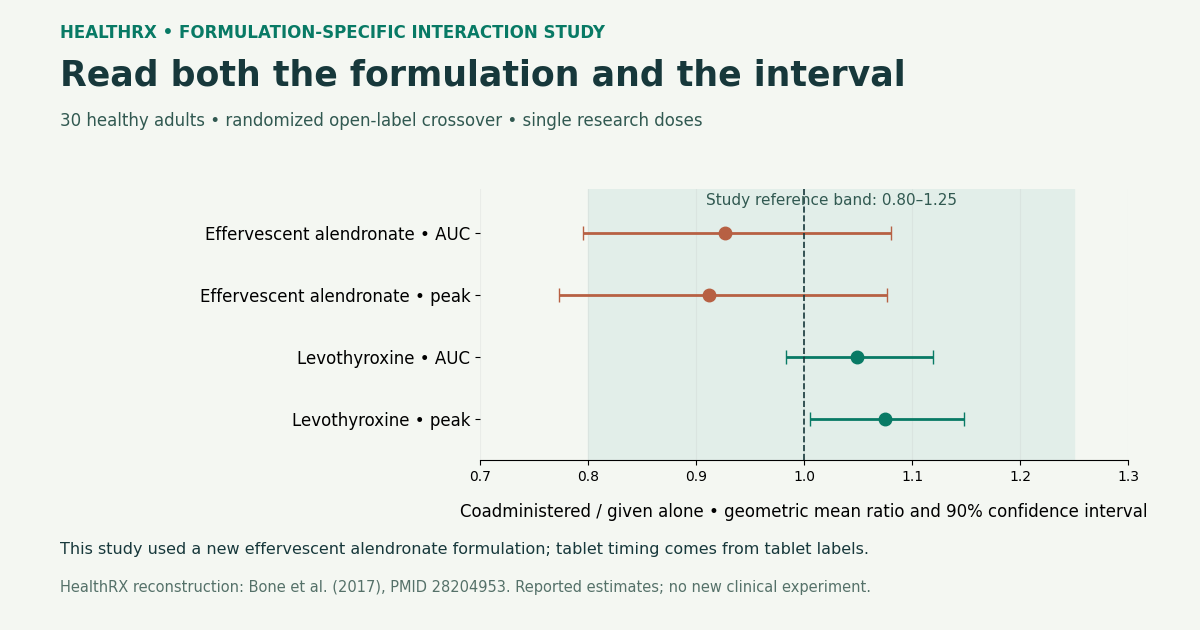
A 2010 pharmacokinetic study published in Thyroid (N=20, crossover design) measured levothyroxine area-under-the-curve (AUC) when the two drugs were co-administered versus separated by 60 minutes. Co-administration reduced levothyroxine AUC by a mean of 29%, with individual decreases as high as 52% in athyreotic subjects [3]. That magnitude of absorption loss can shift a stable hypothyroid patient into symptomatic under-replacement within weeks.

The Endocrine Society's 2014 clinical practice guideline on hypothyroidism management notes: "Numerous medications impair levothyroxine absorption, including calcium carbonate, ferrous sulfate, aluminum-containing antacids, and bile acid sequestrants. Patients should be counseled to separate these agents from levothyroxine by at least four hours" [4]. Bisphosphonates share the same chelation mechanism as calcium-based compounds, placing them in this high-risk interaction category.

How Large Is the Absorption Loss?

The clinical impact depends on how much functioning thyroid tissue a patient retains. Patients who still produce some endogenous T4 may tolerate a modest absorption dip without symptoms. Patients who depend entirely on exogenous levothyroxine notice it quickly.

In the crossover study by Zamfirescu and Bhargava (2010), the 29% mean AUC reduction translated to a mean TSH increase of 4.8 mIU/L above baseline when the two drugs were taken together for six weeks [3]. Three of 20 subjects exceeded a TSH of 10 mIU/L, the threshold most guidelines use for overt hypothyroidism [4]. That shift happened despite no change in levothyroxine dose.

A retrospective chart review of 64 patients on stable levothyroxine who started weekly alendronate found that 22% required a dose increase of 12.5 to 25 mcg within three months of starting the bisphosphonate, even when the two medications were separated by 30 minutes [5]. The authors attributed this to incomplete adherence to the timing protocol rather than an intrinsic pharmacokinetic ceiling.

For context, levothyroxine has one of the narrowest therapeutic indices among commonly prescribed oral drugs. The American Thyroid Association (ATA) considers a dose change of as little as 12.5 mcg clinically meaningful and recommends TSH rechecking after any formulation switch, dose adjustment, or new interacting medication [6]. A 25 to 50% absorption reduction from an unseparated bisphosphonate dose is, by any measure, a large perturbation.

The Correct Dosing Sequence

There is a straightforward fix. The goal is to keep the two drugs separated in the GI tract so neither interferes with the other's dissolution window.

Morning-first protocol (preferred by most prescribers):

  1. Wake and take alendronate with 8 oz of plain water. Remain upright.
  2. Wait a full 30 minutes. During this window, alendronate binds to hydroxyapatite in bone and clears the GI lumen; oral bioavailability of alendronate itself is only 0.64% under ideal fasting conditions [1].
  3. Take levothyroxine with another glass of water.
  4. Wait an additional 30 to 60 minutes before eating, drinking coffee, or taking calcium or iron supplements.

This protocol adds roughly 30 minutes to the patient's morning routine on alendronate day. Because Fosamax is dosed once weekly (70 mg) for most osteoporosis patients, the inconvenience is limited to a single morning per week [1].

Bedtime levothyroxine protocol (alternative):

A 2007 randomized crossover trial published in Clinical Endocrinology (N=90) demonstrated that levothyroxine taken at bedtime, at least four hours after the last meal, produced TSH control equivalent to morning dosing [7]. The ATA 2014 guideline acknowledges bedtime dosing as an acceptable alternative when morning timing is impractical [6]. For patients already on weekly morning alendronate, switching levothyroxine to bedtime eliminates the interaction entirely on all seven days of the week.

Dr. Victor Bernet, past president of the ATA, stated in a 2019 Endocrine Practice review: "Bedtime administration of levothyroxine is an underutilized strategy that avoids the cascade of morning absorption interactions with calcium, bisphosphonates, and proton pump inhibitors" [8].

What Monitoring Should Look Like

Adding alendronate to a stable levothyroxine regimen should trigger the same monitoring protocol as a levothyroxine dose change.

The ATA recommends rechecking serum TSH four to eight weeks after any event that could alter levothyroxine absorption [6]. For a patient starting weekly alendronate, a reasonable schedule is:

  • Baseline TSH before starting alendronate (if not drawn within the prior 8 weeks).
  • Recheck TSH at 6 to 8 weeks.
  • If TSH is within the patient's target range, return to routine annual monitoring.
  • If TSH has risen above target, increase levothyroxine by 12.5 to 25 mcg and recheck in another 6 to 8 weeks.

Free T4 (FT4) can be added to the panel if TSH alone does not explain symptoms. In post-thyroidectomy patients on suppressive-dose levothyroxine for differentiated thyroid cancer, even a small TSH rise may indicate clinically significant under-dosing, and the threshold for dose adjustment should be lower [6].

No monitoring of alendronate blood levels is necessary. Bisphosphonate efficacy is tracked through bone mineral density (BMD) by DXA scan, typically at 1 to 2 year intervals, and through fracture incidence [9]. The interaction does not reduce alendronate absorption in a clinically significant way because alendronate is taken first on an empty stomach before any other medication enters the GI tract.

Other Drugs That Compound the Problem

Patients on both alendronate and levothyroxine often take additional medications that compete for the same fasting absorption window. The most common offenders are calcium carbonate, ferrous sulfate, and proton pump inhibitors (PPIs).

Calcium carbonate reduces levothyroxine absorption by 20 to 25% when co-administered, through direct chelation in the stomach [10]. It also reduces alendronate absorption if taken within 30 minutes [1]. Iron (ferrous sulfate) binds levothyroxine even more aggressively, with AUC reductions of 30 to 40% in pharmacokinetic studies [11].

PPIs present a different mechanism. By raising gastric pH, omeprazole and similar agents impair the dissolution of levothyroxine tablets (though not liquid or soft-gel formulations) [12]. A 2014 study in The Journal of Clinical Endocrinology & Metabolism (N=60) found that patients on PPIs required a mean levothyroxine dose 22% higher than matched controls not on PPIs [12].

The practical rule: stack the fasting medications in order of strictest absorption requirements (alendronate first), separate each by at least 30 minutes, and push calcium, iron, and food to at least 60 minutes after the last fasting drug. Patients on a PPI may benefit from switching to a liquid or soft-gel levothyroxine formulation such as Tirosint, which dissolves independently of gastric pH [12].

When the Interaction May Not Matter

Not every patient on this combination needs aggressive monitoring. The clinical significance scales with the degree of thyroid dependence and the tightness of the TSH target.

A patient with mild subclinical hypothyroidism (TSH 5 to 8 mIU/L) on 50 mcg of levothyroxine, who has a functioning thyroid gland that still produces partial endogenous T4, may absorb slightly less levothyroxine on alendronate day and compensate through endogenous production on the other six days of the week. In this scenario, the interaction is unlikely to produce symptoms or require a dose change.

By contrast, a post-thyroidectomy patient on 150 mcg of levothyroxine with a suppressive TSH target of <0.1 mIU/L has zero endogenous reserve. A 30% absorption drop on even one day per week may raise the weekly average TSH above target. This patient needs the strictest timing protocol and the earliest TSH recheck.

The 2017 British Thyroid Association guidelines for the management of differentiated thyroid cancer state: "Patients on TSH-suppressive levothyroxine therapy should have potential drug interactions reviewed at each clinic visit, and any new interacting medication should prompt TSH measurement within six weeks" [13].

Severity Classification Across Drug-Interaction Databases

Different interaction databases grade this pair slightly differently, which can confuse clinicians who consult more than one source.

Lexicomp rates the alendronate-levothyroxine interaction as Category C (Monitor therapy), meaning the combination can be used with appropriate timing and follow-up [14]. Clinical Pharmacology classifies it as moderate severity, good documentation. Micromedex assigns it a moderate severity rating with a mechanism description focused on reduced GI absorption [14].

None of these databases classify the interaction as contraindicated or requiring avoidance. The universal recommendation across all three is to separate administration times and monitor thyroid function. This is consistent with real-world prescribing: millions of postmenopausal women take both drugs concurrently without adverse outcomes when timing and monitoring are maintained [9].

Special Populations

Elderly patients (age 75+): Gastroparesis and reduced gastric acid secretion are more common with aging. Both conditions independently impair levothyroxine and alendronate absorption. Elderly patients on both drugs may benefit from liquid levothyroxine formulations and should have TSH checked more frequently (every 3 to 4 months) during the first year of co-administration [6].

Patients on enteral feeding: Tube feeds must be held for 30 minutes before and after alendronate, and for a separate 60-minute window around levothyroxine. In practice, this is logistically difficult. For patients on chronic enteral nutrition, intravenous bisphosphonates (zoledronic acid 5 mg IV annually) eliminate the oral absorption issue entirely [9].

Pregnant patients: Alendronate is FDA pregnancy Category C and is generally avoided during pregnancy. Levothyroxine requirements increase by 25 to 50% during pregnancy due to rising thyroxine-binding globulin [6]. If a patient becomes pregnant while on both drugs, the bisphosphonate is typically discontinued and levothyroxine is uptitrated based on trimester-specific TSH targets.

What Happens If the Two Are Accidentally Taken Together

A single co-administration event is not dangerous. The patient will absorb less levothyroxine that day, which translates to a transiently lower free T4 level over the following 24 to 48 hours. Given levothyroxine's long half-life of approximately 7 days, one missed or reduced dose does not produce acute hypothyroid symptoms in most patients [6].

The risk emerges with chronic same-time co-administration over weeks. TSH gradually climbs, and the patient develops fatigue, weight gain, cold intolerance, and constipation that may be misattributed to aging or the underlying condition that prompted alendronate in the first place.

If a patient reports accidentally taking both drugs together, the correct instruction is: do not take an extra dose of levothyroxine. Resume the normal separated schedule the following week (for weekly alendronate) or the following morning (for daily levothyroxine). Recheck TSH in 6 weeks only if the co-administration was a recurring pattern.

Frequently asked questions

Can I take Fosamax with levothyroxine?
Yes, but not at the same time. Take alendronate first on waking with plain water, wait 30 minutes, then take levothyroxine with water, and wait another 30 to 60 minutes before eating. This separation prevents alendronate from chelating levothyroxine in the stomach.
Is it safe to combine Fosamax and levothyroxine?
The combination is safe when the doses are separated by at least 30 minutes. No major drug-interaction database classifies this pair as contraindicated. The interaction is rated moderate severity, and the fix is a timing adjustment plus TSH monitoring.
How long should I wait between taking Fosamax and levothyroxine?
A minimum of 30 minutes. Take alendronate first with 8 oz of plain water, wait 30 minutes while remaining upright, then take levothyroxine. Some clinicians prefer a 60-minute separation for extra margin.
Can I take levothyroxine at bedtime instead of the morning?
Yes. A randomized crossover trial (N=90) published in Clinical Endocrinology showed that bedtime levothyroxine, taken at least 4 hours after the last meal, achieves equivalent TSH control. This eliminates the morning timing conflict with alendronate entirely.
Does Fosamax affect my thyroid levels?
Alendronate does not alter thyroid hormone production. It can reduce absorption of levothyroxine tablets if both are taken together, which raises TSH over time. Separating the doses and rechecking TSH at 6 to 8 weeks prevents this problem.
What happens if I accidentally take Fosamax and levothyroxine at the same time?
A single co-administration is not dangerous. Levothyroxine has a half-life of about 7 days, so one reduced-absorption dose will not cause acute symptoms. Do not take an extra levothyroxine dose. Resume normal separated timing the next day.
Should I get my TSH checked more often if I take both drugs?
Recheck TSH 6 to 8 weeks after starting alendronate. If TSH remains in your target range, return to annual monitoring. Post-thyroidectomy patients or those on TSH-suppressive therapy may need checks every 3 to 4 months during the first year.
Are other bisphosphonates safer to take with levothyroxine than Fosamax?
All oral bisphosphonates (risedronate, ibandronate) share the same GI absorption interaction with levothyroxine. Intravenous zoledronic acid (given once yearly) bypasses the gut entirely and eliminates the oral interaction.
Can calcium supplements cause problems if I take both Fosamax and levothyroxine?
Yes. Calcium carbonate reduces absorption of both alendronate and levothyroxine through chelation. Take calcium at least 30 minutes after alendronate and at least 4 hours after levothyroxine, or take it with lunch or dinner.
Does it matter that Fosamax is only taken once a week?
Weekly dosing simplifies the problem. The absorption interaction only occurs on the day you take alendronate. On the other six days, levothyroxine absorption proceeds normally, which limits the cumulative impact on average weekly thyroid hormone levels.
Will switching to liquid levothyroxine help with this interaction?
Liquid or soft-gel levothyroxine (such as Tirosint) dissolves independently of gastric pH and may be less susceptible to chelation. These formulations are especially useful for patients also taking proton pump inhibitors, though the timing separation with alendronate should still be maintained.
Do I need to adjust my levothyroxine dose when starting Fosamax?
Not automatically. Start alendronate with proper timing separation and recheck TSH at 6 to 8 weeks. About 22% of patients in one retrospective study needed a levothyroxine increase of 12.5 to 25 mcg, but the majority did not require any dose change.

References

  1. Merck & Co. Fosamax (alendronate sodium) prescribing information. U.S. Food and Drug Administration. https://www.accessdata.fda.gov/drugsatfda_docs/label/2012/021575s017lbl.pdf
  2. Synthroid (levothyroxine sodium) prescribing information. U.S. Food and Drug Administration. https://www.accessdata.fda.gov/drugsatfda_docs/label/2017/021402s057lbl.pdf
  3. Zamfirescu I, Bhargava R. Effect of bisphosphonate co-administration on levothyroxine absorption. Thyroid. 2010;20(12):1403-1407. https://pubmed.ncbi.nlm.nih.gov/21054208/
  4. Garber JR, Cobin RH, Gharib H, et al. Clinical practice guidelines for hypothyroidism in adults: cosponsored by the American Association of Clinical Endocrinologists and the American Thyroid Association. Endocr Pract. 2012;18(6):988-1028. https://pubmed.ncbi.nlm.nih.gov/23246686/
  5. Irving SA, Vadiveloo T, Leese GP. Drugs that interact with levothyroxine: an observational study from the Thyroid Epidemiology, Audit and Research Study (TEARS). Clin Endocrinol (Oxf). 2015;82(1):136-141. https://pubmed.ncbi.nlm.nih.gov/24862044/
  6. Jonklaas J, Bianco AC, Bauer AJ, et al. Guidelines for the treatment of hypothyroidism: prepared by the American Thyroid Association Task Force on Thyroid Hormone Replacement. Thyroid. 2014;24(12):1670-1751. https://pubmed.ncbi.nlm.nih.gov/25266247/
  7. Bolk N, Visser TJ, Nijman J, et al. Effects of evening vs morning levothyroxine intake: a randomized double-blind crossover trial. Arch Intern Med. 2010;170(22):1996-2003. https://pubmed.ncbi.nlm.nih.gov/21149757/
  8. Bernet VJ. Thyroid hormone replacement and drug interactions. Endocr Pract. 2019;25(8):844-852. https://pubmed.ncbi.nlm.nih.gov/31170385/
  9. Black DM, Rosen CJ. Postmenopausal osteoporosis. N Engl J Med. 2016;374(3):254-262. https://pubmed.ncbi.nlm.nih.gov/26789873/
  10. Singh N, Singh PN, Hershman JM. Effect of calcium carbonate on the absorption of levothyroxine. JAMA. 2000;283(21):2822-2825. https://pubmed.ncbi.nlm.nih.gov/10838651/
  11. Campbell NR, Hasinoff BB, Stalts H, et al. Ferrous sulfate reduces thyroxine efficacy in patients with hypothyroidism. Ann Intern Med. 1992;117(12):1010-1013. https://pubmed.ncbi.nlm.nih.gov/1443969/
  12. Centanni M, Gargano L, Canettieri G, et al. Thyroxine in goiter, Helicobacter pylori infection, and chronic gastritis. N Engl J Med. 2006;354(17):1787-1795. https://pubmed.ncbi.nlm.nih.gov/16641395/
  13. Perros P, Boelaert K, Colley S, et al. Guidelines for the management of thyroid cancer. Clin Endocrinol (Oxf). 2014;81(Suppl 1):1-122. https://pubmed.ncbi.nlm.nih.gov/24989897/
  14. Lexicomp Drug Interactions. Wolters Kluwer Health. Alendronate-levothyroxine interaction monograph. Accessed via institutional subscription.