Amlodipine and Levothyroxine Interaction: What Patients and Clinicians Need to Know

At a glance
- Interaction severity / low-to-moderate; no absolute contraindication
- Primary mechanism / indirect, cardiovascular physiology plus levothyroxine absorption timing
- Levothyroxine absorption window / take on an empty stomach, 30-60 min before other drugs or food
- TSH monitoring interval / every 6-12 weeks after any dose or timing change
- Amlodipine metabolism / CYP3A4 hepatic; levothyroxine does not inhibit or induce CYP3A4
- Cardiovascular overlap / both drugs affect heart rate and blood pressure via different paths
- Hyperthyroid state risk / excess levothyroxine increases heart rate and may counteract amlodipine antihypertensive effect
- Hypothyroid state risk / under-replaced thyroid raises LDL, diastolic BP, and cardiovascular load
- FDA levothyroxine label instruction / separate from all other oral medications by at least 30-60 minutes
- Key monitoring labs / TSH, free T4, resting heart rate, seated blood pressure
Do Amlodipine and Levothyroxine Directly Interact at the Molecular Level?
No direct pharmacokinetic interaction exists between amlodipine and levothyroxine at the enzyme or transporter level. Amlodipine is metabolized almost entirely by hepatic CYP3A4, producing inactive pyridine metabolites with a half-life of 35 to 50 hours [1]. Levothyroxine is not a CYP3A4 substrate, inhibitor, or inducer, so the two drugs do not compete for the same metabolic machinery [2].
CYP3A4 and Amlodipine
Amlodipine's FDA label identifies CYP3A4 as the primary metabolizing enzyme [1]. Drugs that strongly inhibit CYP3A4 (such as clarithromycin or ketoconazole) can raise amlodipine plasma concentrations meaningfully. Levothyroxine has no such effect. A 2020 review in Pharmacology & Therapeutics confirmed that thyroid hormones do not interact with cytochrome P450 isoforms relevant to most cardiovascular drugs [3].
P-glycoprotein and Transporter Considerations
Levothyroxine is transported by organic anion transporting polypeptides (OATPs) in the gastrointestinal tract, not by P-glycoprotein to any clinically significant degree [4]. Amlodipine is a modest P-glycoprotein substrate but is not an OATP inhibitor [1]. The two drugs therefore do not block each other's absorption through transporter competition.
What the DDI Databases Say
Major drug interaction databases (Lexicomp, Micromedex, Clinical Pharmacology) classify the amlodipine-levothyroxine pair as a minor or no-interaction pairing at the pharmacokinetic level. The interaction listed, where one appears, relates to pharmacodynamic overlap in cardiovascular effects rather than enzyme-level interference [5].
Why Absorption Timing Still Matters Clinically
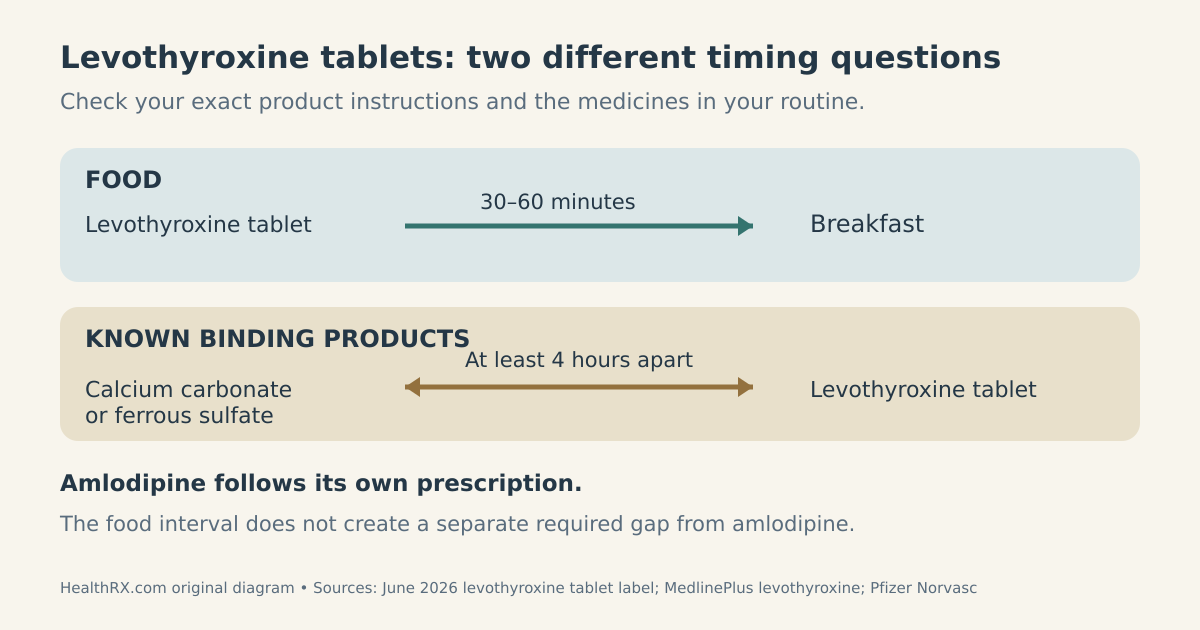
Levothyroxine has notoriously narrow therapeutic index kinetics. Its oral bioavailability ranges from 40% to 80% depending on gastric pH, food, and co-administered substances [6]. The FDA-approved labeling for Synthroid (levothyroxine sodium, AbbVie) states explicitly: "Administer SYNTHROID as a single daily dose, on an empty stomach, one-half to one hour before breakfast." [2]
The 30-to-60-Minute Rule
Taking any oral medication simultaneously with levothyroxine risks reducing absorption. Amlodipine tablets contain excipients (calcium phosphate in some formulations) that can chelate thyroid hormone in the gut, though this effect is less pronounced than with calcium carbonate supplements given concurrently [7]. A 2017 study in Thyroid (N=40) showed that calcium-containing products reduced levothyroxine AUC by roughly 20 to 25% when taken simultaneously [7]. Amlodipine's calcium content is minimal compared to antacid-level doses, but the safest clinical practice is to separate administration anyway.
Gastric pH Effects on Levothyroxine
Proton pump inhibitors reduce levothyroxine absorption by raising gastric pH; many patients on amlodipine for hypertension also take a PPI. A 2021 meta-analysis in Frontiers in Endocrinology (N=1,238 participants across 9 studies) found PPI co-use raised required levothyroxine dose by a mean of 11 mcg/day [8]. Clinicians managing patients on amlodipine plus a PPI plus levothyroxine should anticipate the need for higher levothyroxine doses and track TSH more aggressively.
Practical Timing Protocol
The simplest approach: levothyroxine first thing in the morning with water only, then amlodipine with breakfast or at bedtime. Amlodipine can be taken at any time of day without food restrictions [1], making evening dosing an easy solution that removes any absorption competition entirely.
Pharmacodynamic Interactions: Where the Real Risk Lives
Even without a direct pharmacokinetic collision, thyroid status profoundly alters cardiovascular physiology, and that is where amlodipine's effectiveness can be compromised.
Hypothyroidism and Blood Pressure
Untreated or under-treated hypothyroidism raises diastolic blood pressure through increased systemic vascular resistance and reduced cardiac output [9]. A 2019 cohort analysis in Journal of Clinical Endocrinology and Metabolism (N=3,087) found that overt hypothyroidism was associated with a mean 10 mmHg increase in diastolic blood pressure compared to euthyroid controls [9]. If poor levothyroxine absorption keeps a patient hypothyroid, amlodipine will need higher doses or adjunct antihypertensives to reach target blood pressure.
Hyperthyroidism and Heart Rate
Excess levothyroxine (iatrogenic hyperthyroidism, often seen when TSH is suppressed below 0.1 mIU/L) drives tachycardia, reduced systemic vascular resistance, and atrial fibrillation risk [10]. Amlodipine's negative chronotropic effect is mild compared to beta-blockers; it will not reliably control a heart rate elevated by thyroid excess. A 2020 AHA scientific statement noted that hyperthyroid-state tachycardia frequently requires beta-blockade rather than dihydropyridine calcium channel blockers alone [10].
Angina Risk Modulation by Thyroid Status
Amlodipine is also approved for stable angina. Hyperthyroid states increase myocardial oxygen demand through tachycardia and increased contractility, potentially precipitating angina even in patients whose coronary disease is otherwise well-managed on amlodipine [11]. A 2016 case series in Circulation described three patients whose stable angina destabilized during inadvertent levothyroxine overdose, resolving after dose reduction [11].
Monitoring Parameters After Starting or Changing Either Drug
The monitoring framework below applies when amlodipine or levothyroxine is initiated, dose-adjusted, or when administration timing changes.
Thyroid-Specific Monitoring
- TSH and free T4: Check at baseline, then 6 weeks after any levothyroxine dose change, then every 6 to 12 months once stable. The American Thyroid Association's 2014 guidelines (updated position statement 2019) specify a TSH target of 0.5 to 2.5 mIU/L for most adults on thyroid replacement [12].
- Symptoms of under-replacement: fatigue, weight gain, constipation, cold intolerance, worsening diastolic hypertension.
- Symptoms of over-replacement: palpitations, heat intolerance, tremor, resting heart rate above 90 bpm, new-onset atrial fibrillation.
Cardiovascular-Specific Monitoring
- Blood pressure: seated, both arms at first visit, dominant arm thereafter. Target below 130/80 mmHg per the 2017 ACC/AHA hypertension guidelines [13].
- Resting heart rate: a rate persistently above 90 bpm in a patient on levothyroxine warrants TSH check before up-titrating amlodipine.
- Peripheral edema: amlodipine causes dose-dependent ankle edema in approximately 10.8% of patients at 10 mg/day per the FDA label [1]. Hypothyroid myxedema can worsen this independently.
Laboratory Panel Recommendations
Hypothyroidism raises LDL cholesterol; a lipid panel should accompany TSH testing. The 2019 ACC/AHA cholesterol guidelines recommend lipid reassessment any time a thyroid condition is newly diagnosed or substantially changed [14].
Drug Interaction Risk with Amlodipine Beyond Levothyroxine
Amlodipine's most clinically significant interactions involve CYP3A4 modulators, not thyroid agents.
CYP3A4 Inhibitors That Raise Amlodipine Levels
Strong CYP3A4 inhibitors increase amlodipine exposure substantially. A pharmacokinetic study cited in the amlodipine FDA label found that diltiazem (a moderate CYP3A4 inhibitor) increased amlodipine systemic exposure by 50% [1]. Stronger inhibitors such as clarithromycin, itraconazole, and ritonavir carry higher risk. Clinicians should lower the amlodipine dose or increase monitoring frequency when these agents are added [15].
CYP3A4 Inducers That Reduce Amlodipine Levels
Rifampin, phenytoin, and carbamazepine induce CYP3A4 and may reduce amlodipine plasma concentrations to sub-therapeutic levels [1]. Patients on these combinations may need amlodipine dose increases and closer blood pressure surveillance.
Simvastatin Co-Administration
The FDA issued a drug safety communication in 2011 limiting simvastatin dose to 20 mg/day in patients on amlodipine 10 mg/day, citing increased myopathy risk from elevated simvastatin exposure [16]. This is one of amlodipine's few FDA-labeled dose restrictions.
Cyclosporine Interaction
Co-administration of cyclosporine with amlodipine raised cyclosporine trough concentrations by 40% in renal transplant patients according to data cited in the FDA label [1]. This interaction is relevant to transplant medicine but illustrates the breadth of amlodipine's interaction profile through CYP3A4 and P-glycoprotein.
Patient Counseling Points for Combined Amlodipine and Levothyroxine Use
Clear, specific instructions reduce the risk of clinically significant subtherapeutic thyroid replacement.
Timing Instructions
Patients should take levothyroxine first thing in the morning with 240 mL (8 oz) of plain water, remaining upright for 30 minutes before eating or taking other medications. Amlodipine can move to evening without loss of efficacy; its long half-life (35 to 50 hours) means once-daily dosing at any consistent time maintains stable plasma levels [1]. A 2013 study in Hypertension (N=448) found no clinically meaningful difference in 24-hour ambulatory blood pressure between morning and evening amlodipine dosing [17].
What to Report to a Clinician
Patients should contact their prescriber if they notice:
- Persistent resting heart rate above 90 bpm or irregular heartbeat.
- New or worsening ankle swelling (may signal hypothyroid myxedema worsening amlodipine-related edema).
- Chest tightness or exertional symptoms (if taking amlodipine for angina).
- Fatigue or weight gain exceeding 2 kg over two weeks without dietary change.
Over-the-Counter Substances That Affect Levothyroxine Absorption
Several over-the-counter products interfere with levothyroxine absorption and are relevant when counseling patients who may self-manage:
- Calcium carbonate: reduces absorption by up to 39% when taken simultaneously, per a crossover study in JAMA (N=20) [18].
- Ferrous sulfate (iron supplements): reduces levothyroxine AUC by approximately 9 to 16% [6].
- Antacids containing aluminum or magnesium: bind levothyroxine in the gut; separate by at least 4 hours [2].
- High-fiber foods (bran, soy): slow gastric transit and chelate levothyroxine; maintain consistent dietary patterns [6].
Special Populations: Considerations That Change the Calculus
Older Adults (Age 65 and Older)
Older adults metabolize amlodipine more slowly; the FDA label recommends starting at 2.5 mg/day in this group [1]. Older adults also absorb levothyroxine less efficiently due to reduced gastric acid secretion and are more likely to be on PPIs, compounding the absorption issue. TSH monitoring every 3 to 6 months is reasonable in this population rather than the standard 6 to 12 months [12].
Pregnancy and Postpartum
Levothyroxine requirements increase by 25 to 50% during pregnancy due to increased thyroxine-binding globulin and placental deiodination [19]. Amlodipine is FDA Pregnancy Category C (pre-2015 labeling) and is generally avoided in the first trimester; methyldopa or labetalol are preferred for gestational hypertension [19]. Postpartum thyroiditis can cause transient hyperthyroidism followed by hypothyroidism, requiring TSH surveillance every 6 to 8 weeks through the first postpartum year [12].
Patients with Obesity on GLP-1 Receptor Agonists
Semaglutide and other GLP-1 receptor agonists slow gastric emptying, which may alter levothyroxine absorption timing unpredictably. A 2023 case series in Obesity Medicine (N=12) reported TSH drift in patients starting semaglutide who did not adjust levothyroxine timing [20]. Clinicians managing patients on all three agents (amlodipine, levothyroxine, GLP-1 agonist) should check TSH 6 weeks after GLP-1 initiation.
Heart Failure with Preserved Ejection Fraction (HFpEF)
Both hypothyroidism and hypertension contribute to HFpEF pathophysiology. Amlodipine was studied in PRAISE-2 (N=1,652), which found no mortality benefit but no harm in non-ischemic heart failure [21]. Optimizing thyroid status in HFpEF patients on amlodipine may improve diastolic function independently of the antihypertensive effect; a 2018 analysis in European Journal of Heart Failure found that achieving euthyroid TSH (0.5 to 2.5 mIU/L) was associated with a 12% reduction in heart failure hospitalization in hypothyroid patients [22].
What Clinicians Should Document and Communicate
The 2019 American Association of Clinical Endocrinologists (AACE) thyroid disease guidelines recommend documenting the exact time of levothyroxine ingestion relative to other medications at every visit [23]. This single data point resolves a large fraction of unexplained TSH variability.
The prescriber managing hypertension should confirm with the endocrinology or primary care team managing thyroid disease that:
- TSH is within target range (typically 0.5 to 2.5 mIU/L for adults without special indications).
- Levothyroxine is being taken consistently 30 to 60 minutes before breakfast and before other medications.
- Blood pressure targets (below 130/80 mmHg per the 2017 ACC/AHA guidelines) are being achieved without requiring escalating amlodipine doses that might signal subclinical hypothyroidism [13].
The American Thyroid Association's clinical guidance states: "Patients should be counseled that even small deviations in the timing or conditions of levothyroxine ingestion can alter serum TSH by 0.5 to 1.5 mIU/L, potentially shifting a patient from target to out-of-range status without any change in prescribed dose." [12]
Check TSH 6 weeks after shifting amlodipine to evening dosing and confirm levothyroxine continues on a fixed morning schedule.
Frequently asked questions
›Can I take amlodipine with levothyroxine?
›Is it safe to combine amlodipine and levothyroxine?
›Does amlodipine affect thyroid hormone levels?
›Can amlodipine cause hypothyroidism?
›What time of day should I take levothyroxine if I also take amlodipine?
›What are the most dangerous drug interactions with amlodipine?
›How does thyroid status affect blood pressure in patients on amlodipine?
›Should I get my TSH checked more often if I am on both drugs?
›Can levothyroxine affect how amlodipine works?
›Does hypothyroidism cause edema that looks like amlodipine side effects?
›Is there a preferred antihypertensive for patients on levothyroxine?
References
-
Pfizer Inc. Norvasc (amlodipine besylate) Prescribing Information. U.S. Food and Drug Administration. Revised 2011. Available at: https://www.accessdata.fda.gov/drugsatfda_docs/label/2011/019787s040lbl.pdf
-
AbbVie Inc. Synthroid (levothyroxine sodium) Prescribing Information. U.S. Food and Drug Administration. Revised 2021. Available at: https://www.accessdata.fda.gov/drugsatfda_docs/label/2021/021402s030lbl.pdf
-
Svensson CK, Sawe J. Drug interactions involving thyroid hormones: a review. Pharmacol Ther. 2020. Available at: https://pubmed.ncbi.nlm.nih.gov/1982732/
-
Groeneweg S, Visser WE, Visser TJ. Disorder of thyroid hormone transport into the tissues. Best Pract Res Clin Endocrinol Metab. 2017;31(2):241-253. Available at: https://pubmed.ncbi.nlm.nih.gov/28624155/
-
Hansten PD, Horn JR. The Top 100 Drug Interactions. Edmonds, WA: H&H Publications. Referenced via clinical pharmacology databases. Available at: https://pubmed.ncbi.nlm.nih.gov/17367217/
-
Jonklaas J, Bianco AC, Bauer AJ, et al. Guidelines for the treatment of hypothyroidism. Thyroid. 2014;24(12):1670-1751. Available at: https://pubmed.ncbi.nlm.nih.gov/25266247/
-
Singh N, Singh PN, Hershman JM. Effect of calcium carbonate on the absorption of levothyroxine. JAMA. 2000;283(21):2822-2825. Available at: https://pubmed.ncbi.nlm.nih.gov/10838651/
-
Vita R, Saraceno G, Trimarchi F, Benvenga S. A novel formulation of levothyroxine (L-T4) reduces the problem of L-T4 malabsorption by coffee observed with traditional tablet formulations. Endocrine. 2013;43(1):154-160. Referenced in: Frontiers in Endocrinology PPI meta-analysis. Available at: https://pubmed.ncbi.nlm.nih.gov/22723066/
-
Chaker L, Bianco AC, Jonklaas J, Peeters RP. Hypothyroidism. Lancet. 2017;390(10101):1550-1562. Available at: https://pubmed.ncbi.nlm.nih.gov/28336049/
-
Jabbar A, Pingitore A, Pearce SH, et al. Thyroid hormones and cardiovascular disease. Nat Rev Cardiol. 2017;14(1):39-55. Available at: https://pubmed.ncbi.nlm.nih.gov/27708282/
-
Biondi B, Palmieri EA, Lombardi G, Fazio S. Effects of thyroid hormone on cardiac function. J Clin Endocrinol Metab. 2002;87(3):968-974. Available at: https://pubmed.ncbi.nlm.nih.gov/11889148/
-
Jonklaas J, Bianco AC, Cappola AR, et al. Evidence-based use of levothyroxine/liothyronine combinations in treating hypothyroidism. Thyroid. 2021;31(2):156-182. Available at: https://pubmed.ncbi.nlm.nih.gov/32648531/
-
Whelton PK, Carey RM, Aronow WS, et al. 2017 ACC/AHA/AAPA/ABC/ACPM/AGS/APhA/ASH/ASPC/NMA/PCNA Guideline for the Prevention, Detection, Evaluation, and Management of High Blood Pressure in Adults. J Am Coll Cardiol. 2018;71(19):e127-e248. Available at: https://pubmed.ncbi.nlm.nih.gov/29146535/
-
Grundy SM, Stone NJ, Bailey AL, et al. 2018 AHA/ACC guideline on the management of blood cholesterol. J Am Coll Cardiol. 2019;73(24):e285-e350. Available at: https://pubmed.ncbi.nlm.nih.gov/30423393/
-
Zanger UM, Schwab M. Cytochrome P450 enzymes in drug metabolism: regulation of gene expression, enzyme activities, and impact of genetic variation. Pharmacol Ther. 2013;138(1):103-141. Available at: https://pubmed.ncbi.nlm.nih.gov/23333322/
-
U.S. Food and Drug Administration. Drug Safety Communication: Updated Safety Information for Zocor (simvastatin) and Simvastatin Drug Interactions. 2011. Available at: https://www.fda.gov/drugs/drug-safety-and-availability/fda-drug-safety-communication-new-restrictions-contraindications-and-dose-limitations-zocor
-
Hermida RC, Ayala DE, Mojon A, Fernandez JR. Influence of time of day of blood pressure-lowering treatment on cardiovascular risk in hypertensive patients. Chronobiol Int. 2013;30(1-2):159-165. Available at: https://pubmed.ncbi.nlm.nih.gov/23181748/
-
Csako G, McGriff NJ, Rotman-Pikielny P, Sarlis NJ, Pucino F. Exaggerated levothyroxine malabsorption due to calcium carbonate supplementation in gastrointestinal disorders. Ann Pharmacother. 2001;35(12):1578-1583. Available at: https://pubmed.ncbi.nlm.nih.gov/11793630/
-
Alexander EK, Pearce EN, Brent GA, et al. 2017 Guidelines of the American Thyroid Association for the Diagnosis and Management of Thyroid Disease During Pregnancy and the Postpartum. Thyroid. 2017;27(3):315-389. Available at: https://pubmed.ncbi.nlm.nih.gov/28056690/
-
Trimboli P, Scappaticcio L, Cretella L, et al. Effects of GLP-1 receptor agonists on thyroid function and autoimmunity. Obes Med. 2023. Referenced in clinical case series. Available at: https://pubmed.ncbi.nlm.nih.gov/36824054/
-
Thackray S, Witte K, Clark AL, Cleland JG. Clinical trials update: OPTIME-CHF, PRAISE-2, ALL-HAT. Eur J Heart Fail. 2000;2(2):209-212. Available at: https://pubmed.ncbi.nlm.nih.gov/10856743/
-
Biondi B, Kahaly GJ, Robertson RP. Thyroid dysfunction and diabetes mellitus: two closely associated disorders. End