Why Progesterone Is Paired With an Estradiol Patch
An estradiol patch and oral progesterone can be prescribed together because they have different jobs. Systemic estradiol treats menopausal symptoms and helps prevent bone loss. Progesterone provides opposition to estrogen’s effect on the uterine lining. That intended partnership is different from a drug interaction that changes medicine exposure or causes unwanted effects. Neither purpose makes every combination risk-free. [1,4]
Why the uterus matters
For someone with a uterus, systemic estrogen generally needs adequate endometrial protection. Without it, estrogen can stimulate the lining and increase the risk of endometrial hyperplasia and cancer. Oral progesterone is one option, not the only option: other progestogens and suitable combined products can provide protection. After hysterectomy, a progestogen is usually unnecessary, although selected circumstances, including endometriosis, warrant individualized specialist review. [1,4]
Protection depends on the progestogen’s dose and duration in relation to estrogen exposure. Higher estrogen doses may require more progestogen, but evidence for optimal protection at high doses is limited. A familiar progesterone schedule should not be assumed to cover every patch strength. Oral and vaginal progesterone also cannot simply be treated as interchangeable. [4]
What combination evidence actually supports
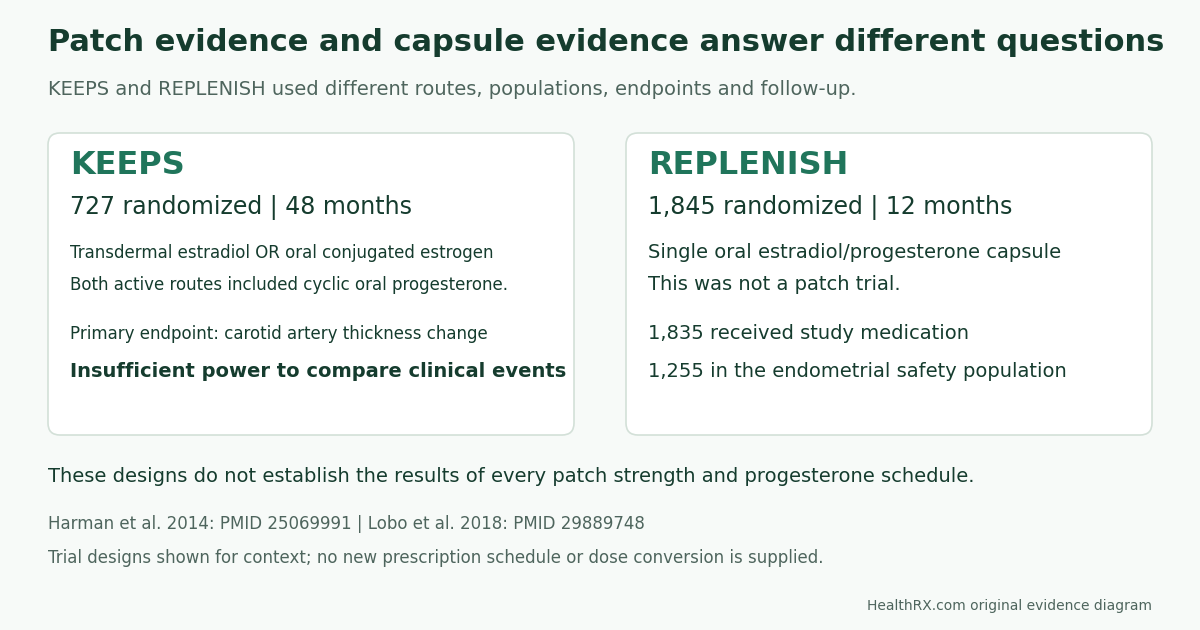
The key question is not just whether a study included estrogen and progesterone. It is whether it tested the relevant route, population, outcome and duration. Evidence from an oral combination can inform discussion without directly establishing the results of a patch-plus-capsule prescription.
| Study or source | Study question | Route | Population | Duration | What cannot be concluded |
|---|---|---|---|---|---|
| PROMETRIUM label trial [2] | Does progesterone protect the endometrium during estrogen treatment? | Oral conjugated estrogens with oral progesterone | 358 postmenopausal women with a uterus | Up to 36 months | Direct protection evidence for every estradiol patch pairing |
| KEEPS [5] | Does early hormone treatment change progression of carotid artery thickness? | Oral conjugated estrogens or transdermal estradiol, with cyclic oral progesterone | 727 selected healthy, recently menopausal women aged 42–58 | 48 months | Prevention of cardiovascular events or established long-term cancer safety |
| REPLENISH [6] | What are the endometrial and symptom outcomes of a combined capsule? | Single oral estradiol/progesterone capsule | Postmenopausal women; 1,255 in the endometrial safety population | 12 months | Equivalent results for separate patches and progesterone capsules |
| E3N [7] | Do breast cancer associations differ by hormone formulation? | Oral or transdermal estrogen with different progestogens | 80,377 women in an observational cohort | Mean 8.1 postmenopausal years | Randomized proof of a risk-free patch/progesterone combination |
KEEPS found similar annual changes in carotid artery thickness between groups. It was not powered to establish differences in clinical cardiovascular events. Its selected population also limits extrapolation to older people or those with established cardiovascular disease. [5]
REPLENISH reported no endometrial hyperplasia in its defined endometrial safety population. That finding belongs to the studied oral product and follow-up period. It does not cover all estrogen/progesterone combinations. E3N found different breast cancer associations with different progestogens, but its observational design cannot establish causal safety rankings. [6,7]
Pairing does not eliminate interactions
A patch avoids initial liver first-pass metabolism, but estradiol is still partly metabolized through CYP3A4. Medicines such as rifampin and carbamazepine, and supplements such as St John’s wort, can lower estrogen exposure. Some azoles, macrolides, ritonavir and grapefruit may increase it. Transdermal delivery does not make estrogen immune to interactions. [3]
Oral progesterone can cause drowsiness or dizziness, which is why the PROMETRIUM label directs bedtime use. This is a safety instruction, not proof of a sleep benefit. Food can increase exposure; follow the instructions for the product actually dispensed. Brand PROMETRIUM contains peanut oil, but ingredients should not be generalized to every formulation. [2]
Make the paired prescription reviewable
Keep one record containing:
- The patch’s actual brand, delivery rate and change frequency.
- The progesterone’s brand, route and prescribed schedule.
- Whether the uterus is present, and relevant surgical history.
- Other medicines and supplements, including recent changes.
- When bleeding, dizziness or sedation began relative to treatment changes.
This gives the prescriber a clearer account than an isolated symptom. It supports review rather than changing both medicines at once.
Report unscheduled bleeding promptly. Assessment depends on its timing, intensity, the current regimen and individual risk factors; heavy bleeding should not be left unreported while waiting for a calendar milestone. Ultrasound or biopsy may be appropriate, but neither follows one universal rule. [8]
Finally, review the combination periodically. Continued treatment should have a documented indication and an individualized benefit–risk discussion—not a promise of lifelong safety or an automatic stop at age 60 or 65. [1]
Frequently asked questions
Can I take an estradiol patch with progesterone HRT?
Yes, a systemic estradiol patch and oral progesterone can be prescribed together. Progesterone commonly provides endometrial protection when the uterus is present. Whether your particular products and schedule are appropriate depends on your estrogen exposure, medical history and treatment goals. [1,4]
Is it safe to combine an estradiol patch and progesterone HRT?
The combination can be appropriate, but it is not universally risk-free. Risks vary with hormone type, dose, route, duration, timing and personal history. Evidence supporting one regimen does not establish safety for every patch strength, progesterone schedule or treatment duration. [1]
Does progesterone reduce the effectiveness of the estradiol patch?
Progesterone is paired with estrogen to oppose its effects on the uterine lining, not to cancel its symptom benefits. That intended opposition should not be confused with reduced patch absorption. Persistent symptoms need a prescription review, not an automatic increase in estrogen. [1,4]
Why do I need progesterone if I am already using an estradiol patch?
A systemic patch can still stimulate the uterine lining. If you have a uterus, adequate endometrial protection is generally needed. Oral progesterone is one option; other progestogens or combined products may serve that role. After hysterectomy, selected exceptions require specialist consideration. [1,4]
What time of day should I take progesterone with my estradiol patch?
For oral PROMETRIUM, the label specifies bedtime because drowsiness and dizziness can occur. Follow your dispensed product’s instructions and prescribed schedule. The patch has its own change schedule; pairing the medicines does not mean their administration times must coincide. [2,3]
Can the estradiol patch and progesterone interact with other medications?
Yes. A patch does not eliminate estrogen interactions: enzyme-inducing medicines and St John’s wort may reduce exposure, while some inhibitors may increase it. Progesterone also needs medication review. Give your pharmacist the full prescription, nonprescription and supplement list rather than assuming no interaction. [2,3]
What is the difference between micronized progesterone and medroxyprogesterone acetate (MPA)?
Micronized progesterone is progesterone formulated for absorption; MPA is a different, synthetic progestogen. Both can serve an endometrial-protection role in appropriate regimens, but they are not interchangeable milligram for milligram. Observational differences between progestogens do not prove that one is universally safer. [4,7]
Should I use cyclic or continuous progesterone with my estradiol patch?
Neither schedule is right for everyone. Selection depends on menopausal stage, bleeding pattern, estrogen dose and the prescribed product. Both the amount and duration of progestogen matter for protection. Do not change schedules solely because a trial used a particular cyclic regimen. [4,5]
Does the estradiol patch affect how my body absorbs progesterone?
The cited studies do not establish that an estradiol patch changes oral progesterone absorption. Oral progesterone exposure can vary with food and product instructions. Evidence about uterine protection is not proof that the two medicines have entirely independent metabolism or no possible interactions. [2,3]
What are the signs that my estradiol-progesterone combination needs adjustment?
Unscheduled bleeding, troublesome sedation or dizziness, and persistent symptoms warrant review, but do not identify a specific dose change by themselves. Record onset, regimen changes and other medicines. Report bleeding promptly; its timing, severity and your risk factors guide further assessment. [1,2,8]
Can I use vaginal progesterone instead of oral with my estradiol patch?
A route change needs a review of the specific product and estrogen regimen. The BMS describes limited evidence for the optimal vaginal regimen and notes uncertainty about using oral preparations vaginally. An oral capsule’s instructions alone do not establish a validated vaginal regimen for that product. [4]
How long can I safely stay on the estradiol patch plus progesterone?
There is no universally safe fixed duration. Continue only through periodic review of your indication, benefits, risks and preferences. Longer use can be appropriate for documented indications; reaching age 60 or 65 does not itself require stopping, nor does it guarantee continued suitability. [1]
References
Sources checked October 14, 2026.
- The 2022 hormone therapy position statement of The North American Menopause Society.
- PROMETRIUM prescribing information.
- CLIMARA prescribing information.
- British Menopause Society: Progestogens and endometrial protection.
- Harman et al. (2014): Arterial imaging outcomes and cardiovascular risk factors in recently menopausal women—KEEPS.
- Lobo et al. (2018): Evaluation of a combined oral estradiol/progesterone formulation—REPLENISH.
- Fournier et al. (2008): Unequal risks for breast cancer associated with different hormone replacement therapies—E3N.
- British Menopause Society: Management of unscheduled bleeding on hormone replacement therapy.