HealthRx.com

Accutane (Isotretinoin) Travel & Timezone-Shift Protocols

Medical lab testing image for Accutane (Isotretinoin) Travel & Timezone-Shift Protocols
Clinical image for SHBG (Extended): Normal Reference Ranges vs. Functional Optimal Levels Image: HealthRX.com custom clinical image

Accutane (Isotretinoin) Travel and Timezone-Shift Protocols

At a glance

  • Drug / isotretinoin (Accutane, Absorica, Claravis, Zenatane)
  • Typical dose range / 0.5 to 1 mg/kg/day in one or two divided doses
  • Half-life / approximately 21 hours (parent compound); 24 hours (4-oxo-isotretinoin metabolite)
  • iPLEDGE lab window / within 30 days before each prescription fill
  • Pregnancy test window / within 30 days (females of reproductive potential) before each fill
  • Missed-dose rule / skip if near next dose; never double-dose
  • Sun protection abroad / SPF 50+ broad-spectrum, reapplied every 2 hours
  • Carry-on rule / keep all isotretinoin in original labeled packaging in carry-on luggage
  • Cumulative target dose / 120 to 150 mg/kg for durable remission per Strauss et al. 1984
  • iPLEDGE portal / available at ipledgeprogram.com; accessible from any internet connection

Why Travel Creates Real Risk for Isotretinoin Patients

Travel is not a benign backdrop for isotretinoin therapy. Disrupted sleep schedules, unfamiliar food environments, UV intensity at new latitudes, and fragmented access to laboratory services can each compromise the safety architecture that isotretinoin requires.

Isotretinoin's teratogenicity is absolute. The FDA classifies it Pregnancy Category X, and the iPLEDGE program exists specifically to prevent fetal exposure [1]. A single missed pregnancy test or a prescription fill that falls outside the 30-day window does not just inconvenience the patient. It triggers a lock-out in iPLEDGE that requires re-authorization from the prescribing physician before dispensing resumes [1]. International travel adds at least three layers of complexity: time-zone arithmetic, access to CLIA-certified or equivalent laboratories, and the physical logistics of keeping a Schedule-regulated drug through customs checkpoints.

The Pharmacokinetics That Actually Matter for Scheduling

Isotretinoin reaches peak plasma concentration (Cmax) roughly 2 to 4 hours after an oral dose when taken with a high-fat meal [2]. Food increases bioavailability approximately two-fold compared with the fasted state. This is not a minor effect. A patient who misses the fat co-administration rule because airline food is low-fat, or because they are jet-lagged and skipping breakfast, may absorb substantially less drug per dose across a multi-week trip. That lowers effective cumulative dose and may reduce the probability of durable remission.

The 21-hour half-life of the parent compound means plasma levels stay relatively stable with once-daily dosing, but a shift of more than 8 to 10 hours (for example, a New York-to-Tokyo crossing) moves the dosing window enough that a structured transition plan is better than ad-hoc guessing.

iPLEDGE Program Obligations Do Not Pause for Travel

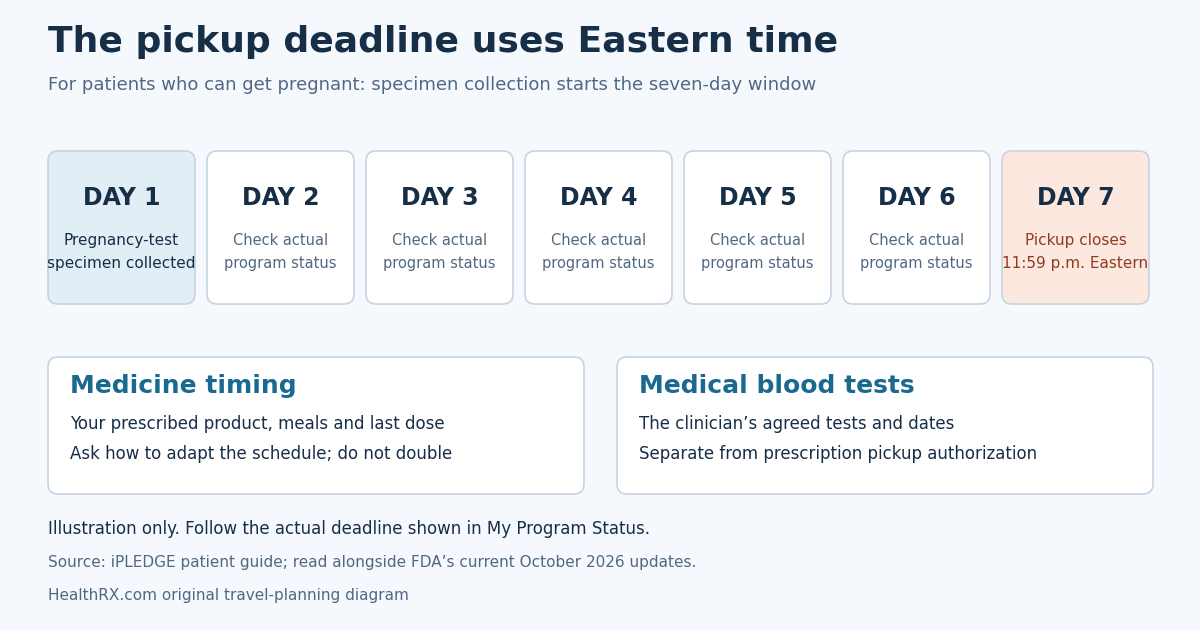
Every patient dispensed isotretinoin in the United States must be enrolled in iPLEDGE regardless of where they physically reside during therapy [1]. The program's December 2021 update removed the gender-based testing split and now categorizes patients as "people who can get pregnant" or "people who cannot get pregnant," but the monthly verification windows remained unchanged [1]. Patients who can get pregnant must use two forms of contraception and confirm a negative pregnancy test within 30 days before each prescription fill. The prescription must be filled within 7 days of the prescriber's authorization.

International travel does not extend these windows. The iPLEDGE portal is accessible from any internet connection, so the 30-day and 7-day clocks continue running from any country.

Pre-Travel Checklist: What to Do Before You Board

A structured pre-departure review 2 to 4 weeks before travel prevents most in-trip complications.

Medication Supply and Customs Documentation

Bring enough isotretinoin to cover the entire trip plus a 7-day buffer. Isotretinoin dispensing in the United States is a 30-day supply per fill because of iPLEDGE [1]. For trips longer than 3 weeks, the prescriber may need to authorize a fill early or coordinate with an in-network pharmacy that will hold a second fill for pickup immediately before departure. Keep all capsules in the original pharmacy-labeled container. Do not transfer them to a weekly pill organizer for customs purposes; labeled packaging demonstrates legal possession.

Carry a letter on clinic letterhead stating the patient's name, the drug name, the dose, the prescriber's contact information, and the clinical indication. Some countries restrict retinoids at the border. Japan, Brazil, and several Gulf Cooperation Council states have specific import rules for retinoids; checking with each country's embassy at least 30 days before travel is prudent.

Laboratory Planning Across Time Zones

The iPLEDGE lab window requires results from a certified laboratory. Outside the United States, Quest Diagnostics and LabCorp do not operate, but many international hospitals and private clinics can run a serum or urine beta-hCG and a lipid panel with liver function tests (the standard isotretinoin monitoring panel) [3].

Before departure, identify a laboratory at your destination that can run these tests and can provide results in English or with a certified translation. The prescriber needs to upload the results to iPLEDGE. Confirm whether the international lab's reference ranges will be interpretable against U.S. Thresholds. Triglycerides above 800 mg/dL require dose reduction or discontinuation regardless of country [3].

Contraception Continuity

For patients who can get pregnant, combined oral contraceptives (COC), a levonorgestrel IUD, or a long-acting reversible contraceptive (LARC) should be the primary method. Traveling across time zones creates COC timing errors if the patient takes their pill at a local-time clock rather than maintaining the original interval. Missing the daily COC window by more than 3 hours increases ovulation risk for progestin-only pills; for combined pills the window is longer but the principle still applies.

The American College of Obstetricians and Gynecologists (ACOG) guidance on hormonal contraception timing states that for combined estrogen-progestin pills, any pill taken within 24 hours of the scheduled time maintains contraceptive efficacy [4]. Even so, isotretinoin patients should use a backup method (condoms) for the first 7 days after any major schedule disruption, consistent with the iPLEDGE requirement for two concurrent contraceptive methods [1].

Timezone-Shift Dosing Protocols

Once-Daily Dosing Across Time Zones

The 21-hour half-life provides a buffer. For time zone crossings of 6 hours or fewer, no formal dosing transition is necessary. Take the dose at the usual local time at the destination. For crossings of 7 to 12 hours (for example, U.S. East Coast to Central Europe, or U.S. West Coast to East Asia), use a 3-day stepwise shift:

  • Day 1 at destination: take the dose 3 to 4 hours later than the home schedule.
  • Day 2: take the dose 3 to 4 hours later again.
  • Day 3 onward: take the dose at the target local time.

This approach prevents the plasma trough from widening beyond roughly 28 to 30 hours between doses. A trough this wide is unlikely to produce a clinically meaningful dip in retinoid receptor activation given isotretinoin's tissue half-life in sebaceous glands, but it keeps the dosing interval predictable. For crossings beyond 12 hours, complete the 3-day transition protocol and confirm the new target time with the prescriber before travel.

Twice-Daily Dosing Across Time Zones

Twice-daily dosing (typically 0.5 mg/kg morning and 0.5 mg/kg evening) requires maintaining a consistent 10 to 14 hour interval. On long-haul flights, count forward from the last dose taken at home. If the interval would exceed 14 hours before landing, take the next dose during the flight with whatever fatty food is available on board, even a small bag of peanuts or an airline croissant. If the interval would fall below 8 hours, skip the in-flight dose and resume on arrival with the evening dose.

What to Do If a Dose Is Missed

Missed doses should be skipped, not doubled. Because isotretinoin accumulates in adipose tissue and sebaceous glands, a single missed dose does not reset efficacy. Strauss et al. (1984, N=150) established that durable remission depends on total cumulative dose reaching 120 to 150 mg/kg rather than on maintaining a specific peak plasma level on any given day [5]. A missed dose lowers cumulative dose marginally but does not reverse progress. Doubling the next dose raises the risk of acute toxicity including headache, myalgia, and elevated intracranial pressure.

Sun Protection and Environmental Exposure Abroad

Isotretinoin increases photosensitivity by thinning the stratum corneum and reducing sebaceous gland output, which removes some of the skin's natural barrier function [6]. UV exposure at tropical latitudes, high altitudes, or on reflective surfaces (snow, white sand, open water) is meaningfully greater than at home for most U.S.-based patients.

Sunscreen Selection for Travelers

Use a broad-spectrum sunscreen with SPF 50 or higher. Mineral-based sunscreens (zinc oxide 20% or titanium dioxide) are preferred over chemical UV filters in patients on isotretinoin because some chemical filters can irritate already-sensitized skin [6]. Reapply every 2 hours when outdoors, and immediately after swimming or sweating. Do not rely on SPF-rated clothing alone; neck, ears, and hand dorsa are consistently under-protected.

Physical sun avoidance between 10 a.m. And 4 p.m. Local time is especially relevant at latitudes below 30 degrees north or above 30 degrees south during summer months. The UV index in destinations like Miami (June UV index average 11), Bangkok (UV index 12 to 13 year-round), or the Maldives (UV index 12 to 14) exceeds the UV index of a typical northern U.S. Winter city by a factor of 3 to 4 [7].

Altitude and Dry-Cabin Air

Pressurized cabin humidity averages 10 to 20%, far below the 40 to 60% humidity of a typical indoor environment. Isotretinoin already reduces lacrimal gland secretion and mucous membrane moisture [6]. Long flights worsen ocular dryness and cheilitis. Use preservative-free artificial tears every 2 hours during flight. Apply a fragrance-free emollient (petrolatum or ceramide-based) to lips and nostrils before boarding. At high-altitude destinations (above 2,500 meters), UV intensity increases approximately 10 to 12% per 1,000 meters of elevation [7]. Adjust sunscreen frequency accordingly.

Heat, Diet, and Lipid Management Abroad

Isotretinoin raises serum triglycerides in roughly 25% of patients, and up to 44% may show some elevation [3]. Travel diets in many destinations are higher in refined carbohydrates and saturated fats than a patient's home diet, which may exacerbate triglyceride elevation.

Managing Triglycerides Without a Home Lab

If lab access abroad is limited, the practical strategy is dietary. Reduce alcohol completely; alcohol is an independent triglyceride driver and interacts additively with isotretinoin. Limit added sugars and refined carbohydrates. Eat fish or plant-based omega-3 sources daily. The FDA label for isotretinoin states that triglycerides above 500 mg/dL require dose reduction, and above 800 mg/dL require discontinuation [3]. If a patient develops symptoms consistent with pancreatitis (epigastric pain, nausea, vomiting) while abroad, they should seek emergency evaluation and hold isotretinoin until triglyceride levels are confirmed below 500 mg/dL.

Alcohol on the Road

No safe level of alcohol has been defined during isotretinoin therapy. Both isotretinoin and alcohol are hepatotoxic at elevated exposures, and the combination raises transaminases more than either alone in animal models [8]. For travelers attending events where alcohol is socially expected, the practical clinical instruction is to limit intake to no more than one standard drink per occasion and to ensure a liver function panel is drawn at the next available iPLEDGE monitoring visit.

iPLEDGE Portal Management from Abroad

The iPLEDGE portal (ipledgeprogram.com) is web-based and functions from any country with internet access. Patients log in with their username and password, confirm their two contraceptive methods, answer the monthly educational questions, and acknowledge their pregnancy test result. The system does not know or care what time zone the patient is in.

The practical risk is a 7-day fill window that expires while a patient is in transit or in a remote location without pharmacy access. The HealthRX Isotretinoin Travel Decision Framework (to be reviewed and finalized by the HealthRX medical team before publication) recommends the following sequence for any trip longer than 10 days:

  1. Confirm the iPLEDGE authorization date for the next expected fill.
  2. If that date falls during the trip, coordinate a fill at a U.S. Specialty pharmacy before departure that can ship to a U.S. Address, or arrange for a trusted contact to pick up and hold the prescription.
  3. If the patient will return before the 30-day lab window closes, draw labs within 2 days of return and upload results before the 30-day clock expires.
  4. If the 30-day window will expire during the trip, identify an international lab capable of running the required panel and coordinate upload of results with the prescriber before departure.

Telemedicine follow-up with the prescriber from abroad is legally permissible in most jurisdictions for patients established in care. Schedule a video visit at the midpoint of any trip exceeding 3 weeks to review labs, symptoms, and contraceptive status.

Customs, Legal Status, and Country-Specific Restrictions

Isotretinoin is a Pregnancy Category X drug in the United States and carries equivalent warnings under EMA (EU) and Health Canada classifications. Its import is controlled or restricted in a number of countries.

Countries with Known Restrictions

Saudi Arabia and several other GCC states restrict the import of isotretinoin without advance authorization from the Ministry of Health. Brazil's ANVISA requires a special prescription (receita especial) for dispensing and may not honor U.S. Prescriptions. Japan classifies isotretinoin under its Pharmaceutical and Medical Devices Act in a category that requires import notification for personal use quantities exceeding a 1-month supply [9]. Australia's Therapeutic Goods Administration (TGA) permits personal importation of a 3-month supply with a valid prescription but requires the drug to remain in original packaging.

Carrying more than a 3-month supply through any international customs checkpoint raises scrutiny regardless of country. For trips requiring more than 90 days of supply, consult the embassy of each destination country and the prescribing physician's office at least 6 weeks before departure.

Airport Security in the United States

The Transportation Security Administration (TSA) does not require prescription medications to be declared separately, but keeping isotretinoin in a carry-on rather than checked luggage prevents loss from misrouted baggage. Temperature excursions in aircraft holds (which can reach -40°C) degrade soft-gel capsule integrity. Store isotretinoin at 15 to 30°C per FDA label guidance [3].

Monitoring Parameters and When to Stop the Drug

Standard isotretinoin monitoring includes CBC, LFTs (AST, ALT), and a fasting lipid panel at baseline and at 4-week intervals or per prescriber discretion. The Endocrine Society and AAD recommend dose reduction for ALT or AST above three times the upper limit of normal, and discontinuation if elevations persist [10].

While traveling, patients should be aware of symptoms that require holding isotretinoin immediately regardless of where labs stand:

  • Severe headache with visual changes (papilledema, pseudotumor cerebri)
  • Epigastric or mid-back pain suggesting pancreatitis
  • Severe musculoskeletal pain or dark urine suggesting rhabdomyolysis
  • Severe mucocutaneous reactions (Stevens-Johnson syndrome)
  • Depression, mood change, or suicidal ideation (a pharmacovigilance signal that remains under investigation) [11]

The FDA MedWatch program accepts adverse event reports from patients internationally at fda.gov/safety/medwatch [1]. Documenting and reporting any serious adverse event during travel protects the patient's medical record and contributes to post-market surveillance data.

Return Home: Resuming Normal Protocol

Within 48 hours of return, patients should:

  1. Confirm iPLEDGE login and check the status of the next authorization window.
  2. Draw a full monitoring panel if the 30-day window is within 10 days of closing.
  3. Resume the home dosing schedule. No re-titration is needed after travel.
  4. Schedule a follow-up visit with the prescriber to review any lab results obtained abroad.

The cumulative dose target of 120 to 150 mg/kg established by Strauss et al. (1984, N=150) remains the benchmark for durable remission, defined as no relapse requiring re-treatment at 5 years of follow-up [5]. Time lost to missed doses during travel is recoverable by extending the course by the number of missed days, subject to prescriber review and iPLEDGE re-authorization if the course extension crosses a new 30-day window.

A prescriber note in the medical record documenting the travel period, the expected number of missed doses, and the plan to recover those dose-days is the cleanest way to protect both the patient's outcome and the clinical record.

Frequently asked questions

Can I take isotretinoin on a plane?
Yes. Keep capsules in the original pharmacy-labeled container in your carry-on bag. Aircraft hold temperatures can damage soft-gel capsules. The TSA does not require declaration of prescription medications, but carry a physician letter documenting the prescription for international customs checkpoints.
What happens if I miss a dose of Accutane while traveling?
Skip the missed dose and take the next dose at the scheduled time. Do not double up. A single missed dose reduces your cumulative total marginally but does not reverse progress. Doubling the dose increases the risk of headache, myalgia, and elevated intracranial pressure.
Does crossing time zones affect how isotretinoin works?
The drug's pharmacokinetics are unchanged, but your dosing interval shifts. For crossings under 6 hours, take the dose at the new local time. For crossings of 7 to 12 hours, use a 3-day stepwise shift of 3 to 4 hours per day to avoid extending the dosing interval beyond 28 to 30 hours.
How do I handle iPLEDGE requirements while abroad?
The iPLEDGE portal is web-accessible from any country. Your 30-day lab window and 7-day fill window continue running. Identify an international lab before departure if your lab window expires during the trip, and coordinate result upload with your prescriber before you leave.
Can I get my isotretinoin prescription filled in another country?
In most countries, U.S. Prescriptions are not honored. You must bring an adequate supply from the United States. Some countries also restrict isotretinoin import. Check with the embassy of each destination country at least 30 days before travel.
How much sun protection do I need while on Accutane abroad?
Use SPF 50 or higher broad-spectrum sunscreen, reapplied every 2 hours. At tropical latitudes or high altitudes, UV index can reach 12 to 14, three to four times higher than a typical northern U.S. Winter environment. Mineral sunscreens with zinc oxide 20% are preferred.
Is alcohol safe to drink while traveling on isotretinoin?
No safe level has been defined. Both isotretinoin and alcohol stress the liver. Limit intake to no more than one standard drink per occasion if social circumstances make complete abstinence impractical, and ensure a liver function panel is drawn at the next iPLEDGE visit.
What should I do if my contraception schedule is disrupted by time zone changes?
For combined oral contraceptives, any pill taken within 24 hours of the scheduled time maintains efficacy per ACOG guidance. Use condom backup for 7 days after any significant schedule disruption. IPLEDGE requires two concurrent contraceptive methods throughout therapy.
How do I manage isotretinoin monitoring labs in a foreign country?
Identify a private hospital or clinic lab at your destination before departure. Confirm it can run serum beta-hCG, a lipid panel, and liver function tests. Ensure results are in English or can be translated. Your U.S. Prescriber must upload results to iPLEDGE.
What are the signs that I should stop isotretinoin immediately while traveling?
Hold the drug and seek emergency care for severe headache with visual changes, epigastric or back pain suggesting pancreatitis, dark urine suggesting rhabdomyolysis, severe skin reactions, or worsening depression or suicidal ideation. Contact your prescriber and report to FDA MedWatch.
Does isotretinoin need to be refrigerated during travel?
No. Store at 15 to 30 degrees Celsius, which is standard room temperature. Keep capsules out of direct sunlight and away from humidity. Aircraft cabin overhead bins are an adequate storage environment; the hold is not.
How does high altitude affect isotretinoin therapy?
UV intensity increases roughly 10 to 12 percent per 1,000 meters of elevation above sea level. At altitudes above 2,500 meters, reapply sunscreen more frequently and increase physical sun avoidance. Altitude does not alter isotretinoin pharmacokinetics or iPLEDGE requirements.

References

  1. U.S. Food and Drug Administration. IPLEDGE REMS Program for Isotretinoin. FDA Drug Safety Communication. Updated December 2021. https://www.fda.gov/drugs/postmarket-drug-safety-information-patients-and-providers/isotretinoin-ipledge
  2. Colburn WA, Gibson DM, Wiens RE, Hanigan JJ. Food increases the bioavailability of isotretinoin. J Clin Pharmacol. 1983;23(11-12):534-539. https://pubmed.ncbi.nlm.nih.gov/6644633/
  3. Roche Laboratories Inc. Accutane (isotretinoin) Prescribing Information. Revised 2010. https://www.accessdata.fda.gov/drugsatfda_docs/label/2010/018662s059lbl.pdf
  4. American College of Obstetricians and Gynecologists. Combined Hormonal Contraceptives. ACOG Practice Bulletin No. 206. 2019. https://www.acog.org/clinical/clinical-guidance/practice-bulletin/articles/2019/03/combined-hormonal-contraceptives
  5. Strauss JS, Rapini RP, Shalita AR, et al. Isotretinoin therapy for acne: results of a multicenter dose-response study. J Am Acad Dermatol. 1984;10(3):490-496. https://pubmed.ncbi.nlm.nih.gov/6232977/
  6. Leyden JJ. Retinoids and acne. J Am Acad Dermatol. 1988;19(1 Pt 2):164-168. https://pubmed.ncbi.nlm.nih.gov/3049832/
  7. World Health Organization. Global Solar UV Index: A Practical Guide. WHO/SDE/OEH/02.2. Geneva: WHO; 2002. https://www.who.int/publications/i/item/9241590076
  8. Vahlquist A, Rollman O. Clinical pharmacology of 3 generations of retinoids. Dermatologica. 1987;175(Suppl 1):20-27. https://pubmed.ncbi.nlm.nih.gov/2892324/
  9. Japan Ministry of Health, Labour and Welfare. Pharmaceutical and Medical Devices Act: Personal Import Notification Requirements. Updated 2022. https://www.mhlw.go.jp/english/policy/health-medical/pharmaceuticals/01.html
  10. Zaenglein AL, Pathy AL, Schlosser BJ, et al. Guidelines of care for the management of acne vulgaris. J Am Acad Dermatol. 2016;74(5):945-973. https://pubmed.ncbi.nlm.nih.gov/26897386/
  11. Huang YC, Cheng YC. Isotretinoin treatment for acne and risk of depression: a systematic review and meta-analysis. J Am Acad Dermatol. 2017;76(6):1068-1076. https://pubmed.ncbi.nlm.nih.gov/28291553/
Free2-min check·
Start assessment