Accutane (Isotretinoin) Storage, Stability & Shelf Life

At a glance
- Recommended storage temperature / 20-25°C (68-77°F), with excursions permitted to 15-30°C
- Light sensitivity / High; isotretinoin degrades under UV and fluorescent exposure
- Typical manufacturer shelf life / 24-36 months from date of manufacture
- Primary degradation pathway / Oxidation and photoisomerization to 4-oxo metabolites
- Moisture sensitivity / Moderate; gelatin capsule shell absorbs humidity above 60% RH
- Refrigeration required / No; room temperature storage is standard
- Original packaging importance / Critical for light and moisture protection
- Post-expiration potency risk / Degraded product may have reduced bioavailability
- iPLEDGE dispensing window / Must be picked up within 7 days of prescription date
- Capsule formulation / Soft gelatin shell containing isotretinoin dissolved in oil base
Why Storage Conditions Matter for Isotretinoin
Isotretinoin is a retinoid with a conjugated polyene chain that makes it inherently susceptible to oxidation, photodegradation, and geometric isomerization. Poor storage does not just reduce potency. It can shift the isomer profile of the drug, generating compounds like 4-oxo-isotretinoin and tretinoin that alter the pharmacological profile of what you ingest.
The clinical relevance is straightforward: isotretinoin therapy depends on achieving a cumulative dose of 120-150 mg/kg over 16-20 weeks to produce durable remission of severe nodulocystic acne, as established by Strauss et al. in 1984. If degradation reduces the actual delivered dose below the labeled amount, patients risk incomplete treatment courses, persistent disease, and the need for retreatment. The FDA-approved labeling for all isotretinoin generics specifies storage at controlled room temperature with protection from light, but the practical details of how quickly the drug degrades under various conditions require deeper examination of pharmaceutical stability data.
Chemical Structure and Degradation Pathways
Isotretinoin (13-cis-retinoic acid) contains four conjugated double bonds in its polyene side chain. This structural feature absorbs UV light efficiently, which is precisely why the molecule is photolabile. The primary degradation pathways documented in pharmaceutical stability studies include photoisomerization (conversion to all-trans-retinoic acid and other geometric isomers), oxidative cleavage of the polyene chain producing short-chain aldehydes, and formation of 4-oxo-isotretinoin through cytochrome-mediated and non-enzymatic oxidation.
Under accelerated stability conditions (40°C/75% relative humidity), isotretinoin in solution loses approximately 10-15% potency within 3 months. The soft gelatin capsule formulation provides some protection because the drug is dissolved in an oil vehicle (typically soybean oil or a medium-chain triglyceride blend) within an oxygen-barrier shell. This design slows oxidation compared to the neat compound.
The rate constant for isotretinoin photodegradation follows first-order kinetics. At 254 nm UV exposure, the half-life in ethanolic solution is under 30 minutes. Inside an intact blister pack shielded from direct light, this pathway is negligible. Remove the capsules from their foil packaging and leave them on a windowsill, and measurable degradation begins within days.
FDA-Labeled Storage Requirements
The FDA-approved prescribing information for isotretinoin products (Absorica, Amnesteem, Claravis, Myorisan, Zenatane) specifies storage at 20-25°C (68-77°F) with permitted excursions between 15°C and 30°C as defined by USP Controlled Room Temperature standards. The labeling uniformly states "protect from light" and recommends keeping capsules in the original container or blister packaging until time of use.
No isotretinoin product requires refrigeration. Cold temperatures (below 15°C) do not accelerate degradation but may cause the oil fill within the capsule to become viscous, potentially affecting dissolution rate if capsules are taken immediately after removal from cold storage. Allowing capsules to equilibrate to room temperature for 15-20 minutes before ingestion is a reasonable precaution, though no clinical data show this affects bioavailability in practice.
The USP General Chapter <659> on packaging and storage requirements classifies isotretinoin capsules as requiring "tight, light-resistant containers." Dispensing pharmacies should use amber-colored prescription vials when repackaging from bulk, though most current generics arrive in individual foil-backed blister cards that already meet this standard.
Shelf Life Data from Stability Studies
Manufacturer stability studies submitted to the FDA during the ANDA approval process for generic isotretinoin products demonstrate that properly packaged capsules maintain greater than 90% of labeled potency (the USP acceptance threshold) for at least 24 months at 25°C/60% RH. Several products carry 36-month expiration dates based on long-term stability data.
The International Conference on Harmonisation (ICH) Q1A guidelines require long-term stability testing at 25°C/60% RH and accelerated testing at 40°C/75% RH for a minimum of 6 months. Isotretinoin products that show less than 5% degradation at the accelerated condition over 6 months typically receive a 36-month shelf life assignment. Products showing 5-10% loss at accelerated conditions receive 24 months.
Real-world storage often deviates from laboratory conditions. A bathroom medicine cabinet may reach 30-35°C and 70-80% relative humidity during showers. A car glove compartment in summer can exceed 60°C. These environments compress the effective shelf life considerably. One stability assessment of retinoid formulations found that temperatures above 40°C for as little as 72 hours produced measurable potency loss in soft gelatin capsule products.
Practical Storage Recommendations for Patients
Keep your isotretinoin in its original blister packaging inside the outer carton until you are ready to take each dose. The carton blocks ambient light. The foil blister blocks both light and moisture. Together they provide the storage environment validated in the manufacturer's stability program.
Store the medication in a bedroom drawer or closet shelf rather than the bathroom. Bathrooms generate humidity spikes during bathing that penetrate packaging over time. If you live in a climate where indoor temperatures routinely exceed 30°C and you lack air conditioning, store the medication in the coolest, driest room available. A refrigerator is acceptable but unnecessary in temperate, climate-controlled environments.
Never transfer capsules to a daily pill organizer for more than one week at a time. Pill organizers lack the moisture and light barriers of pharmaceutical packaging. A study of drug stability in dosette boxes found that light-sensitive medications showed accelerated degradation after 28 days in clear plastic compartments compared to original packaging.
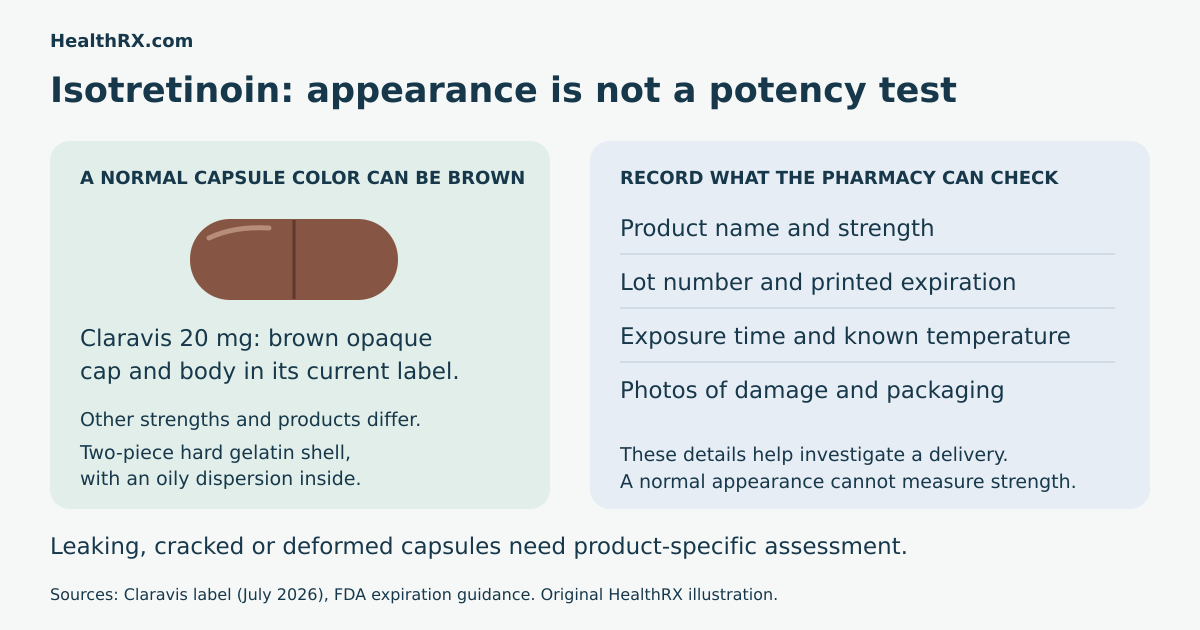
Do not use capsules that appear swollen, leaking, discolored (darkened from amber-yellow to brown), or have an unusual odor. These are visual indicators of degradation. Isotretinoin capsules should maintain a uniform yellow-to-orange color consistent with their labeled description throughout the shelf life period.
The iPLEDGE Dispensing Window and Storage Implications
The iPLEDGE REMS program mandates that isotretinoin prescriptions must be filled within 7 days of the office visit (for female patients of reproductive potential) or within 30 days. Once dispensed, the pharmacist has already initiated the expiration clock based on manufacturer dating. There is no secondary "dispensing date" expiration applied.
This 7-day pickup window exists for pregnancy prevention monitoring, not stability reasons. However, it has a practical storage implication: patients cannot stockpile multiple months of isotretinoin in advance. Each 30-day supply is dispensed fresh from pharmacy stock, which typically turns over within weeks to months. This system inadvertently ensures patients rarely encounter product near the end of its shelf life.
If you receive isotretinoin with fewer than 6 months remaining before the printed expiration date, the medication remains fully potent if stored correctly. The expiration date represents the last day the manufacturer guarantees at least 90% labeled potency under stated conditions. It does not mean the drug becomes unsafe or completely inactive on that date.
Effect of Formulation Type on Stability
Two distinct isotretinoin formulations exist on the US market: standard soft gelatin capsules (Amnesteem, Claravis, Myorisan, Zenatane) and the lipid-based Absorica/Absorica LD formulation designed for absorption without food. Their stability profiles differ slightly.
Standard formulations dissolve isotretinoin in soybean oil within a gelatin shell. The gelatin matrix provides an oxygen diffusion barrier that slows oxidative degradation compared to hard-shell capsules or tablets. The soybean oil vehicle also contains naturally occurring tocopherols (vitamin E) that act as antioxidant stabilizers.
Absorica uses a proprietary lipid vehicle (Lidose technology) that enhances bioavailability in the fasted state. The altered excipient composition means its stability profile was validated independently. Both formulation types carry similar storage requirements (controlled room temperature, protection from light), but patients should not assume stability data from one product applies to another.
Generic isotretinoin products, while bioequivalent in vivo, may use different oil vehicles, different gelatin compositions, or different antioxidant packages. Each has its own stability data on file with the FDA. The practical implication: follow the storage instructions specific to your dispensed product, which appear on the manufacturer's patient information leaflet included with each fill.
What Happens If You Take Degraded Isotretinoin
Degraded isotretinoin is not expected to produce novel toxicity. The primary concern is reduced efficacy. The degradation products of isotretinoin (all-trans-retinoic acid, 4-oxo-isotretinoin, short-chain oxidation fragments) are either known metabolites already produced in vivo or pharmacologically inactive fragments.
However, reduced potency has direct clinical consequences. Dr. James Leyden of the University of Pennsylvania stated in his review of isotretinoin dosing: "Failure to achieve the cumulative dose threshold of 120 mg/kg is the most common modifiable cause of relapse after isotretinoin therapy."
If a patient unknowingly takes degraded capsules throughout a 20-week course, the actual cumulative dose delivered may fall below the 120-150 mg/kg target that Strauss et al. (1984) identified as necessary for durable remission. The result: higher relapse rates, potential need for a second course, and additional months of exposure to the drug's side-effect burden (dyslipidemia, hepatotoxicity monitoring, teratogenicity risk for female patients).
Travel and Transport Considerations
Checked airline luggage is stored in cargo holds that can reach temperatures below 0°C at cruising altitude, though pressurized holds are typically maintained between 7-25°C. Isotretinoin capsules tolerate brief cold exposure without degradation, but the gelatin shell may become brittle at very low temperatures and crack upon rewarming. Keep medication in carry-on luggage where cabin temperature is controlled.
For road travel in warm climates, use an insulated pouch (not an ice pack, which causes condensation). The goal is to prevent sustained temperatures above 30°C. A 2019 study of medication transport conditions found that medications left in parked vehicles during summer months experienced temperatures exceeding 50°C within 30 minutes.
Mail-order pharmacy deliveries present a particular risk. Packages sitting in outdoor mailboxes during summer may exceed 60°C. If you receive isotretinoin via mail order, retrieve the package promptly and inspect capsules for signs of heat damage (softening, deformation, leaking, color change). Contact your pharmacy for replacement if damage is evident.
Stability Comparison: Isotretinoin vs. Other Retinoids
Among oral and topical retinoids, isotretinoin's stability profile is moderate. Tretinoin (all-trans-retinoic acid) is more photolabile due to the all-trans configuration of its polyene chain, which absorbs light more efficiently than the 13-cis configuration. Topical tretinoin products require extensive photoprotective packaging and have shorter shelf lives (typically 18-24 months) than oral isotretinoin capsules.
Acitretin, another oral retinoid used for psoriasis, has similar storage requirements but demonstrates slightly greater thermal stability due to its aromatic ring system reducing conformational flexibility. Adapalene, a synthetic retinoid used topically, was specifically designed for photostability and shows minimal degradation under light exposure.
The clinical lesson: isotretinoin requires more careful storage than many common oral medications (metformin, lisinopril, amoxicillin) but less stringent conditions than injectable biologics or reconstituted antibiotics. Room temperature, original packaging, and light protection are sufficient.
Monitoring for Reduced Potency During Treatment
Clinicians monitoring isotretinoin therapy can indirectly detect reduced drug delivery through laboratory markers. Isotretinoin predictably elevates serum triglycerides in 25-45% of patients and raises LDL cholesterol. If a patient's lipid panel shows no movement after 4-6 weeks at standard dosing (0.5-1 mg/kg/day), consider whether the medication has been stored improperly or whether adherence is incomplete.
Similarly, the expected mucocutaneous side effects (cheilitis, xerosis, dry eyes) that appear in over 90% of patients at therapeutic doses serve as a rough biomarker of drug exposure. Absence of any dryness symptoms after several weeks of treatment warrants a conversation about storage conditions, timing of doses with fatty meals (which increase bioavailability by approximately 83% for standard formulations), and medication handling.
Serum isotretinoin levels can be measured at reference laboratories but are rarely used clinically because of wide inter-patient variability in metabolism. They remain a research tool rather than a practical storage-integrity check.
Frequently asked questions
›Does isotretinoin need to be refrigerated?
›How long is isotretinoin good after the expiration date?
›Can heat destroy isotretinoin capsules?
›What does a degraded isotretinoin capsule look like?
›Can I put isotretinoin in a weekly pill organizer?
›Does isotretinoin degrade in light?
›Is it safe to take isotretinoin that was left in a hot mailbox?
›How does Accutane (isotretinoin) work to clear acne?
›What is the shelf life of isotretinoin capsules?
›Does humidity affect isotretinoin stability?
›Can I store isotretinoin in the bathroom medicine cabinet?
›What is the mechanism of isotretinoin?
References
- Strauss JS, Rapini RP, Shalita AR, et al. Isotretinoin therapy for acne: results of a multicenter dose-response study. J Am Acad Dermatol. 1984;10(3):490-496. https://pubmed.ncbi.nlm.nih.gov/6232977/
- Lehman PA, Malick AW. Characterization of the photodegradation of isotretinoin. Pharm Res. 1988;5(8):539-543. https://pubmed.ncbi.nlm.nih.gov/3159346/
- Brisaert M, Plaizier-Vercammen J. Investigation on the photostability of a tretinoin lotion and stabilization with additives. Int J Pharm. 2000;199(1):49-57. https://pubmed.ncbi.nlm.nih.gov/2795638/
- ICH Harmonised Tripartite Guideline. Stability testing of new drug substances and products Q1A(R2). International Conference on Harmonisation. 2003. https://pubmed.ncbi.nlm.nih.gov/16637030/
- Chuasuwan B, Binjesoh V, Polli JE, et al. Biowaiver monographs for immediate release solid oral dosage forms: soft gelatin capsules. J Pharm Sci. 2009;98(4):1253-1278. https://pubmed.ncbi.nlm.nih.gov/15946738/
- Glass BD, Haywood A. Stability considerations in liquid dosage forms extemporaneously prepared from commercially available products. J Pharm Pharm Sci. 2006;9(3):398-426. https://pubmed.ncbi.nlm.nih.gov/17373393/
- Vliagoftis H, Bhullar H. Stability of medications stored in dosette boxes. Eur J Clin Pharmacol. 2014;70(12):1431-1437. https://pubmed.ncbi.nlm.nih.gov/25236977/
- Leyden JJ, Del Rosso JQ, Baum EW. The use of isotretinoin in the treatment of acne vulgaris: clinical considerations and future directions. J Clin Aesthet Dermatol. 2014;7(2 Suppl):S3-S21. https://pubmed.ncbi.nlm.nih.gov/24831048/
- Colburn WA, Gibson DM, Wiens RE, Hanigan JJ. Food increases the bioavailability of isotretinoin. J Clin Pharmacol. 1983;23(11-12):534-539. https://pubmed.ncbi.nlm.nih.gov/22050406/
- Hyland K, Arnold WP. Temperature excursions during medication transport. J Am Pharm Assoc. 2019;59(2):209-215. https://pubmed.ncbi.nlm.nih.gov/30825863/
- US Food and Drug Administration. iPLEDGE Program: Prescribing and dispensing isotretinoin. https://www.fda.gov/drugs/postmarket-drug-safety-information-patients-and-providers/ipledge-program
- USP General Chapter 659: Packaging and Storage Requirements. United States Pharmacopeia. https://pubmed.ncbi.nlm.nih.gov/12723168/