Ferritin and Medicines: Read the Result in Context
A medicine can change ferritin without making the test wrong. Iron treatment can replenish stores; bleeding can deplete them. Inflammation can raise ferritin even when iron availability is limited. Separately, a supplement such as biotin can interfere with certain laboratory methods. These are different problems, and they need different explanations. [1–3]
The useful question is not simply, “Does this drug affect ferritin?” It is, “Does it change my iron balance, change the biology behind ferritin, or interfere with the measurement?” One result cannot answer that by itself.
Interpret ferritin alongside the clinical picture
Ferritin helps assess iron stores. A low result can indicate iron deficiency before hemoglobin falls, so a normal blood count does not necessarily rule out depleted stores. However, ferritin also rises with inflammation and other illnesses. WHO guidance emphasizes interpreting it in that context, rather than applying one cutoff to everyone. [1]
Use the reference interval printed on your own report. Intervals differ by age, sex and laboratory. A result outside that interval deserves interpretation, but the flag is not a diagnosis. Compare it with previous results, the reason for testing and any relevant blood-count or iron-study findings. [2]
Three different ways medicines enter the picture
| Type of change | Concrete examples | What the result means |
|---|---|---|
| Genuine change in iron stores or use | Oral or IV iron replenishment; ferritin decline observed during aspirin treatment; acid suppression associated with iron deficiency; red-cell production during testosterone treatment | Ferritin may correctly reflect a biological change. This is not a false assay value. [4–7,9] |
| Biological elevation that can obscure iron reserves | Inflammation, infection or liver disease occurring during treatment for another condition | The ferritin rise is real, but it may not faithfully represent stored iron. The illness and medication context need review. [1,2,8] |
| Analytical interference | Biotin exposure with a susceptible ferritin immunoassay | The laboratory method may produce a misleading measurement. Check the performing laboratory’s assay and preparation instructions. [2] |
More than one category can apply. Someone taking iron may also have an inflammatory illness, for example. A medication list helps explain possibilities; it does not establish the cause.
Oral iron, biotin and the test actually ordered
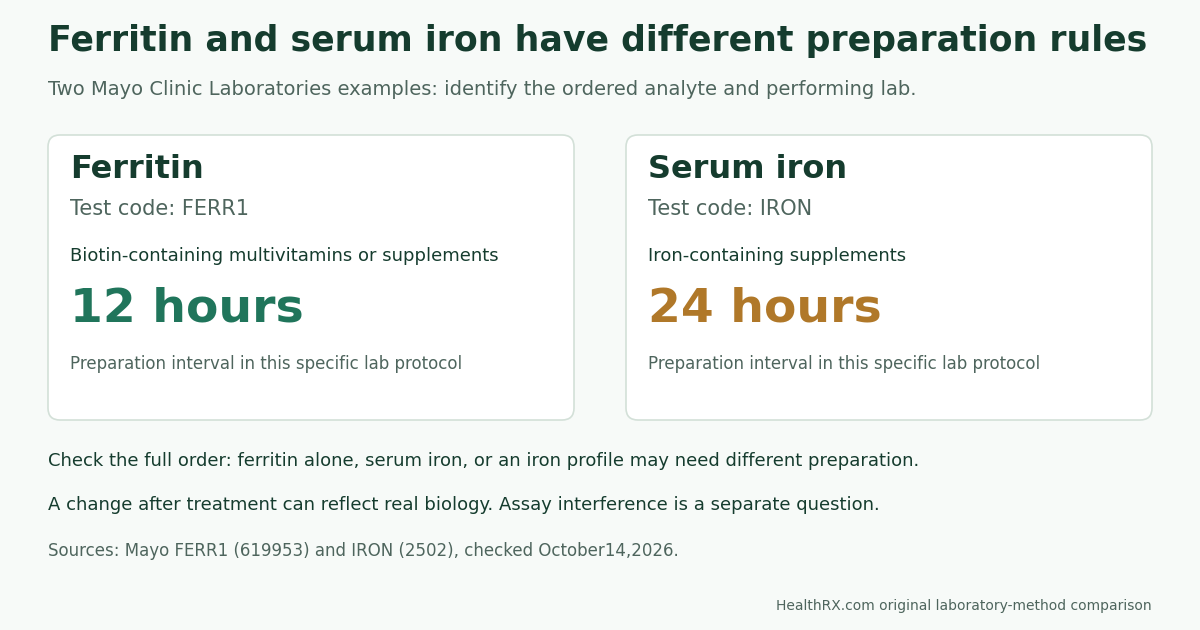
“An iron test” may mean ferritin alone, serum iron, or a profile that includes transferrin saturation. Preparation instructions are not interchangeable.
Mayo Clinic Laboratories’ serum-iron test specifies avoiding iron-containing supplements for 24 hours; it prefers, but does not require, an eight-hour fast. Oral iron can transiently raise serum iron substantially. That protocol should not automatically be applied to a ferritin-only order or turned into a recommendation to stop prescribed treatment. Ask which tests were ordered and whose instructions apply. [3]
Biotin is a different issue. Mayo’s FERR1 ferritin method uses an electrochemiluminescent sandwich immunoassay with biotin-related components. Its preparation instructions specify avoiding biotin-containing multivitamins or supplements for 12 hours. This is a particular laboratory protocol, not a universal washout for every assay or prescription-dose biotin. Share the exact product and dose with the laboratory. [2]
Reading ferritin after IV iron
An increase after IV iron is expected and is not automatically an assay error. Timing matters because the clinician may be assessing treatment response rather than establishing untreated iron stores.
For ferumoxytol specifically, the FERAHEME label calls for assessment of hemoglobin, ferritin, iron and transferrin saturation at least one month after the second infusion. That instruction does not establish a waiting period for every IV iron formulation. Record the product, last infusion date and purpose of the follow-up test; earlier measurements are not automatically meaningless. [4]
Medicines that can change iron balance
Aspirin provides an example of a biological effect, not laboratory distortion. In the ASPREE analysis of older community-dwelling adults, daily low-dose aspirin increased anemia incidence. The ferritin subset also showed greater declines than placebo. The study did not establish each participant’s cause of anemia. A falling result warrants review, not automatic aspirin discontinuation. [5]
Long-term acid suppression deserves a different discussion. A large case-control study associated at least two years of proton pump inhibitor or H2-receptor antagonist use with iron deficiency. It did not prove causation or show that every user develops impaired absorption. Moving a PPI dose away from the blood draw does not resolve a possible chronic iron-balance issue. [6]
Testosterone can increase iron use as red-cell production rises. A trial of testosterone gel in older men with mobility limitations found increased hemoglobin and hematocrit alongside reduced ferritin and hepcidin. This does not mean every person receiving testosterone has iron deficiency; the blood count and clinical context matter. [7]
When ferritin is high
High ferritin alone does not establish iron overload. Common explanations include inflammation, infection, liver disease, kidney disease, alcohol use and metabolic conditions. Depending on the situation, assessment may include transferrin saturation, a blood count, kidney function and liver tests. Inflammatory markers are useful when indicated, not mandatory with every ferritin measurement. [8]
Changes in menstrual bleeding during contraception or hormone therapy can also change iron losses. That is different from claiming estrogen directly raises ferritin by a predictable amount. When ferritin is low, consider bleeding, diet, absorption and iron demand rather than assuming a medicine explains everything. [9]
Bring a useful record
Before review, note the ordered tests, laboratory method if available, reference interval and collection date. Record exact oral-iron and biotin products, doses and last use; the IV iron formulation and last infusion date; other medication changes; bleeding changes; and recent inflammatory illness. Bring previous ferritin and blood-count results if available. This record supports interpretation without inventing a drug-hold schedule or a universal ferritin target.
Frequently asked questions
What is a normal ferritin level?
Use the age- and sex-appropriate reference interval on your laboratory report, not a universal online range. Interpretation also depends on inflammation, symptoms and other results. A value within the interval does not always settle whether iron availability is adequate. [1][2]
What does a high ferritin mean?
High ferritin can accompany inflammation, infection, liver disease, kidney disease, alcohol use or iron overload. The result alone cannot distinguish these causes. Your history, trend and selected tests—often including transferrin saturation—help determine what needs investigation. [8]
What does a low ferritin mean?
Low ferritin usually points toward depleted iron stores and can appear before anemia develops. The next question is why: blood loss, inadequate intake, reduced absorption or increased demand may contribute. Evaluation should address the cause, not just the laboratory number. [9]
Can testosterone therapy lower ferritin?
Yes. Testosterone can stimulate red-cell production and increase iron use. A trial in older men found lower ferritin alongside higher hemoglobin and hematocrit. That is a biological change, not assay distortion, and does not diagnose iron deficiency in every testosterone user. [7]
Do PPIs affect iron and ferritin levels?
Long-term PPI use has been associated with iron deficiency, potentially relevant when ferritin falls. The evidence does not prove that PPIs cause deficiency in every user. Review the indication and other possible causes with your clinician rather than stopping treatment yourself. [6]
How long after an IV iron infusion should I wait to check ferritin?
Timing depends on the product and purpose of testing. The FERAHEME label specifies assessing response at least one month after the second ferumoxytol infusion. Do not apply that schedule to every IV iron product; confirm the planned follow-up with your treating clinician. [4]
Does alcohol raise ferritin levels?
Alcohol use can be relevant to raised ferritin, including through liver disease. Ferritin alone cannot show whether alcohol is responsible or whether iron overload is present. There is no universally validated 72-hour abstinence period that resets ferritin; share your usual intake. [8]
Should I stop my iron supplement before a ferritin blood test?
Confirm the actual order and laboratory instructions. Mayo’s 24-hour supplement restriction is for serum iron, not automatically ferritin alone. Biotin may require separate assay-specific preparation. Do not apply either instruction as a blanket reason to stop prescribed medicines. [2][3]
What is soluble transferrin receptor and when should it be tested?
Soluble transferrin receptor is a blood marker related to cellular iron demand and red-cell production. It may help in selected uncertain cases, including when inflammation complicates ferritin interpretation. It is not needed for everyone; clinicians consider it alongside other findings. [3,7]
Can methotrexate cause elevated ferritin?
An elevated result during methotrexate treatment does not establish that the drug caused it. The underlying inflammatory condition, liver disease or another illness may contribute. Review the trend, symptoms and relevant liver tests with your clinician rather than assigning causality from ferritin alone. [8]
Does estrogen or birth control affect ferritin?
Hormonal treatment can change menstrual bleeding, which may change iron losses and eventually ferritin. The effect depends on the bleeding pattern and other factors. This does not establish a direct estrogen effect on ferritin synthesis or a predictable increase for every user. [9]
How do I know if my ferritin is high from iron overload or inflammation?
You cannot reliably distinguish them from ferritin alone. Transferrin saturation, medical history, ferritin trends and selected blood, liver or kidney tests help. Inflammatory markers may be appropriate when indicated. High ferritin by itself is not a reason to begin iron-removal treatment. [8]
References
Sources checked October 14, 2026.
- WHO guideline on use of ferritin concentrations to assess iron status in individuals and populations (2020)
- Mayo Clinic Laboratories: Ferritin, Serum—FERR1
- Mayo Clinic Laboratories: Iron, Serum
- DailyMed: FERAHEME prescribing information
- McQuilten et al. Effect of Low-Dose Aspirin Versus Placebo on Incidence of Anemia in the Elderly (2023)
- Lam et al. Proton Pump Inhibitor and Histamine-2 Receptor Antagonist Use and Iron Deficiency (2017)
- Bachman et al. Testosterone induces erythrocytosis via increased erythropoietin and suppressed hepcidin (2014)
- British Columbia: High Ferritin and Iron Overload—Investigation and Management (2021)
- British Columbia: Iron Deficiency—Diagnosis and Management