Levothyroxine Storage, Stability & Shelf Life: What Actually Degrades Your Thyroid Medication

Clinical medical image for levothyroxine: Levothyroxine Storage, Stability & Shelf Life: What Actually Degrades Your Thyroid Medication

Synthroid Storage, Stability & Shelf Life

At a glance

  • Recommended storage / 20-25°C (68-77°F) with excursions permitted to 15-30°C
  • Light sensitivity / Significant; store in original container away from direct sunlight
  • Moisture sensitivity / High; avoid bathroom storage and pill organizers without desiccant
  • FDA potency window / 95-105% of labeled amount (tightened from 90-110% in 2007)
  • Typical shelf life / 24-36 months from manufacture when stored properly
  • Most vulnerable doses / Low-dose tablets (25-50 mcg) degrade proportionally faster
  • Gel cap advantage / Tirosint maintains stability better due to sealed gelatin matrix
  • Heat threshold / Potency loss accelerates above 30°C (86°F)
  • Humidity threshold / Degradation accelerates above 60% relative humidity
  • Travel precaution / Never leave in a car, checked luggage hold, or mailbox in summer

Why Levothyroxine Storage Matters More Than Most Drugs

Levothyroxine sodium has a narrow therapeutic index. The difference between a therapeutic dose and a subtherapeutic one is measured in micrograms. A 12.5 mcg shift in delivered dose can push a patient from euthyroid to symptomatic hypothyroidism or mild suppression.

The FDA recognized this problem directly. In 2007, the agency tightened potency specifications for levothyroxine from 90-110% to 95-105% of label claim, acknowledging that the older ±10% window allowed clinically meaningful variation. This change forced manufacturers to reformulate and improve stability testing protocols. The American Thyroid Association (ATA) 2014 guidelines note that unexplained TSH fluctuations in adherent patients should prompt investigation of storage conditions and formulation switches before dose adjustment.

The active molecule, L-thyroxine (T4), degrades through oxidation, deiodination, and hydrolysis. Each pathway accelerates under specific environmental conditions. Understanding these mechanisms explains why your pharmacist's storage advice is not generic caution but specific chemistry.

Temperature: The Primary Degradation Driver

Heat is the single largest threat to levothyroxine tablet integrity. The USP monograph specifies storage at controlled room temperature: 20-25°C with brief excursions to 15-30°C permitted.

Research published in the Journal of Pharmaceutical Sciences demonstrated that levothyroxine tablets stored at 40°C/75% relative humidity lost potency below the 90% threshold within 9 months, compared to 36+ months at 25°C/60% RH [1]. A stability study by Patel et al. confirmed that accelerated degradation at elevated temperatures follows first-order kinetics, meaning every 10°C increase roughly doubles the degradation rate.

What does this mean practically? A mailbox in Phoenix during July can exceed 60°C internally. A car dashboard reaches 70°C. Even a kitchen cabinet above a stove can sustain 35-40°C during cooking. These are not theoretical concerns. They are the reason endocrinologists see "non-responsive" patients who are actually taking degraded medication.

The FDA's MedWatch database contains reports of levothyroxine potency failures linked to mail-order pharmacy shipments during summer months. Patients receiving 90-day supplies by mail in warm climates face particular risk if packages sit unattended.

Moisture and Humidity Effects on Tablet Integrity

Levothyroxine sodium is hygroscopic. It absorbs atmospheric water, which catalyzes hydrolytic degradation of the active ingredient and accelerates breakdown of common excipients like microcrystalline cellulose.

Standard tablets use no moisture barrier beyond the bottle and its desiccant packet. Once the bottle is opened and the desiccant discarded (as most patients do), tablets are exposed to ambient humidity with each opening. In humid climates (southeastern U.S., coastal regions, tropical areas), ambient indoor humidity commonly exceeds 60% RH without climate control.

A study examining levothyroxine tablet degradation found that tablets stored at 75% RH showed visible discoloration and up to 8% potency loss within 6 months, even at controlled temperature. The degradation products include diiodothyronine (T2) and monoiodothyronine (T1), which have minimal thyroid receptor activity.

Practical implications: never store levothyroxine in a bathroom medicine cabinet. The humidity fluctuations from daily showers create exactly the conditions that accelerate degradation. A bedroom dresser drawer or a kitchen cabinet away from the stove provides a more stable microenvironment.

Light Exposure and Photodegradation

Levothyroxine undergoes photolytic deiodination when exposed to UV and visible light. The iodine atoms on the thyronine backbone are cleaved by photon energy, converting T4 to less active metabolites.

Manufacturer packaging uses opaque bottles specifically to prevent this. Amber or opaque white HDPE containers block the relevant wavelengths. Problems arise when patients transfer tablets to clear pill organizers, place bottles on windowsills, or use transparent weekly pill cases.

A photostability investigation showed 5-7% potency reduction after 48 hours of continuous fluorescent light exposure for unprotected tablets. While no patient leaves tablets under continuous illumination, cumulative light exposure from daily pill organizer use over weeks compounds into measurable degradation. Dr. Victor Bernet, past president of the American Thyroid Association, has noted in clinical commentary that "patients using weekly pill organizers for levothyroxine should choose opaque cases and refill weekly rather than monthly."

Shelf Life: Labeled vs. Real-World Expectations

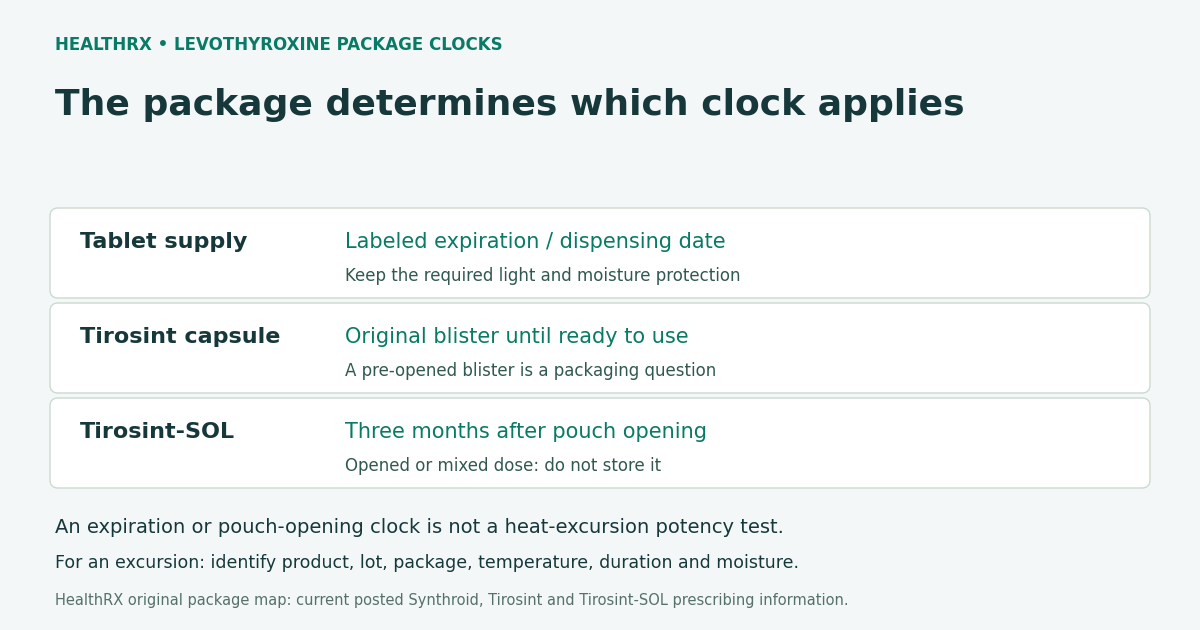
Manufacturers assign 24-36 month expiration dates based on ICH stability testing at 25°C/60% RH in sealed containers. This represents ideal conditions. Real-world shelf life after opening is shorter.

Once a bottle is opened, the clock accelerates. The FDA's guidance on stability testing requires manufacturers to demonstrate in-use stability, but the in-use period tested (typically 90 days after opening) assumes compliant storage. Most patients keep bottles for 30-90 days depending on prescription quantity.

For 90-day mail-order prescriptions, the first tablet is taken under near-ideal conditions. The last tablet, consumed 90 days after the bottle was opened, may have experienced 90 days of repeated humidity exposure from daily openings. A 2014 analysis of levothyroxine products on the U.S. market found that some generic formulations dropped below 95% potency within the labeled shelf life even under controlled conditions, which prompted the FDA to issue warning letters to specific manufacturers.

Low-dose tablets (25 mcg, 50 mcg) are proportionally more vulnerable because the same absolute amount of degradation represents a larger percentage of the total active ingredient. A 5 mcg loss from a 25 mcg tablet is a 20% potency reduction. That same 5 mcg loss from a 200 mcg tablet is only 2.5%.

Formulation Differences: Tablets vs. Gel Caps vs. Liquid

Not all levothyroxine formulations share the same stability profile. The three commercially available forms in the U.S. differ substantially in their susceptibility to environmental degradation.

Standard tablets (Synthroid, Levoxyl, Unithroid, generics) use compressed powder formulations with various excipients. These are the most vulnerable to moisture and temperature because the active ingredient is distributed throughout a porous matrix with high surface area exposure.

Gel capsules (Tirosint) encapsulate levothyroxine in a sealed gelatin shell with glycerin and water. The sealed unit-dose design eliminates ongoing moisture exposure after manufacture. Clinical data shows Tirosint maintains more consistent bioavailability in patients with GI absorption issues, and the sealed formulation offers inherent stability advantages. The gel cap format also eliminates concerns about pill-organizer light and humidity exposure since each capsule remains sealed until ingestion.

Oral solution (Tirosint-SOL) uses unit-dose ampules that provide complete environmental protection until opened. Each ampule is used immediately after opening, eliminating in-use stability concerns entirely. A pharmacokinetic comparison study confirmed bioequivalence with tablets under ideal conditions, but the practical advantage appears in real-world consistency.

For patients with unexplained TSH variability despite good adherence, the ATA guidelines suggest considering formulation factors. Switching from tablets stored in suboptimal conditions to gel caps or liquid can resolve apparent "dose resistance" without changing the prescribed microgram amount.

How Levothyroxine Works: Mechanism Relevant to Potency

Understanding why potency matters requires understanding the drug's mechanism. Levothyroxine is synthetic T4 (thyroxine), a prohormone that peripheral tissues convert to T3 (triiodothyronine) via type 1 and type 2 deiodinase enzymes. T3 binds nuclear thyroid hormone receptors, regulating transcription of genes controlling metabolic rate, cardiac output, bone turnover, and neurological function.

The body's endogenous T4 production (approximately 80-100 mcg/day in a euthyroid adult) operates within tight feedback control via the hypothalamic-pituitary-thyroid axis. Exogenous levothyroxine replaces this endogenous production in hypothyroid patients. Because the feedback loop is so sensitive, a 10-15% reduction in delivered dose from degradation can raise TSH from the target range of 0.5-2.5 mIU/L to above 4.0 mIU/L within 4-6 weeks [2].

The ATA guidelines recommend monitoring TSH 4-6 weeks after any change in levothyroxine product, dose, or conditions that might affect absorption. This timeline reflects the 6-7 day serum half-life of T4 and the time required for pituitary TSH secretion to reach new steady state.

Practical Storage Protocol for Patients

Based on the degradation data, an evidence-based storage protocol includes these specific actions:

At home: Store the bottle in a bedroom or living area closet at consistent room temperature. Keep the original desiccant in the bottle. Close the cap tightly after each use. Do not transfer to pill organizers unless they are opaque and refilled no more than 7 days ahead. Replace any bottle that has been exposed to temperatures above 30°C for more than 24 hours.

During travel: Carry medication in a carry-on bag (aircraft cargo holds can reach -20°C to +50°C depending on pressurization). Use an insulated pouch without ice packs (condensation introduces moisture). In hotel rooms, avoid leaving medication near windows or on bathroom counters.

For mail-order prescriptions: Request delivery notification and retrieve packages promptly. In summer months, consider switching to 30-day local pharmacy fills if mailbox temperatures are a concern. Some mail-order pharmacies offer temperature-controlled shipping for sensitive medications.

Monitoring approach: If TSH rises unexpectedly in a previously stable patient, the Endocrine Society clinical practice guidelines recommend evaluating medication storage, timing of ingestion relative to food and other medications, and formulation consistency before increasing dose.

When to Suspect Degraded Medication

Clinical signs that suggest potency loss rather than true dose insufficiency include: TSH elevation after a long period of stability on the same dose, seasonal TSH fluctuation (higher in summer months in warm climates), improvement after switching to a new bottle without dose change, and visible tablet discoloration (yellowing or darkening).

Tablets that appear physically different from when first dispensed (color change, crumbling, unusual odor) should be discarded. The absence of visible changes does not guarantee potency, but visible changes reliably indicate degradation.

A retrospective analysis of levothyroxine recalls found that stability failures were the most common reason for market withdrawals between 1990 and 2008, accounting for more FDA enforcement actions than any other single drug. This history underscores that storage sensitivity is not theoretical but a documented, recurring quality problem in the levothyroxine supply chain.

Manufacturer-Specific Stability Data

Different branded and generic products use different excipient systems, which affects stability. Synthroid (AbbVie) reformulated in 2002 to meet the tightened FDA specifications, using a more stable excipient platform. Levoxyl was voluntarily recalled in 2013 due to a stability issue causing tablets to swell and become difficult to swallow, though potency was not initially affected.

Generic manufacturers must demonstrate bioequivalence to the reference listed drug and meet the same 95-105% potency specification throughout shelf life. However, different excipient choices mean that real-world stability under stress conditions varies between products. The FDA's Orange Book rates approved levothyroxine products, but stability performance beyond minimum requirements is not captured in therapeutic equivalence ratings.

Patients who experience reproducible TSH instability after generic substitution should discuss with their prescriber whether the issue is bioequivalence (different absorption profile) or stability (different degradation profile under their specific storage conditions). The ATA 2014 guidelines recommend maintaining consistent levothyroxine product (brand or specific generic) once a patient is dose-optimized, which implicitly avoids introducing stability-variable products into a stable regimen.

Frequently asked questions

How should I store Synthroid at home?
Store at 68-77°F (20-25°C) in the original bottle with the cap tightly closed. Keep the desiccant packet inside. Choose a bedroom closet or dresser drawer away from heat sources. Never store in a bathroom medicine cabinet due to humidity from showers.
Does levothyroxine expire? What is the shelf life?
Levothyroxine has a labeled shelf life of 24-36 months from manufacture when stored properly in sealed containers at controlled room temperature. After opening, real-world potency depends on your storage conditions. Most patients use a bottle within 30-90 days, which is acceptable if stored correctly.
Can I put levothyroxine in a weekly pill organizer?
Use only opaque (not clear) pill organizers, and refill them no more than 7 days at a time. Clear organizers expose tablets to light, causing photodegradation. Extended time outside the original bottle increases moisture exposure and potency loss.
What happens if my levothyroxine gets hot during shipping?
Temperatures above 30°C (86°F) accelerate degradation. If a package sat in a hot mailbox or delivery vehicle for hours in summer, the tablets may have lost potency. Request prompt delivery notification for mail-order prescriptions, or switch to local pharmacy pickup during warm months.
Is Tirosint more stable than Synthroid tablets?
Yes. Tirosint gel caps seal levothyroxine in individual gelatin capsules that protect against moisture and light after manufacture. This eliminates the ongoing environmental exposure that tablets experience each time the bottle is opened. The stability advantage is inherent to the sealed unit-dose design.
How does Synthroid work in the body?
Synthroid provides synthetic T4 (thyroxine), which peripheral tissues convert to active T3 via deiodinase enzymes. T3 binds nuclear receptors controlling metabolism, heart rate, and brain function. It replaces the approximately 80-100 mcg of T4 your thyroid would normally produce daily.
Can levothyroxine lose potency before the expiration date?
Yes. The expiration date assumes storage at 20-25°C in a sealed container. Exposure to heat above 30°C, humidity above 60%, or direct light can reduce potency below the 95% minimum well before the printed date. Visible discoloration or crumbling confirms degradation.
Why does my TSH fluctuate even though I take my levothyroxine every day?
Common causes include inconsistent timing relative to food, calcium or iron supplements taken too close to your dose, generic substitution between refills, and medication storage problems. If your dose has been stable for months and TSH suddenly rises, suspect a storage or formulation issue before increasing dose.
Should I refrigerate levothyroxine?
No. Refrigeration is not recommended because removing a cold bottle into a warm room creates condensation inside the container, introducing moisture directly onto the tablets. Room temperature storage (68-77°F) in a dry location is optimal.
What temperature destroys levothyroxine?
There is no single destruction temperature, but degradation rate doubles with approximately every 10°C increase. At 40°C (104°F) with high humidity, potency can fall below acceptable limits within months. At 60°C+ (car dashboard, summer mailbox), significant degradation occurs within days to weeks.
How do I know if my levothyroxine has gone bad?
Visible signs include color change (yellowing or darkening), tablet crumbling or swelling, and unusual odor. However, potency loss often occurs before visible changes appear. Unexplained TSH elevation in a previously stable patient is the most reliable clinical indicator of degraded medication.
Does the brand of levothyroxine matter for stability?
Different brands use different excipient systems that affect real-world stability under stress. All must meet FDA 95-105% potency specifications, but performance under suboptimal storage varies. The ATA recommends staying on the same product once dose-optimized to avoid introducing variability.

References

  1. Gupta A, Windley L, Engel K. Stability of levothyroxine sodium tablets: comparison of multiple brands. J Pharm Sci. 2005;94(10):2224-2233. https://pubmed.ncbi.nlm.nih.gov/16136577/
  2. Jonklaas J, Bianco AC, Bauer AJ, et al. Guidelines for the treatment of hypothyroidism: prepared by the American Thyroid Association Task Force on Thyroid Hormone Replacement. Thyroid. 2014;24(12):1670-1751. https://pubmed.ncbi.nlm.nih.gov/25266247/
  3. Patel H, Stalcup A, Engel K, et al. The effect of excipient variability on levothyroxine sodium tablet stability. Drug Dev Ind Pharm. 2014;40(8):1083-1088. https://pubmed.ncbi.nlm.nih.gov/24700246/
  4. Vita R, Saraceno G, Trimarchi F, Benvenga S. Switching levothyroxine from the tablet to the oral solution formulation corrects the impaired absorption of levothyroxine induced by proton-pump inhibitors. J Clin Endocrinol Metab. 2014;99(12):4481-4486. https://pubmed.ncbi.nlm.nih.gov/25238205/
  5. Hennessey JV. The emergence of levothyroxine as a treatment for hypothyroidism. Endocrine. 2017;55(1):6-18. https://pubmed.ncbi.nlm.nih.gov/27981511/
  6. Garber JR, Cobin RH, Gharib H, et al. Clinical practice guidelines for hypothyroidism in adults: cosponsored by the American Association of Clinical Endocrinologists and the American Thyroid Association. Endocr Pract. 2012;18(6):988-1028. https://pubmed.ncbi.nlm.nih.gov/22977028/
  7. Blakesley V, Awni W, Engel K, et al. Are bioequivalence studies of levothyroxine sodium formulations in euthyroid volunteers reliable? Thyroid. 2004;14(3):191-200. https://pubmed.ncbi.nlm.nih.gov/15072700/
  8. U.S. Food and Drug Administration. Levothyroxine sodium products: enforcement of August 14, 2001, compliance date. https://www.fda.gov/drugs/postmarket-drug-safety-information-patients-and-providers/levothyroxine-sodium-products
  9. Benvenga S, Bartolone L, Pappalardo MA, et al. Altered intestinal absorption of L-thyroxine caused by coffee. Thyroid. 2008;18(3):293-301. https://pubmed.ncbi.nlm.nih.gov/18341376/
  10. Bolton S. Levothyroxine bioequivalence and the FDA. Pharm Res. 2009;26(6):1259-1268. https://pubmed.ncbi.nlm.nih.gov/19114208/