Traveling While on Amlodipine: What You Need to Know

At a glance
- Half-life / 30 to 50 hours, the longest of any calcium channel blocker
- Peak effect / 6 to 12 hours after oral dose
- Storage requirement / below 30°C (86°F), protect from moisture
- Ankle edema prevalence / 10.8% at 10 mg daily (ALLHAT data)
- Heat risk / vasodilation plus ambient heat can drop standing blood pressure
- Altitude concern / mild at elevations below 3,000 m for most patients
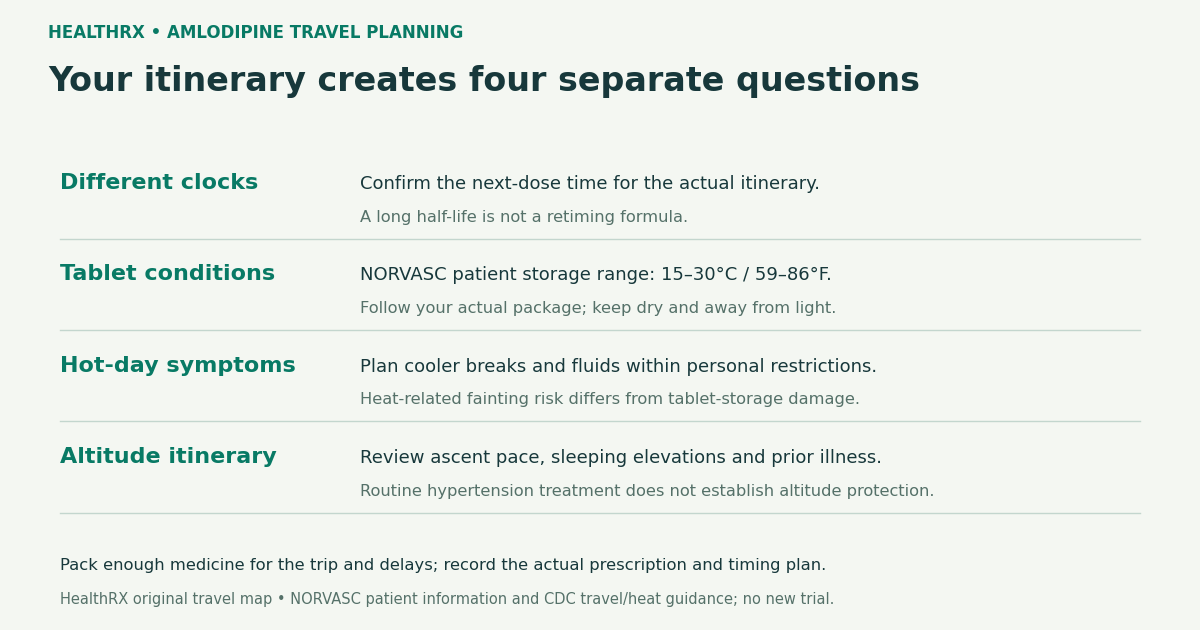
- Time zone adjustment / shift dose by 2 to 3 hours per day until aligned
- Drug class / dihydropyridine calcium channel blocker
- FDA pregnancy category / not recommended; discuss alternatives before travel if planning conception
Why Amlodipine Is Travel-Friendly Compared to Other Blood Pressure Drugs
Amlodipine's pharmacokinetic profile gives it a built-in safety margin that most other antihypertensives lack. Its elimination half-life of 30 to 50 hours means that plasma levels remain within therapeutic range even if a dose is taken several hours late [1]. Compare this with short-acting agents like captopril (half-life of approximately 2 hours) or immediate-release nifedipine, where a missed dose can cause rebound blood pressure spikes.
Steady-State Stability
Because amlodipine reaches steady state over 7 to 8 days, a single delayed dose does not produce the abrupt troughs seen with twice-daily medications [1]. The ALLHAT trial (N=33,357) confirmed that amlodipine-based therapy reduced cardiovascular events comparably to lisinopril and chlorthalidone, with adherence rates that favored the once-daily calcium channel blocker arm [2]. For travelers, this once-daily dosing simplifies pill management across time zones.
No Dietary Restrictions While Abroad
Unlike warfarin (vitamin K sensitivity) or certain ACE inhibitors that interact with potassium-rich foods, amlodipine carries no clinically meaningful food interactions [1]. Grapefruit juice can modestly increase amlodipine exposure via CYP3A4 inhibition, but the effect is small enough that the FDA labeling does not contraindicate it [3]. You can sample local cuisine without recalculating your dose.
Managing Time Zone Changes
Crossing multiple time zones is the most common dosing concern for any once-daily medication. Amlodipine's long half-life makes the adjustment forgiving, but a deliberate plan prevents confusion.
Short Trips (1 to 3 Time Zones)
For shifts of 3 hours or fewer, take your dose at the usual local-equivalent time. If you normally take amlodipine at 8 AM Eastern and fly to London (5 hours ahead), taking it at 1 PM London time on arrival day is acceptable. Shift by 1 to 2 hours per day until you reach your preferred morning time in the new zone. Blood pressure fluctuation from this minor adjustment is clinically insignificant given the drug's half-life [1].
Long-Haul Flights (4+ Time Zones)
When traveling east across 6 or more time zones, your "day" shortens. Do not double-dose to compensate. Take your regular dose before departure, then resume the next dose at your target local time in the destination, even if the interval is only 16 to 18 hours. The American Heart Association's 2024 self-measured blood pressure monitoring guidance recommends travelers carry a validated oscillometric monitor and check readings for 3 mornings after arrival to confirm stable control [4].
Traveling west lengthens the day. If 28 or more hours pass between doses, take an extra half-dose (2.5 mg if on 5 mg; 5 mg if on 10 mg) at the midpoint rather than waiting the full extended interval. Confirm this approach with your prescriber before departure.
Heat, Humidity, and Vasodilation
Amlodipine relaxes vascular smooth muscle. Hot climates do the same thing. The combination can drop blood pressure below comfortable levels, particularly standing blood pressure.
Orthostatic Hypotension Risk
A 2019 analysis in the Journal of Hypertension found that calcium channel blocker users had a 1.5-fold higher incidence of orthostatic hypotension during summer months compared to winter [5]. Symptoms include dizziness on standing, lightheadedness after walking in direct sun, and transient visual dimming. These effects are more pronounced during the first 2 weeks of heat acclimatization.
Practical Heat Strategies
Stay hydrated with 2.5 to 3 liters of fluid daily in tropical destinations. Avoid alcohol during peak heat hours (10 AM to 3 PM), as ethanol compounds vasodilation. Wear compression socks on hot days if you already experience amlodipine-related ankle swelling. The edema is not fluid overload. It is caused by precapillary arteriolar dilation with intact postcapillary venous tone, creating a pressure gradient that pushes fluid into the interstitial space [6]. Heat worsens this gradient.
If you notice persistent dizziness or systolic readings below 100 mmHg, contact a local physician. Do not stop amlodipine abruptly. While calcium channel blockers do not carry the same rebound risk as beta-blockers, uncontrolled hypertension during travel creates its own hazard.
Altitude and Amlodipine
High-altitude destinations (above 2,500 meters) present a distinct physiology. Hypoxia triggers sympathetic activation and pulmonary vasoconstriction. Blood pressure often rises during the first 24 to 48 hours at altitude before partial acclimatization occurs.
What the Evidence Shows
A randomized crossover study published in the European Heart Journal (N=83) found that nifedipine (a related dihydropyridine CCB) reduced systolic pulmonary artery pressure at 4,559 meters by approximately 7 mmHg compared to placebo [7]. Amlodipine has not been studied specifically at extreme altitude, but its mechanism of action (L-type calcium channel blockade) is pharmacologically similar. The 2018 Wilderness Medical Society practice guidelines note that calcium channel blockers "may be considered as adjunctive agents for prevention of high-altitude pulmonary edema in susceptible individuals" [8].
Practical Altitude Guidance
For moderate altitude (2,500 to 3,500 m), such as Denver, Bogotá, or Cusco, most amlodipine users require no dose adjustment. Monitor blood pressure twice daily for the first 3 days. At extreme altitude (above 4,000 m), discuss prophylactic acetazolamide with your physician before the trip, as acetazolamide can cause mild metabolic acidosis that theoretically alters renal clearance of some drugs, though this interaction with amlodipine is not clinically documented [8].
Dr. Andrew Luks of the University of Washington, a co-author of the Wilderness Medical Society altitude guidelines, has stated: "Patients on calcium channel blockers for systemic hypertension can generally continue their medication at altitude, but should monitor for excessive blood pressure lowering during the first 48 hours of acclimatization" [8].
Flying and Immobility
Long-haul flights combine low cabin humidity (10 to 20%), reduced cabin pressure (equivalent to 1,800 to 2,400 m altitude), and prolonged sitting. Each factor interacts with amlodipine's pharmacology in specific ways.
Cabin Pressure Effects
Commercial aircraft cabins are pressurized to the equivalent of 1,800 to 2,400 meters. This mild altitude exposure is well within the range most amlodipine users tolerate without any dose change. A study in Aviation, Space, and Environmental Medicine found that mean arterial pressure in hypertensive passengers increased by 3 to 5 mmHg during cruise altitude compared to ground level [9]. Amlodipine's vasodilatory action may actually buffer this mild rise.
Peripheral Edema During Flights
Ankle swelling is already the most common side effect of amlodipine, occurring in 1.8% of patients at 5 mg and 10.8% at 10 mg in the ALLHAT trial [2]. Prolonged sitting worsens dependent edema regardless of medication. Walk the cabin every 60 to 90 minutes. Consider below-knee compression stockings rated at 15 to 20 mmHg, which a Cochrane review found reduced leg edema and deep vein thrombosis risk during flights exceeding 5 hours [10].
Dehydration and Blood Pressure
Low cabin humidity accelerates insensible fluid loss. Combined with amlodipine's vasodilation, dehydration during a long flight can produce symptomatic hypotension upon standing after landing. Drink 200 to 250 mL of water per hour of flight and avoid excessive caffeine or alcohol, both of which are diuretic.
Medication Storage and Supply
Amlodipine tablets are stable at temperatures up to 30°C (86°F) and should be protected from moisture [1]. This matters when traveling to tropical climates or leaving medication in a car, suitcase, or hotel room without climate control.
Storage Rules
Never store amlodipine in checked luggage during air travel. Cargo holds can reach temperatures below freezing or above 40°C. Keep tablets in your carry-on in their original pharmacy container or a clearly labeled pill organizer. If traveling to a destination where daytime temperatures routinely exceed 35°C, store tablets in an insulated pouch (not directly on ice, which introduces moisture).
Carrying Enough Supply
Pack at least 7 extra days of medication beyond your trip length. Amlodipine is widely available internationally under various brand names (Norvasc, Istin, Amlor, Amlocard), but formulation strength and availability vary by country. Carry a written prescription or a letter from your physician listing the generic name, dose, and indication. The World Health Organization includes amlodipine on its Model List of Essential Medicines, which means it is stocked in most countries [11].
Crossing Borders with Medication
Amlodipine is not a controlled substance in any jurisdiction. You will not face customs scrutiny for carrying it. However, some countries require medications to be in original packaging with a pharmacy label. A brief letter from your prescriber avoids any ambiguity.
Monitoring Blood Pressure Away From Home
The 2024 AHA/AMA joint policy statement on self-measured blood pressure monitoring recommends validated upper-arm oscillometric devices over wrist monitors for accuracy [4]. Portable models weighing under 300 grams are available and fit easily in a carry-on.
When to Check
Measure blood pressure on the morning after arrival, before taking your dose. Repeat for 3 consecutive mornings. If readings are consistently above 140/90 mmHg or below 100/60 mmHg, contact your prescriber. The European Society of Hypertension 2023 guidelines define a home blood pressure target of <135/85 mmHg, which is 5 mmHg lower than the traditional office threshold [12].
Recording and Sharing Readings
Use a logbook or a smartphone app paired with your monitor. Timestamped readings help your physician assess whether blood pressure changes correlate with altitude, heat exposure, or time zone shifts versus a genuine change in disease control. As the 2023 ESH guidelines note: "Home blood pressure monitoring provides a more reliable estimate of usual blood pressure than office measurement and is associated with better prediction of cardiovascular risk" [12].
Alcohol, Diet, and Activity Changes During Travel
Travel often changes eating patterns, alcohol intake, and physical activity. Each of these can interact with amlodipine's blood pressure-lowering effect.
Alcohol
Amlodipine's prescribing information warns that alcohol can potentiate the vasodilatory effect of dihydropyridine calcium channel blockers [1]. Two or more standard drinks consumed in a hot environment while on amlodipine 10 mg can produce clinically meaningful hypotension. Limit intake to one standard drink per sitting during the first 48 hours in a new climate.
Sodium and Fluid Intake
High-sodium meals (common in restaurant and street food) can raise blood pressure acutely. This is less of a concern for amlodipine users than for patients on ACE inhibitors or diuretics, because amlodipine's mechanism does not depend on sodium balance. Still, the DASH-Sodium trial showed that reducing sodium intake from 3,300 mg/day to 1,500 mg/day lowered systolic blood pressure by 7.1 mmHg in hypertensive participants [13]. Try to maintain your usual dietary sodium range.
Exercise at Destination
Physical activity lowers blood pressure acutely through post-exercise hypotension, which can last 12 to 16 hours. If you plan a strenuous hike or a long day of walking, take your amlodipine dose after the activity rather than before, to avoid additive blood pressure lowering during exertion. A meta-analysis of 391 randomized controlled trials (N=48,266) in the British Journal of Sports Medicine found that a single bout of aerobic exercise reduced systolic blood pressure by a mean of 4.8 mmHg in hypertensive individuals [14].
International Prescriptions and Pharmacy Access
Running out of amlodipine abroad is rarely an emergency thanks to the drug's long half-life, but replacement should be obtained within 48 hours.
Pharmacy Availability
Amlodipine is the most widely prescribed calcium channel blocker globally, with availability in over 100 countries [11]. In many nations, including Mexico, Thailand, India, and most of the European Union, it is dispensed without a prescription or with minimal pharmacist review. In the United States, United Kingdom, Canada, and Australia, a local prescription is required.
Telehealth Options
Several international telehealth platforms can issue short-term prescriptions for continuation of existing medications. Before traveling, confirm whether your home insurer covers international telehealth consultations. Save a photo of your medication bottle label and your most recent blood pressure readings on your phone for quick reference during a virtual visit.
What to Do if You Miss a Dose While Traveling
A single missed dose of amlodipine is unlikely to cause a blood pressure crisis. Take the missed dose as soon as you remember, unless it is within 12 hours of your next scheduled dose, in which case skip it and return to your regular schedule [1]. Do not double up. If you miss two consecutive doses, check your blood pressure and contact your prescriber.
The 2020 International Society of Hypertension Global Hypertension Practice Guidelines specifically recommend that clinicians counsel patients on missed-dose protocols before travel, emphasizing that "long-acting agents such as amlodipine provide a pharmacological buffer that shorter-acting drugs do not" [15].
Frequently asked questions
›How does amlodipine affect daily life?
›Can I fly on amlodipine?
›Does amlodipine need to be refrigerated when traveling?
›What happens if I miss a dose of amlodipine during a trip?
›Can I drink alcohol while on amlodipine during vacation?
›Does altitude affect amlodipine?
›How do I adjust my amlodipine dose when crossing time zones?
›Is amlodipine available in other countries if I run out?
›Does heat make amlodipine side effects worse?
›Can I exercise at altitude while taking amlodipine?
›Should I carry a blood pressure monitor when traveling?
›Does amlodipine interact with common travel medications?
References
- U.S. Food and Drug Administration. Norvasc (amlodipine besylate) prescribing information. https://www.accessdata.fda.gov/drugsatfda_docs/label/2011/019787s047lbl.pdf
- ALLHAT Officers and Coordinators. Major outcomes in high-risk hypertensive patients randomized to angiotensin-converting enzyme inhibitor or calcium channel blocker vs diuretic (ALLHAT). JAMA. 2002;288(23):2981-2997. https://jamanetwork.com/journals/jama/fullarticle/195626
- Bailey DG, Dresser GK, Arnold JM. Grapefruit-medication interactions: forbidden fruit or avoidable consequences? CMAJ. 2013;185(4):309-316. https://pubmed.ncbi.nlm.nih.gov/23184849/
- Shimbo D, Artinian NT, Basile JN, et al. Self-measured blood pressure monitoring at home: a joint policy statement from the American Heart Association and American Medical Association. Circulation. 2020;142(4):e42-e63. https://www.ahajournals.org/doi/10.1161/CIR.0000000000000803
- Modesti PA, Morabito M, Massetti L, et al. Seasonal blood pressure changes: an independent relationship with temperature and daylight hours. Hypertension. 2013;61(4):908-914. https://pubmed.ncbi.nlm.nih.gov/23381795/
- Sica DA. Calcium channel blocker-related peripheral edema: can it be resolved? J Clin Hypertens. 2003;5(4):291-295. https://pubmed.ncbi.nlm.nih.gov/12939574/
- Maggiorini M, Mélot C, Pierre S, et al. High-altitude pulmonary edema is initially caused by an increase in capillary pressure. Circulation. 2001;103(16):2078-2083. https://www.ahajournals.org/doi/10.1161/01.CIR.103.16.2078
- Luks AM, Auerbach PS, Freer L, et al. Wilderness Medical Society clinical practice guidelines for the prevention and treatment of acute altitude illness: 2019 update. Wilderness Environ Med. 2019;30(4S):S29-S32. https://pubmed.ncbi.nlm.nih.gov/31248772/
- Humphreys S, Deyermond R, Bali I, et al. The effect of high altitude commercial air travel on oxygen saturation. Anaesthesia. 2005;60(5):458-460. https://pubmed.ncbi.nlm.nih.gov/15819766/
- Clarke MJ, Broderick C, Hopewell S, Juszczak E, Eisinga A. Compression stockings for preventing deep vein thrombosis in airline passengers. Cochrane Database Syst Rev. 2021;4:CD004002. https://www.cochranelibrary.com/cdsr/doi/10.1002/14651858.CD004002.pub4/full
- World Health Organization. WHO Model List of Essential Medicines, 23rd edition. 2023. https://www.who.int/publications/i/item/WHO-MHP-HPS-EML-2023.02
- Mancia G, Kreutz R, Brunström M, et al. 2023 ESH guidelines for the management of arterial hypertension. J Hypertens. 2023;41(12):1874-2071. https://pubmed.ncbi.nlm.nih.gov/37345492/
- Sacks FM, Svetkey LP, Vollmer WM, et al. Effects on blood pressure of reduced dietary sodium and the Dietary Approaches to Stop Hypertension (DASH) diet. N Engl J Med. 2001;344(1):3-10. https://www.nejm.org/doi/full/10.1056/NEJM200101043440101
- Naci H, Salcher-Konrad M, Dias S, et al. How does exercise treatment compare with antihypertensive medications? A network meta-analysis of 391 randomised controlled trials. Br J Sports Med. 2019;53(14):859-869. https://pubmed.ncbi.nlm.nih.gov/30563873/
- Unger T, Borghi C, Charchar F, et al. 2020 International Society of Hypertension global hypertension practice guidelines. Hypertension. 2020;75(6):1334-1357. https://pubmed.ncbi.nlm.nih.gov/32370572/