Traveling With Repatha: Storage Dates and Dose Timing
Put two dates on your travel plan
A storage deadline tells you whether a device remains usable under labeled conditions. A dose date tells you when your prescription calls for an injection. A device can be within its storage window while an injection is overdue; acceptable storage does not settle dose timing.
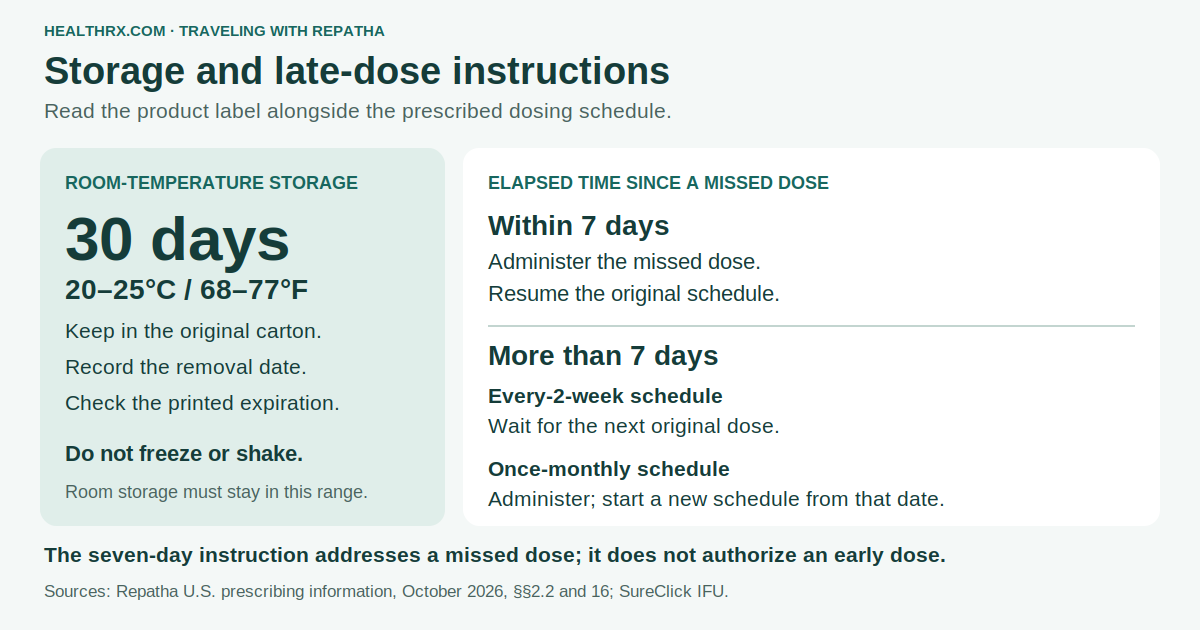
Keep your existing prescription unless your clinician changes it. Ask about planned calendar changes before leaving, especially when crossing the international date line. The missed-dose instructions apply after a missed injection, rather than serving as a scheduling buffer. For an actual missed dose, the current patient instructions distinguish these cases. Use your prescribed frequency. [2]
| Time since the missed dose | Prescribed frequency | Label instruction |
|---|---|---|
| Within 7 days | Either schedule | Give the missed dose and resume the original schedule. |
| More than 7 days | Every 2 weeks | Wait for the next dose on the original schedule. |
| More than 7 days | Once monthly | Give the dose and begin a new monthly schedule from that date. |
Match the instructions to your actual device
The current label lists a prefilled single-dose pen, SureClick autoinjector, and prefilled syringe. Check your carton and its Instructions for Use. The new pen is not made with natural rubber latex; SureClick and syringe versions have latex and nonlatex variants. Pushtronex was discontinued. [1,4]
For a prescribed 420 mg dose, the current label uses three consecutive 140 mg injections within 30 minutes. Count the devices needed for your actual prescription; do not switch regimens to simplify packing. [1]
| Planning question | Supported instruction | Travel implication |
|---|---|---|
| Normal refrigerated storage | 2–8°C in the original carton; never freeze. [1] | Confirm the actual storage range, including overnight. |
| Room-temperature storage | 20–25°C, in the original carton, for up to 30 days. [3] | Record the start and discard dates. |
| Returning a warmed device to refrigeration | The SureClick travel guide says not to return that device once warmed. [3] | Do not alternate storage or reset the clock. |
| Heat, cold, or uncertain exposure | The cited guidance supplies no blanket excursion allowance. [1,3] | Ask a pharmacist or manufacturer before using it. |
Make a record for each carton
Use a phone note or paper record that stays with the medicine. Record each device or carton separately if supplies have different storage histories:
- Device name, strength, lot number, and printed expiration date.
- Prescribed frequency, last injection date, and next planned date.
- Date removed for room-temperature storage and the resulting discard date.
- Known temperatures or exposure concerns, including duration if known.
- Pharmacist or manufacturer advice received about any questionable device.
Record uncertainty honestly. “Left in a parked car; temperature unknown” is more useful than guessing that a cold pack kept it safe. A ski locker or cold car also cannot be assumed to meet either labeled range. Do not shake the medicine. [1,3]
Pack for the journey and the room
Keep medication in its labeled original packaging in hand luggage, with a prescription copy and a medication list. Check your transport provider’s needle policy. For US airport screening, consult the current TSA checkpoint resource; confirm requirements directly rather than assuming a universal liquid or documentation exception. [4,7]
If using an insulated carrier, plan protection from both freezing and overheating. Ask your pharmacist about a suitable arrangement. An ordinary cooler does not establish that the contents stayed within range, and a hotel minibar is not automatically appropriate medicine storage.
For a cruise, contact the operator before booking storage-dependent plans. Confirm refrigerator availability, its temperature range, access when an injection is due, and sharps arrangements. Include travel to the port and any shore stays in the storage timeline. [3,7]
Resolve supply and border questions before departure
Check destination and transit-country embassy guidance for the medicine, quantity, paperwork, and any permission needed. Carry a prescription copy using the generic name, evolocumab; a clinician’s note can explain the injectable supplies. Arrange enough medication for the trip and plausible delays within applicable country rules. [6]
For longer travel, ask your pharmacist about supply and storage options early. A 90-day dispensing quantity does not mean every device can spend 90 days at room temperature. Do not rely on obtaining the same presentation abroad or on a ship’s medical service replacing it. [3,7]
Leave room for training and questions
If treatment is new, arrange injection training before departure and discuss where the first dose should happen. Repatha is not a daily injection; preparation should follow your prescribed schedule and device instructions. [2]
Review new travel medicines, vaccines, pregnancy plans and access to care before leaving. FOURIER evaluated cardiovascular outcomes; it did not test altitude, injector pressure or travel storage. Its results cannot supply a travel-specific dosing rule. [2,7,8]
Frequently asked questions
How does Repatha affect daily life?
Travel mainly adds storage, supply, and injection-planning tasks. Repatha is not injected daily. Learn your prescribed device technique, keep other cholesterol treatment as directed, and maintain a medication list.[2]
Can I fly with Repatha in my carry-on bag?
Carry-on packing is recommended for medicines. Keep Repatha labeled in its original carton, protect its temperature, and check airline and checkpoint requirements for injectable supplies before departure.[4,7]
How long can Repatha stay out of the refrigerator?
Refrigerated storage is 2–8°C. Room storage is 20–25°C in the original carton for up to 30 days. The SureClick travel guide says not to refrigerate it again once warmed. Follow your product’s instructions. [2,3]
What happens if I miss a dose while traveling?
Within seven days, take the missed dose and keep the original schedule. Beyond seven days, the next step differs for every-two-week and monthly prescriptions; use the table above or confirm the dates with your pharmacist. [1,2]
Do I need a doctor's letter to travel with Repatha internationally?
A clinician’s note can help explain injectable supplies, but requirements vary. Check destination and transit-country embassy guidance for documentation, quantities, and permissions; carry a prescription copy naming evolocumab.[6]
Can I inject Repatha at a different time of day if my travel schedule shifts?
Record the last and planned injection dates, including home and destination dates. Ask the pharmacist to reconcile a date-line crossing; avoid moving an injection using an assumed seven-day buffer. [1,2]
Is Repatha safe to use in hot climates?
Storage must remain appropriate for the product. Do not use a device that has frozen. For heat exposure or an uncertain temperature history, obtain product-specific advice before using the affected supply. [1,3]
Can I take Repatha on a cruise?
Plan with the cruise operator beforehand: verify suitable storage temperatures, access, and sharps disposal. Include flights, transfers, and shore stays; do not assume an onboard refrigerator or replacement supply is available.[3,7]
How do I dispose of Repatha autoinjectors while traveling?
Put the used device immediately into a proper sharps container and carry a travel-size container. Arrange local disposal through an approved collection service; keep loose sharps out of aircraft or hotel trash. [5]
Does Repatha interact with travel vaccines or antibiotics?
Have your clinician or pharmacist review the specific vaccine or antibiotic alongside your full medication list and health conditions. These sources do not establish a blanket travel-vaccine or antibiotic interaction guarantee.[2,7]
Will altitude affect how Repatha works?
The cited evidence does not directly test altitude effects or device performance under changing pressure. Continue your prescription unless advised otherwise, and discuss the itinerary and storage arrangements with your clinician.[8]
How soon after starting Repatha can I travel?
The reviewed travel guidance gives no universal waiting period. Arrange injection training and the first-dose plan before leaving. Breathing or swallowing difficulty or facial swelling needs urgent medical help. [2,4]
Can I get a 90-day supply of Repatha before international travel?
Ask your pharmacy, prescriber, and insurer early; availability and coverage vary. Check import quantity limits and plan storage for every device. A larger supply does not extend room-temperature storage.[3,6]
Is Repatha safe to use during pregnancy if I am traveling?
Whether Repatha can harm an unborn baby is unknown. Tell your clinician if pregnant or planning pregnancy. Travel does not create an automatic treatment ban or a reason to stop independently.[2]
References
Sources checked October 14, 2026.
- Amgen. Repatha US Prescribing Information. Revised October 2026. https://www.pi.amgen.com/united_states/repatha/repatha_pi_hcp_english_current.pdf
- Amgen. Repatha Patient Information. October 2026. https://www.pi.amgen.com/united_states/repatha/repatha_ppi_pt_english.pdf
- Amgen. Repatha SureClick Injection Resource Guide. https://www.repatha.com/-/media/Themes/Amgen/Repatha-com-Redesign/Repatha-com-Redesign/Documents/USA-CCF-81824.pdf
- Amgen. How to Start Repatha Injection. https://www.repatha.com/how-to-start-repatha-injection
- FDA. Best Way to Get Rid of Used Needles and Other Sharps. https://www.fda.gov/medical-devices/safely-using-sharps-needles-and-syringes-home-work-and-travel/best-way-get-rid-used-needles-and-other-sharps
- CDC. Traveling Abroad with Medicine. https://wwwnc.cdc.gov/travel/page/travel-abroad-with-medicine?id=55486
- CDC Yellow Book. What To Do When Sick Abroad. https://www.cdc.gov/yellow-book/hcp/health-care-abroad/what-to-do-when-sick-abroad.html
- Sabatine MS, et al. Evolocumab and Clinical Outcomes in Patients with Cardiovascular Disease. New England Journal of Medicine. 2017. https://pubmed.ncbi.nlm.nih.gov/28304224/