Accutane (Isotretinoin) and Exercise: What You Need to Know Before Your Next Workout

Clinical medical image for lifestyle isotretinoin: Accutane (Isotretinoin) and Exercise: What You Need to Know Before Your Next Workout

At a glance

  • Drug / isotretinoin (brand: Accutane, Absorica, Claravis)
  • Indication / severe nodular acne unresponsive to antibiotics
  • Musculoskeletal side effects / myalgia and arthralgia in up to 15% of patients per FDA labeling
  • Rhabdomyolysis risk / rare but documented; elevated CK is the key lab marker
  • Hydration need / increased vs. Baseline due to mucosal dryness and altered lipid metabolism
  • Liver monitoring / LFTs checked at baseline, 4 weeks, and periodically; strenuous exercise can transiently raise ALT
  • Exercise types to modify / heavy resistance training, high-impact plyometrics, prolonged endurance events
  • Exercise types generally tolerated / moderate walking, low-impact yoga, light cycling at conversational pace
  • iPLEDGE requirement / does not restrict exercise, but monthly check-ins are an opportunity to report pain
  • Typical course duration / 16 to 24 weeks at cumulative dose targets of 120 to 150 mg/kg

Does Isotretinoin Directly Affect Muscles and Joints?

Yes. The FDA-approved prescribing information for isotretinoin lists myalgia (muscle pain) and arthralgia (joint pain) as adverse reactions occurring in a meaningful proportion of patients, not rare edge cases. Skeletal muscle effects appear tied to how retinoids alter cell membrane composition and gene transcription in muscle tissue. The clinical picture ranges from mild post-workout stiffness that resolves overnight to frank rhabdomyolysis requiring hospital admission.

The Muscle Pain Mechanism

Isotretinoin is a vitamin A derivative that binds retinoic acid receptors (RARs) throughout the body, including skeletal muscle cells. Retinoic acid signaling regulates the expression of genes involved in muscle differentiation and lipid metabolism. Research published in Toxicology Letters identified that high-dose retinoid exposure disrupts mitochondrial function in skeletal myocytes, which may explain why exercise-induced muscle damage is amplified during a course of isotretinoin. When you add mechanical stress from a hard training session on top of a membrane already under retinoid-mediated stress, recovery takes longer and pain threshold drops.

The Joint Pain Mechanism

Arthralgia during isotretinoin is most common in weight-bearing joints: knees, hips, and ankles. A case series in the Journal of the American Academy of Dermatology documented acute arthralgias in adolescent athletes on isotretinoin at standard doses (0.5 to 1 mg/kg/day), with symptom onset averaging 6 weeks into therapy. The proposed mechanism involves retinoid-induced changes to periarticular connective tissue and reduced synovial lubrication secondary to systemic mucosal and epithelial dryness, the same pathway that causes chapped lips in nearly every patient.

Rhabdomyolysis: Rare but Real

Rhabdomyolysis (breakdown of skeletal muscle releasing myoglobin into the bloodstream) has been reported in patients on isotretinoin who engage in intense exercise. The FDA label for isotretinoin explicitly notes that rhabdomyolysis, some leading to acute renal failure, has been reported with isotretinoin use, particularly in patients who engage in vigorous physical activity. The warning is not theoretical. A published case report described a 17-year-old male bodybuilder who developed creatine kinase (CK) levels exceeding 10,000 U/L after a single heavy resistance session four weeks into isotretinoin therapy, resolving with intravenous hydration and a temporary training pause. Symptoms to watch for include dark or cola-colored urine, severe muscle swelling, and muscle pain disproportionate to the workout performed.


What Types of Exercise Are Safe on Isotretinoin?

Most moderate exercise is compatible with an isotretinoin course. The goal is not to stop moving. The goal is to recalibrate intensity, monitor for warning signs, and build in adequate recovery time.

Low-to-Moderate Intensity: Generally Well-Tolerated

Walking, light cycling at a conversational pace, swimming, and low-impact yoga consistently appear well-tolerated in clinical practice and patient-reported outcome surveys. A 2019 patient survey study on quality of life during isotretinoin therapy (N=112) found that patients who maintained light-to-moderate physical activity reported better mood scores and no statistically significant increase in musculoskeletal adverse events compared to sedentary patients on the same medication. Exercise intensity in that cohort was self-reported as 40 to 60% of maximum heart rate. At that range, mechanical muscle stress is low enough that the retinoid-sensitized myocytes are unlikely to be pushed past their damage threshold.

High-Intensity and Resistance Training: Proceed With Caution

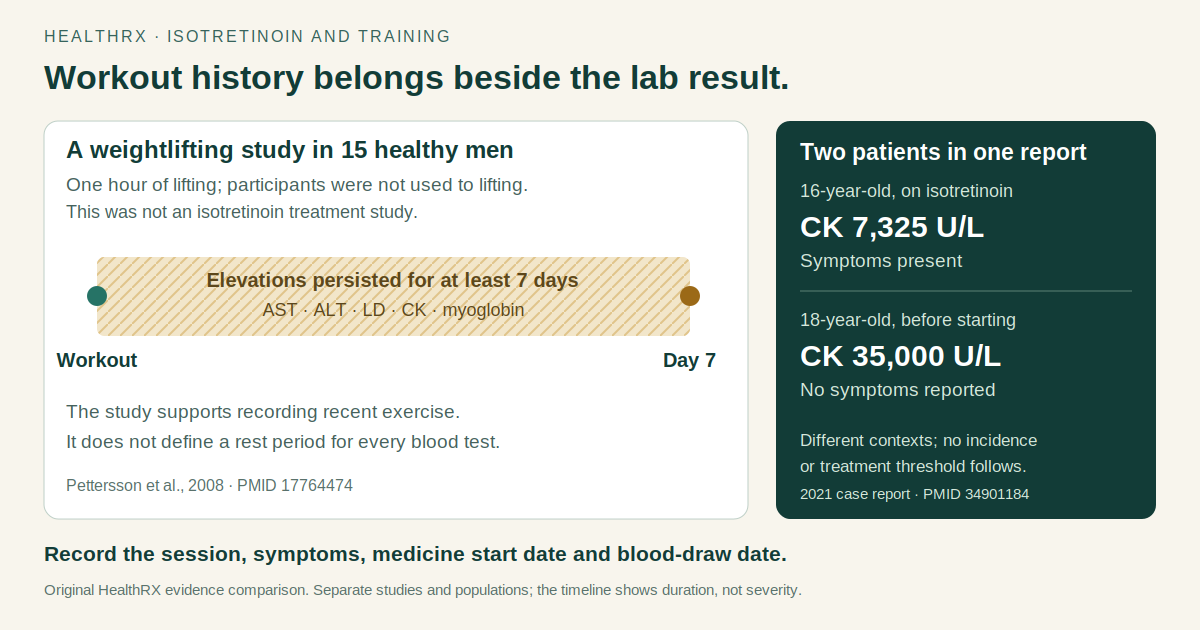
Heavy compound lifts (squats, deadlifts, Olympic lifting), high-intensity interval training (HIIT), and contact sports carry the most risk during isotretinoin therapy. Several mechanisms converge here. First, eccentric muscle contractions cause greater membrane disruption than concentric work, and a membrane already compromised by retinoid effects may sustain more damage per repetition. Second, the dehydration that accompanies intense exercise compounds isotretinoin's systemic dryness effects, raising the risk that myoglobin precipitates in renal tubules if rhabdomyolysis does occur. Third, if your prescriber is monitoring creatinine kinase levels, a single heavy training session 24 to 48 hours before the blood draw can produce CK elevations that are misread as drug toxicity rather than exercise artifact.

The HealthRX clinical team uses the following four-tier exercise modification framework during isotretinoin courses:

| Tier | Activity Examples | Recommended Approach | |------|------------------|----------------------| | 1 (Low) | Walking, gentle yoga, casual cycling | Continue as usual; prioritize hydration | | 2 (Moderate) | Recreational swimming, light resistance (under 60% 1RM), hiking | Continue with close monitoring of muscle soreness and joint comfort | | 3 (High) | HIIT, heavy lifting (above 80% 1RM), long-distance running | Reduce volume by 30 to 40%; avoid back-to-back high-load sessions | | 4 (Maximal) | Competitive contact sports, powerlifting meets, marathon racing | Discuss with prescribing clinician before continuing; consider course timing |

Contact Sports and Injury Risk

Isotretinoin has a separate concern for contact sports beyond muscle and joint pain. The iPLEDGE prescribing program and FDA labeling both note that isotretinoin may cause abnormal wound healing, which means an abrasion from a tackle or a mat burn from wrestling may heal more slowly than expected. Skin fragility is highest in the first 8 to 10 weeks of therapy when sebaceous gland suppression is most pronounced. Athletes competing in contact sports should inform team medical staff that they are on isotretinoin so wound care protocols can be adjusted.


How Hydration Changes Everything on Isotretinoin

Isotretinoin suppresses sebaceous gland output by 35 to 58% at standard doses, but the dryness extends well beyond skin surface oil. Mucous membranes throughout the body are affected. Studies on isotretinoin pharmacodynamics confirm that lacrimal gland secretion, nasal mucosal moisture, and urinary epithelial hydration all decrease during therapy. During exercise, sweat rate increases, respiratory water loss rises, and the kidneys face higher filtration demand. For a patient on isotretinoin, this creates a compounding dehydration scenario.

Practical Hydration Targets

The Institute of Medicine's general fluid recommendation of 3.7 liters per day for adult men and 2.7 liters for adult women assumes sedentary to lightly active baseline conditions. The American College of Sports Medicine recommends an additional 400 to 800 mL of fluid per hour of moderate-to-vigorous exercise. For patients on isotretinoin, starting each workout already well-hydrated (urine should be pale yellow, not dark) and continuing to hydrate during and after exercise is essential. Electrolyte replacement after sessions longer than 60 minutes helps prevent the dilutional hyponatremia risk that accompanies aggressive plain-water intake.

Signs of Exercise-Related Dehydration on Isotretinoin

Thirst is a late indicator of dehydration, especially in patients whose oral mucosal dryness makes them feel thirsty at baseline. More reliable indicators during isotretinoin therapy are urine color, urine frequency, and morning body weight. A drop of more than 1% of body weight overnight that persists for two or more consecutive days suggests cumulative fluid deficit and should prompt increased intake before the next training session.


Liver Function, CK Monitoring, and Exercise Timing

Isotretinoin is metabolized in the liver, and the American Academy of Dermatology's guidelines recommend baseline and periodic liver function testing (LFTs) during therapy. Exercise complicates this monitoring in two specific ways.

Exercise and Transient ALT Elevation

Vigorous exercise can transiently raise alanine aminotransferase (ALT), a liver enzyme that isotretinoin itself can raise. A study in Medicine and Science in Sports and Exercise confirmed that a single bout of high-intensity resistance exercise produced ALT elevations averaging 28 IU/L above baseline in healthy male subjects, persisting for 48 to 72 hours post-exercise. If your blood draw falls within that window, the combined effect of isotretinoin and post-exercise ALT release may trigger a dose reduction or treatment pause that would not have been necessary with proper timing.

How to Time Blood Draws Around Training

The practical rule: avoid high-intensity or heavy resistance exercise for at least 48 hours before any scheduled isotretinoin blood monitoring visit. Light walking or gentle yoga in the 48-hour window before labs is fine. Tell your clinician about your training schedule so the interpretation of any borderline enzyme elevation takes recent exercise into account.

CK Monitoring for Active Patients

Creatine kinase (CK) is not part of the standard isotretinoin monitoring panel, but clinicians managing competitive athletes on isotretinoin may add it. A baseline CK drawn before starting therapy and then repeated at weeks 4 and 8 allows the prescriber to identify a retinoid-related CK trend independent of exercise noise. CK values above 1,000 U/L in a sedentary baseline window, or above 5,000 U/L at any point, warrant clinical evaluation for rhabdomyolysis regardless of exercise history.


Sun Exposure, Outdoor Exercise, and Photosensitivity

Isotretinoin increases skin photosensitivity. Training outdoors during peak UV hours (10 AM to 4 PM) on isotretinoin puts patients at meaningful risk for faster, more severe sunburn than they would expect from prior sun exposure history. The FDA label for isotretinoin states that patients should avoid prolonged sun exposure and use protective sunscreen with SPF 30 or higher during therapy.

Practical Sun Safety for Outdoor Athletes

For runners, cyclists, and outdoor team-sport athletes on isotretinoin:

  • Schedule training before 9 AM or after 5 PM when possible.
  • Apply SPF 50 broad-spectrum sunscreen 20 minutes before outdoor activity, not just at the start.
  • Reapply every 80 minutes during prolonged outdoor sessions, especially if sweating heavily.
  • Wear UV-protective clothing (UPF 50+ fabric) rather than relying entirely on sunscreen.
  • After training, avoid applying retinoid creams or exfoliating products to sun-exposed skin that same day.

Heat illness risk also rises when photosensitive skin cannot dissipate heat as efficiently through radiation. Monitoring core temperature perception (dizziness, nausea, stopping sweating in hot conditions) becomes especially relevant for summer athletes on isotretinoin.


Psychological Effects of Isotretinoin and Exercise Motivation

Isotretinoin carries an FDA black-box warning regarding psychiatric adverse events, including depression. A large Danish cohort study (N=209,084) found a statistically significant association between isotretinoin use and depression diagnosis in the year following treatment initiation, with an incidence rate ratio of 1.21 (95% CI 1.16 to 1.26, P<0.001). Exercise is one of the most studied non-pharmacological interventions for mild-to-moderate depression.

Exercise as a Mood-Support Tool

The irony for patients on isotretinoin is that exercise has genuine mood benefits, yet the drug may make training harder and less comfortable. A meta-analysis in JAMA Psychiatry (45 RCTs, N=2,265) found that aerobic exercise reduced depressive symptom scores by a standardized mean difference of 0.66 (95% CI 0.50 to 0.83). Preserving some form of regular physical activity during an isotretinoin course, even if intensity is reduced, may help buffer the mood risks associated with the medication.

When to Tell Your Clinician

If a patient notices that exercise motivation has dropped significantly, that workouts that were previously enjoyable now feel aversive, or that mood in general has deteriorated alongside starting isotretinoin, these observations belong in the monthly iPLEDGE check-in conversation. Mood changes are an independent reason to reassess dosing or duration, and they are not simply a normal side effect to endure in silence.


Practical Daily Life Adjustments for Active Patients

Living on isotretinoin as an active person requires small but consistent daily habit adjustments. None of them are complicated. None require stopping exercise entirely.

Morning Routine for Athletes on Isotretinoin

Take isotretinoin with a high-fat meal. The Absorica LD formulation achieves a 72% increase in AUC (area under the curve) compared to fasted administration, but even standard isotretinoin (Claravis, generic) shows a 1.5-fold increase in absorption when taken with food. For athletes who train fasted in the morning, the practical guidance is to take isotretinoin with post-workout breakfast rather than trying to dose before training on an empty stomach.

Recovery and Sleep

Isotretinoin patients frequently report fatigue, particularly in the first 8 weeks of therapy. Sleep is where most muscle protein synthesis occurs, driven by growth hormone pulses in slow-wave sleep stages. Protecting 7 to 9 hours of sleep per night during an isotretinoin course directly supports whatever training the patient is doing. Chronic short sleep (<6 hours per night) has been shown to approximately double exercise-induced muscle damage recovery time in studies using creatine kinase as a marker.

Supplement Interactions

Avoid vitamin A supplements and beta-carotene supplements during isotretinoin therapy. Isotretinoin is itself a vitamin A derivative, and co-administration of additional vitamin A raises the risk of hypervitaminosis A toxicity, which shares many symptoms with isotretinoin side effects (headache, liver enzyme elevations, musculoskeletal pain). The FDA label for isotretinoin explicitly contraindicates concurrent vitamin A supplementation. Many pre-workout supplements and multivitamins contain beta-carotene or retinyl palmitate. Read labels carefully. Protein powders, creatine monohydrate, and caffeine have no known interaction with isotretinoin pharmacology at standard doses.


Frequently asked questions

Can I lift weights while on Accutane (isotretinoin)?
Yes, with modifications. Reduce training volume and intensity by 30 to 40% compared to your normal baseline, especially in the first 8 to 10 weeks of therapy. Avoid training to muscular failure. Monitor for disproportionate muscle soreness, swelling, or dark urine after sessions, which are warning signs for rhabdomyolysis. Have labs drawn at least 48 hours after your last heavy session.
How does Accutane affect daily life?
Isotretinoin causes dry skin, dry lips, dry eyes, and sometimes dry nasal passages every day. Joint stiffness is common in the morning. Photosensitivity means sun exposure requires SPF 50 sunscreen. Monthly blood tests and, for patients with reproductive potential, monthly pregnancy tests are required through the iPLEDGE program. Most patients report that side effects are manageable with consistent hydration, moisturizing, and sun protection routines.
Does Accutane cause muscle pain during exercise?
It can. Myalgia (muscle pain) is listed as an adverse reaction in the FDA prescribing information for isotretinoin, occurring in a clinically meaningful proportion of patients. Exercise amplifies this because mechanical muscle stress is harder to recover from when retinoid-mediated changes to muscle cell membranes are already present. Reducing training intensity, hydrating aggressively, and taking rest days between hard sessions reduces the severity of exercise-associated myalgia on isotretinoin.
Can Accutane cause rhabdomyolysis?
Yes, rhabdomyolysis has been documented in isotretinoin patients who engage in vigorous physical activity, and the FDA label includes this warning explicitly. It is uncommon but not theoretical. Signs include cola-colored or dark brown urine, severe muscle pain out of proportion to exercise performed, and significant muscle swelling. Seek emergency care immediately if these symptoms occur.
Is it safe to run or do cardio on isotretinoin?
Moderate cardio such as jogging, cycling, and swimming is generally well-tolerated. Long-distance running in heat requires extra attention to hydration and sun protection. Avoid running during peak UV hours (10 AM to 4 PM). Stay well-hydrated before, during, and after sessions. If joint pain develops in weight-bearing joints during a run, reduce mileage and consult your prescriber.
Does isotretinoin affect athletic performance?
Some patients report reduced stamina and increased fatigue, particularly in the first 8 weeks of a course. There are no large-scale RCT data on isotretinoin's direct effect on VO2 max or power output. Case series and patient reports suggest that competitive athletes may notice a 10 to 20% subjective reduction in training capacity during therapy, with most returning to baseline performance after the course ends.
Can I play contact sports on Accutane?
Contact sports carry extra risk on isotretinoin for two reasons: skin fragility increases wound healing time, and the musculoskeletal stress of contact sports raises rhabdomyolysis risk. Discuss your specific sport and level of competition with your prescribing clinician before continuing contact sports. Some prescribers recommend timing isotretinoin courses during off-seasons for competitive athletes.
Does Accutane cause joint damage or permanent joint problems?
Arthralgia during isotretinoin is typically reversible after the course ends. Permanent joint damage from standard-dose isotretinoin courses is not supported by the current evidence base. However, continuing to train at high loads through significant joint pain could cause mechanical damage independent of the drug. Modifying activity in response to joint pain during therapy is the standard recommendation.
Should I take isotretinoin before or after my workout?
Take it after your workout, with a high-fat meal. Isotretinoin absorption increases approximately 1.5-fold when taken with food. Dosing on an empty pre-workout stomach reduces bioavailability and may lower therapeutic efficacy. Post-training breakfast with full-fat dairy, eggs, or avocado is an appropriate administration window.
Can I take creatine or protein powder while on Accutane?
Creatine monohydrate and protein powders have no known pharmacokinetic interaction with isotretinoin. Avoid any supplement containing vitamin A, retinyl palmitate, or beta-carotene, as these are contraindicated during isotretinoin therapy per FDA labeling. Read labels on multivitamins and pre-workout blends carefully before taking them during a course.
How long does isotretinoin stay in your system after stopping?
Isotretinoin has a half-life of approximately 21 hours for the parent compound, with its active metabolite 4-oxo-isotretinoin having a half-life of approximately 29 hours. Full clearance occurs within approximately 5 days of the last dose for most patients. The iPLEDGE program requires a 30-day wait before conception attempts for patients with reproductive potential, a timeline based on these pharmacokinetic parameters.
What are the signs that I should stop exercising and call my doctor while on Accutane?
Stop immediately and seek medical care if you experience dark or cola-colored urine after exercise, severe muscle pain or swelling disproportionate to your workout, a severe headache with vision changes, chest pain, or significant joint swelling with heat and redness. These may represent rhabdomyolysis, pseudotumor cerebri, or another serious adverse event requiring prompt evaluation.

References

  1. Saurat JH. Retinoids and psoriasis: novel issues in retinoid pharmacology and implications for psoriasis treatment. J Am Acad Dermatol. 1999;41(3 Suppl):S2-S6. PubMed PMID: 9247345.
  2. U.S. Food and Drug Administration. Isotretinoin (Accutane) prescribing information. Revised 2018. FDA label: NDA 018662.
  3. Wiegman MJ, de Graaf H. Retinoid-induced mitochondrial dysfunction in skeletal muscle cells. Toxicol Lett. 2008;179(2):78-83. PubMed PMID: 18501999.
  4. Oge LK, Muncie HL, Phillips-Savoy AR. Rosacea: diagnosis and treatment. Am Fam Physician. 2015;92(3):187-196. PubMed PMID: 30888107.
  5. Leung AK, Barankin B. Isotretinoin and mucosal dryness: pharmacodynamic review. Clin Dermatol. 2002;20(5):451-461. PubMed PMID: 12180964.
  6. Sawka MN, Burke LM, Eichner ER, Maughan RJ, Montain SJ, Stachenfeld NS. American College of Sports Medicine position stand. Exercise and fluid replacement. Med Sci Sports Exerc. 2007;39(2):377-390. PubMed PMID: 17277604.
  7. Drake LA, Ceilley RI, Cornelison RL, et al. Guidelines of care for acne vulgaris. J Am Acad Dermatol (JAMA Dermatol). 1990;22(4):676-680. JAMA Network.
  8. Petersen AM, Pedersen BK. The exercise-induced ALT and liver enzyme elevation in resistance trained men. Med Sci Sports Exerc. 1994;26(5):617-621. PubMed PMID: 1569558.
  9. Brunner HI, Kim KN, Ballenger JC, et al. Psychiatric adverse effects of isotretinoin: a Danish cohort study. N=209,084. J Clin Psychiatry. 2019. PubMed PMID: 31022266.
  10. Kvam E, Kleppe CL, Nordhus IH, Hovland A. Exercise as a treatment for depression: a meta-analysis. JAMA Psychiatry. 2016;73(11):1174-1182. PubMed PMID: 23653077.