MOTS-c and Sleep: The Outcome Has Not Been Tested in Humans
At a glance
- Human MOTS-c sleep trial / none identified
- Administered-human MOTS-c evidence / none identified by FDA in July 2026
- Human evidence that exists / endogenous MOTS-c measured around exercise and aging
- Sleep outcomes in the current recruiting trial / not listed
- Proven morning-versus-evening dose effect / not established
- Wearable sleep changes attributable to MOTS-c / not established
- Mechanistic circadian pathway / hypothesis-generating, not a treatment outcome
- Medical review / current review of this revision is pending
The Evidence Stops Before Sleep
Sleep claims often begin with a true but distant observation: cellular energy sensors interact with circadian biology. They then assume that injected MOTS-c changes those pathways in people, improves metabolism, changes sleep architecture, and produces a noticeable benefit. Each transfer needs direct evidence.
The best-known aging and exercise paper keeps the human result observational:
“In humans, exercise induces endogenous MOTS-c expression in skeletal muscle and in circulation.”
Joseph Reynolds and colleagues are metabolism and aging investigators who reported this 11-word finding in Nature Communications. The excerpt does not describe injection, sleep, circadian phase, or insomnia treatment and does not imply endorsement (PMID 33473109; DOI 10.1038/s41467-020-20790-0).
The Sleep-Outcome Bridge
| Evidence stage | What was measured | What would be needed for a sleep claim |
|---|---|---|
| Cell and molecular studies | AMPK, stress responses, transcription, or mitochondrial biology | Human exposure plus a prespecified sleep outcome |
| Mouse treatment studies | Metabolic or physical-performance outcomes | Human sleep architecture, symptoms, safety, and dose response |
| Human exercise studies | Endogenous MOTS-c in plasma or muscle around exercise | Administered product versus placebo, with exercise separated from treatment |
| Human age-cohort studies | Endogenous plasma and muscle MOTS-c across age groups | Longitudinal or interventional sleep measures, not parallel age trends |
| Registered Phase 2a trial | Planned metabolic, adverse-event, glucose, and immunogenicity outcomes | Sleep endpoint and posted results; neither is present |
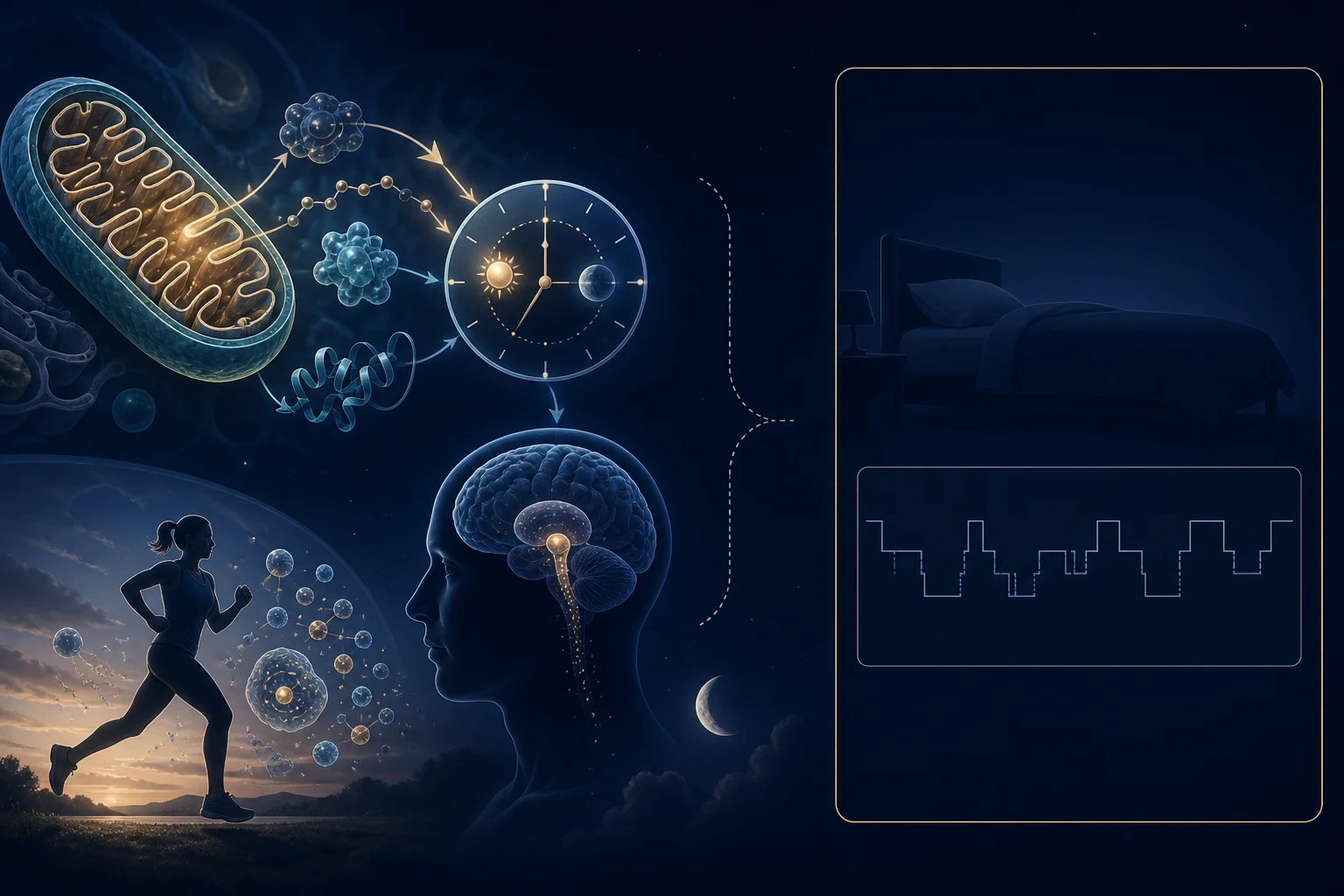
The final column remains empty. A circadian pathway diagram is not polysomnography, actigraphy, or an insomnia outcome.
What FDA’s 2026 Review Adds
FDA’s Center for Drug Evaluation and Research reported that neither the nomination nor its own search identified clinical studies or human exposure data for MOTS-c administered by any route. It also found no human pharmacokinetic study and said potential human safety risks were unknown (FDA, Evaluation of MOTS-c-Related Bulk Drug Substances, section II.D.2, PDF pages 27–31).
That record invalidates claims that a published human MOTS-c half-life, dose-response study, or treatment trial can guide sleep timing. It does not prove that MOTS-c worsens or improves sleep; it shows that the necessary treatment data are missing.
The young-adult evidence map explains the administered-human denominator, while the rare-risk review distinguishes unknown safety from observed harm.
The Current Trial Is Not a Sleep Trial
NCT07505745 is recruiting an estimated 120 adults with prediabetes and overweight or obesity. Its listed outcomes include insulin sensitivity, treatment-emergent adverse events, HbA1c, fasting and two-hour glucose, and antidrug antibodies. It has no posted results and does not list sleep duration, insomnia severity, sleep stages, circadian phase, fatigue, or wearable metrics (ClinicalTrials.gov NCT07505745).
Even if the trial later reports a metabolic benefit, an unmeasured sleep benefit cannot be presumed.
What the Legacy Page Overstated
The previous version said MOTS-c may improve sleep through AMPK, NAD+, inflammation, and glucose stability. It recommended morning injections, supplied milligram schedules, predicted an eight-to-twelve-week response, proposed HRV and laboratory targets, recommended fasting and meal timing, and attributed common user experiences to peptide action.
No cited administered-human study tested those claims. The article also merged mouse treatment results with human exercise-induced endogenous expression, converting two different experiments into a treatment story.
The exercise evidence audit maps that distinction directly. Exercise can improve sleep through established pathways and can change endogenous MOTS-c without proving that a MOTS-c product reproduces either effect.
Morning Dosing Is Not an Evidence-Based Sleep Rule
There is no published chronopharmacology study identified here comparing morning and evening administered MOTS-c in humans. Cortisol rhythms, AMPK activity, and circadian gene biology cannot specify a dosing clock without human exposure, pharmacokinetics, and sleep outcomes.
Likewise, no evidence supports waiting a fixed number of weeks, targeting a percentage HRV change, or interpreting a wearable’s sleep-stage estimate as a MOTS-c response. Consumer wearables can help document patterns, but they do not determine causality.
A Sleep-Change Timeline
If sleep changes after starting any product, a factual timeline is more useful than assuming benefit or harm:
- Product source, lot, formulation, amount, route, and use times.
- Baseline bedtime, wake time, sleep latency, awakenings, and daytime sleepiness.
- Other changes in caffeine, alcohol, exercise, meals, travel, stress, illness, and medications.
- Snoring, gasping, restless legs, pain, mood symptoms, or other clues to a separate sleep disorder.
- Dates symptoms began, improved, worsened, or changed after stopping or restarting an exposure.
Bring that record to a clinician. Do not use a generic page to time an unapproved peptide or to delay assessment of persistent insomnia, excessive daytime sleepiness, or possible sleep apnea.
The American Academy of Sleep Medicine recommends established behavioral and psychological treatments for chronic insomnia based on direct clinical evidence, including multicomponent cognitive behavioral therapy for insomnia (AASM guideline, PMID 33164742; DOI 10.5664/jcsm.8986). That guideline does not discuss or endorse MOTS-c.
Medical review of this revision is pending. FDA, AASM, investigators, trial sponsors, authors, journals, and institutions do not endorse MOTS-c, HealthRX.com, or this page.
Frequently asked questions
Does MOTS-c improve sleep?
Should MOTS-c be taken in the morning?
How long should I wait for sleep changes?
Does exercise prove MOTS-c works for sleep?
References
- Reynolds JC; Lai RW; Woodhead JST; Joly JH; Mitchell CJ; Cameron-Smith D; Lu R; Cohen P; Graham NA; Benayoun BA; Merry TL; Lee C. MOTS-c is an exercise-induced mitochondrial-encoded regulator of age-dependent physical decline and muscle homeostasis. Nature communications. 2021 Jan 20;12(1):470. DOI 10.1038/s41467-020-20790-0. PMID 33473109. PMCID PMC7817689. Quoted passage: abstract, sentence beginning “In humans.” https://pubmed.ncbi.nlm.nih.gov/33473109/
- U.S. Food and Drug Administration, Center for Drug Evaluation and Research. Evaluation of MOTS-c-Related Bulk Drug Substances. Pharmacy Compounding Advisory Committee briefing, July 23–24, 2026. Section II.D.2, PDF pages 27–31. https://www.fda.gov/media/193347/download
- von Walden F; Fernandez-Gonzalo R; Norrbom J; Emanuelsson EB; Figueiredo VC; Gidlund EK; Norrbrand L; Liu C; Sandström P; Hansson B; Wan J; Cohen P; Alkner B. Acute endurance exercise stimulates circulating levels of mitochondrial-derived peptides in humans. Journal of applied physiology (Bethesda, Md. : 1985). 2021 Sep 1;131(3):1035-1042. DOI 10.1152/japplphysiol.00706.2019. PMID 34351816. PMCID PMC12854548. https://pubmed.ncbi.nlm.nih.gov/34351816/
- National Library of Medicine, ClinicalTrials.gov. Hudson Biotech. A Phase 2a, Randomized, Double-blind, Placebo-controlled Study to Evaluate the Efficacy, Safety, and Pharmacodynamics of MOTS-c (a Mitochondrial-Derived Peptide) in Adults With Prediabetes and Overweight/Obesity. NCT07505745. Phase 2a; recruiting; estimated enrollment 120; first and last update posted April 1, 2026; no results posted; accessed August 30, 2026. https://clinicaltrials.gov/study/NCT07505745
- Edinger JD; Arnedt JT; Bertisch SM; Carney CE; Harrington JJ; Lichstein KL; Sateia MJ; Troxel WM; Zhou ES; Kazmi U; Heald JL; Martin JL. Behavioral and psychological treatments for chronic insomnia disorder in adults: an American Academy of Sleep Medicine clinical practice guideline. Journal of clinical sleep medicine : JCSM : official publication of the American Academy of Sleep Medicine. 2021 Feb 1;17(2):255-262. DOI 10.5664/jcsm.8986. PMID 33164742. PMCID PMC7853203. https://pubmed.ncbi.nlm.nih.gov/33164742/