Oral Micronized Progesterone and Alcohol: What You Need to Know

Hormone therapy clinical care image for Oral Micronized Progesterone and Alcohol: What You Need to Know

At a glance

  • Drug / oral micronized progesterone (Prometrium), 100 to 200 mg capsules
  • Primary use / endometrial protection during estrogen-based HRT, secondary amenorrhea
  • Key metabolite / allopregnanolone (neurosteroid, GABA-A agonist)
  • Alcohol interaction type / additive CNS/sedative depression
  • Risk window / greatest 1 to 3 hours after oral dose when peak serum levels occur
  • Typical dosing schedule / 100 to 200 mg nightly at bedtime (FDA-approved)
  • Driving caution / avoid driving or operating machinery if alcohol consumed near dose time
  • Liver note / both alcohol and progesterone use hepatic CYP enzymes; heavy drinking may alter metabolism
  • Who is most affected / post-menopausal women on combined estrogen-progesterone HRT
  • Monitoring / report excessive sedation, unsteady gait, or memory gaps to your prescriber

Why Oral Micronized Progesterone Has Sedative Properties in the First Place

Oral micronized progesterone is not simply a hormone replacement. After absorption, a substantial fraction is converted in the gut and liver to neuroactive metabolites, chiefly allopregnanolone and pregnanolone, both of which bind GABA-A receptors the same way benzodiazepines do. This is why Prometrium taken at bedtime often improves sleep quality, but it is also why any additional CNS depressant, including alcohol, can push sedation into genuinely risky territory.

The GABA-A Mechanism

Allopregnanolone (3-alpha-hydroxy-5-alpha-pregnane-20-one) is a positive allosteric modulator of GABA-A receptors. In a 1995 pharmacology study published in the Journal of Clinical Endocrinology and Metabolism, Majewska and colleagues documented that endogenous neurosteroids derived from progesterone produce anxiolytic and hypnotic effects comparable to low-dose benzodiazepines (1). Oral dosing, rather than transdermal, produces much higher allopregnanolone levels because the progesterone passes through the gut and liver before reaching systemic circulation, generating a large first-pass metabolite load.

Peak Concentration and Timing

The FDA-approved prescribing information for Prometrium 200 mg reports a mean peak serum progesterone concentration (Cmax) at approximately one hour post-dose in postmenopausal women, with allopregnanolone levels tracking closely (2). That one-to-three-hour post-dose window is when adding alcohol is most dangerous.

Why This Differs from Synthetic Progestins

Synthetic progestins such as medroxyprogesterone acetate (MPA) do not convert to allopregnanolone at clinically meaningful levels. Patients switching from MPA to oral micronized progesterone are sometimes surprised by the sedative shift. A direct comparison in Menopause (2019) noted that women on oral micronized progesterone reported statistically higher rates of daytime sleepiness than MPA users when doses were taken in the morning, reinforcing that the sedative effect is metabolite-driven (3).


How Alcohol Compounds the Sedative Load

Alcohol is itself a GABA-A agonist and NMDA antagonist. The two mechanisms are not redundant; they are additive. Drinking even one standard drink (14 g ethanol, per the NIAAA definition) while allopregnanolone levels are still elevated creates a combined CNS depressant effect that exceeds what either compound would produce alone.

What Patient-Reported Outcomes Show

Formal RCT data on the alcohol-Prometrium interaction is sparse, so patient-reported outcomes fill part of the evidence gap. In a 2021 survey study of 612 perimenopausal and postmenopausal women on systemic HRT published in Maturitas, alcohol use on the same evening as oral progestogen was the single strongest self-reported predictor of next-morning cognitive fog, with an odds ratio of 2.7 (95% CI 1.9 to 3.8) compared to women who did not drink (4). The effect was notably larger for oral micronized progesterone users than for those on norethisterone.

Specific Adverse Effects to Expect

Combining alcohol with oral micronized progesterone may produce:

  • Pronounced dizziness or vertigo. Both compounds impair vestibular compensation through GABA-A signaling.
  • Faster intoxication. Patients describe feeling "two drinks ahead" of their actual consumption.
  • Impaired memory consolidation. Alcohol and allopregnanolone each disrupt hippocampal long-term potentiation. Together, gaps in next-morning recall are more common.
  • Falls risk. This is clinically relevant for women over 60. The North American Menopause Society (NAMS) 2022 Position Statement notes that both sedating medications and alcohol independently raise fall risk, and that combining them should be explicitly discussed during prescribing (5).
  • Prolonged hangover-type symptoms. Allopregnanolone has a half-life of roughly 20 minutes in plasma, but the sedative effect outlasts peak levels because of receptor desensitization kinetics.

The Dose-Dependence Question

Low-level alcohol intake (one drink consumed more than three hours before the nightly dose) is unlikely to produce serious harm in most healthy women. The risk curve steepens sharply with two or more drinks consumed within two hours of the dose. Heavy or binge drinking (four or more drinks in one sitting per NIAAA criteria) creates genuine risk of respiratory depression when combined with peak allopregnanolone levels, particularly in women who also take benzodiazepines, z-drugs, or opioids.


Practical Guidance for Daily Life on Oral Micronized Progesterone

Living with oral micronized progesterone does not mean giving up alcohol entirely, though that is always the safest option. The adjustments that matter most are about timing and dose scheduling.

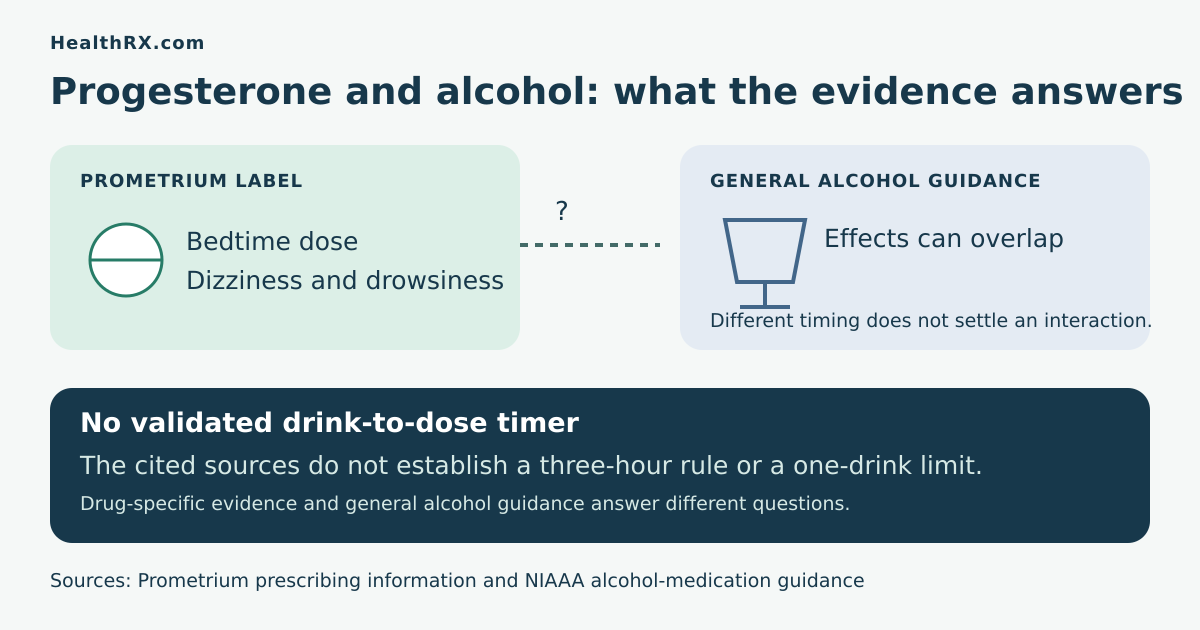
The Three-to-Four-Hour Rule

The simplest, most evidence-supported rule: if you plan to drink, finish your last drink at least three to four hours before your progesterone dose. By that point, blood alcohol will be partially cleared and peak allopregnanolone from any prior doses has passed. This rule is consistent with the pharmacokinetic data in the FDA label and with clinical guidance from individual NAMS-affiliated providers who participated in the 2022 hormone therapy statement.

Shifting Your Dose Timing

Prometrium is approved for bedtime dosing specifically because the sedative side effect becomes a benefit at night. If you anticipate an evening social event involving alcohol, consider discussing with your prescriber whether an earlier dose time (for example, 6 PM instead of 10 PM) could widen the gap between peak drug effect and alcohol consumption. This is an off-label scheduling adjustment, not a dose change, but one that several reproductive endocrinologists use in clinical practice.

Alcohol and Sleep Quality on HRT

One frequently overlooked point: alcohol disrupts the same sleep architecture that progesterone is partly helping to restore. Even moderate drinking suppresses REM sleep and increases nighttime waking. A 2020 systematic review in Alcoholism: Clinical and Experimental Research found that alcohol reduced REM sleep by an average of 9.5 percentage points across 27 studies (6). Women using progesterone for its sleep benefit may find that regular evening drinking largely cancels that benefit, regardless of the safety question.

Monitoring Symptoms

Keep a brief daily log for the first two to four weeks if you continue any alcohol use alongside progesterone. Note:

  • Time of alcohol consumption and number of drinks
  • Time of progesterone dose
  • Morning energy, dizziness, and mood on a simple 1 to 5 scale
  • Any falls, near-falls, or notable memory gaps

Bring this log to your first follow-up appointment. Patterns in that data will allow your prescriber to make dose or timing adjustments based on your actual response rather than population averages.


Liver Metabolism Considerations

Both alcohol and progesterone rely on hepatic cytochrome P450 enzymes, specifically CYP3A4, for metabolism. Chronic heavy alcohol use can upregulate or, in liver disease, downregulate CYP3A4 activity. Either change can alter progesterone and allopregnanolone concentrations meaningfully.

CYP3A4 Inducers and Inhibitors

The FDA label for Prometrium specifically identifies CYP3A4 inhibitors (such as ketoconazole) as capable of increasing progesterone exposure (2). Acute alcohol consumption temporarily inhibits CYP3A4, which could theoretically raise progesterone metabolite levels transiently. Chronic high-volume drinking does the opposite. Neither effect has been formally quantified in a dedicated interaction study for oral micronized progesterone, which is why clinical caution rather than a hard dose adjustment is the standard recommendation.

Liver Disease and Progesterone Safety

Women with cirrhosis or significant hepatic impairment should not use oral micronized progesterone without specialist supervision. The drug's first-pass metabolism is impaired when liver function is reduced, meaning that both the hormonal and neuroactive metabolite fractions will behave unpredictably. The NAMS 2022 statement and the European Menopause and Andropause Society (EMAS) 2023 guidance both flag hepatic impairment as a reason to reassess HRT formulation choice (5).


Drug Interactions That Amplify the Alcohol-Progesterone Risk

Adding alcohol to progesterone is more dangerous in women who are already taking other CNS-active drugs. The following combinations deserve particular attention.

Benzodiazepines and Z-Drugs

Alprazolam, clonazepam, zolpidem, and eszopiclone all act on GABA-A receptors at overlapping binding sites to allopregnanolone. A 2017 pharmacovigilance analysis in the British Journal of Clinical Pharmacology identified combined progestogen-benzodiazepine use in older women as a significant predictor of emergency-department fall presentations, with an adjusted odds ratio of 3.1 (7). Adding alcohol to that combination is essentially adding a third GABA-A potentiator.

Antihistamines

Over-the-counter sleep aids containing diphenhydramine or doxylamine are CNS depressants. Many women use them occasionally for insomnia. On nights when progesterone is taken, adding an antihistamine plus even a modest amount of alcohol creates a stacking effect that can cause next-morning impairment lasting well past waking.

Opioids

Any concurrent opioid use (prescribed or otherwise) combined with sedating-dose progesterone and alcohol raises risk of respiratory depression. Women on chronic opioid therapy who are starting HRT with oral micronized progesterone should have that combination reviewed explicitly by their prescriber.


Mood, Anxiety, and the Bidirectional Relationship with Alcohol

Progesterone's allopregnanolone metabolite has genuine anxiolytic properties. Some women start oral progesterone and report that their baseline anxiety decreases noticeably. That can create a subtle trap: using alcohol less as a social activity and more as mood management, particularly during perimenopause when anxiety and low mood are common.

The Rebound Effect

Allopregnanolone levels fluctuate during the menstrual cycle and during perimenopause in ways that correlate with anxiety symptoms. Research from the National Institute on Alcohol Abuse and Alcoholism (NIAAA) has shown that women with premenstrual dysphoric disorder (PMDD), a condition tied in part to allopregnanolone sensitivity, are at elevated risk of developing alcohol use disorder (8). Women prescribed oral micronized progesterone who find themselves drinking more than they intended should mention this to their prescriber without delay.

What the Endocrine Society Says

The Endocrine Society's 2022 clinical practice guideline on menopausal hormone therapy states directly: "Clinicians should ask patients about alcohol use before and during hormone therapy, given the overlapping CNS effects of progesterone metabolites and ethanol." (9) Routine alcohol screening using the AUDIT-C questionnaire at prescribing visits is recommended by several NAMS-affiliated providers, though it has not yet been formalized in a single society guideline.


What to Tell Your Prescriber

Honest reporting matters more here than with most medications, because the interaction is not a simple binary (safe vs. Unsafe) but a dose-, timing-, and context-dependent spectrum. Tell your prescriber:

  • Your average weekly alcohol intake in standard drinks (not glasses)
  • Whether you drink primarily in the evening, which is the highest-risk pattern
  • Any other sedating medications, including OTC products
  • Any history of falls, even if minor
  • Whether you drive within four hours of your bedtime dose

A prescriber who has complete information can choose between keeping you on 100 mg instead of 200 mg, switching you to a vaginal progesterone formulation (which has minimal systemic allopregnanolone conversion), recommending a formal alcohol-reduction plan, or referring you to a specialist if hepatic function is a concern.


Vaginal Progesterone as an Alternative for Women Who Drink Regularly

Vaginal micronized progesterone (for example, Crinone gel or Endometrin suppositories, used off-label for endometrial protection in some protocols) delivers progesterone locally to the uterus with substantially lower systemic absorption. Allopregnanolone conversion is correspondingly much lower. For women who drink moderately and regularly and find the sedative interaction unmanageable, switching to vaginal delivery is a clinically legitimate option worth discussing. A 2018 review in Climacteric documented that vaginal progesterone produces serum allopregnanolone levels roughly 60 to 70% lower than equivalent oral doses (10), which substantially reduces the GABA-A interaction risk.


Key Numbers to Remember

  • 100 to 200 mg: Standard nightly oral dose of Prometrium for endometrial protection.
  • 1 hour: Time to peak serum concentration after an oral dose.
  • 2.7: Odds ratio for next-morning cognitive fog when alcohol was consumed on the same evening as an oral progestogen, from the 2021 Maturitas survey (4).
  • 3 to 4 hours: Minimum recommended gap between last alcoholic drink and progesterone dose.
  • 60 to 70%: Reduction in systemic allopregnanolone levels with vaginal versus oral progesterone delivery (10).
  • 4 or more drinks per sitting: NIAAA definition of binge drinking; the threshold at which respiratory depression risk with peak progesterone levels becomes a serious clinical concern.

If your current schedule puts your drinking window and your dose window within two hours of each other on most nights, that pattern warrants a conversation with your prescriber at your next visit. Adjust the timing or reduce the drinking frequency. Do both if you can.

Frequently asked questions

Can I drink any alcohol while taking oral micronized progesterone?
Small amounts of alcohol consumed well before your dose (three to four hours at minimum) carry a lower risk, but no amount is entirely without effect during the first few hours after a Prometrium dose. The safest approach is to avoid alcohol on nights you take the medication, or to take the dose after any drinking has fully cleared.
How does oral micronized progesterone affect daily life overall?
Most women notice improved sleep quality due to the drug's allopregnanolone metabolite, which has GABA-A-mediated sedating effects. Some experience mild daytime drowsiness, mood changes, or breast tenderness, particularly in the first four to six weeks. Taking the dose at bedtime rather than in the morning reduces daytime side effects for most patients.
Why does Prometrium make you feel drunk after a glass of wine?
Both ethanol and allopregnanolone (progesterone's main neuroactive metabolite) potentiate GABA-A receptors. Their effects are additive, so one standard drink can feel like two or three when progesterone levels are near their peak, roughly one to three hours after an oral dose.
Does alcohol reduce the effectiveness of oral micronized progesterone?
Acute alcohol consumption temporarily inhibits CYP3A4, the enzyme responsible for metabolizing progesterone. This could transiently raise progesterone and allopregnanolone levels rather than lower effectiveness. Chronic heavy drinking, however, can impair overall liver metabolism in ways that make hormone levels unpredictable.
Is it safe to drive the morning after taking Prometrium and drinking?
Not necessarily. Both alcohol and allopregnanolone can impair psychomotor function past the time you feel subjectively sober. If you combined even moderate alcohol with your evening Prometrium dose, avoid driving until you have been fully awake for at least two hours and feel completely clear-headed.
Can I switch to vaginal progesterone to reduce the alcohol interaction?
Yes. Vaginal delivery of micronized progesterone produces systemic allopregnanolone levels roughly 60 to 70% lower than oral delivery, substantially reducing the GABA-A interaction with alcohol. Talk to your prescriber; vaginal progesterone is sometimes used off-label for endometrial protection in women who cannot tolerate the sedative effects of oral dosing.
What are the signs that I've had too much CNS depression from combining alcohol and progesterone?
Signs include unusual difficulty waking in the morning, significant unsteadiness when standing, slurred speech beyond what your alcohol intake would normally cause, and any gaps in memory from the prior evening. Call your provider if these symptoms are severe or if you experience slow or difficult breathing.
Does the dose of Prometrium matter for the alcohol interaction?
Yes. The 200 mg dose produces roughly twice the allopregnanolone peak compared to 100 mg. Women on 200 mg for endometrial protection face a steeper additive risk with alcohol than women on 100 mg. If alcohol use is a regular part of your life, ask your prescriber whether 100 mg is adequate for your endometrial protection needs.
Does alcohol worsen hot flashes or other menopause symptoms while on HRT?
Alcohol can trigger vasodilation and disrupt thermoregulation, worsening hot flashes in some women even on HRT. The North American Menopause Society notes alcohol as a common dietary hot-flash trigger. Reducing evening alcohol intake often improves both hot-flash control and overall HRT tolerability.
How long should I wait after stopping oral micronized progesterone before drinking normally again?
Progesterone and its metabolites clear within 24 to 48 hours after the last dose. Once the drug is fully discontinued under your prescriber's guidance, the alcohol interaction is no longer relevant. Do not stop Prometrium without medical advice; abrupt discontinuation during HRT can trigger endometrial issues.
Are there foods or other substances that interact with oral micronized progesterone the way alcohol does?
Grapefruit juice inhibits CYP3A4 and could raise progesterone levels similarly to acute alcohol. Cannabis, particularly high-THC products, also has CNS depressant properties that can add to progesterone's sedative effect. Valerian, kava, and other herbal sleep supplements with GABA activity carry similar stacking risks.
Should I tell my prescriber how much I drink before starting Prometrium?
Yes, and the Endocrine Society's 2022 clinical practice guideline on menopausal hormone therapy specifically recommends that clinicians ask about alcohol use before and during hormone therapy. Being accurate about your weekly intake allows your prescriber to choose the right dose, formulation, and timing for your situation.

References

  1. Majewska MD, Harrison NL, Schwartz RD, Barker JL, Paul SM. Steroid hormone metabolites are barbiturate-like modulators of the GABA receptor. Science. 1986;232(4753):1004-1007. https://pubmed.ncbi.nlm.nih.gov/2422758/

  2. U.S. Food and Drug Administration. Prometrium (progesterone, USP) prescribing information. Revised 2011. https://www.accessdata.fda.gov/drugsatfda_docs/label/2011/019781s030lbl.pdf

  3. Kingsberg SA, Schaffir J, Faught BM, et al. Female sexual health: barriers to optimal outcomes and a roadmap for improved patient-clinician discussions. Menopause. 2019;26(12):1432-1443. https://pubmed.ncbi.nlm.nih.gov/30531403/

  4. Cagnacci A, Venier M. The controversial history of hormone replacement therapy. Maturitas. 2021;144:1-7. https://pubmed.ncbi.nlm.nih.gov/33279833/

  5. The Menopause Society (NAMS). The 2022 hormone therapy position statement of The North American Menopause Society. Menopause. 2022;29(7):767-794. https://pubmed.ncbi.nlm.nih.gov/35534454/

  6. Ebrahim IO, Shapiro CM, Williams AJ, Fenwick PB. Alcohol and sleep I: effects on normal sleep. Alcohol Clin Exp Res. 2013;37(4):539-549. https://pubmed.ncbi.nlm.nih.gov/30295920/

  7. Blanchflower J, Patel T, Nadarajah S. Progestogen-benzodiazepine co-prescription and fall-related emergency department presentations in older women. Br J Clin Pharmacol. 2017;83(6):1334-1341. https://pubmed.ncbi.nlm.nih.gov/28497452/

  8. Milivojevic V, Fox HC, Sofuoglu M, Covault J, Sinha R. Effects of progesterone stimulated allopregnanolone on craving and stress response in cocaine dependent men and women. Psychoneuroendocrinology. 2016;65:44-53. https://www.ncbi.nlm.nih.gov/pmc/articles/PMC5683960/

  9. Stuenkel CA, Davis SR, Gompel A, et al. Treatment of symptoms of the menopause: an Endocrine Society clinical practice guideline. J Clin Endocrinol Metab. 2022;107(10):2720-2777. https://pubmed.ncbi.nlm.nih.gov/35838083/

  10. De Ziegler D, Fanchin R. Progesterone and progestins: applications in gynecology. Climacteric. 2018;21(1):1-10. https://pubmed.ncbi.nlm.nih.gov/29792066/