Retatrutide, Relationships and Libido: What Research Can Tell You
At a glance
- Retatrutide weight-loss results cannot tell you whether desire will rise or fall.[2]
- Studies of relationships and sexual function after surgery concern different treatments and populations.[3,4]
- Keep physical symptoms, sexual desire and relationship concerns separate when describing a change.
What the studies actually measured
Retatrutide is an investigational, once-weekly triple agonist in clinical development, with multiple phase 3 results reported.[1] Its development as a weight-loss treatment does not establish a sexual-health benefit.
| Evidence | Measured outcomes | Limits for intimacy questions |
|---|---|---|
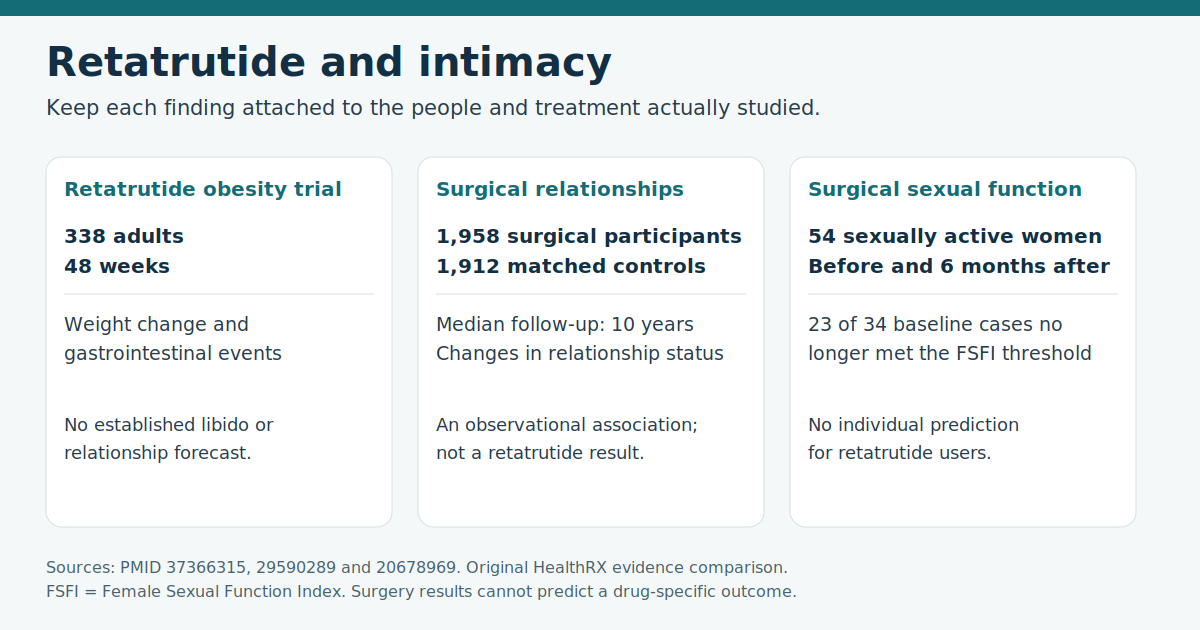
| Retatrutide phase 2 obesity trial: 338 adults, 48 weeks | Weight change and safety, including gastrointestinal adverse effects | Did not establish effects on desire, relationship status, fertility or timing sex after injections.[2] |
| Swedish surgical relationship cohort | Separation/divorce and new relationships over long follow-up | Observational associations after surgery cannot predict a retatrutide user's relationship.[3] |
| Surgical sexual-function cohort: 54 sexually active women | Self-reported sexual function before and six months after surgery | Selected participants, no retatrutide exposure and no universal recovery timeline.[4] |
In the Swedish Obese Subjects cohort, 1,958 surgical participants were compared with 1,912 matched controls over a median of 10 years. The adjusted hazard ratio was 1.28 for separation or divorce among people partnered at baseline, and 2.03 for marriage or a new relationship among people initially single. These are different outcomes in different groups, not percentages or a prediction for one couple. The study was observational and involved surgery, so it cannot establish what retatrutide does to a relationship.[3]
In the smaller sexual-function study, 23 of 34 women who initially met a sexual-dysfunction threshold no longer met it at six months.[4] This finding does not establish an individual chance of improvement with retatrutide—or a deadline for feeling more interested in sex.
Desire, physical comfort and hormones are different questions
The phase 2 retatrutide trial reported gastrointestinal adverse effects that were mostly mild or moderate and dose-related.[2] Feeling nauseated may be a reason someone wants to postpone intimacy, but that practical possibility is not evidence that retatrutide directly suppresses libido. The trial supplies no reliable post-injection window for sex or universal month when intimacy should feel normal.
Hormone findings also need boundaries. A meta-analysis of diet and bariatric-surgery studies found increases in total and unbound testosterone with weight loss.[5] It did not establish a retatrutide effect or prove that a hormone change produces greater desire. A review concerning functional hypogonadism in men aged 50 and older emphasizes nonspecific symptoms and the relevance of weight and other health conditions.[7] Persistent concerns warrant an individualized assessment, not an automatic hormone panel or testing calendar.
Make the conversation specific
Body image, changing routines and worries about attraction can be discussed without predicting that treatment will help or damage a relationship. One way to start the conversation:
“I'm considering participating in a retatrutide study. I don't know whether my interest in sex will change. If I feel sick or less comfortable, I'd like us to talk rather than assume it means less attraction. What would help us stay connected?”
For a useful conversation, keep a short note containing the date, symptoms, appetite or eating difficulties, energy, interest in intimacy, and anything you want to discuss. Add study-treatment timing if relevant, without treating a recurring pattern as proof of causation. Share persistent or troubling symptoms with the study team; use the relationship notes to clarify needs with your partner.
Keep mood concerns separate from assumptions
In January 2026, the FDA reported no increased suicidal-ideation or behavior risk in its review of studied approved GLP-1 receptor agonists and requested warning removal for Saxenda, Wegovy and Zepbound.[6] That finding is not retatrutide-specific safety clearance. New or worsening mood changes deserve clinical attention rather than being attributed automatically to weight loss, hormones or relationship stress.
Frequently asked questions
How does retatrutide affect daily life?
The clearest relevant evidence concerns weight change and side effects, including nausea and other gastrointestinal symptoms.[2] Those experiences may raise questions about meals, social plans or physical comfort. If participating in a study, ask its team about visit requirements and how to report symptoms that interfere with your routine.
Does retatrutide reduce libido?
The 2023 phase 2 obesity trial does not establish a predictable reduction in libido.[2] They also cannot rule out an individual's concern. If desire changes, describe when it began and whether nausea, low energy, mood or relationship concerns occurred alongside it; that record can support discussion without identifying a cause by itself.
Can retatrutide improve sexual function?
A sexual-function benefit was not established by the 2023 retatrutide obesity trial.[2] Some women reported improved sexual function after bariatric surgery, but that small before-and-after study involved a different intervention.[4] It cannot supply a retatrutide success rate, predict men's outcomes or promise improvement after a particular number of months.
How should I talk to my partner about starting retatrutide?
Start with uncertainty and a concrete request: “I don't know how I'll feel during the study. If I'm nauseated or less interested in sex, can we check in rather than assume it's about attraction?” Discuss what closeness means to each of you without setting a recovery deadline.
Will retatrutide change how I feel about my relationship?
The retatrutide obesity trial cannot predict how you will feel about a relationship.[2] Surgical cohorts observed changes in relationship status, but those associations do not establish that retatrutide changes feelings or causes breakups.[3] Discuss specific concerns—such as attraction, attention or shared routines—rather than treating a medication decision as a forecast for the relationship.
Does retatrutide affect alcohol tolerance or desire?
The obesity-trial findings cited here do not establish how retatrutide changes alcohol tolerance or interest in drinking.[1,2] Reduced appetite is not evidence of a predictable alcohol effect. If you are in a trial, ask the study team about alcohol-related restrictions and report unexpected symptoms rather than assuming your previous drinking experience still applies.
What should I eat on retatrutide to maintain energy for intimacy and daily activities?
The 2023 phase 2 obesity trial does not establish a diet or calorie target for sexual energy.[2] If nausea or appetite changes make eating difficult, describe your intake and energy concerns to the study team and ask whether individualized nutrition support is appropriate. No food or supplement in these sources is shown to preserve libido during treatment.
Is retatrutide approved and where can I get it?
Lilly’s September 2026 update describes retatrutide as investigational, with multiple phase 3 results reported.[1] It is not yet approved for public use. For participation information, consult official trial information and the listed study contacts; eligibility and enrollment depend on the individual study.
How long do GI side effects last on retatrutide?
The phase 2 trial reported mostly mild or moderate, dose-related gastrointestinal adverse effects, but it does not supply a dependable duration for an individual.[2] There is no supported universal recovery month or post-injection intimacy window. Tell the study team about persistent, worsening or disruptive symptoms rather than following an invented timeline.
Should I tell my employer or colleagues that I am on retatrutide?
Separate what you want to share socially from what you need to discuss about scheduling or work tasks. You might describe an appointment or symptom-related need without volunteering intimate details. If study visits affect work, ask the study team what documentation it can provide and review relevant workplace policies.
Can retatrutide affect fertility?
The 2023 phase 2 obesity trial does not establish a fertility benefit or an individual pregnancy risk.[2] Weight loss, sexual desire and fertility are separate outcomes, so changes in one cannot confirm changes in another. If pregnancy planning or contraception is relevant, discuss it with the study team and your clinician rather than inferring safety or benefit.
Does retatrutide cause depression or mood changes?
These sources do not establish a retatrutide-specific answer. The FDA's January 2026 review found no increased suicidal-ideation or behavior risk in the studied approved GLP-1 medicines; that is not retatrutide safety clearance.[6] New or worsening mood symptoms deserve prompt clinical attention, regardless of whether their cause is clear.
References
- Lilly. What to know about retatrutide. Manufacturer FAQ, September 2026. https://www.lilly.com/news/stories/what-to-know-about-retatrutide
- Jastreboff AM, et al. Triple–Hormone-Receptor Agonist Retatrutide for Obesity — A Phase 2 Trial. 2023. https://pubmed.ncbi.nlm.nih.gov/37366315/
- Bruze G, et al. Associations of Bariatric Surgery With Changes in Interpersonal Relationship Status: Results From 2 Swedish Cohort Studies. 2018. https://pubmed.ncbi.nlm.nih.gov/29590289/
- Bond DS, et al. Significant resolution of female sexual dysfunction after bariatric surgery. 2011. https://pubmed.ncbi.nlm.nih.gov/20678969/
- Corona G, et al. Body weight loss reverts obesity-associated hypogonadotropic hypogonadism: a systematic review and meta-analysis. 2013. https://pubmed.ncbi.nlm.nih.gov/23482592/
- U.S. Food and Drug Administration. FDA requests removal of suicidal behavior and ideation warning from glucagon-like peptide-1 receptor agonist medications. January 13, 2026. https://www.fda.gov/drugs/drug-safety-communications/fda-requests-removal-suicidal-behavior-and-ideation-warning-glucagon-peptide-1-receptor-agonist-glp
- Grossmann M, Matsumoto AM. A Perspective on Middle-Aged and Older Men With Functional Hypogonadism: Focus on Holistic Management. 2017. https://pubmed.ncbi.nlm.nih.gov/28359097/