Travel During a Retatrutide Trial: Storage, Schedules and Documents
At a glance
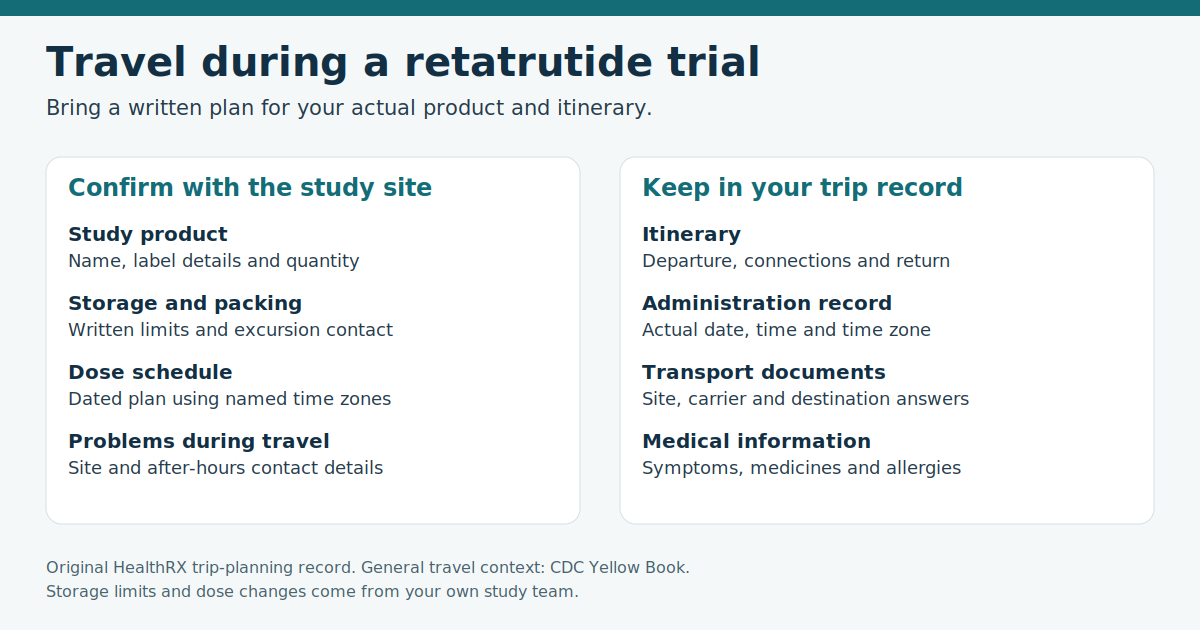
Ask your study site to confirm transport conditions, the dose schedule across time zones, required documents and what to do after a storage problem or illness. Separately check destination and transit-country entry requirements. Keep those answers together in an accessible trip record.[2,3]
Get the trip cleared with your study site
Send your coordinator your departure and return dates, flight connections, destinations and planned activities. Flag overnight flights, remote stays, unreliable refrigeration, upcoming dose increases and any procedures involving sedation. Ask whether travel affects study visits, laboratory work, dispensing or access to replacement supplies. Request a reply that addresses your itinerary rather than relying on a verbal reassurance.
The manufacturer’s public overview gives no universal deadline for notifying a study site about travel. Ask your site what notice your study requires, including how much time it needs to arrange supplies and documents. Retatrutide trial instructions must come from the team responsible for your participation.[1]
Build a travel record
Use this trip record to keep the answers together. Mark unresolved items “awaiting confirmation” so a missing answer is easy to spot.
| Requested record | Who confirms it | How to log it |
|---|---|---|
| Product identification and quantity | Study site | Copy the dispensed product’s label details and dispensing record |
| Storage limits and permitted transport setup | Study site or study pharmacy | Save written limits, packing instructions and excursion contact |
| Dose dates across time zones | Study team | Record dates, times and named time zones |
| Delayed, missed or uncertain dose instructions | Study team | Attach the written decision instructions and contact number |
| Destination and transit entry documents | Responsible government authority, with study-team input | Save requirements, permission and confirmation dates |
| Illness, lost supplies and urgent contacts | Study site | Keep daytime and after-hours numbers available offline |
Pack to the product’s written requirements
Ask exactly how the dispensed product must be stored during transport and at your accommodation. Obtain instructions for any cooling device, temperature monitoring and handling after a suspected temperature excursion. Do not infer allowable room-temperature time from another injectable medicine. The manufacturer’s public retatrutide overview cannot establish these limits.[1]
CDC’s general travel advice favors keeping medicines and supplies in carry-on luggage and original containers.[2] That does not establish airline acceptance of every cooler, needle or investigational product. Check relevant airline and screening arrangements separately. If a flight delay or hotel storage problem occurs, document the circumstances and ask the site whether the affected supply may be used; do not guess from its appearance.
Resolve dose timing before crossing time zones
Ask for a dated schedule showing which time zone each entry uses, including the return journey. Have the team address a delayed flight, a forgotten dose and uncertainty about whether a dose was administered. Do not create your own catch-up schedule or borrow semaglutide’s missed-dose window. The manufacturer’s public overview does not provide a time-zone adjustment or missed-dose rule.[1]
Log the actual administration date, local time and time zone immediately afterward. Keep the planned schedule alongside the actual record so discrepancies are easy to explain.
Prepare documents and a route to care
For international trips, check both destination and transit-country requirements with the responsible authorities. A prescription alone does not guarantee entry, and advance permission may be needed. Ask specifically about your investigational study product rather than assuming ordinary prescription rules settle the question.[3]
CDC recommends a medical letter covering conditions, medicines, doses, allergies, equipment and clinician contacts, plus accessible health information and knowledge of local care options.[2] Ask the site how to describe your participation accurately, including any blinded treatment assignment. Carry its emergency contact details without assuming it provides round-the-clock clinical care.
Plan for symptoms and unexpected treatment
Gastrointestinal adverse effects were dose-related and mostly mild to moderate in the phase 2 obesity trial; that finding does not predict your risk on a particular flight.[5] Ask the site how to handle nausea, vomiting, reduced intake or difficulty keeping fluids down, and when to seek local care. Request approval before adding travel medicines: GLP-1-related gastric-emptying effects provide context, not a retatrutide-specific interaction or pill-spacing rule.[6]
If surgery or sedation becomes necessary, disclose all medicines and the last study dose. ASA guidance for approved GLP-1 medicines uses individualized assessment; it does not establish a retatrutide continuation rule or universal seven-day hold. Have the study site and anesthesia team coordinate.[4]
Frequently asked questions
How does retatrutide affect daily life?
Trial participation can involve scheduled doses, visits and symptom reporting, so travel planning should include those commitments. Gastrointestinal effects were common in the phase 2 obesity study and were dose-related.[5] Ask your site which symptoms, eating difficulties or activity changes should prompt contact under your study’s instructions.
Can I fly with retatrutide in my carry-on?
CDC generally recommends carrying medicines and supplies in hand luggage and original containers.[2] For your study product, confirm the transport setup with the site and check airline and security arrangements for needles, cooling materials and equipment. General carry-on advice is not confirmation that every proposed setup will be accepted.
What happens if I miss a dose while traveling?
Use your study team’s written missed-dose instructions, or contact the team if you do not have them. Do not double a dose, shorten the interval or apply semaglutide instructions on your own. Record the scheduled dose, what happened and your current time zone to help the team advise you.[1]
Does retatrutide need to be refrigerated at all times?
Lilly’s public overview does not provide storage temperatures or permitted time outside refrigeration.[1] Obtain instructions for your actual dispensed product from the study site or pharmacy. Ask about transport, hotel storage and what to do after a temperature excursion before deciding whether a supply remains usable.
Can I drink alcohol while on retatrutide?
The retatrutide obesity report cited here does not establish a safe alcohol allowance or an injection-day drinking rule. Ask your study team whether the protocol restricts alcohol and how your symptoms, other medicines or health conditions affect its advice. Do not interpret the absence of a published limit as evidence of safety.
What should I tell a foreign doctor or emergency room about retatrutide?
Explain that you are participating in a retatrutide study, giving the study name, known treatment details, last dose, symptoms, other medicines and allergies. If treatment is blinded, say so rather than guessing. Provide site contacts and available documents; mention study treatment specifically before anesthesia or sedation.[2,4]
Does altitude or air travel affect how retatrutide works?
The cited phase 2 study did not test flight, altitude or jet-lag effects, so it cannot establish whether those conditions change retatrutide’s effects.[5] Ask your site about your itinerary, particularly remote or high-altitude travel, and resolve storage, dose timing and access to medical care before departure.
Can I exercise normally on vacation while taking retatrutide?
The retatrutide obesity trial does not establish a vacation exercise limit or a carbohydrate-replacement formula. Discuss unusually strenuous activities, remote excursions and current symptoms with your study team. Leave room to change activities if nausea, vomiting or reduced intake disrupts your plans.[5]
Is retatrutide safe to bring into other countries?
Permission depends on the destination, transit route and specific product. Check with responsible government authorities and your study team before travel; a prescription or medical letter alone does not guarantee entry.[3] Ask whether an investigational product requires advance authorization, and keep the resulting documents with your travel record.
How do I handle nausea on a long flight while on retatrutide?
Before departure, ask your site for a symptom plan, including whether any nausea medicine is appropriate and when to seek care. Gastrointestinal effects occurred in retatrutide trials, but no universal flight antiemetic regimen follows from those findings.[5] If vomiting prevents fluid intake, seek prompt medical advice. If you are already in flight, alert the crew to worsening symptoms.
What is retatrutide and how is it different from semaglutide?
Retatrutide is an investigational medicine targeting GIP, GLP-1 and glucagon receptors. Wegovy’s prescribing information identifies semaglutide as a GLP-1 receptor agonist.[1,7] Their shared GLP-1 activity does not make product instructions interchangeable. For travel, use your study’s retatrutide-specific storage and dosing directions rather than rules from an Ozempic or Wegovy label.
Does retatrutide interact with any travel medications?
Have the study team assess each proposed medicine, including motion-sickness treatments, antimalarials, antibiotics and nonprescription products. GLP-1-related effects on gastric emptying do not establish a retatrutide-specific interaction list or a universal interval between oral medicines and injections.[6] Provide names, doses and intended use rather than asking about “travel tablets” generally.
Does crossing time zones change when I should inject retatrutide?
Obtain a dated plan from your study site that names the time zone for each dose, including the return journey. Record actual administration times alongside it. Lilly’s public overview supplies no universal rule for moving a retatrutide dose across time zones, so a fixed two-day or four-day window cannot be inferred from that page.[1]
What should I do if my retatrutide pen is lost or confiscated during travel?
Contact your study site with the product identification, quantity, last dose and circumstances. Ask how replacement supply and any interruption must be handled under your study instructions. If an authority holds the product, retain the paperwork and contact details. Do not replace it with an unverified product or change the dose schedule yourself.
How does retatrutide compare to semaglutide and tirzepatide for weight loss?
These cited trials tested different medicines against placebo: retatrutide in a 48-week phase 2 trial, semaglutide in the 68-week STEP 1 trial and tirzepatide in the 72-week SURMOUNT-1 trial.[5,8,9] Their results do not establish a head-to-head ranking or interchangeable travel instructions. Trial duration, doses and participants matter when interpreting the separate results.
References
- Lilly. What to know about retatrutide.
- CDC Yellow Book. Travelers with Chronic Illnesses.
- CDC Yellow Book. Traveling with Prohibited or Restricted Medications.
- American Society of Anesthesiologists. Drugs for Diabetes or Weight Loss.
- Jastreboff AM, et al. Triple–Hormone-Receptor Agonist Retatrutide for Obesity—A Phase 2 Trial. 2023.
- Marathe CS, et al. Effects of GLP-1 and incretin-based therapies on gastrointestinal motor function. 2011.
- Novo Nordisk. Wegovy prescribing information. Revised June 2026. Semaglutide receptor classification only; its instructions do not establish retatrutide travel rules.
- Wilding JPH, et al. Once-Weekly Semaglutide in Adults with Overweight or Obesity. 2021. STEP 1; not a retatrutide or travel trial.
- Jastreboff AM, et al. Tirzepatide Once Weekly for the Treatment of Obesity. 2022. SURMOUNT-1; not a retatrutide or travel trial.