Reclast and Exercise: Plan Around Symptoms and Fracture History
Exercise remains part of osteoporosis care while you receive Reclast (zoledronic acid). Plan each workout around your current symptoms, fracture history and how steadily you move. The guidance here concerns osteoporosis infusions.
Let symptoms guide the next workout
Reclast can cause fever, muscle aches, joint pain and fatigue. Acute reactions occur mostly within the first three days, usually resolve within three days of starting, and sometimes last 7–14 days. These descriptions are not return-to-gym deadlines. There is no established rule requiring everyone to rest for 24–72 hours or resume normal training on day four. [1]
If you feel well and steady, gentle familiar activity may be reasonable. If you feel feverish, dizzy or exhausted, postpone strenuous exercise. A shorter walk near home may suit you better than a remote trail or demanding class. Resume your usual routine according to symptoms and existing activity restrictions, rather than trying to make up missed sessions.
Be appropriately hydrated before the infusion, following your own care plan if you have heart or kidney problems. A universal fluid target is not appropriate. [1]
Match activity to fracture and fall history
The UK osteoporosis exercise consensus supports resistance and impact exercise for bone health, strength and balance work for fall prevention, and spinal-extension work for posture. It recommends avoiding a high degree of spinal flexion. People with vertebral fractures or multiple low-trauma fractures generally need impact limited to the equivalent of brisk walking; those at risk of falling should begin with targeted strength and balance work. These are evidence-informed consensus recommendations, not a Reclast-specific workout schedule. [2]
Tell a physical therapist about previous spinal fractures, other fractures and recent falls before choosing unfamiliar exercises. Ask for help adapting movements you actually use, such as lifting shopping bags, getting up from the floor or handling gym equipment. A modification should make the task manageable without assuming that every bend or turn is forbidden.
What the research does—and does not—show
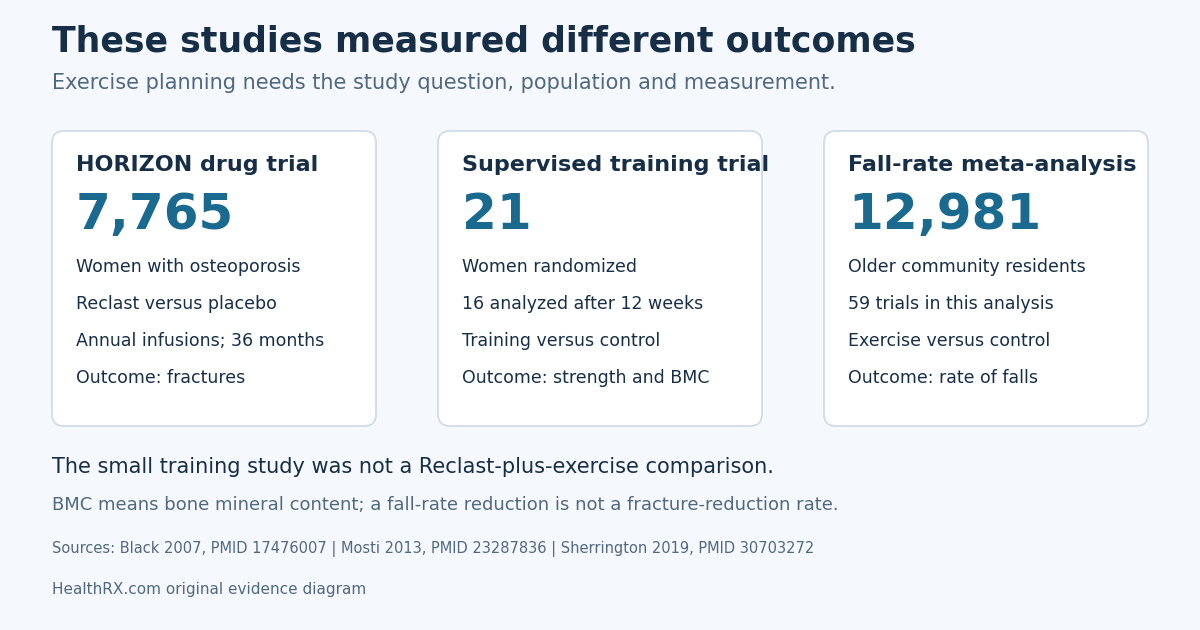
Drug treatment and exercise address related needs, but their studies measure different outcomes. Improved strength, bone mineral content and fewer falls are not interchangeable with demonstrated fracture prevention.
| Evidence and question | What was measured or found | What it does not establish |
|---|---|---|
| HORIZON: Does Reclast prevent fractures? | Among 7,765 women, annual treatment over three years reduced vertebral and hip fractures versus placebo. [3] | It did not compare drug plus exercise with drug alone or clear participants for high-impact activity. |
| Mosti: Can supervised strength training change bone measures? | Twenty-one women with low bone mass were randomized; 16 were analyzed after 12 weeks. Spine and femoral-neck bone mineral content increased with training. [4] | This was not a Reclast-combination trial; bone mineral content is not BMD, and the study did not establish fracture reduction. |
| Cochrane: Can exercise reduce falls? | In the 59-trial fall-rate analysis involving 12,981 community-dwelling older adults, exercise reduced the rate by 23%. [5] | That is not 23% fewer fractures or a result specific to Reclast users. Resistance training alone had uncertain effects on falls. |
These findings support keeping exercise in the plan without borrowing a small study’s maximal-squat program as a home prescription. Reclast’s fracture benefit also does not erase an existing spinal fracture or make running appropriate for everyone.
Keep a useful activity record
Use a notebook or phone note to connect symptoms with activity. Bring dated notes to your treatment or physical-therapy review.
- Before treatment: Record fracture locations, any spinal-fracture history, falls or unsteadiness, and your usual workout.
- Infusion: Note the date and how you felt beforehand.
- Symptoms: Record onset, location, severity and whether symptoms occur at rest or during activity.
- Movement: Note which exercise or everyday task aggravates symptoms and what you changed.
- Follow-up: Write down the team’s or therapist’s adaptations and the agreed review plan.
Know when to stop and contact the team
Severe, incapacitating bone, joint or muscle pain can begin one day to several months after Reclast. New thigh, groin or other bony pain warrants evaluation for a possible atypical fracture. Do not push through these symptoms or assume they are ordinary training soreness. Contact the treating team rather than waiting for a scheduled workout review. [1]
Frequently asked questions
How does Reclast (zoledronic acid) affect daily life?
An early flu-like reaction can temporarily disrupt work, errands or exercise. Plan flexibility around the infusion, then adapt activities to how you feel. Longer-term exercise choices should reflect fracture history and fall risk, rather than the medication name alone. [1,2]
Can I exercise the day I receive my Reclast infusion?
There is no standard same-day exercise clearance. If you feel well and steady, gentle familiar movement may be reasonable within your existing restrictions. Skip strenuous activity if you feel unwell, and ask the infusion team about symptoms that arise that day. [8]
What exercises are best for building bone while on zoledronic acid?
Weight-bearing activity and resistance exercise are useful choices. Walking and suitable low-impact equipment offer options when higher-impact activity is unsuitable. Choose movements and positions that fit your fracture history; a physical therapist can help adapt them. [7]
Are there exercises I should avoid with osteoporosis while on Reclast?
Avoid a high degree of spinal bending forward, particularly with vertebral fractures. High-impact activity may also need limiting after vertebral or multiple low-trauma fractures. Ask for specific movement adaptations rather than avoiding exercise altogether. [2]
How long does the fatigue after Reclast infusion last?
Fatigue may accompany the early reaction, which commonly starts within three days and can last several days, sometimes up to two weeks. That range is not a recovery deadline. Contact your team if fatigue is worsening, persistent or accompanied by concerning symptoms. [8]
Does zoledronic acid cause muscle weakness or joint pain that affects exercise?
Muscle and joint pain can interfere with activity. Severe pain can also begin days to months later and needs prompt medical contact. Do not assume new weakness is routine infusion recovery. Report hip, groin or thigh pain promptly; seek emergency help for breathing difficulty or throat swelling. [8]
Can I do high-impact exercise like running on zoledronic acid?
Taking Reclast does not by itself clear you for running. Prior fractures, fall risk, pain and your running background matter. People with previous fractures or high fracture risk may need lower-impact options and an individualized movement assessment. [7]
Do I need to take calcium and vitamin D with Reclast if I exercise regularly?
Exercise does not replace calcium and vitamin D. Reclast guidance recommends supplementation when dietary intake is inadequate. Review your food intake and supplement plan with the treating team rather than assuming exercise covers those needs. [1]
How soon after starting Reclast will I see improvement in bone density?
Bone-density change is assessed over months to years, not by how a workout feels. Follow-up DXA timing depends on treatment and clinical circumstances. Your clinician will interpret the trend; no individual gain is guaranteed, and exercise need not wait for BMD to become normal. [9]
Does alcohol affect how well Reclast works?
No established alcohol threshold tells us when Reclast’s benefit is canceled. Heavy drinking can reduce bone formation, affect calcium balance and increase falls. Those bone-health and safety concerns matter even without a precise drug-effect calculation. [10]
Can yoga or Pilates be done while taking zoledronic acid?
They may be options with appropriate adaptations. Choose poses suited to your fracture history and avoid deep spinal flexion. After spinal fractures, ask a physical therapist to review movements rather than assuming every pose in a class is safe. [2]
What is the long-term drug holiday policy for Reclast, and does it change my exercise needs?
Fracture risk is generally reassessed after three years of IV bisphosphonate treatment; a holiday is not automatic. Higher-risk patients may continue treatment, while selected lower-risk patients may pause under an individualized plan. Exercise remains important during either approach and does not replace medication when treatment is needed. [6]
References
Sources checked October 14, 2026.
- DailyMed: RECLAST prescribing information, Sandoz; updated February 3, 2026
- Brooke-Wavell et al. (2022): Strong, steady and straight—UK consensus statement on physical activity and exercise for osteoporosis
- Black et al. (2007): Once-yearly zoledronic acid for treatment of postmenopausal osteoporosis—HORIZON trial
- Mosti et al. (2013): Maximal strength training in postmenopausal women with osteoporosis or osteopenia
- Sherrington et al. (2019): Exercise for preventing falls in older people living in the community—Cochrane review
- Adler et al. (2016): ASBMR task force report on long-term bisphosphonate treatment
- Bone Health & Osteoporosis Foundation: Exercise and safe movement; reviewed October 24, 2023
- MedlinePlus: Zoledronic acid injection
- LeBoff et al. (2022): The clinician’s guide to prevention and treatment of osteoporosis
- Bone Health & Osteoporosis Foundation: Boning Up—healthy-lifestyle brochure