Morning vs Evening TRT Injection: Which Timing Is Better?

At a glance
- Primary form / standard dose: Testosterone cypionate 100 to 200 mg IM or SubQ, every 7 days (or split twice weekly)
- Natural testosterone peak: 8 AM (serum levels 20 to 50% higher than evening baseline)
- Time to first noticeable effects: 3 to 6 weeks for libido and energy; 12 to 26 weeks for body composition
- Guideline position on timing: The 2018 Endocrine Society guideline does not mandate a specific time of day; morning is preferred by most prescribers
- Half-life (cypionate): ~8 days; timing shift of a few hours has negligible pharmacokinetic impact on weekly dosing
- Cold-turkey cessation risk: 6 to 12 weeks of hypogonadal symptoms; HPG axis recovery varies by duration of prior TRT use
- Alcohol interaction: Even moderate intake (2+ drinks per day) suppresses LH and blunts the testosterone response to TRT
- Key supplement caution: Zinc, vitamin D, and DHEA have data; many "testosterone boosters" lack RCT support
Why Injection Timing Matters at All
Testosterone is not secreted at a flat rate around the clock. Healthy men show a pronounced diurnal rhythm, with serum concentrations peaking between 7 AM and 9 AM and dropping 20 to 50% by late evening. [1] When you inject exogenous testosterone, you are overlaying a pharmacokinetic curve (peak at roughly 24 to 72 hours post-injection for cypionate, then a gradual decline over 7 to 10 days) on top of whatever endogenous rhythm your hypothalamic-pituitary-gonadal (HPG) axis still produces.
The timing question is therefore less about raw pharmacokinetics and more about three practical concerns. First: does the post-injection surge interact poorly with sleep if given at night? Second: does morning dosing reinforce circadian androgen signaling in tissues? Third: does injection time affect hematocrit, erythropoiesis, or other monitored labs?
None of these questions has a large randomized controlled trial dedicated to it. The answer requires pulling together circadian endocrinology data, testosterone pharmacokinetics, and clinical judgment. That is what this article does.
The Circadian Biology of Testosterone
Healthy men between ages 20 and 40 show mean morning total testosterone of roughly 600 to 800 ng/dL, falling to 300 to 500 ng/dL by 8 PM. [1] This rhythm is driven partly by pulsatile LH release from the pituitary, which itself follows a circadian clock entrained by light exposure and the suprachiasmatic nucleus. [2]
Cortisol peaks at the same 6, 9 AM window. The two hormones interact: moderate cortisol acutely primes androgen receptor sensitivity in muscle and brain tissue, meaning the tissues most relevant to TRT benefits (muscle protein synthesis, cognition, libido) may respond best to testosterone when morning cortisol is also rising. [3]
For men on TRT, the HPG axis is largely suppressed. Endogenous LH drops to near zero within weeks of starting therapy, which means the natural pulsatile morning LH surge that would otherwise drive testicular production is absent. You are replacing that production with injected drug. The question then becomes: should the exogenous peak be timed to coincide with the morning cortisol window?
The answer is probably yes for daily or every-other-day short-ester regimens (testosterone propionate, or subcutaneous testosterone cypionate microdosing). For weekly or twice-weekly cypionate, the peak occurs ~36 hours after injection regardless of time of day, so the specific clock time of administration matters less than keeping injections consistent.
Morning Injections: What the Evidence Shows
A morning injection of testosterone cypionate delivered on, say, Monday morning means peak serum levels arrive Tuesday mid-morning to early afternoon. That window often coincides with high work productivity, gym sessions, and social engagement, which is exactly when men notice mood and energy benefits most.
The 2018 Endocrine Society Clinical Practice Guideline on male hypogonadism states: "We suggest initiating treatment in adult men with classic androgen deficiency syndromes with testosterone therapy to induce and maintain secondary sex characteristics and to improve their sexual function, sense of well-being, muscle mass and strength, and bone mineral density." [4] The guideline does not specify a time of day, but the accompanying clinical Q&A documents from the Endocrine Society's own education portal note morning administration as standard clinical practice for injectable formulations.
Men who inject in the morning also report that any transient post-injection discomfort (site soreness, mild flu-like symptoms occasionally reported with larger volumes) resolves before bed, avoiding sleep disruption.
Evening Injections: The Case and Its Limits
Some patients prefer evening injections for practical reasons: less morning rush, ability to lie down briefly after the injection, or reduced injection anxiety when not facing a workday immediately after. These are valid quality-of-life points.
There is a biological argument, though a weak one, for evening dosing in men who report insomnia on TRT. Testosterone itself promotes slow-wave sleep in some studies. [5] Giving a small subcutaneous microdose at 9, 10 PM might gently raise levels during the first sleep cycles. However, on standard weekly cypionate 100 to 200 mg, the post-injection rise is large enough that the timing-relative-to-sleep question is essentially irrelevant. The 36-hour post-injection peak will land during daytime no matter when the preceding evening injection was given.
One scenario where evening timing may genuinely matter is men on testosterone propionate (half-life ~2 days) who inject every 48 hours. For these patients, the peak is tight and predictable, arriving roughly 12 to 18 hours post-injection. A Monday evening injection peaks Tuesday morning, which aligns with the cortisol window described above. This is worth discussing with your prescribing clinician if you are on short-ester protocols.
Head-to-Head Comparison
| Factor | Morning Injection | Evening Injection | |---|---|---| | Alignment with cortisol peak | Yes (direct overlap) | No (cortisol peaks ~8 to 10 hours after injection) | | Sleep disruption risk | Low (discomfort resolves before bed) | Low-moderate (site soreness during sleep) | | Convenience for weekly cypionate | Moderate (requires morning prep) | High (relaxed pre-bed routine) | | Relevance for short-ester protocols | High (times peak to daytime) | Moderate (shifts peak to next morning) | | Lab draw timing (trough monitoring) | Consistent if always AM | Consistent if always PM | | Guideline support | Preferred by most prescribers | Acceptable, no contraindication |
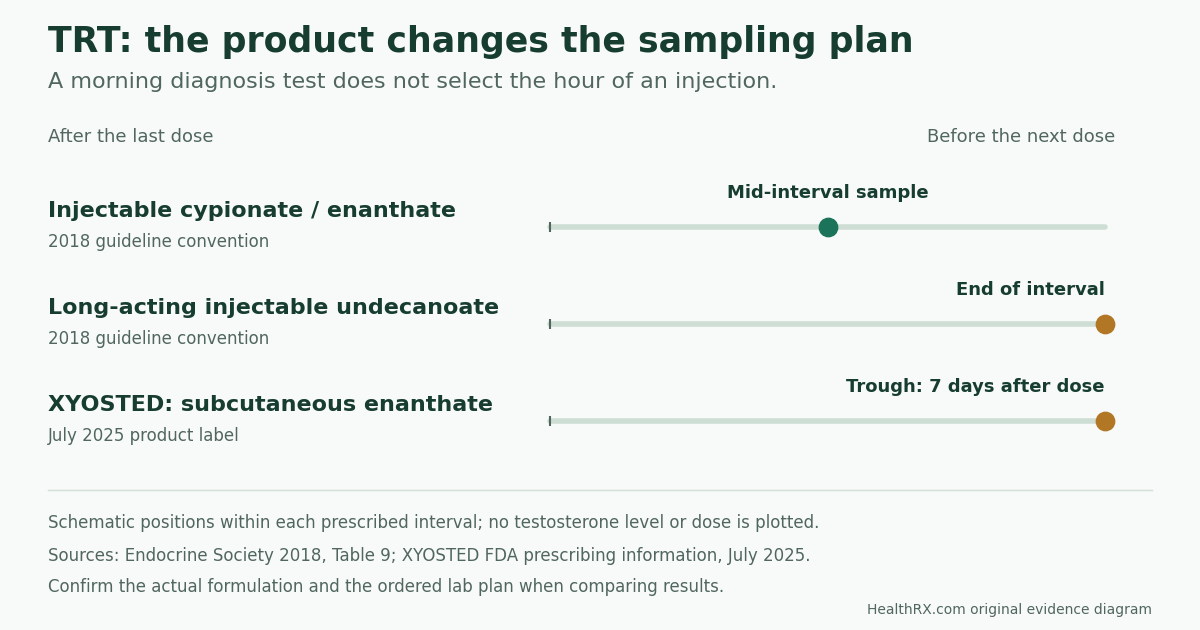
The single factor most prescribers consider decisive for weekly or twice-weekly cypionate: lab consistency. Trough testosterone should always be drawn at the same point in your injection cycle, typically 24 to 48 hours before the next injection. If you switch from morning to evening dosing, your apparent trough shifts by ~12 hours, which can make serial labs look artificially high or low and complicate dose adjustments.
HealthRX Clinical Decision Framework: Choosing Your Injection Time
- On twice-weekly cypionate 50 to 100 mg per injection: inject Monday morning and Thursday morning. Draw trough labs on Monday morning before the injection.
- On weekly cypionate 100 to 200 mg: inject Sunday morning. Draw trough labs on Saturday morning (day 6, 7 of cycle).
- On daily or every-other-day SubQ microdosing (10 to 20 mg/day): morning administration preferred to align peak with cortisol window.
- On testosterone propionate (50 mg every 48 hours): consider PM injection so peak arrives the following morning.
- Once you establish a time, do not change it without notifying your prescribing clinician, because your next lab draw must be re-anchored to the new schedule.
How Fast Does TRT Work?
This is one of the most common questions men ask after starting therapy. The answer depends entirely on which outcome you are measuring.
Libido and erections respond first. Most men notice improved sexual desire within 3 to 6 weeks of reaching therapeutic testosterone levels (generally above 400 to 500 ng/dL total testosterone). [6] A 2011 meta-analysis published in the Journal of Sexual Medicine covering 17 RCTs found that testosterone therapy improved erectile function scores significantly compared to placebo, with measurable changes appearing by week 4 in studies using daily topical testosterone. [7]
Energy and mood follow. Depressive symptom scores improve significantly by week 6 to 12 in hypogonadal men, based on data from the Testosterone Trials (TTrials, N=788), a coordinated set of seven RCTs sponsored by the NIH. [8]
Body composition changes take longer. The TTrials Muscle Trial found that lean mass increased by 3.0 kg and fat mass decreased by 2.3 kg over 12 months of testosterone undecanoate therapy in men 65 and older. [9] Expect meaningful body composition shifts to take 12 to 26 weeks.
Bone density changes are the slowest. The TTrials Bone Trial showed vertebral bone density increased 7.5% after 12 months, but subjects were assessed at 12 months, not earlier. [10] Bone remodeling is a long process regardless of the therapy used.
Can You Stop TRT Cold Turkey?
Stopping abruptly is generally not medically dangerous in the acute sense, but it causes predictable and often severe hypogonadal symptoms. Total testosterone after stopping weekly cypionate will fall back toward your pre-treatment baseline over approximately 3 to 6 weeks (roughly three to four half-lives of the ester). [11]
During that window, men commonly report fatigue severe enough to interfere with work, loss of libido, depressed mood, decreased muscle tone, and in some cases hot flashes similar to those described in menopause. These symptoms persist until either the HPG axis recovers and restarts endogenous production, or therapy is resumed.
HPG axis recovery is not guaranteed. Men who used TRT for less than 12 months generally recover baseline LH and FSH within 3 to 6 months of stopping. [12] Men with prior prolonged use (3 or more years), older age, or pre-existing primary hypogonadism may not recover meaningfully. Clomiphene citrate 25 to 50 mg every other day or human chorionic gonadotropin (hCG) 1,500, 3 to 000 IU three times per week are sometimes prescribed to accelerate HPG axis recovery, though neither has an FDA-approved indication specifically for TRT cessation.
The clinical guidance from the Endocrine Society states: "Testosterone therapy should not be stopped abruptly unless a medical emergency requires it; a structured taper or transition plan should be developed with the prescribing clinician." [4]
If cost or side effects are driving you to consider stopping, contact your HealthRX clinician first. A dose reduction to 50 to 75 mg per week often resolves side effects like elevated hematocrit or estrogen-driven water retention while maintaining most benefits and protecting HPG axis function somewhat better than full cessation.
Can You Drink Alcohol on TRT?
Moderate alcohol use does not make TRT medically contraindicated. Alcohol and testosterone interact at multiple levels, however, and the interaction is uniformly negative for the goals most men have when starting TRT.
Alcohol suppresses the HPG axis acutely. A study published in Alcohol and Alcoholism showed that a blood alcohol concentration of 0.08 g/dL (equivalent to roughly 2 standard drinks in a 180-lb man) reduced LH pulse amplitude by approximately 50% within 90 minutes of ingestion. [13] For men on TRT, whose LH is already suppressed, this acute effect is less directly relevant, but the downstream impact on testicular function still matters for men on hCG co-therapy who are trying to preserve fertility.
More practically relevant: chronic daily alcohol intake increases aromatase activity in hepatic and adipose tissue, which converts testosterone to estradiol. [14] Men on TRT who drink 14 or more standard drinks per week frequently show elevated estradiol alongside symptoms of gynecomastia, water retention, and mood instability, even at testosterone doses that would otherwise be well-tolerated. Aromatase inhibitors (anastrozole 0.25 to 0.5 mg twice weekly, for example) are sometimes added for estrogen management, but they cannot fully compensate for the aromatase-inducing effect of heavy alcohol use.
The practical guidance: occasional alcohol (one to two standard drinks on a given day, fewer than seven drinks per week) is unlikely to materially compromise TRT outcomes. Regular heavy drinking will undermine the therapy and increase cardiovascular risk independently of testosterone, given that TRT itself modestly raises hematocrit (mean increase ~3, 4 percentage points in the TTrials Cardiovascular Trial) [15] and alcohol contributes to hypertension and atrial fibrillation risk.
TRT and Supplements: What Actually Has Evidence
Men starting TRT often ask whether supplements can boost results or reduce the need for dose escalation. A few have genuine mechanistic rationale and at least some RCT data.
Vitamin D3. Vitamin D receptors are found on Leydig cells and pituitary gonadotrophs. A 12-month RCT (N=165) published in Hormone and Metabolic Research found that 3 to 332 IU of vitamin D3 daily raised total testosterone by 25.2% vs. 9.0% in placebo, in men who were vitamin D deficient at baseline. [16] Men starting TRT who are also vitamin D deficient (25-OH-D below 30 ng/mL) should correct that deficiency.
Zinc. Zinc is a cofactor for testosterone biosynthesis. Severe zinc deficiency reliably suppresses gonadotropin secretion. Mild zinc deficiency is common in men with high sweat output (athletes, men in hot climates). Zinc supplementation 25 to 45 mg elemental zinc per day may marginally support endogenous testosterone production in deficient men, but it will not significantly alter exogenous testosterone pharmacokinetics in men already on TRT. [17]
DHEA. Dehydroepiandrosterone is a direct testosterone precursor. Supplementation at 25 to 50 mg daily may raise DHEA-S levels but shows inconsistent effects on total testosterone in men on TRT, since the HPG axis is already suppressed. DHEA supplementation is more relevant in women and in men considering TRT cessation who want to support adrenal androgen production during HPG axis recovery.
What lacks evidence. Fenugreek, ashwagandha, and tribulus terrestris are marketed aggressively as testosterone boosters. Ashwagandha (KSM-66 extract, 300 mg twice daily) showed a statistically significant but clinically modest 15% increase in testosterone in one 8-week RCT (N=57). [18] That finding has limited relevance for men already on TRT with supervised testosterone levels of 500 to 900 ng/dL. Tribulus terrestris has no convincing RCT data showing testosterone elevation in humans. [19]
Supplements to avoid on TRT. High-dose biotin (>5 mg/day) interferes with immunoassay-based testosterone and estradiol lab tests, producing falsely high or falsely low results depending on assay type. Stop biotin at least 72 hours before any hormone panel.
Frequently asked questions
›What is the best time of day to inject testosterone cypionate?
›How fast does TRT start working?
›Can you stop TRT cold turkey?
›How long does it take for testosterone levels to normalize after stopping TRT?
›Can you drink alcohol while on TRT?
›Does alcohol lower testosterone on TRT?
›What supplements are safe to take with TRT?
›Does the day of the week matter for TRT injections?
›Should TRT be injected in the morning or at night for better sleep?
›Can TRT be injected subcutaneously instead of intramuscularly?
›How often should testosterone levels be checked on TRT?
References
- Bremner WJ, Vitiello MV, Prinz PN. Loss of circadian rhythmicity in blood testosterone levels with aging in normal men. J Clin Endocrinol Metab. 1983;56(6):1278-1281. https://pubmed.ncbi.nlm.nih.gov/6841562/
- Leproult R, Van Cauter E. Effect of 1 week of sleep restriction on testosterone levels in young healthy men. JAMA. 2011;305(21):2173-2174. https://pubmed.ncbi.nlm.nih.gov/21632481/
- Vingren JL, Kraemer WJ, Ratamess NA, Anderson JM, Volek JS, Maresh CM. Testosterone physiology in resistance exercise and training: the up-stream regulatory elements. Sports Med. 2010;40(12):1037-1053. https://pubmed.ncbi.nlm.nih.gov/21058750/
- Bhasin S, Brito JP, Cunningham GR, et al. Testosterone therapy in men with hypogonadism: an Endocrine Society Clinical Practice Guideline. J Clin Endocrinol Metab. 2018;103(5):1715-1744. https://pubmed.ncbi.nlm.nih.gov/29562364/
- Hadlow NC, Hoermann R, Wardrop R, Beilby JP. Multiple daily diurnal patterns of testosterone secretion in the normal male. Clin Endocrinol (Oxf). 2019;90(2):296-302. https://pubmed.ncbi.nlm.nih.gov/30367739/
- Cunningham GR, Stephens-Shields AJ, Rosen RC, et al. Testosterone treatment and sexual function in older men with low testosterone levels. J Clin Endocrinol Metab. 2016;101(8):3096-3104. https://pubmed.ncbi.nlm.nih.gov/27172433/
- Bolona ER, Uraga MV, Haddad RM, et al. Testosterone use in men with sexual dysfunction: a systematic review and meta-analysis of randomized placebo-controlled trials. Mayo Clin Proc. 2007;82(1):20-28. https://pubmed.ncbi.nlm.nih.gov/17285783/
- Snyder PJ, Bhasin S, Cunningham GR, et al. Effects of testosterone treatment in older men. N Engl J Med. 2016;374(7):611-624. https://www.nejm.org/doi/10.1056/NEJMoa1506119
- Storer TW, Basaria S, Traustadottir T, et al. Effects of testosterone supplementation for 3 years on muscle performance and physical function in older men. J Clin Endocrinol Metab. 2017;102(2):583-593. https://pubmed.ncbi.nlm.nih.gov/27736314/
- Snyder PJ, Kopperdahl DL, Stephens-Shields AJ, et al. Effect of testosterone treatment on volumetric bone density and strength in older men with low testosterone. JAMA Intern Med. 2017;177(4):471-479. https://pubmed.ncbi.nlm.nih.gov/28241268/
- Moss JL, Crosnoe LE, Kim ED. Effect of rejuvenation hormones on spermatogenesis. Fertil Steril. 2013;99(7):1814-1820. https://pubmed.ncbi.nlm.nih.gov/23517855/
- Liu PY, Swerdloff RS, Veldhuis JD. The rationale, efficacy and safety of androgen therapy in older men: future research and current practice recommendations. J Clin Endocrinol Metab. 2004;89(10):4789-4796. https://pubmed.ncbi.nlm.nih.gov/15472166/
- Cicero TJ, Bell RD, Wiest WG, Allison JH, Polakoski K, Robins E. Function of the male sex organs in heroin and methadone users. N Engl J Med. 1975;292(17):882-887. https://pubmed.ncbi.nlm.nih.gov/1089829/
- Sarkola T, Eriksson CJ. Testosterone increases in men after a low dose of alcohol. Alcohol Clin Exp Res. 2003;27(4):682-685. https://pubmed.ncbi.nlm.nih.gov/12711931/
- Budoff MJ, Ellenberg SS, Lewis CE, et al. Testosterone treatment and coronary artery plaque volume in older men with low testosterone. JAMA. 2017;317(7):708-716. https://pubmed.ncbi.nlm.nih.gov/28241355/
- Pilz S, Frisch S, Koertke H, et al. Effect of vitamin D supplementation on testosterone levels in men. Horm Metab Res. 2011;43(3):223-225. https://pubmed.ncbi.nlm.nih.gov/21154195/
- Prasad AS, Mantzoros CS, Beck FW, Hess JW, Brewer GJ. Zinc status and serum testosterone levels of healthy adults. Nutrition. 1996;12(5):344-348. https://pubmed.ncbi.nlm.nih.gov/8875519/
- Wankhede S, Langade D, Joshi K, Sinha SR, Bhattacharyya S. Examining the effect of Withania somnifera supplementation on muscle strength and recovery: a randomized controlled trial. J Int Soc Sports Nutr. 2015;12:43. https://pubmed.ncbi.nlm.nih.gov/26609282/
- Gauthaman K, Adaikan PG, Prasad RN. Aphrodisiac properties of Tribulus Terrestris extract (protodioscin) in normal and castrated rats. Life Sci. 2002;71(12):1385-1396. https://pubmed.ncbi.nlm.nih.gov/12127166/