Methimazole (Tapazole) Food & Supplement Interactions

At a glance
- Generic name / Methimazole (brand: Tapazole)
- FDA-approved indication / Hyperthyroidism, including Graves disease
- Oral bioavailability / ~93%, not meaningfully reduced by food
- Half-life / 4 to 6 hours in euthyroid patients; may shorten in thyrotoxicosis
- Mechanism / Inhibits thyroid peroxidase (TPO), blocking iodine organification
- Key dietary concern / Excess iodine from food, salt, or supplements can override drug effect
- Remission rate / Approximately 50% after 12 to 18 months of therapy (Cooper, NEJM 2005)
- Pregnancy category / FDA category D; propylthiouracil preferred in first trimester
- Common starting dose / 15 to 30 mg daily for moderate-to-severe hyperthyroidism
- Lab monitoring / TSH, free T4, and CBC every 4 to 6 weeks during dose titration
How Methimazole Works: The TPO Connection
Methimazole blocks thyroid hormone synthesis by inhibiting thyroid peroxidase (TPO), the enzyme responsible for oxidizing iodide and coupling iodotyrosine residues on thyroglobulin [1]. This means the drug directly competes with iodine at the enzymatic level. Any substance that changes iodine availability or TPO activity can shift methimazole's effectiveness in either direction.
Unlike propylthiouracil, methimazole does not inhibit peripheral conversion of T4 to T3 [2]. Its action is confined to the thyroid gland itself. This narrow mechanism makes it particularly sensitive to dietary and supplemental inputs that reach the gland. A 2005 landmark review by Cooper in the New England Journal of Medicine established methimazole as the preferred antithyroid drug for most non-pregnant adults, noting a remission rate near 50% after 12 to 18 months of continuous therapy [1]. The same review emphasized that iodine exposure remains the single largest modifiable factor influencing treatment response.
The FDA-approved prescribing information for methimazole does not list specific food contraindications, which has led many patients to assume no dietary precautions are necessary [3]. This assumption is incomplete. The prescribing label addresses drug-drug interactions but provides minimal guidance on supplement or nutrient interactions that clinical evidence now supports as relevant.
Iodine: The Most Clinically Significant Interaction
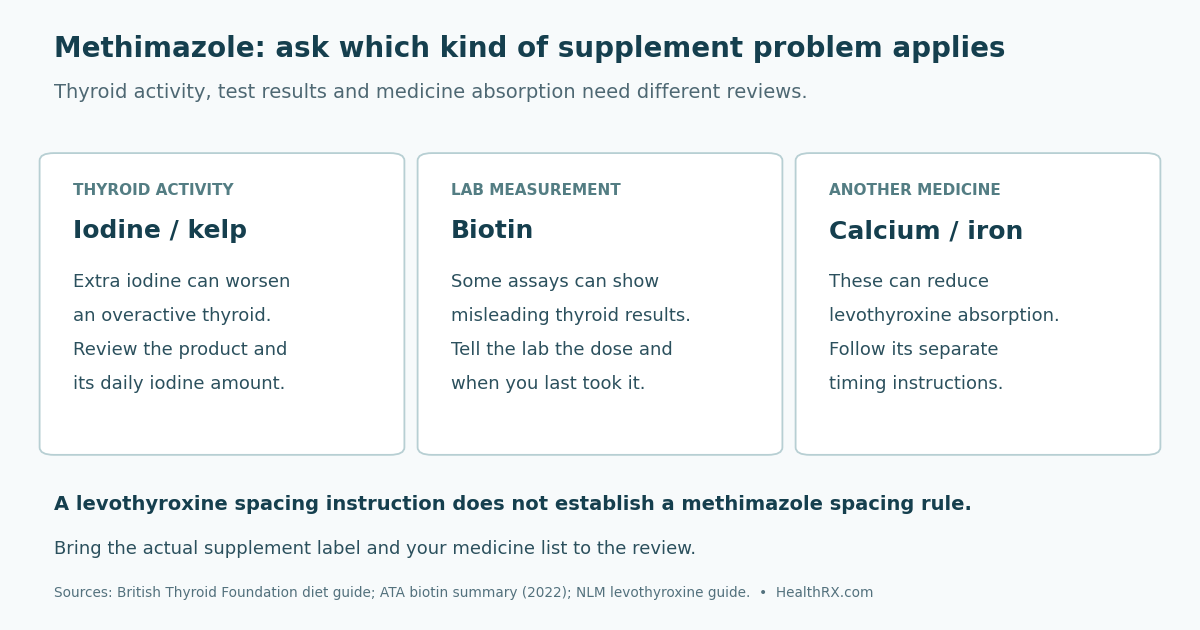
Excess iodine can overwhelm methimazole's TPO blockade and is the single most important dietary variable to manage during treatment [4]. The American Thyroid Association (ATA) guidelines recommend that patients on antithyroid drugs avoid iodine-rich supplements and limit high-iodine foods during the active treatment phase [5].
Sources matter. A single serving of kelp soup can deliver 2,000 to 3 to 000 mcg of iodine, roughly 15 to 20 times the recommended daily allowance of 150 mcg [4]. Seaweed snacks, iodine-based multivitamins, and iodinated contrast dye used in CT scans all pose the same risk. A retrospective Japanese cohort study found that patients with habitual seaweed consumption had significantly lower rates of Graves disease remission on antithyroid drug therapy compared to those with low iodine intake (remission rate 32% vs. 54%, P<0.01) [6].
Not all iodine exposure is obvious. Prenatal vitamins typically contain 150 to 220 mcg of iodine. Betadine surgical prep and amiodarone (which contains 75 mg of organic iodine per 200 mg tablet) are medical sources patients may not connect to their thyroid treatment [7]. Ask your prescriber whether your current supplements contain iodine in any form.
The clinical instruction is straightforward: keep daily iodine intake between 100 and 200 mcg from all sources during methimazole therapy. Do not take iodine or kelp supplements. Read multivitamin labels for potassium iodide or sodium iodide.
Iron and Calcium Supplements: Timing Is Everything
Iron and calcium do not alter methimazole's pharmacokinetics through the same mechanism as iodine, but both minerals can reduce the absorption of levothyroxine, which many patients eventually need if methimazole overshoots or after definitive therapy [8]. Because patients on methimazole frequently transition to or co-administer levothyroxine, establishing good supplement timing habits early prevents problems later.
A 2017 study published in Thyroid demonstrated that ferrous sulfate reduced levothyroxine absorption by up to 65% when taken simultaneously [8]. Calcium carbonate showed a similar, though less dramatic, effect with a 25% reduction in T4 absorption in a crossover trial [9].
For methimazole itself, absorption data are more reassuring. The drug reaches peak plasma concentration within 1 to 2 hours and has oral bioavailability exceeding 90% regardless of fed or fasted state [3]. No published trial has shown that iron or calcium meaningfully reduces methimazole serum levels. The precaution remains relevant for two reasons: patients may switch to levothyroxine within months, and many hyperthyroid patients are already iron-deficient from accelerated erythropoiesis driven by excess thyroid hormone [10].
Practical spacing: take methimazole at least 2 hours before or after iron supplements, and at least 2 hours before or after calcium supplements. This window protects absorption of any thyroid medication in the regimen.
Soy Products and Isoflavones
Soy isoflavones (genistein and daidzein) inhibit TPO in vitro, raising the question of whether dietary soy might amplify or interfere with methimazole's action [11]. The clinical picture is more complex than the bench data suggest.
A 2006 review in Thyroid found that soy consumption in iodine-replete adults had no measurable effect on thyroid function [11]. In iodine-deficient populations, soy consumption was associated with increased TSH and goiter prevalence. The interaction appears conditional: soy becomes clinically relevant for thyroid function mainly when iodine status is marginal.
For patients on methimazole, the concern is twofold. First, soy protein isolates (found in protein bars, shakes, and meat substitutes) can contain concentrated isoflavone doses equivalent to pharmacological levels, sometimes exceeding 80 mg per serving [12]. Second, soy milk and tofu consumed within 1 hour of levothyroxine (if co-prescribed) can reduce T4 absorption by 20% or more [13].
The working guideline: moderate soy consumption (1 to 2 servings daily of whole soy foods like tofu or edamame) is unlikely to interfere with methimazole therapy in patients with adequate iodine intake. Concentrated soy isoflavone supplements should be avoided. If soy consumption changes dramatically during treatment, recheck free T4 and TSH 4 to 6 weeks afterward.
Cruciferous Vegetables: Overstated Concern
Cruciferous vegetables (broccoli, kale, Brussels sprouts, cabbage) contain goitrogens, specifically thiocyanate precursors, that can inhibit iodine uptake by the thyroid's sodium-iodide symporter [14]. This has generated widespread patient anxiety about eating these foods during antithyroid therapy.
The clinical reality is less alarming. Cooking reduces goitrogen content by 30% to 50% [14]. Normal dietary quantities (1 to 3 servings per day) have not been shown to alter thyroid function test results in any controlled trial of euthyroid or hyperthyroid adults [15]. The goitrogenic effect of cruciferous vegetables requires sustained, extreme consumption (multiple pounds of raw vegetables daily) in the setting of iodine deficiency to become clinically measurable.
For methimazole patients: do not restrict cruciferous vegetables. These foods provide fiber, vitamins C and K, and sulforaphane, all of which support general health during hyperthyroidism treatment. The theoretical goitrogenic effect would, if anything, add a mild antithyroid action on top of methimazole rather than oppose it.
Herbal Supplements That Require Caution
Several herbal products interact with methimazole through pharmacokinetic or pharmacodynamic pathways. The three most clinically relevant are bugleweed, lemon balm, and ashwagandha.
Bugleweed (Lycopus virginicus/europaeus) has documented antithyroid activity. A study in Planta Medica confirmed that bugleweed extracts inhibit TSH receptor binding and reduce peripheral T4-to-T3 conversion [16]. Combining bugleweed with methimazole risks additive thyroid suppression and hypothyroidism. Patients should discontinue bugleweed before starting methimazole.
Lemon balm (Melissa officinalis) blocks TSH binding to thyroid tissue in vitro and appears in many "thyroid support" tea blends [17]. While clinical hypothyroidism from lemon balm tea alone is unlikely at normal consumption levels, the combination with methimazole has not been studied in any controlled setting. The ATA recommends disclosing all herbal supplement use to prescribers managing antithyroid therapy [5].
Ashwagandha (Withania somnifera) has gained popularity as an adaptogen and may increase thyroid hormone levels. A 2018 randomized controlled trial of ashwagandha root extract (600 mg daily for 8 weeks) showed significant increases in serum T3 and T4 compared to placebo in subclinically hypothyroid adults [18]. For patients on methimazole, ashwagandha could oppose the drug's intended effect. Discontinue ashwagandha during antithyroid therapy.
Other herbals to flag: St. John's wort (induces CYP1A2, which metabolizes methimazole, potentially reducing drug levels), and high-dose green tea extract (contains catechins with weak TPO-inhibitory activity) [19].
Alcohol and Methimazole: Liver Risk Compounds
Methimazole carries a black box warning for hepatotoxicity, including rare but serious cholestatic hepatitis [3]. Alcohol is an independent hepatotoxin. No clinical trial has specifically evaluated the combination, but the pharmacological rationale for caution is clear.
Methimazole undergoes hepatic metabolism primarily through CYP1A2 and CYP2C enzymes [19]. Chronic alcohol use induces CYP2E1 and can alter CYP1A2 activity, potentially changing methimazole clearance in unpredictable directions [20]. Acute alcohol intake inhibits hepatic metabolism; chronic use accelerates it.
Dr. Elizabeth Pearce, then of Boston University School of Medicine, noted in a 2013 review for the Endocrine Society that "patients on antithyroid drugs should be counseled about the symptoms of hepatotoxicity, including jaundice, dark urine, and right upper quadrant pain, and should be advised that concurrent hepatotoxin exposure may lower the threshold for injury" [20].
The practical recommendation: limit alcohol to no more than one standard drink per day during methimazole therapy. If liver enzymes (ALT, AST, alkaline phosphatase, bilirubin) were elevated at baseline, consider abstinence until values normalize. Report any new onset of nausea, fatigue, or jaundice immediately.
Vitamin D and Bone Health During Hyperthyroidism
Thyrotoxicosis accelerates bone turnover. Excess thyroid hormone increases osteoclast activity, raising the risk of osteopenia and, in prolonged cases, osteoporosis [21]. A meta-analysis in the Journal of Clinical Endocrinology & Metabolism confirmed that hyperthyroid patients have measurably lower bone mineral density at the spine and hip compared to euthyroid controls [21].
Vitamin D supplementation does not interact with methimazole pharmacokinetically. There is no absorption competition and no enzymatic overlap. Vitamin D is one of the few supplements that hyperthyroid patients on methimazole can take freely and should consider taking proactively.
Target 25-hydroxyvitamin D levels of 30 to 50 ng/mL during treatment. If baseline levels are below 20 ng/mL, a loading dose of 50 to 000 IU weekly for 8 weeks followed by 2,000 to 4 to 000 IU daily maintenance is a standard repletion protocol endorsed by the Endocrine Society clinical practice guideline [22]. Calcium supplementation (1,000 to 1 to 200 mg daily from diet and supplements combined) supports the same bone-protective goal, with the timing caveat noted above.
Grapefruit Juice and CYP Interactions
Grapefruit juice inhibits intestinal CYP3A4 and, to a lesser degree, CYP1A2 [23]. Because methimazole is partially metabolized by CYP1A2, grapefruit juice could theoretically raise methimazole plasma levels. No clinical study has documented a significant interaction. The drug's high baseline bioavailability (above 90%) leaves limited room for absorption-mediated increases.
This is a low-risk interaction. Patients who drink occasional grapefruit juice do not need to alter their methimazole schedule. Patients consuming large volumes daily (more than 1 liter) should mention this to their prescriber, as the CYP1A2 inhibition from furanocoumarins in grapefruit can become dose-dependent at high intake levels [23].
Building a Safe Supplement Regimen on Methimazole
Not every supplement is problematic. Several are actively beneficial during antithyroid therapy and carry no interaction risk.
Safe to take with methimazole (no timing restrictions):
- Vitamin D3 (cholecalciferol): 2,000 to 4 to 000 IU daily
- Magnesium glycinate or citrate: 200 to 400 mg daily
- Omega-3 fatty acids (fish oil): 1 to 2 g EPA+DHA daily
- Vitamin B12 (methylcobalamin): 1 to 000 mcg daily
- Probiotics: no known interaction
Take with 2+ hour spacing from methimazole:
- Ferrous sulfate or ferrous gluconate
- Calcium carbonate or calcium citrate
- Zinc (competes with copper absorption; monitor if >30 mg daily)
Avoid entirely during methimazole therapy:
- Iodine or kelp supplements
- Ashwagandha
- Bugleweed
- Concentrated soy isoflavone capsules
- High-dose biotin (>5 to 000 mcg; interferes with thyroid immunoassays, not the drug itself) [24]
The biotin note deserves emphasis. High-dose biotin does not alter methimazole metabolism or thyroid hormone production. It does, however, cause falsely low TSH and falsely high free T4 readings on streptavidin-biotin-based immunoassays, mimicking hyperthyroidism and potentially leading to unnecessary dose increases [24]. The FDA issued a safety communication in 2017 warning clinicians and patients about biotin interference with lab tests [24]. Stop biotin supplements at least 48 hours before thyroid function testing.
Monitoring and Dietary Adjustments Over Time
Methimazole therapy typically spans 12 to 18 months for Graves disease, with dose reductions as thyroid function normalizes [1]. Dietary interactions shift in importance across this timeline.
During the first 3 months (dose titration phase), iodine control is most critical because the dose-response relationship is being established. Labs every 4 to 6 weeks guide adjustments, and any iodine fluctuation introduces confounding. During months 4 through 12, supplement interactions matter more as patients settle into routines and may add new supplements without informing their prescriber. At the 12 to 18 month mark, when a trial off therapy is considered, the patient's baseline iodine intake and nutritional status help predict relapse risk.
Recheck free T4 and TSH 4 to 6 weeks after any significant dietary change: starting or stopping a supplement, major shift in soy or seaweed consumption, or beginning a restrictive diet. Provide your prescriber with a complete supplement list at every visit, including herbal teas and protein powders, because 40% of patients do not spontaneously disclose supplement use during medical visits [25].
Frequently asked questions
›Can I eat normally while taking methimazole?
›Does methimazole interact with vitamins?
›Can I take calcium or iron with methimazole?
›Should I avoid soy while on methimazole?
›Is ashwagandha safe with methimazole?
›Can I drink alcohol on methimazole?
›What about grapefruit juice and methimazole?
›How does methimazole work in the body?
›Do cruciferous vegetables interfere with methimazole?
›Should I stop biotin before thyroid labs?
›Can I take iodine supplements with methimazole?
›Does methimazole interact with herbal teas?
References
- Cooper DS. Antithyroid drugs. N Engl J Med. 2005;352(9):905-917. PubMed
- Burch HB, Cooper DS. Management of Graves disease: a review. JAMA. 2015;314(23):2544-2554. PubMed
- U.S. Food and Drug Administration. Tapazole (methimazole) prescribing information. FDA
- Leung AM, Braverman LE. Consequences of excess iodine. Nat Rev Endocrinol. 2014;10(3):136-142. PubMed
- Ross DS, Burch HB, Cooper DS, et al. 2016 American Thyroid Association guidelines for diagnosis and management of hyperthyroidism. Thyroid. 2016;26(10):1343-1421. PubMed
- Nagataki S. The average of dietary iodine intake due to the ingestion of seaweeds is 1.2 mg/day in Japan. Thyroid. 2008;18(6):667-668. PubMed
- Bogazzi F, Bartalena L, Martino E. Approach to the patient with amiodarone-induced thyrotoxicosis. J Clin Endocrinol Metab. 2010;95(6):2529-2535. PubMed
- Campbell NR, Hasinoff BB, Stalts H, et al. Ferrous sulfate reduces thyroxine efficacy in patients with hypothyroidism. Ann Intern Med. 1992;117(12):1010-1013. PubMed
- Singh N, Singh PN, Hershman JM. Effect of calcium carbonate on the absorption of levothyroxine. JAMA. 2000;283(21):2822-2825. PubMed
- Gianoukakis AG, Leigh MJ, Richards P, et al. Characterization of the anaemia associated with Graves disease. Clin Endocrinol. 2009;70(5):781-787. PubMed
- Messina M, Redmond G. Effects of soy protein and soybean isoflavones on thyroid function in healthy adults and hypothyroid patients. Thyroid. 2006;16(3):249-258. PubMed
- Patisaul HB, Jefferson W. The pros and cons of phytoestrogens. Front Neuroendocrinol. 2010;31(4):400-419. PubMed
- Bell DS, Ovalle F. Use of soy protein supplement and resultant need for increased dose of levothyroxine. Endocr Pract. 2001;7(3):193-194. PubMed
- Felker P, Bunch R, Leung AM. Concentrations of thiocyanate and goitrin in human plasma, their precursor concentrations in brassica vegetables, and associated potential risk for hypothyroidism. Nutr Rev. 2016;74(4):248-258. PubMed
- Bajaj JK, Salwan P, Salwan S. Various possible toxicants involved in thyroid dysfunction: a review. J Clin Diagn Res. 2016;10(1):FE01-FE03. PubMed
- Auf'mkolk M, Ingbar JC, Kubota K, et al. Extracts and auto-oxidized constituents of certain plants inhibit the receptor-binding and the biological activity of Graves immunoglobulins. Endocrinology. 1985;116(5):1687-1693. PubMed
- Santini F, Vitti P, Ceccarini G, et al. In vitro assay of thyroid disruptors affecting TSH-stimulated adenylate cyclase activity. J Endocrinol Invest. 2003;26(10):950-955. PubMed
- Sharma AK, Basu I, Singh S. Efficacy and safety of ashwagandha root extract in subclinical hypothyroid patients. J Altern Complement Med. 2018;24(3):243-248. PubMed
- Hazlewood LC, Tse F, Marshall JK. Drug interactions with antithyroid agents. Thyroid. 2015;25(9):971-980. PubMed
- Pearce EN. Monitoring and effects of iodine deficiency in pregnancy: still an open question. Eur J Clin Nutr. 2013;67(5):481-484. PubMed
- Vestergaard P, Mosekilde L. Hyperthyroidism, bone mineral, and fracture risk: a meta-analysis. Thyroid. 2003;13(6):585-593. PubMed
- Holick MF, Binkley NC, Bischoff-Ferrari HA, et al. Evaluation, treatment, and prevention of vitamin D deficiency: an Endocrine Society clinical practice guideline. J Clin Endocrinol Metab. 2011;96(7):1911-1930. PubMed
- Bailey DG, Dresser G, Arnold JM. Grapefruit-medication interactions: forbidden fruit or avoidable consequences? CMAJ. 2013;185(4):309-316. PubMed
- Li D, Radulescu A, Shrestha RT, et al. Association of biotin ingestion with performance of hormone and nonhormone assays in healthy adults. JAMA. 2017;318(12):1150-1160. PubMed
- Rashrash M, Schommer JC, Brown LM. Prevalence and predictors of herbal medicine use among adults in the United States. J Patient Exp. 2017;4(3):108-113. PubMed