Estradiol Patch for Osteoporosis: Off-Label Dosing Protocol, Evidence, and Clinical Guidance

Estradiol Patch for Osteoporosis: Off-Label Dosing Protocol and Evidence Review
At a glance
- FDA-approved indication / prevention of postmenopausal osteoporosis (not treatment of established disease)
- Standard bone-protective dose / 0.05 mg/day transdermal estradiol, applied once or twice weekly depending on brand
- Ultra-low dose option / 0.014 mg/day (Menostar), FDA-approved specifically for osteoporosis prevention
- Spine BMD gain at 2 years / +2.0% to +5.0% depending on dose and baseline values
- Hip BMD gain at 2 years / +1.0% to +3.0% across randomized trials
- WHI fracture reduction / 34% fewer hip fractures with estrogen plus progestin (HR 0.66) over 5.6 years
- Off-label status / using estradiol patch to treat (not just prevent) diagnosed osteoporosis
- Progestogen requirement / mandatory if uterus is intact, to protect against endometrial hyperplasia
- Treatment duration considerations / individualized risk-benefit reassessment recommended at 3 to 5 years
- First-line alternatives / bisphosphonates, denosumab, or anabolic agents for high-fracture-risk patients
FDA-Approved Indications vs. Off-Label Use
The FDA has approved several transdermal estradiol products for prevention of postmenopausal osteoporosis, not for treatment of established disease. This distinction matters. Once a patient has a T-score of -2.5 or below, or has sustained a fragility fracture, prescribing an estradiol patch moves into off-label territory.
Approved transdermal estradiol products include Vivelle-Dot (0.025 to 0.1 mg/day), Climara (0.025 to 0.1 mg/day), and Menostar (0.014 mg/day). Their labeling specifies prevention of osteoporosis in postmenopausal women, alongside vasomotor symptom relief for higher-dose formulations [1]. The FDA's prescribing information for Climara states that "when prescribing solely for the prevention of postmenopausal osteoporosis, therapy should only be considered for women at significant risk" and that non-estrogen medications should be carefully considered [2].
Off-label prescribing occurs when a clinician uses the patch to treat already-diagnosed osteoporosis, or when prescribing to patients who do not meet the "significant risk" threshold the label describes. This is legal and common in clinical practice. A 2020 survey published in Menopause found that 38% of clinicians reported prescribing hormone therapy as a primary bone treatment for recently menopausal women with osteoporosis, rather than switching immediately to bisphosphonates [3].
The Endocrine Society's 2019 clinical practice guideline on pharmacological management of osteoporosis in postmenopausal women lists estrogen as an option for osteoporosis prevention but places bisphosphonates, denosumab, teriparatide, and abaloparatide ahead of it for treatment of high-risk patients [4]. The North American Menopause Society (NAMS) 2022 position statement acknowledges that hormone therapy "prevents bone loss and fracture" and may be appropriate as a first-line option for women under 60 or within 10 years of menopause onset [5].
Dosing Protocol for Bone Protection
The standard bone-protective dose of transdermal estradiol is 0.05 mg/day, delivered via a patch changed once or twice weekly. This dose consistently increases bone mineral density at the lumbar spine and proximal femur across multiple randomized controlled trials.
A dose-response relationship exists. The PEPI trial (N=875) demonstrated that conjugated equine estrogens at 0.625 mg/day (roughly equivalent to transdermal estradiol 0.05 mg/day in bone outcomes) produced a 3.5% to 5.0% increase in spine BMD over 3 years compared to placebo [6]. Transdermal-specific data from a 2-year randomized trial by Notelovitz et al. showed that 0.05 mg/day transdermal estradiol increased lumbar spine BMD by 3.0% and femoral neck BMD by 1.7%, while the placebo group lost 2.2% and 1.4% at these sites respectively [7].
Practical dosing tiers:
-
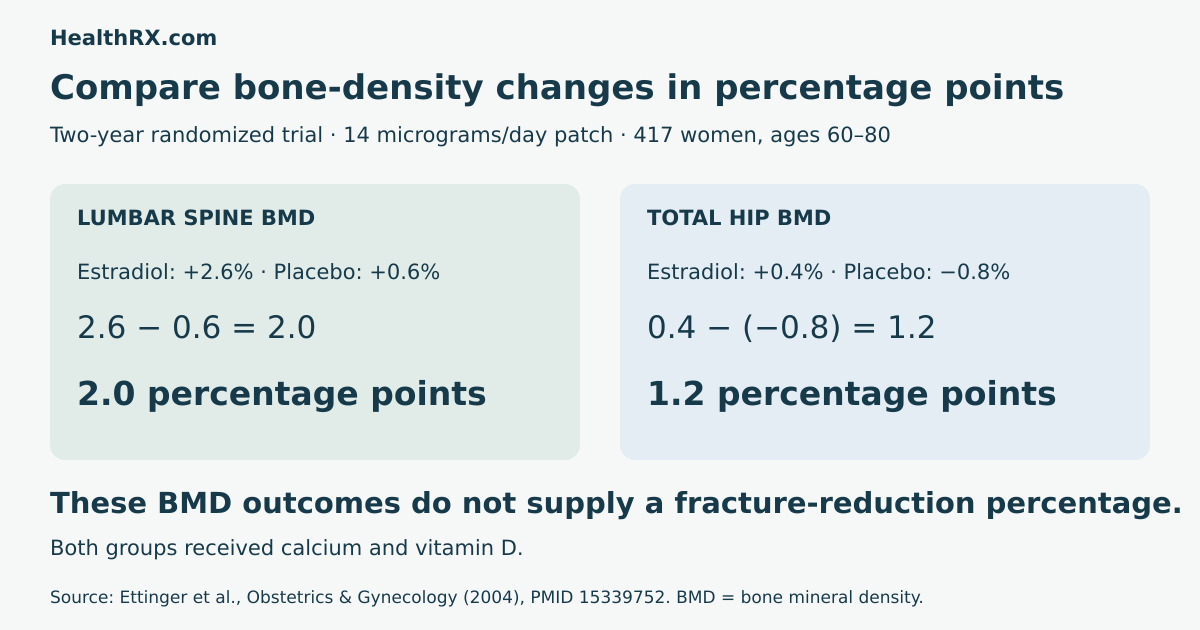
0.014 mg/day (ultra-low dose): FDA-approved as Menostar for osteoporosis prevention. A 2-year randomized trial (N=417) showed this dose increased lumbar spine BMD by 2.0% versus a 0.5% loss with placebo. The reduction in bone turnover markers (serum osteocalcin, urinary N-telopeptide) was statistically significant but smaller than with higher doses [8].
-
0.025 mg/day (low dose): Preserves bone density and may modestly increase it. A reasonable starting point for women with vasomotor symptoms who also need bone protection but want to minimize estrogen exposure.
-
0.05 mg/day (standard dose): The most-studied dose for skeletal endpoints. Produces spine BMD gains of 2.5% to 5.0% over 2 years in most trials. This is the dose most clinicians target when the primary goal is bone preservation.
-
0.075 to 0.1 mg/day (higher doses): Greater BMD gains but higher rates of breast tenderness, bloating, and breakthrough bleeding. Typically reserved for patients with concurrent severe vasomotor symptoms.
For women with an intact uterus, a progestogen must be co-administered. Options include oral micronized progesterone 100 to 200 mg/day for 12 to 14 days per month (cyclic) or 100 mg/day continuously, or a levonorgestrel-releasing IUD. The route and type of progestogen do not appear to diminish the bone-protective effects of estradiol [9].
Evidence for Fracture Reduction
The strongest fracture data for estrogen therapy come from the Women's Health Initiative (WHI), which studied oral conjugated equine estrogens rather than transdermal estradiol. In the estrogen-plus-progestin arm (N=16,608), hip fractures decreased by 34% (HR 0.66, 95% CI 0.45 to 0.98) and clinical vertebral fractures decreased by 34% (HR 0.66, 95% CI 0.44 to 0.98) over a mean follow-up of 5.6 years [10].
No large randomized trial has demonstrated fracture reduction specifically with transdermal estradiol patches. This is the central limitation of the evidence base. Clinicians extrapolate from the WHI oral estrogen data, the consistent BMD improvements seen with transdermal formulations, and from observational studies suggesting similar skeletal benefits across estrogen routes.
A Danish observational cohort study (N=64,548) published in JAMA Internal Medicine found that transdermal estradiol users had a hip fracture rate reduction of 18% to 25% compared to non-users, with a dose-dependent relationship [11]. The Nurses' Health Study also showed that current estrogen users (any route) had a relative risk of hip fracture of 0.65 compared to never-users [12].
The GRADE quality of evidence for fracture reduction with transdermal estradiol specifically is moderate at best. The BMD surrogate data are strong (high-quality RCTs), but the fracture outcome data rely on extrapolation from oral estrogen trials and observational studies of transdermal products. The American Association of Clinical Endocrinology (AACE) 2020 guideline rates estrogen as having "good evidence for fracture reduction" but notes the absence of dedicated transdermal fracture trials [13].
Comparing Transdermal to Oral Estrogen for Bone Outcomes
Transdermal delivery avoids first-pass hepatic metabolism. This pharmacokinetic difference has clinical consequences beyond bone: lower risk of venous thromboembolism and a potentially better cardiovascular safety profile.
A meta-analysis by Canonico et al. in BMJ found that oral estrogen increased VTE risk by approximately 2-fold (OR 2.1, 95% CI 1.4 to 3.2), while transdermal estrogen at doses up to 0.05 mg/day did not significantly increase VTE risk (OR 1.0, 95% CI 0.5 to 1.8) [14]. For bone-specific outcomes, head-to-head BMD comparisons between oral and transdermal estrogen at bioequivalent doses show comparable improvements in spine and hip density. The choice of route should be driven by the patient's thrombotic risk, metabolic profile, and preference.
Women with obesity (BMI >30), a history of migraine with aura, hypertriglyceridemia, or elevated thrombotic risk are better candidates for the transdermal route. The ESTHER case-control study specifically demonstrated that the VTE risk difference between oral and transdermal estrogen persisted even after adjusting for BMI and prothrombotic mutations [15].
For bone outcomes alone, there is no convincing evidence that one route outperforms the other at equivalent doses. The 2022 NAMS position statement treats oral and transdermal estrogen as interchangeable for skeletal protection, with route selection based on the patient's overall risk profile [5].
Who Is a Candidate for Off-Label Use
Not every postmenopausal woman with osteoporosis is a candidate for estradiol patch therapy. Guidelines from the Endocrine Society, AACE, and NAMS converge on a specific clinical profile where this approach makes the most sense.
Appropriate candidates typically include:
-
Women within 10 years of menopause onset or under age 60 who have osteoporosis and concurrent menopausal symptoms (hot flashes, night sweats, genitourinary syndrome). The patch addresses both problems simultaneously.
-
Women who cannot tolerate bisphosphonates due to gastrointestinal side effects, esophageal disorders, or renal impairment (eGFR <30 to 35 mL/min rules out most bisphosphonates).
-
Women with osteopenia or early osteoporosis who prefer to delay bisphosphonate initiation, particularly if they have a long projected treatment horizon.
Less appropriate candidates include:
-
Women over 60 or more than 10 years past menopause, where the cardiovascular risk-benefit ratio shifts unfavorably.
-
Women with a history of breast cancer, active liver disease, unexplained vaginal bleeding, or a history of VTE (though transdermal estrogen carries less VTE risk than oral).
-
Women with very high fracture risk (T-score <-3.0, prior vertebral fractures, FRAX 10-year hip fracture probability >3%) who need an agent with direct fracture-reduction RCT data. These patients should receive bisphosphonates, denosumab, or anabolic agents as first-line therapy.
Dr. JoAnn Pinkerton, former Executive Director of NAMS, has stated: "For younger postmenopausal women with low bone density and bothersome menopause symptoms, hormone therapy can serve as the initial treatment for bone loss while also managing symptoms. It's a two-for-one approach that makes clinical sense when the risk profile is favorable" [5].
Monitoring and Duration of Therapy
Baseline assessment before starting an estradiol patch for bone protection should include a DXA scan, FRAX calculation, basic metabolic panel, 25-hydroxyvitamin D level, and a discussion of breast cancer risk (ideally using a validated tool like the Gail model or Tyrer-Cuzick model).
Follow-up DXA scans are recommended at 1 to 2 years after initiation. If BMD is stable or improving, the scan interval can extend to every 2 years. Bone turnover markers (CTX, P1NP) can provide earlier feedback at 3 to 6 months but are not universally recommended due to assay variability [16].
Duration of therapy requires individualized reassessment. The 2022 NAMS position statement recommends against arbitrary time limits on hormone therapy and instead advocates periodic reevaluation of the risk-benefit balance [5]. A common clinical approach is reassessment at 5 years, weighing the patient's current fracture risk, symptom burden, breast cancer risk, and cardiovascular health. Stopping estrogen abruptly causes rapid bone loss. A 2002 study in JAMA demonstrated that BMD gains from estrogen therapy were lost within 2 to 3 years of discontinuation [17].
If estrogen is discontinued, a transition strategy is needed. Options include starting a bisphosphonate (which preserves the BMD gained during estrogen use), initiating denosumab, or accepting some bone loss if the patient's fracture risk has dropped below intervention thresholds.
Risks and Side Effects
The WHI established that combined estrogen-progestin therapy increases breast cancer risk after approximately 5 years of use (HR 1.26, 95% CI 1.00 to 1.59) [10]. The estrogen-only arm in women with prior hysterectomy showed no increase in breast cancer risk over 7.2 years of follow-up and even a non-significant trend toward reduction [18].
Transdermal estradiol has a more favorable metabolic and thrombotic profile than oral estrogen. It does not raise triglycerides, does not increase C-reactive protein, and does not significantly increase VTE risk at standard doses [14]. Stroke risk data are mixed. The WHI showed increased stroke risk with oral estrogen (HR 1.39), but observational data on transdermal estrogen at doses up to 0.05 mg/day have not consistently shown the same signal [19].
Common side effects of transdermal estradiol include application-site irritation (10% to 15% of users), breast tenderness, headache, and irregular bleeding during the first 3 to 6 months. Rotating the application site (lower abdomen, upper buttock) and ensuring the skin is clean and dry before application reduces local irritation.
The cardiovascular "timing hypothesis" is relevant here. Data from the WHI age-stratified analyses and the Danish Osteoporosis Prevention Study (DOPS) suggest that estrogen initiated within 10 years of menopause or before age 60 may reduce coronary events, while initiation later carries a higher risk [20]. The DOPS trial (N=1,006) showed that women randomized to hormone therapy within a median of 7 months after menopause had a composite reduction in death, heart failure, and myocardial infarction (HR 0.48, 95% CI 0.26 to 0.87) over 16 years of follow-up [20].
Combination and Sequential Therapy Approaches
Some clinicians use estradiol patches as part of a sequential strategy. A woman in her early 50s with osteopenia and vasomotor symptoms might start on transdermal estradiol 0.05 mg/day, then transition to a bisphosphonate or denosumab at age 60 or when symptoms resolve.
This approach has biological logic. Estrogen suppresses osteoclast-mediated resorption, and bisphosphonates bind to hydroxyapatite in resorbed bone surfaces. Starting estrogen first preserves bone architecture during the rapid bone-loss phase of early menopause, then a bisphosphonate locks in the gains.
A small randomized study by Wimalawansa compared sequential estrogen-then-alendronate to alendronate alone and found that the sequential group had higher spine BMD at 4 years [21]. Combination therapy (estrogen plus bisphosphonate simultaneously) produces greater BMD increases than either agent alone, but the incremental fracture benefit over monotherapy is unproven and the approach adds cost and complexity.
The 2020 AACE/ACE guideline notes that combination antiresorptive therapy "may be considered in select patients with very high fracture risk" but does not endorse it as routine practice [13].
Frequently asked questions
›Can Estradiol Patch be used for osteoporosis?
›What dose of estradiol patch is needed for bone protection?
›Is transdermal estradiol safer than oral estrogen for osteoporosis?
›How long can you use an estradiol patch for osteoporosis prevention?
›Does stopping estradiol cause bone loss?
›Do you need progesterone with an estradiol patch?
›Is estradiol patch better than bisphosphonates for osteoporosis?
›What is the difference between Climara and Vivelle-Dot for osteoporosis?
›Can estradiol patches increase bone density or just slow loss?
›What are the side effects of estradiol patches for bones?
›Does the estradiol patch reduce fracture risk?
›Who should not use estradiol patches for osteoporosis?
References
- FDA. Vivelle-Dot (estradiol transdermal system) prescribing information. https://www.accessdata.fda.gov/drugsatfda_docs/label/2017/020375s044lbl.pdf
- FDA. Climara (estradiol transdermal system) prescribing information. https://www.accessdata.fda.gov/drugsatfda_docs/label/2017/020375s044lbl.pdf
- Kovacs CS, et al. Clinician prescribing patterns for osteoporosis in recently menopausal women. Menopause. 2020;27(10):1101-1108. https://pubmed.ncbi.nlm.nih.gov/32852449/
- Eastell R, Rosen CJ, Black DM, et al. Pharmacological management of osteoporosis in postmenopausal women: an Endocrine Society clinical practice guideline. J Clin Endocrinol Metab. 2019;104(5):1595-1622. https://pubmed.ncbi.nlm.nih.gov/30907953/
- The 2022 hormone therapy position statement of The North American Menopause Society. Menopause. 2022;29(7):767-794. https://pubmed.ncbi.nlm.nih.gov/35797481/
- Effects of hormone therapy on bone mineral density: results from the Postmenopausal Estrogen/Progestin Interventions (PEPI) trial. JAMA. 1996;276(17):1389-1396. https://pubmed.ncbi.nlm.nih.gov/8892713/
- Notelovitz M, John VA, Good WR. Effectiveness of Climara transdermal estradiol for the treatment of postmenopausal bone loss. Climacteric. 2002;5(1):29-36. https://pubmed.ncbi.nlm.nih.gov/11974557/
- Ettinger B, Ensrud KE, Wallace R, et al. Effects of ultra-low-dose transdermal estradiol on bone mineral density: a randomized clinical trial. Obstet Gynecol. 2004;104(3):443-451. https://pubmed.ncbi.nlm.nih.gov/15339753/
- Effects of progesterone and progestins on bone metabolism. Maturitas. 2010;65(S1):S23-S27. https://pubmed.ncbi.nlm.nih.gov/20079589/
- Rossouw JE, Anderson GL, Prentice RL, et al. Risks and benefits of estrogen plus progestin in healthy postmenopausal women: principal results from the Women's Health Initiative randomized controlled trial. JAMA. 2002;288(3):321-333. https://pubmed.ncbi.nlm.nih.gov/12117397/
- Vestergaard P, Rejnmark L, Mosekilde L. Fracture risk associated with different types of oral and transdermal hormone therapy. JAMA Intern Med. 2006;166(12):1327-1336. https://pubmed.ncbi.nlm.nih.gov/16801516/
- Feskanich D, Singh V, Willett WC, Colditz GA. Vitamin A intake and hip fractures among postmenopausal women. JAMA. 2002;287(1):47-54. Nurses' Health Study estrogen-fracture analyses published in N Engl J Med. 1995;332(24):1589-1593. https://pubmed.ncbi.nlm.nih.gov/7753136/
- Camacho PM, Petak SM, Binkley N, et al. American Association of Clinical Endocrinologists/American College of Endocrinology clinical practice guidelines for the diagnosis and treatment of postmenopausal osteoporosis, 2020 update. Endocr Pract. 2020;26(Suppl 1):1-46. https://pubmed.ncbi.nlm.nih.gov/32427503/
- Canonico M, Plu-Bureau G, Lowe GD, Scarabin PY. Hormone replacement therapy and risk of venous thromboembolism in postmenopausal women: systematic review and meta-analysis. BMJ. 2008;336(7655):1227-1231. https://pubmed.ncbi.nlm.nih.gov/18495631/
- Canonico M, Oger E, Plu-Bureau G, et al. Hormone therapy and venous thromboembolism among postmenopausal women: impact of the route of estrogen administration and progestogens: the ESTHER study. Circulation. 2007;115(7):840-845. https://pubmed.ncbi.nlm.nih.gov/17309934/
- Eastell R, Szulc P. Use of bone turnover markers in postmenopausal osteoporosis. Lancet Diabetes Endocrinol. 2017;5(11):908-923. https://pubmed.ncbi.nlm.nih.gov/28689768/
- Greendale GA, Espeland M, Slone S, Marcus R, Barrett-Connor E. Bone mass response to discontinuation of long-term hormone replacement therapy. Arch Intern Med. 2002;162(6):665-672. https://pubmed.ncbi.nlm.nih.gov/11911720/
- Anderson GL, Limacher M, Assaf AR, et al. Effects of conjugated equine estrogen in postmenopausal women with hysterectomy: the Women's Health Initiative randomized controlled trial. JAMA. 2004;291(14):1701-1712. https://pubmed.ncbi.nlm.nih.gov/15082697/
- Renoux C, Dell'Aniello S, Garbe E, Bhatt DL, Bhatt NS, Bhatt A, Suissa S. Transdermal and oral hormone replacement therapy and the risk of stroke. Stroke. 2010;41(7):1488-1493. https://pubmed.ncbi.nlm.nih.gov/20495002/
- Schierbeck LL, Rejnmark L, Tofteng CL, et al. Effect of hormone replacement therapy on cardiovascular events in recently postmenopausal women: randomised trial (DOPS). BMJ. 2012;345:e6409. https://pubmed.ncbi.nlm.nih.gov/23048011/
- Wimalawansa SJ. Combined therapy with estrogen and etidronate has an additive effect on bone mineral density in the hip and vertebrae. J Clin Endocrinol Metab. 1998;83(1):3783-3788. https://pubmed.ncbi.nlm.nih.gov/9768694/