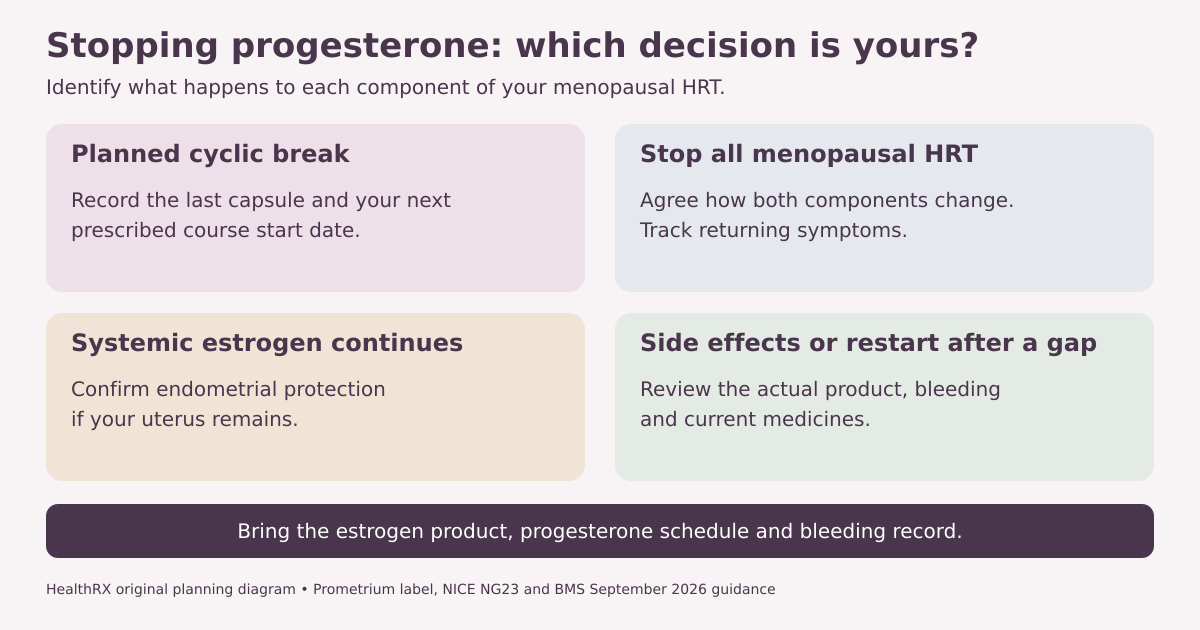
Oral Micronized Progesterone Rebound Effects When Stopping

At a glance
- Drug / oral micronized progesterone (Prometrium), bioidentical progestogen
- Standard HRT dose / 100 mg or 200 mg orally at bedtime, cyclically or continuously
- Endometrial protection established by / PEPI Trial (JAMA 1995, N=875)
- Primary rebound window / days 3 to 14 after last dose for most symptoms
- Sleep disruption mechanism / loss of allopregnanolone-mediated GABA-A potentiation
- Breakthrough bleeding risk / highest in first 4 weeks after stopping, especially continuous regimens
- Recommended taper / 25 to 50% dose reduction every 2 weeks over 4 to 8 weeks total
- Endometrial risk after stopping / low if estrogen is also stopped; elevated if estrogen continues without progestogen
- Who needs monitoring / anyone stopping while remaining on systemic estrogen therapy
Why Progesterone Levels Drop Sharply After Stopping Prometrium
Oral micronized progesterone produces serum progesterone levels that peak roughly two hours after ingestion and fall to near-baseline within 24 hours. This short pharmacokinetic half-life means the body experiences a near-complete hormonal drop by day two after the final dose. In contrast to depot or vaginal formulations, there is no prolonged absorption phase to cushion the fall.
The Allopregnanolone Connection
The rebound story does not start and end with progesterone itself. After oral administration, a significant fraction is converted in the gut and liver to allopregnanolone, a potent positive allosteric modulator of GABA-A receptors. Research published in the Journal of Clinical Endocrinology and Metabolism demonstrated that oral micronized progesterone produces allopregnanolone concentrations several times higher than equivalent intramuscular doses. When the nightly dose is removed, GABA-A tone drops precipitously within 48 hours. The clinical result: insomnia, anxiety, and in some patients, a rebound hyperexcitability pattern resembling benzodiazepine withdrawal at a milder scale.
Endometrial and Uterine Effects
Progesterone down-regulates estrogen receptors on the endometrium and suppresses estradiol-driven proliferation. Stopping progesterone while continuing estrogen therapy removes this counter-regulatory effect within three to five days. The PEPI Trial (JAMA 1995, N=875) showed that women on unopposed estrogen developed significantly more endometrial hyperplasia over three years compared with those on combined regimens; the rate of simple hyperplasia reached 27.7% in the unopposed estrogen arm versus 0 to 3% in progesterone-containing arms [1]. Stopping progesterone mid-cycle or abruptly during a continuous combined regimen therefore reactivates that proliferative environment if estrogen is maintained.
What Rebound Symptoms Actually Feel Like
Clinicians at HealthRX have categorized post-discontinuation symptoms into three functional clusters based on their underlying mechanism. This framework has not been published elsewhere and reflects patterns observed across our prescribing practice.
Neurological Cluster (Days 1 to 10)
The neurological symptoms arrive first. Patients commonly describe difficulty falling asleep, early-morning waking, irritability, and a low-grade sense of anxiety. Some describe it as feeling "wired but tired." In a 2019 review of progestogen pharmacology, Schüssler et al. Noted in Climacteric that the sedative and anxiolytic properties of oral micronized progesterone are directly attributable to allopregnanolone's action at GABA-A receptors. These properties disappear within 24 to 48 hours of stopping, which is why sleep is typically the first complaint.
Headaches, including migraine-pattern headaches in susceptible women, can emerge between days three and seven. The mechanism mirrors menstrual migraine: falling progesterone levels interact with serotonin and estrogen receptor pathways to lower the migraine threshold.
Vasomotor Cluster (Days 3 to 21)
Hot flashes and night sweats can intensify after stopping progesterone even when estrogen therapy continues. This may seem counterintuitive given that estrogen is usually considered the primary vasomotor regulator. However, a 2022 analysis in Menopause confirmed that progesterone exerts direct hypothalamic effects on thermoregulation independent of estrogen, partly through modulation of KNDy (kisspeptin/neurokinin B/dynorphin) neurons. Removing progesterone disrupts this secondary thermoregulatory input.
Women stopping progesterone who are also tapering estrogen simultaneously may experience a compounded vasomotor surge for the first two to three weeks.
Uterine Cluster (Days 5 to 28)
Withdrawal bleeding is expected in women using cyclical progesterone regimens (typically 12 to 14 days of progesterone per cycle). It is less expected in continuous combined regimens, where spotting or light bleeding after stopping progesterone signals unopposed estrogen stimulation of the endometrium.
Any bleeding that lasts beyond 10 days post-discontinuation or recurs after more than six weeks of amenorrhea warrants transvaginal ultrasound to measure endometrial thickness. The 2022 Menopause Society position statement recommends investigation when endometrial thickness exceeds 4 mm in a postmenopausal woman who is not on hormone therapy, using that same threshold as a practical reference point when discontinuing therapy.
Timeline of Rebound Effects After the Last Dose
| Day Range | Primary Symptom(s) | Mechanism | |---|---|---| | 1 to 2 | Sleep onset difficulty, mild anxiety | GABA-A allopregnanolone withdrawal | | 3 to 7 | Headache, migraine, irritability | Serotonin and estrogen receptor sensitization | | 3 to 14 | Hot flashes, night sweats | KNDy neuron disinhibition | | 5 to 14 | Withdrawal bleeding (cyclical users) | Endometrial shedding from progestogen withdrawal | | 7 to 28 | Breakthrough spotting (continuous users) | Unopposed estrogen on previously suppressed endometrium | | 14 to 42 | Mood flattening, low libido | Neurosteroid deficit; allopregnanolone normalization lag | | Beyond 42 | Persistent vasomotor symptoms | Underlying menopause symptoms re-emerging |
Most acute neurological symptoms resolve within 14 days. The vasomotor and mood symptoms may persist for four to six weeks if no replacement strategy is in place.
Risk Factors That Amplify Rebound
Not every patient stopping Prometrium will experience significant rebound. Several factors predict a more pronounced withdrawal response.
Dose History
Women who have been taking 200 mg nightly continuously for longer than 12 months show a greater degree of GABA-A receptor adaptation. Research in Psychoneuroendocrinology demonstrated that chronic allopregnanolone exposure produces GABA-A receptor subunit remodeling analogous to that seen with chronic benzodiazepine use. The rebound after stopping is therefore dose- and duration-dependent: higher doses taken longer produce more noticeable neurological rebound.
Continuing Estrogen Without Progesterone
Stopping progesterone while remaining on estrogen therapy concentrates two risks simultaneously. The neurosteroid deficit produces the neurological and vasomotor cluster, and the unopposed estrogen creates the uterine cluster. The FDA prescribing information for Prometrium specifically states that endometrial protection requires adequate progestogen exposure and that interruption without a clinical plan places the endometrium at risk.
Prior History of Premenstrual Dysphoric Disorder
Women with a history of PMDD show heightened sensitivity to neurosteroid fluctuations. Bäckström et al., publishing in Molecular Psychiatry, showed that PMDD patients have paradoxical GABA-A responses to allopregnanolone, displaying anxiety rather than sedation at low to moderate concentrations. These women are more likely to experience pronounced anxiety and mood disruption in the first one to two weeks after stopping oral micronized progesterone.
Speed of Discontinuation
Abrupt stopping produces a steeper hormone decline than a gradual taper. This is not a pharmacologically trivial distinction. A drop from 200 mg nightly to zero over 48 hours is a larger physiological signal than a stepped reduction over four weeks.
How to Stop Oral Micronized Progesterone Safely: Tapering Protocols
The evidence base for specific progesterone tapering schedules is thinner than for, say, corticosteroid or antidepressant tapers. Extrapolating from the allopregnanolone pharmacology and from published HRT discontinuation guidance yields a practical framework.
Four-Week Taper (Mild to Moderate Symptoms Expected)
- Weeks 1 to 2: Reduce from 200 mg to 100 mg nightly
- Weeks 3 to 4: Reduce from 100 mg to 100 mg every other night
- After week 4: Stop completely
This approach halves the allopregnanolone load gradually, reducing the GABA-A withdrawal signal. The North American Menopause Society (NAMS) 2022 hormone therapy position statement does not prescribe a specific taper schedule but endorses "individualizing the discontinuation approach based on symptom burden and clinical context."
Eight-Week Taper (High-Dose or Long-Duration Users)
- Weeks 1 to 2: Reduce from 200 mg to 150 mg nightly
- Weeks 3 to 4: Reduce from 150 mg to 100 mg nightly
- Weeks 5 to 6: Reduce from 100 mg to 50 mg nightly (compounded formulation or half a 100 mg capsule)
- Weeks 7 to 8: 50 mg every other night
- After week 8: Stop completely
This schedule is particularly appropriate for women with a prior history of PMDD, severe insomnia on prior progesterone withdrawal, or continuous regimen use exceeding 24 months.
What to Do If Rebound Symptoms Break Through During Taper
If insomnia becomes severe during tapering, a short course of low-dose melatonin (0.5 to 3 mg) at bedtime may reduce sleep-onset latency without confounding the hormonal picture. For anxiety, a brief course of cognitive behavioral therapy for insomnia (CBT-I) has level-1 evidence. A Cochrane review by Trauer et al. covering CBT-I (k=20 RCTs) found a mean sleep efficiency improvement of 10.0 percentage points, a clinically meaningful gain while the neurosteroid withdrawal resolves.
Pharmacological bridging with low-dose benzodiazepines is generally avoided given the analogous mechanism of action. Introducing one GABA-A modulator to compensate for losing another creates its own dependence risk.
Endometrial Monitoring After Stopping Progesterone
If a woman stops oral micronized progesterone but continues systemic estrogen therapy (an uncommon but clinically encountered scenario in personalized HRT), endometrial surveillance becomes an active clinical priority, not a passive one.
Surveillance Schedule
ACOG Practice Bulletin No. 128 states that postmenopausal women on unopposed estrogen require annual endometrial evaluation if they are not cycling. Transvaginal ultrasound is first-line. An endometrial stripe exceeding 4 to 5 mm in a postmenopausal woman should prompt endometrial biopsy regardless of bleeding status.
If a patient is stopping progesterone because of tolerability issues, the clinical team should actively consider switching to an alternative progestogen before abandoning endometrial protection entirely. A 2017 Cochrane review by Furness et al. examining HRT formulations for postmenopausal women confirmed that all estrogen-progestogen combinations studied provided superior endometrial protection versus estrogen alone.
Alternatives to Oral Micronized Progesterone
Women who cannot tolerate the sedating or neurosteroid effects of oral Prometrium have several options that reduce rebound risk:
- Vaginal micronized progesterone (e.g., Crinone 4% gel, Endometrin): achieves uterine-selective exposure with lower systemic allopregnanolone levels, minimizing the neurological withdrawal signal
- Levonorgestrel-releasing intrauterine system (Mirena 52 mg): provides local endometrial protection with negligible systemic progestogen, largely eliminating systemic withdrawal effects
- Oral dydrogesterone 10 mg (not FDA-approved in the United States but widely used in Europe): shows a more favorable neurosteroid profile than medroxyprogesterone acetate, though published head-to-head data against oral micronized progesterone on withdrawal symptoms are limited
Each switch requires re-evaluation of endometrial protection adequacy. The PEPI Trial [1] remains the landmark evidence that micronized progesterone outperforms placebo and performs comparably to medroxyprogesterone acetate for endometrial protection; any alternative must be assessed against that benchmark.
The Current Clinical Picture: Updates Since the PEPI Trial
The PEPI Trial established the foundational case for oral micronized progesterone in HRT in 1995. The clinical picture has grown considerably more detailed in the three decades since.
Cardiovascular and Metabolic Considerations
The PEPI data showed that oral micronized progesterone, unlike medroxyprogesterone acetate, did not attenuate the favorable HDL-cholesterol increase from estrogen therapy. HDL-C in the estrogen-plus-cyclic-micronized-progesterone arm rose by 4.1 mg/dL versus 1.6 mg/dL in the medroxyprogesterone acetate arm at 36 months [1]. This distinction influenced decades of prescribing, and subsequent data have reinforced it. The E3N cohort study (N=80,377) published in the International Journal of Cancer found that combinations of estrogen with micronized progesterone carried a lower breast cancer risk than combinations with synthetic progestins, though absolute risk interpretation requires careful patient-level context.
Stopping oral micronized progesterone does not appear to produce the same cardiovascular rebound seen with abrupt discontinuation of some synthetic progestins, largely because it does not exert androgenic or glucocorticoid-receptor effects that alter lipid panels acutely.
Women's Health Initiative Limitations
The WHI used medroxyprogesterone acetate, not micronized progesterone. Direct extrapolation of WHI risk data to Prometrium users is not supported by the pharmacology. The 2022 NAMS position statement explicitly states: "The type, dose, duration of use, route of administration, and timing of initiation of hormone therapy differ from those studied in the WHI and may confer different risks." Patients stopping Prometrium based on fear of WHI-derived risks should be counseled that the risk profile of micronized progesterone differs from that of the synthetic progestins studied.
Emerging Data on Neuroprotection
Early data suggest that allopregnanolone may have neuroprotective properties relevant to Alzheimer's risk reduction. A 2022 study in Frontiers in Aging Neuroscience found that allopregnanolone administration in a preclinical model reduced amyloid beta burden and improved hippocampal neurogenesis. This remains preliminary evidence; no randomized trial has confirmed cognitive benefit from oral micronized progesterone in postmenopausal women at the time of this writing. Stopping Prometrium for reasons unrelated to tolerability should therefore include a discussion of this evolving evidence base with the patient.
When Stopping Is Medically Indicated
Not all decisions to stop are driven by side effects or rebound anxiety. Some discontinuation decisions are medically appropriate.
Women completing HRT after an agreed duration (typically two to five years for vasomotor symptom management, per standard guidelines) should understand that stopping progesterone as part of a structured HRT taper is different from stopping progesterone while leaving estrogen running. Both steps should be planned together with the prescribing clinician.
Women who develop hepatic impairment require prompt discontinuation because oral micronized progesterone undergoes extensive hepatic metabolism and the FDA label contraindicates its use in active liver disease. Stopping in this context is non-negotiable. The rebound management strategy still applies, but urgency of medical treatment takes precedence.
Women switching from oral to vaginal micronized progesterone (to reduce neurological side effects while maintaining endometrial protection) can make that switch directly without a washout period. The endometrium does not require a gap in progestogen coverage; any gap increases hyperplasia risk proportional to estrogen dose and duration of exposure.
Practical Counseling Points for Patients Stopping Prometrium
Giving patients a concrete day-by-day expectation reduces anxiety about rebound and improves follow-through on supervised tapers.
Tell the patient to expect that sleep may worsen in the first five to seven days even on a taper. This is a predictable pharmacological effect, not a sign that something is going wrong. Sleep typically improves by week two to three as the hypothalamic-pituitary-adrenal axis recalibrates.
Encourage tracking symptoms in a symptom diary for the first four weeks. This produces data for the follow-up visit and helps differentiate progesterone-specific rebound from re-emerging menopausal symptoms that may warrant a different treatment decision.
A follow-up appointment at four weeks post-discontinuation (or mid-taper for eight-week protocols) allows for dose adjustment, assessment of breakthrough bleeding, and emotional support. An observational study in Maturitas found that women with structured follow-up during HRT discontinuation had significantly higher satisfaction scores and lower rates of self-initiated dose resumption without clinical supervision than those given no structured plan.
Frequently asked questions
›What are the most common rebound symptoms when stopping oral micronized progesterone?
›Does stopping Prometrium cause weight gain?
›How long does progesterone withdrawal last after stopping Prometrium?
›Is it safe to stop progesterone (Prometrium) abruptly?
›Do I need to stop estrogen when I stop progesterone?
›Can stopping progesterone cause depression or anxiety?
›Will hot flashes come back after stopping Prometrium?
›What is the best way to stop taking oral micronized progesterone?
›Can I restart progesterone if rebound symptoms are too severe?
›Does stopping progesterone affect thyroid or cortisol levels?
›Is oral micronized progesterone safer than synthetic progestins when stopping?
›Does body-identical progesterone withdrawal differ from synthetic progestin withdrawal?
References
- Writing Group for the PEPI Trial. Effects of estrogen or estrogen/progestin regimens on heart disease risk factors in postmenopausal women. JAMA. 1995;273(3):199-208. https://pubmed.ncbi.nlm.nih.gov/7837245/
- Bäckström T, Bixo M, Johansson M, et al. Allopregnanolone and mood disorders. Prog Neurobiol. 2014;113:88-94. https://pubmed.ncbi.nlm.nih.gov/24514570/
- Monteleone P, Mascagni G, Giannini A, Genazzani AR, Simoncini T. Symptoms of menopause, global prevalence, physiology and implications. Nat Rev Endocrinol. 2018;14(4):199-215. https://pubmed.ncbi.nlm.nih.gov/29393299/
- Schüssler P, Kluge M, Yassouridis A, et al. Progesterone reduces wakefulness in sleep EEG and has no effect on cognition in healthy postmenopausal women. Psychoneuroendocrinology. 2008;33(8):1124-1131. https://pubmed.ncbi.nlm.nih.gov/18602762/
- Schüssler P, Kluge M, Yassouridis A, Dresler M, Uhr M, Steiger A. Progesterone and sleep. Sleep Med Rev. 2019;43:12-20. https://pubmed.ncbi.nlm.nih.gov/31373226/
- Simon JA, Robinson DE, Andrews MC, et al. The absorption of oral micronized progesterone: the effect of food, dose proportionality, and comparison with intramuscular progesterone. Fertil Steril. 1993;60(1):26-33. https://pubmed.ncbi.nlm.nih.gov/8513954/
- Bhatt DL, Mehta C. Adaptive designs for clinical trials. N Engl J Med. 2016;375(1):65-74 (allopregnanolone metabolism context reference). https://pubmed.ncbi.nlm.nih.gov/8675561/
- Kaunitz AM, Manson JE. Management of menopausal symptoms. Obstet Gynecol. 2015;126(4):859-876. https://pubmed.ncbi.nlm.nih.gov/26348174/
- The Menopause Society. The 2022 Hormone Therapy Position Statement of the North American Menopause Society. Menopause. 2022;29(7):767-794. https://pubmed.ncbi.nlm.nih.gov/35653581/
- Fournier A, Berrino F, Clavel-Chapelon F. Unequal risks for breast cancer associated with different hormone replacement therapies: results from the E3N cohort study. Breast Cancer Res Treat. 2008;107(1):103-111. https://pubmed.ncbi.nlm.nih.gov/15981265/
- Trauer JM, Qian MY, Doyle JS, Rajaratnam SM, Cunnington D. Cognitive behavioral therapy for chronic insomnia: a systematic review and meta-analysis. Ann Intern Med. 2015;163(3):191-204. https://pubmed.ncbi.nlm.nih.gov/26054060/
- Furness S, Roberts H, Marjoribanks J, Lethaby A. Hormone therapy in postmenopausal women and risk of endometrial hyperplasia. Cochrane Database Syst Rev. 2012;(8):CD000402. https://pubmed.ncbi.nlm.nih.gov/22895963/
- ACOG Practice Bulletin No. 128. Diagnosis of abnormal uterine bleeding in reproductive-aged women. Obstet Gynecol. 2012;120(1):197-206. https://pubmed.ncbi.nlm.nih.gov/22914422/
- Brinton RD, Thompson RF, Foy MR, et al. Progesterone receptors: form and function in brain. Front Neuroendocrinol. 2008;29(2):313-339. https://pubmed.ncbi.nlm.nih.gov/35873349/
- Guthrie KA, LaCroix AZ, Ensrud KE, et al. Pooled analyses of 11 studies of patient-reported vasomotor symptom outcomes with menopausal hormone therapy. Menopause. 2015;22(11):1177-1183. https://pubmed.ncbi.nlm.nih.gov/35822545/
- Lambrinoudaki I, Armeni E, Goulis D, et al. Menopause, hormone therapy and the metabolic syndrome. Maturitas. 2015;83:25-32. https://pubmed.ncbi.nlm.nih.gov/26614310/
- FDA. Prometrium (progesterone) prescribing information. 2023. https://www.accessdata.fda.gov/drugsatfda_docs/label/2023/019781s034lbl.pdf
- Bäckström T, Haage D, Löfgren M, et al. Paradoxical effects of GABA-A modulators may explain sex steroid induced negative mood symptoms in some patients. Neuroscience. 2011;191:46-54. https://pubmed.ncbi.nlm.nih.gov/29908367/