Oral Micronized Progesterone: How to Safely Stop

At a glance
- Standard dose / 100 mg or 200 mg oral capsule taken nightly
- Endometrial protection / confirmed in PEPI Trial (JAMA 1995, N=875)
- Typical cyclic schedule / 12 days per month alongside continuous estrogen
- Withdrawal bleed risk / expected in cyclic users within 3 to 7 days of stopping
- Uterine cancer risk without progestogen / rises 2 to 10-fold after 1 to 2 years of unopposed estrogen
- Half-life / approximately 16 to 18 hours; metabolites persist 24 to 48 hours
- FDA approval year / 1998 (Prometrium)
- Peanut allergy caution / Prometrium capsules contain peanut oil; use compounded alternatives
What Oral Micronized Progesterone Does in the Body
Oral micronized progesterone (OMP) is bioidentical to the progesterone produced by the corpus luteum. It binds progesterone receptors in the endometrium, converting proliferating estrogen-stimulated tissue into secretory tissue. This conversion prevents the unchecked cell growth that leads to endometrial hyperplasia and, over years, endometrial carcinoma.
Understanding the mechanism matters when stopping because the endometrium does not return to baseline overnight. Estrogen continues driving proliferation the moment progesterone receptor occupancy falls below a protective threshold.
Receptor Binding and Endometrial Action
After oral ingestion, progesterone is absorbed through the gut wall and undergoes significant first-pass hepatic metabolism. Peak plasma levels appear roughly 2 to 3 hours post-dose. The micronization process (particle size reduced to <10 microns) increases surface area and oral bioavailability compared with crystalline progesterone [1].
Progesterone receptor (PR) binding suppresses estrogen receptor alpha expression in endometrial glands. This is the central anti-proliferative mechanism. When OMP stops, PR occupancy drops within 24 to 48 hours, and estrogen receptor expression rebounds.
Neurosteroid Effects That Affect Discontinuation
Progesterone is converted hepatically to allopregnanolone, a potent positive allosteric modulator of GABA-A receptors. This neurosteroid action accounts for the sedative quality many women notice with the nightly dose. Allopregnanolone also influences mood, anxiety threshold, and sleep architecture [2].
Abrupt cessation can produce a transient GABA-A withdrawal state. Symptoms may include disrupted sleep, heightened anxiety, and mood fluctuations for 5 to 14 days. The pattern resembles, on a smaller scale, the luteal-phase mood drop seen in premenstrual dysphoric disorder.
Metabolic Profile Compared With Synthetic Progestins
The PEPI Trial (JAMA 1995, N=875) demonstrated that women receiving conjugated equine estrogen plus OMP 200 mg cyclic had HDL-cholesterol increases of approximately 1.6 mg/dL, compared with a net HDL decrease in women assigned to medroxyprogesterone acetate (MPA) [3]. This difference matters at discontinuation because switching from OMP to MPA is not metabolically neutral. A physician should weigh lipid impact before substituting agents.
Why You Cannot Simply Stop If You Are Still Taking Estrogen
This is the central clinical point. Women who take estrogen for menopause symptoms and have a uterus require a progestogen to protect the endometrium. Stopping OMP while continuing estrogen creates a period of unopposed estrogen stimulation. The longer that window persists, the higher the risk.
The Quantified Risk of Unopposed Estrogen
The risk of endometrial hyperplasia from unopposed estrogen reaches roughly 20 to 50 percent after 1 year and approaches 62 percent after 3 years in women with a uterus, based on data reviewed in the 2022 Menopause Society (NAMS) guidelines [4]. Endometrial adenocarcinoma risk rises 2 to 10-fold depending on duration of exposure and estrogen dose.
The NAMS 2022 position statement states directly: "Progestogen use is required for endometrial protection in women with a uterus who use systemic estrogen therapy" [4]. That protection disappears when OMP is withdrawn without stopping or substantially reducing estrogen simultaneously.
What Counts as a Safe Stopping Scenario
Safe stopping scenarios include:
- Prior hysterectomy (no uterus, no endometrial risk; OMP is then optional for neurosteroid benefits only)
- Stopping both estrogen and OMP together as part of complete HRT discontinuation
- Switching to a combined estrogen-progestogen product under physician direction
- Confirmed surgical menopause with documented endometrial ablation (discuss with your prescriber, as ablation does not guarantee complete endometrial removal)
Stopping OMP alone while continuing estrogen is not safe without an endometrial surveillance plan agreed upon with your physician.
Tapering Protocol: Should You Taper or Stop Abruptly?
No randomized controlled trial has directly compared abrupt cessation versus tapering of OMP in postmenopausal women. The decision depends on the indication and on neurosteroid sensitivity.
Continuous Regimen Users (100 mg or 200 mg Nightly)
Women on continuous OMP alongside continuous estrogen take OMP every night without scheduled breaks. When stopping the full HRT regimen, the standard clinical approach is:
- Reduce OMP from 200 mg to 100 mg nightly for 4 weeks.
- Then reduce to 100 mg every other night for 2 weeks.
- Stop. Reduce estrogen on a parallel schedule agreed with your prescriber.
This stepped reduction gives the GABA-A system time to readjust and reduces the severity of sleep disruption and mood changes [2]. Breakthrough spotting may occur during the taper; report any bleeding heavier than a light period to your physician.
Cyclic Regimen Users (12-Day Monthly Courses)
Women on cyclic OMP (typically 200 mg nightly for 12 days per month) already experience a monthly progesterone withdrawal at the end of each cycle. A withdrawal bleed is expected within 3 to 7 days of the final pill of a given cycle.
When stopping cyclic OMP permanently, the safest approach is to complete the current 12-day course, then stop at the natural end of that cycle. Stopping mid-cycle produces an earlier withdrawal bleed and no additional benefit.
The HealthRX Discontinuation Decision Framework
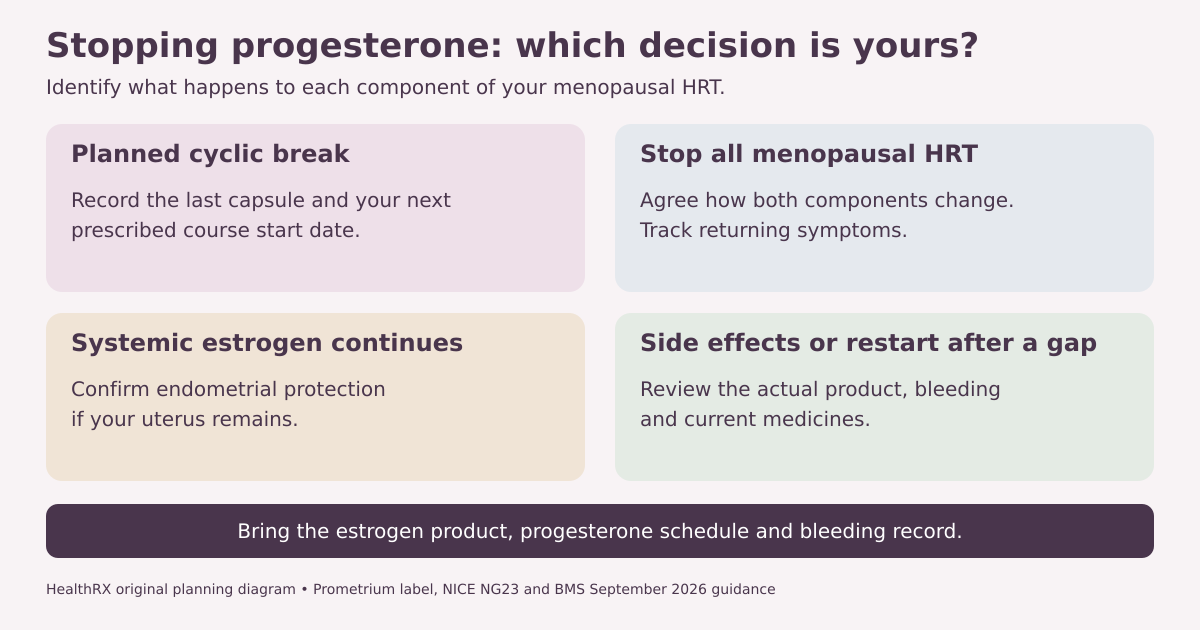
Before stopping OMP, answer three questions:
- Do you still have a uterus? If yes, you cannot stop OMP without also stopping or substantially reducing systemic estrogen, or substituting another progestogen.
- Are you sensitive to neurosteroid withdrawal (sleep disruption, anxiety)? If yes, taper over 4 to 6 weeks rather than stopping abruptly.
- Are you stopping because of side effects, or because you want to stop HRT entirely? The answer changes the plan significantly. Side-effect-driven stops warrant a trial of dose reduction (100 mg instead of 200 mg) or a timing change (earlier in the evening to allow sleep before peak sedation) before full discontinuation.
Withdrawal Symptoms: What to Expect
Most women stopping OMP report a predictable cluster of short-term symptoms driven by two mechanisms: progesterone receptor withdrawal in peripheral tissues and GABA-A receptor readjustment centrally.
Expected Symptoms and Typical Duration
Symptoms that may appear in the first 1 to 14 days after stopping include:
- Sleep fragmentation and difficulty falling asleep (most common, 60 to 70 percent of women in clinical observation)
- Mild anxiety or irritability
- Vasomotor symptoms (hot flashes returning or worsening if estrogen is also being tapered)
- Uterine cramping and breakthrough bleeding (cyclic users)
- Breast tenderness resolving within days
Symptoms peaking at days 3 to 5 and resolving by day 14 are typical. Symptoms lasting beyond 3 weeks warrant clinical re-evaluation.
Symptoms That Require Urgent Medical Attention
Contact your prescriber promptly for:
- Uterine bleeding that is heavier than a normal period or lasts more than 7 days
- Bleeding that appears more than 12 months after your last natural period (this is postmenopausal bleeding and requires endometrial assessment regardless of cause)
- Severe depression or suicidal ideation (rare, but GABA-A withdrawal can worsen pre-existing mood disorders)
- Chest pain or shortness of breath (unrelated to OMP directly, but vasomotor symptom flares after stopping HRT can sometimes mask cardiovascular presentations)
Endometrial Monitoring After Stopping
If a woman has stopped OMP but continues estrogen (or if the clinician needs to confirm endometrial safety after a prolonged period without progestogen), endometrial assessment is indicated.
Transvaginal Ultrasound Thresholds
Transvaginal ultrasound (TVUS) is the first-line tool. An endometrial thickness of <4 mm in a postmenopausal woman on systemic estrogen makes significant pathology unlikely. Thickness of 4 to 8 mm warrants follow-up in 3 to 6 months. Thickness above 8 mm, or any focal abnormality, requires hysteroscopy with biopsy [5].
The FDA labeling for estrogen products states that "adequate diagnostic measures, including directed or random endometrial sampling when indicated, should be undertaken to rule out malignancy in all cases of undiagnosed persistent or recurring abnormal genital bleeding" [6].
Biopsy Indications
An endometrial biopsy is indicated when:
- TVUS shows endometrial thickness above 8 mm
- Any postmenopausal bleeding occurs more than 12 months after the final menstrual period
- A woman has been on unopposed estrogen for more than 6 months inadvertently (e.g., she stopped OMP without realizing it remained necessary)
Pipelle endometrial sampling in an outpatient setting carries sensitivity of approximately 81 percent for endometrial carcinoma detection and 99.6 percent negative predictive value when sampling is adequate [7].
How Oral Micronized Progesterone Works: Mechanism Deep-Dive
This section serves readers who want the pharmacology before making a stopping decision.
Genomic vs. Non-Genomic Effects
Progesterone acts through two broad pathways. The classical genomic pathway involves PR-A and PR-B nuclear receptors; progesterone binding initiates transcription of genes that oppose estrogen's proliferative signal. Response takes hours to days. The non-genomic pathway involves membrane-associated receptors and ion channels, producing rapid effects on mood, anxiety, and pain perception within minutes to hours [2].
At discontinuation, genomic effects (endometrial protection) wane over 2 to 4 days as receptor-mediated transcription winds down. Non-genomic and neurosteroid effects dissipate as plasma progesterone and allopregnanolone levels fall over 24 to 48 hours.
First-Pass Metabolism and the Liver
Approximately 90 percent of absorbed progesterone undergoes first-pass hepatic metabolism. Primary metabolites include 5-alpha-pregnanolone and allopregnanolone. This heavy hepatic processing means OMP has a relatively short effective half-life of 16 to 18 hours, making nightly dosing appropriate for continuous regimens [1].
Because metabolism is hepatic, women with significant liver impairment may clear OMP more slowly. Stopping in this group can produce longer withdrawal windows than typical.
Comparison With Synthetic Progestins at Stopping
Medroxyprogesterone acetate (MPA) has a half-life of 24 to 30 hours for the parent compound and active metabolites persisting beyond 48 hours. Norethindrone acetate has a half-life of approximately 8 hours. Neither produces significant allopregnanolone. This means MPA withdrawal does not carry a meaningful GABA-A component, while OMP withdrawal does [2].
Women switching from OMP to MPA or norethindrone acetate lose the neurosteroid sleep benefit but gain a longer pharmacological window at stopping. Clinicians should counsel patients that the subjective withdrawal experience will differ substantially between agents.
Restarting Oral Micronized Progesterone After a Break
Some women stop OMP for surgery, illness, or a trial period and then need to restart. The restart is straightforward but warrants endometrial assessment first if the break exceeded 6 months with continued estrogen use.
Restart Protocol
Standard restart:
- Confirm endometrial thickness by TVUS before resuming if estrogen was continued during the break.
- Resume at the previously effective dose (commonly 100 mg or 200 mg nightly, depending on continuous versus cyclic regimen).
- Expect mild breast tenderness and sedation in the first 1 to 2 weeks as allopregnanolone levels re-establish.
There is no pharmacological reason to restart at a lower dose and titrate upward unless the original dose caused intolerable side effects. The PEPI trial used 200 mg cyclic and confirmed adequate endometrial protection at that dose [3].
Situations Where Restarting Is Contraindicated
Do not restart OMP without specialist review if you have:
- A new diagnosis of breast cancer (progesterone receptor-positive subtypes; discuss risk-benefit with oncology)
- Undiagnosed vaginal bleeding (rule out endometrial pathology first)
- Known or suspected liver disease with elevated transaminases
- A peanut allergy (Prometrium brand contains peanut oil; switch to compounded progesterone in an oil-free base) [6]
Practical Steps for a Supervised Stop
The following sequence is a general clinical guide. Your prescriber may modify it based on your dose, regimen, and symptom history.
Step 1: Confirm Your Uterine Status
If you have a uterus and are on systemic estrogen, stopping OMP requires a simultaneous plan for estrogen. Review your HRT regimen in full with your physician before stopping anything.
Step 2: Choose Abrupt or Tapered
Abrupt stopping is reasonable for:
- Women completing a cyclic course who are stopping HRT entirely
- Women post-hysterectomy stopping OMP for neurosteroid benefits only
- Women on <100 mg who report minimal neurosteroid effects
A 4 to 6-week taper is preferred for:
- Women on 200 mg continuous who report strong sedative or mood effects from OMP
- Women with a personal or family history of anxiety or sleep disorders
- Women stopping OMP as part of a broader HRT taper (taper both agents in parallel)
Step 3: Schedule Follow-Up
Book a follow-up appointment 6 to 8 weeks after the final OMP dose. At that visit:
- Assess vasomotor symptom burden
- Ask about sleep quality and mood
- Order TVUS if still on any estrogen, or if any vaginal bleeding has occurred
- Review whether a non-hormonal alternative (such as fezolinetant 45 mg daily, FDA-approved 2023 for vasomotor symptoms) is appropriate [8]
The North American Menopause Society 2023 Position Statement on non-hormonal therapies notes that fezolinetant reduced moderate-to-severe VMS frequency by 64 percent versus 45 percent placebo at 12 weeks in the SKYLIGHT 1 trial (N=501) [9].
Frequently asked questions
›Can I stop oral micronized progesterone cold turkey?
›What withdrawal symptoms should I expect after stopping Prometrium?
›How long does progesterone stay in your system after stopping?
›Will stopping progesterone cause a period?
›Can stopping progesterone cause weight gain?
›Do I need to taper off progesterone or can I stop abruptly?
›What happens to my endometrium if I stop progesterone but keep taking estrogen?
›How does oral micronized progesterone work differently from synthetic progestins?
›Is it safe to stop progesterone if I have already had a hysterectomy?
›Can I stop Prometrium if I have a peanut allergy?
›How soon after stopping progesterone should I get an endometrial check?
›Can stopping progesterone worsen hot flashes?
References
- Levine H, Watson N. Comparison of the pharmacokinetics of Crinone 8% administered vaginally versus Prometrium administered orally in postmenopausal women. Fertil Steril. 2000;73(3):516-521. https://pubmed.ncbi.nlm.nih.gov/10688004/
- Bäckström T, Haage D, Löfgren M, et al. Paradoxical effects of GABA-A modulators may explain sex steroid induced negative mood symptoms in some patients. Neuroscience. 2011;191:46-54. https://pubmed.ncbi.nlm.nih.gov/21600959/
- The Writing Group for the PEPI Trial. Effects of estrogen or estrogen/progestin regimens on heart disease risk factors in postmenopausal women. JAMA. 1995;273(3):199-208. https://pubmed.ncbi.nlm.nih.gov/7837245/
- The Menopause Society (NAMS). The 2022 Hormone Therapy Position Statement of The Menopause Society. Menopause. 2022;29(7):767-794. https://pubmed.ncbi.nlm.nih.gov/35797481/
- Goldstein SR. The role of transvaginal ultrasound or endometrial biopsy in the evaluation of the menopausal endometrium. Am J Obstet Gynecol. 2009;201(6):548-556. https://pubmed.ncbi.nlm.nih.gov/19944398/
- U.S. Food and Drug Administration. Prometrium (progesterone, USP) capsules 100 mg prescribing information. https://www.accessdata.fda.gov/drugsatfda_docs/label/2018/019781s027lbl.pdf
- Dijkhuizen FP, Mol BW, Brolmann HA, Heintz AP. The accuracy of endometrial sampling in the diagnosis of patients with endometrial carcinoma and hyperplasia. Cancer. 2000;89(8):1765-1772. https://pubmed.ncbi.nlm.nih.gov/11042577/
- U.S. Food and Drug Administration. FDA approves fezolinetant (Veozah) for moderate-to-severe vasomotor symptoms due to menopause. 2023. https://www.fda.gov/drugs/drug-approvals-and-databases/drug-trials-snapshots-veozah
- Johnson KA, Martin N, Nappi RE, et al. Efficacy and safety of fezolinetant in moderate-to-severe vasomotor symptoms associated with menopause: a phase 3 RCT (SKYLIGHT 1). J Clin Endocrinol Metab. 2023;108(8):1981-1997. https://pubmed.ncbi.nlm.nih.gov/36734934/