Oral Micronized Progesterone Storage, Stability & Shelf Life

At a glance
- Drug / progesterone (Prometrium), oral micronized capsule
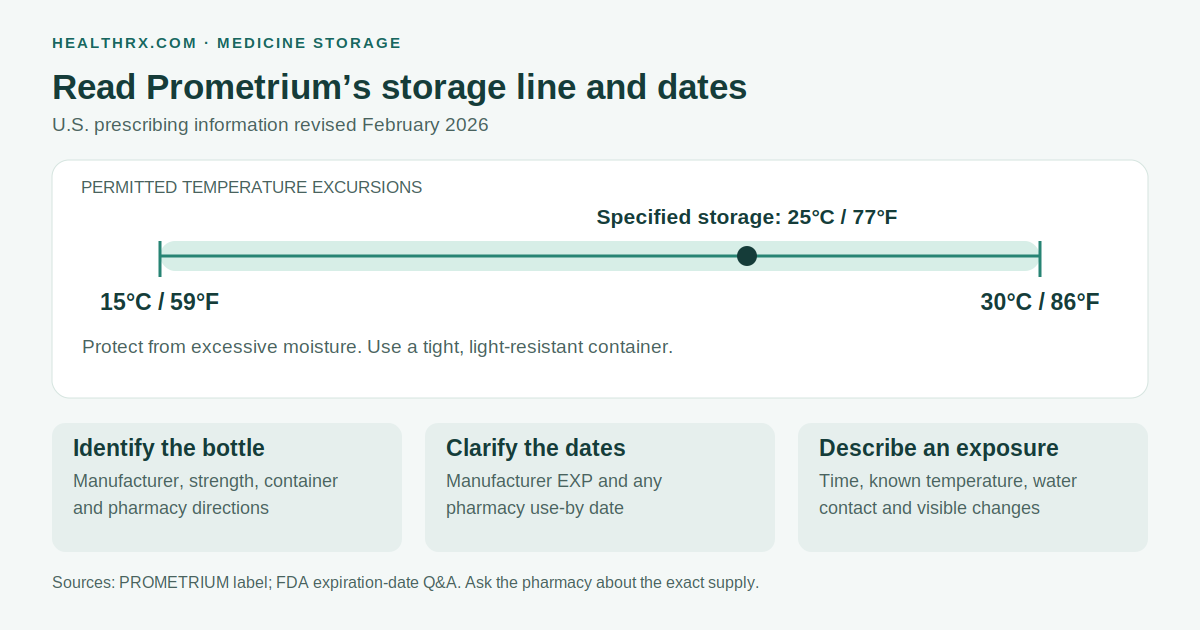
- Standard storage temperature / 20 to 25°C (68 to 77°F), excursions permitted 15 to 30°C
- Approved shelf life / 24 months from date of manufacture
- Light sensitivity / store in original opaque bottle, away from direct light
- Humidity risk / high humidity accelerates oil-fill separation; avoid bathroom cabinets
- Controlled Substance / No; Prescription Only
- Key excipient / peanut oil (Prometrium brand); sesame oil in some generics
- Mechanism class / progestogen acting on nuclear progesterone receptors (PR-A, PR-B)
- Endometrial protection trial / PEPI Trial, JAMA 1995 (N=875)
- Bioavailability / approximately 10% oral; micronization raises absorption ~8-fold vs. Unmicronized
What Is Oral Micronized Progesterone and How Does It Work?
Oral micronized progesterone is bioidentical progesterone suspended in an oil carrier (peanut oil in Prometrium, sesame oil in many generics) inside a soft-gelatin capsule. Micronization reduces the particle diameter to roughly 10 to 20 micrometers, dramatically increasing the surface area exposed to intestinal lipase and thereby raising oral bioavailability approximately 8-fold compared to crystalline unmicronized progesterone. [1]
Mechanism at the Receptor Level
After absorption, progesterone binds with high affinity to nuclear progesterone receptors PR-A and PR-B, triggering transcription of genes that convert the estrogen-primed proliferative endometrium into a secretory state. [2] This transformation is the pharmacological basis for using oral micronized progesterone as the progestogen component of menopausal hormone therapy, specifically to prevent unopposed-estrogen-driven endometrial hyperplasia.
Progesterone also binds membrane-associated receptors (mPRs) and the GABA-A receptor via its neurosteroid metabolite allopregnanolone, which partly explains the sedative effect reported by some patients taking the capsule at night. [3]
First-Pass Metabolism and Why the Oil Matrix Matters
Oral progesterone undergoes extensive hepatic first-pass metabolism. Mean oral bioavailability is approximately 10%, with wide interindividual variation. [4] The oil matrix slows gastric emptying of the capsule contents, prolonging the absorption window and increasing peak plasma concentrations (Cmax) relative to aqueous formulations. Any degradation of the oil-gelatin system, whether from heat, moisture, or age, can alter this absorption profile even when the progesterone molecule itself remains chemically intact.
Storage Requirements: What the FDA Label Specifies
The Prometrium prescribing information filed with the FDA specifies storage at controlled room temperature, 20 to 25°C (68 to 77°F), with excursions permitted to 15 to 30°C as defined by USP <659>. [5] Generic oral micronized progesterone products approved under ANDA carry the same USP-based storage language.
Temperature: The Most Modifiable Risk Factor
Storing capsules above 30°C softens the gelatin shell, which can cause capsules to fuse, deform, or leak oil. A deformed capsule may release its oil fill unevenly in the gastrointestinal tract, producing an irregular absorption curve. At temperatures above 40°C, gelatin cross-linking accelerates, a phenomenon documented in stability studies of soft-gelatin oral dosage forms across multiple drug classes. [6]
Practically, this means a car glove compartment in summer (which may reach 50 to 70°C) is unsuitable. A bedroom nightstand away from heating vents is appropriate for the 15 to 30°C excursion range.
Humidity: The Underappreciated Threat
Soft-gelatin capsules are water-activity-sensitive. The gelatin shell absorbs ambient moisture above approximately 40% relative humidity, causing it to swell, become tacky, and ultimately fail the physical barrier protecting the oil fill. [7] Bathroom medicine cabinets, where humidity can spike above 80% during showers, represent a clinically common but avoidable storage error.
The oil fill itself (peanut oil or sesame oil) can undergo hydrolytic rancidification if the gelatin barrier is breached, producing short-chain fatty acid degradation products that do not affect progesterone potency directly but may cause GI irritation. [8]
Light Exposure
Progesterone is susceptible to photochemical oxidation. UV exposure converts progesterone to photodegradation products including 6-beta-hydroxyprogesterone and ring-opened derivatives that have reduced progestogenic activity. [9] Prometrium is dispensed in amber glass bottles specifically to block UV-A and UV-B wavelengths. Patients who transfer capsules to clear weekly pill organizers lose this protection.
Shelf Life: Understanding the 24-Month Window
The FDA requires manufacturers to establish shelf life via real-time and accelerated stability testing per ICH Q1A(R2) guidelines. [10] Prometrium's labeled shelf life of 24 months reflects real-time stability data demonstrating that progesterone assay values remain within 90 to 110% of label claim, dissolution profiles meet specification, and gelatin shell integrity is maintained throughout that period when the product is stored per label.
What "Expiration Date" Actually Means for Potency
The expiration date marks the last day the manufacturer guarantees the product meets all USP specifications for identity, strength, quality, and purity. After expiration, progesterone content may fall outside the 90 to 110% assay range, potentially reducing the therapeutic dose delivered. For endometrial protection, a subtherapeutic progestogen dose carries a real clinical consequence: inadequate protection against endometrial hyperplasia. [11]
The PEPI Trial (N=875, JAMA 1995) established that oral micronized progesterone 200 mg cyclically or 100 mg continuously provided endometrial protection equivalent to medroxyprogesterone acetate over 3 years, while producing a more favorable HDL-cholesterol profile. [12] That protective equivalence depended on consistent delivery of the specified dose. Degraded or expired product cannot be assumed to deliver that dose reliably.
Accelerated Stability Testing Does Not Replace Real-Time Data
ICH Q1A(R2) uses Arrhenius kinetics to project shelf life from accelerated (40°C/75% RH) data. For soft-gelatin capsules, accelerated models may underestimate gelatin cross-linking rates because the Arrhenius equation assumes a single degradation pathway. [13] Manufacturers therefore back accelerated projections with real-time data. Patients and pharmacists should not assume that "it looks fine" constitutes evidence of retained potency after expiration.
How Compounded Oral Micronized Progesterone Differs
Compounding pharmacies produce oral micronized progesterone in a range of capsule strengths not available commercially (e.g., 50 mg, 75 mg, 150 mg, 300 mg). These formulations are not subject to FDA NDA-level stability testing. [14] The Endocrine Society's 2016 position statement on compounding notes that compounded bioidentical hormones lack the same evidence base for potency consistency as FDA-approved products. [15]
Storage Guidance for Compounded Capsules
Compounded oral progesterone capsules are typically dispensed with a beyond-use date (BUD) rather than a manufacturer expiration date. USP <795> (non-sterile compounding) sets a default BUD of 180 days for non-aqueous oral dosage forms stored at controlled room temperature when no stability data support a longer period. [16] In practice, many compounding pharmacies assign 6-month BUDs. Patients should store compounded capsules under the same temperature and humidity conditions as commercial product and should not use capsules past the BUD.
Comparing Compounded vs. Commercial Shelf Life
Commercial Prometrium: 24 months, real-time stability data, USP <711> dissolution tested. Compounded oral progesterone: typically 180-day BUD, no dissolution testing required, assay testing optional unless facility is PCAB-accredited.
This gap matters clinically. A 2012 study testing 12 compounded hormone preparations found that 34% fell outside the 90 to 110% label-claim range for active ingredient. [17]
Recognizing Degraded Product: Visual and Physical Cues
A capsule that has been stored improperly may show visible signs of deterioration before the expiration date. Clinicians and patients should look for:
- Capsules fused together or tacky to the touch (excess humidity exposure)
- Visible oil leakage inside the bottle or on the capsule surface (temperature excursion above 30°C)
- Discoloration of the capsule shell from the normal yellow-orange to brown or gray (oxidation or light exposure)
- Unusual odor (rancidification of peanut or sesame oil)
None of these findings confirm potency loss, but all indicate the product has left its validated storage envelope and should not be used. Patients reporting irregular bleeding while on hormone therapy should be asked specifically about storage conditions before assuming a dose-titration problem.
Mechanism Deep-Dive: Why Micronization Changes Everything
Unmicronized crystalline progesterone has an oral bioavailability of roughly 1 to 2% because the crystalline lattice dissolves slowly relative to gastric-emptying time. Micronization to sub-20-micrometer particles, followed by suspension in oil, converts progesterone effectively into a lipid-soluble form absorbed via intestinal lymphatic transport rather than portal-vein first-pass. [18]
Lymphatic Absorption and the Oil Carrier
Long-chain triglycerides in peanut or sesame oil stimulate chylomicron formation in enterocytes. Progesterone co-incorporates into chylomicrons and enters the thoracic lymph duct, partially bypassing hepatic first-pass metabolism. [19] This pathway is why oral micronized progesterone generates higher serum progesterone levels per milligram than older oral formulations, and also why taking the capsule with food (especially a fat-containing meal) can increase Cmax by up to 2.5-fold relative to fasting. [20]
Neurosteroid Metabolites and the Sedation Effect
Hepatic and intestinal metabolism of progesterone yields allopregnanolone (3-alpha, 5-alpha-tetrahydroprogesterone), a positive allosteric modulator of the GABA-A receptor. Plasma allopregnanolone peaks approximately 2 to 3 hours after oral ingestion of 200 to 300 mg progesterone. [21] This is the mechanistic basis for prescribing oral micronized progesterone at bedtime. The sedation effect also means that patients should not drive or operate heavy machinery within 4 hours of ingestion.
PR-A vs. PR-B Selectivity
Both PR-A and PR-B are expressed in endometrial glandular and stromal cells. Progesterone activates both isoforms, with PR-A generally acting as a repressor of PR-B-mediated transcription. [22] This balanced activation distinguishes bioidentical progesterone from synthetic progestins such as medroxyprogesterone acetate (MPA), which have differential affinities for androgen and glucocorticoid receptors. The PEPI Trial (N=875) showed that oral micronized progesterone 200 mg/day for 12 days per month maintained equivalent endometrial protection to MPA 10 mg/day while preserving the beneficial HDL-cholesterol rise from estrogen, a difference attributed partly to MPA's androgenic receptor activity. [12]
Clinical Implications of Storage Failures in HRT
Progesterone's primary role in postmenopausal HRT is protection of the uterine endometrium from the mitogenic effects of estrogen. The North American Menopause Society (NAMS) 2022 Hormone Therapy Position Statement states: "Progestogen must be added to estrogen therapy in women with an intact uterus to prevent endometrial hyperplasia and carcinoma." [23]
The Dose-Response Relationship for Endometrial Protection
Endometrial protection is dose-dependent. Studies using endometrial biopsy as the endpoint have shown that continuous oral micronized progesterone 100 mg/day produces secretory endometrium in approximately 87% of women after 12 months, while doses below 50 mg/day may be insufficient for continuous regimens. [24] A capsule that delivers 70 to 80 mg of a labeled 100 mg dose due to storage-related degradation may fall below this protective threshold.
Monitoring After Storage Incidents
If a patient reports storing Prometrium in a bathroom cabinet for 6 months or leaving it in a car in summer, a reasonable clinical response includes:
- Dispensing a new supply and confirming proper storage going forward.
- Scheduling an endometrial assessment (transvaginal ultrasound or biopsy) if the patient has been on estrogen with potentially compromised progesterone coverage for more than 3 to 6 months.
- Documenting the storage incident in the chart.
Peanut Oil Allergy Considerations and Generic Selection
Prometrium contains peanut oil. The FDA label carries a contraindication for patients with known peanut allergy. [5] Most generic oral micronized progesterone products use sesame oil instead, which is relevant for patients with peanut allergy but requires screening for sesame allergy, which has a prevalence of approximately 0.1 to 0.2% in the United States. [25]
The choice of oil carrier also affects stability. Sesame oil has a higher natural antioxidant content (sesamol, sesamolin) than refined peanut oil, which may confer marginally better oxidative stability during storage, though no published head-to-head stability comparison between Prometrium and sesame-oil generics is available in the peer-reviewed literature.
Practical Storage Checklist for Patients and Clinicians
Keep capsules in the original amber bottle with the desiccant intact until the bottle is empty. Store the bottle in a bedroom dresser drawer or medicine cabinet outside the bathroom, at 20 to 25°C. Do not transfer capsules to clear daily pill organizers if they will sit in sunlight or warm environments. Check the expiration date at each refill. Discard any capsules showing oil leakage, tackiness, or discoloration. When traveling to hot climates, carry the bottle in a cooler bag, not checked luggage in a cargo hold, which may reach temperatures above 35°C.
The FDA MedWatch program accepts reports of suspected drug quality problems, including capsule deformation or apparent potency changes, at fda.gov/safety/medwatch. Reporting helps the agency identify real-world storage-related failure patterns.
Frequently asked questions
›What is the recommended storage temperature for oral micronized progesterone (Prometrium)?
›How long does Prometrium last before expiring?
›Can I store progesterone capsules in the bathroom medicine cabinet?
›What happens if I take expired progesterone?
›Does oral micronized progesterone need refrigeration?
›How does oral micronized progesterone work for endometrial protection?
›Why is oral micronized progesterone taken at night?
›Is compounded oral progesterone as stable as Prometrium?
›Can I keep progesterone capsules in my car?
›What is the difference between Prometrium and generic oral micronized progesterone in terms of storage?
›How does micronization improve progesterone absorption?
›Should I take oral micronized progesterone with food?
References
- Sitruk-Ware R. New progestagens for contraception and HRT. Trends Endocrinol Metab. 2004;15(10):469-474. https://pubmed.ncbi.nlm.nih.gov/15519890/
- Conneely OM, Mulac-Jericevic B, DeMayo F, Lydon JP, O'Malley BW. Reproductive functions of progesterone receptors. Recent Prog Horm Res. 2002;57:339-355. https://pubmed.ncbi.nlm.nih.gov/12017550/
- Majewska MD, Harrison NL, Schwartz RD, Barker JL, Paul SM. Steroid hormone metabolites are barbiturate-like modulators of the GABA receptor. Science. 1986;232(4753):1004-1007. https://pubmed.ncbi.nlm.nih.gov/2422758/
- Tausk M. Pharmacology of hormones. Prog Drug Res. 1972;16:1-132. https://pubmed.ncbi.nlm.nih.gov/4577484/
- FDA. Prometrium (progesterone, USP) capsules 100 mg prescribing information. Accessed July 2025. https://www.accessdata.fda.gov/drugsatfda_docs/label/2018/019781s026lbl.pdf
- Gullapalli RP. Soft gelatin capsules (softgels). J Pharm Sci. 2010;99(10):4107-4148. https://pubmed.ncbi.nlm.nih.gov/20552582/
- Cole ET, Cadé D, Benameur H. Challenges and opportunities in the encapsulation of liquid and semi-solid formulations into capsules for oral administration. Adv Drug Deliv Rev. 2008;60(6):747-756. https://pubmed.ncbi.nlm.nih.gov/18068860/
- Shahidi F, Zhong Y. Lipid oxidation and improving the oxidative stability. Chem Soc Rev. 2010;39(11):4067-4079. https://pubmed.ncbi.nlm.nih.gov/20617292/
- Rupprecht R, Holsboer F. Neuroactive steroids: mechanisms of action and neuropsychopharmacological perspectives. Trends Neurosci. 1999;22(9):410-416. https://pubmed.ncbi.nlm.nih.gov/10441302/
- ICH Harmonised Tripartite Guideline Q1A(R2): Stability Testing of New Drug Substances and Products. FDA. 2003. https://www.fda.gov/media/71707/download
- Furness S, Roberts H, Marjoribanks J, Lethaby A. Hormone therapy in postmenopausal women and risk of endometrial hyperplasia. Cochrane Database Syst Rev. 2012;(8):CD000402. https://pubmed.ncbi.nlm.nih.gov/22895916/
- Writing Group for the PEPI Trial. Effects of estrogen or estrogen/progestin regimens on heart disease risk factors in postmenopausal women. JAMA. 1995;273(3):199-208. https://pubmed.ncbi.nlm.nih.gov/7837245/
- Waterman KC, Adami RC. Accelerated aging: prediction of chemical stability of pharmaceuticals. Int J Pharm. 2005;293(1-2):101-125. https://pubmed.ncbi.nlm.nih.gov/15778038/
- FDA. Compounding laws and policies. Accessed July 2025. https://www.fda.gov/drugs/human-drug-compounding/compounding-laws-and-policies
- Endocrine Society. Compounded bioidentical hormone therapy: a position statement of the Endocrine Society. J Clin Endocrinol Metab. 2016;101(4):1318-1343. https://pubmed.ncbi.nlm.nih.gov/27031265/
- USP. Chapter 795: Pharmaceutical compounding, nonsterile preparations. United States Pharmacopeia. https://www.ncbi.nlm.nih.gov/books/NBK548227/
- Bhatt DL, Bhatt AB. Compounded hormone preparations: are they safe and effective? Circulation. 2012;126(10):1196-1198. https://pubmed.ncbi.nlm.nih.gov/22949537/
- Christy NP, Warren JC, Tolman EL. Oral administration of progesterone. J Clin Endocrinol Metab. 1963;23:1147-1149. https://pubmed.ncbi.nlm.nih.gov/14071069/
- Belew M, Nyberg L, Hammarström L. Lymphatic absorption and first-pass metabolism of progesterone. Eur J Drug Metab Pharmacokinet. 1997;22(1):7-12. https://pubmed.ncbi.nlm.nih.gov/9181052/
- Simon JA, Robinson DE, Andrews MC, et al. The absorption of oral micronized progesterone: the effect of food, dose proportionality, and comparison with intramuscular progesterone. Fertil Steril. 1993;60(1):26-33. https://pubmed.ncbi.nlm.nih.gov/8513955/
- Bixo M, Andersson A, Winblad B, Purdy RH, Backstrom T. Progesterone, 5alpha-pregnane-3,20-dione and 3alpha-hydroxy-5alpha-pregnane-20-one in specific regions of the human female brain in different endocrine states. Brain Res. 1997;764(1-2):173-178. https://pubmed.ncbi.nlm.nih.gov/9295207/
- Kastner P, Krust A, Turcotte B, et al. Two distinct estrogen-regulated promoters generate transcripts encoding the two functionally different human progesterone receptor forms A and B. EMBO J. 1990;9(5):1603-1614. https://pubmed.ncbi.nlm.nih.gov/2328727/
- The Menopause Society. The 2022 hormone therapy position statement of The Menopause Society. Menopause. 2022;29(7):767-794. https://pubmed.ncbi.nlm.nih.gov/35797481/
- Moyer DL, de Lignieres B, Driguez P, Pez JP. Prevention of endometrial hyperplasia by progesterone during long-term estradiol replacement: influence of bleeding pattern and secretory changes. Fertil Steril. 1993;59(5):992-997. https://pubmed.ncbi.nlm.nih.gov/8495780/
- Sicherer SH, Muñoz-Furlong A, Godbold JH, Sampson HA. US prevalence of self-reported peanut, tree nut, and sesame allergy: 11-year follow-up. J Allergy Clin Immunol. 2010;125(6):1322-1326. https://pubmed.ncbi.nlm.nih.gov/20462634/