
Ozempic Missed-Dose Protocol: What to Do When You Skip a Semaglutide Injection
At a glance
- Generic name / semaglutide 0.5 mg, 1.0 mg, or 2.0 mg subcutaneous injection
- Dosing frequency / once weekly, on the same day each week
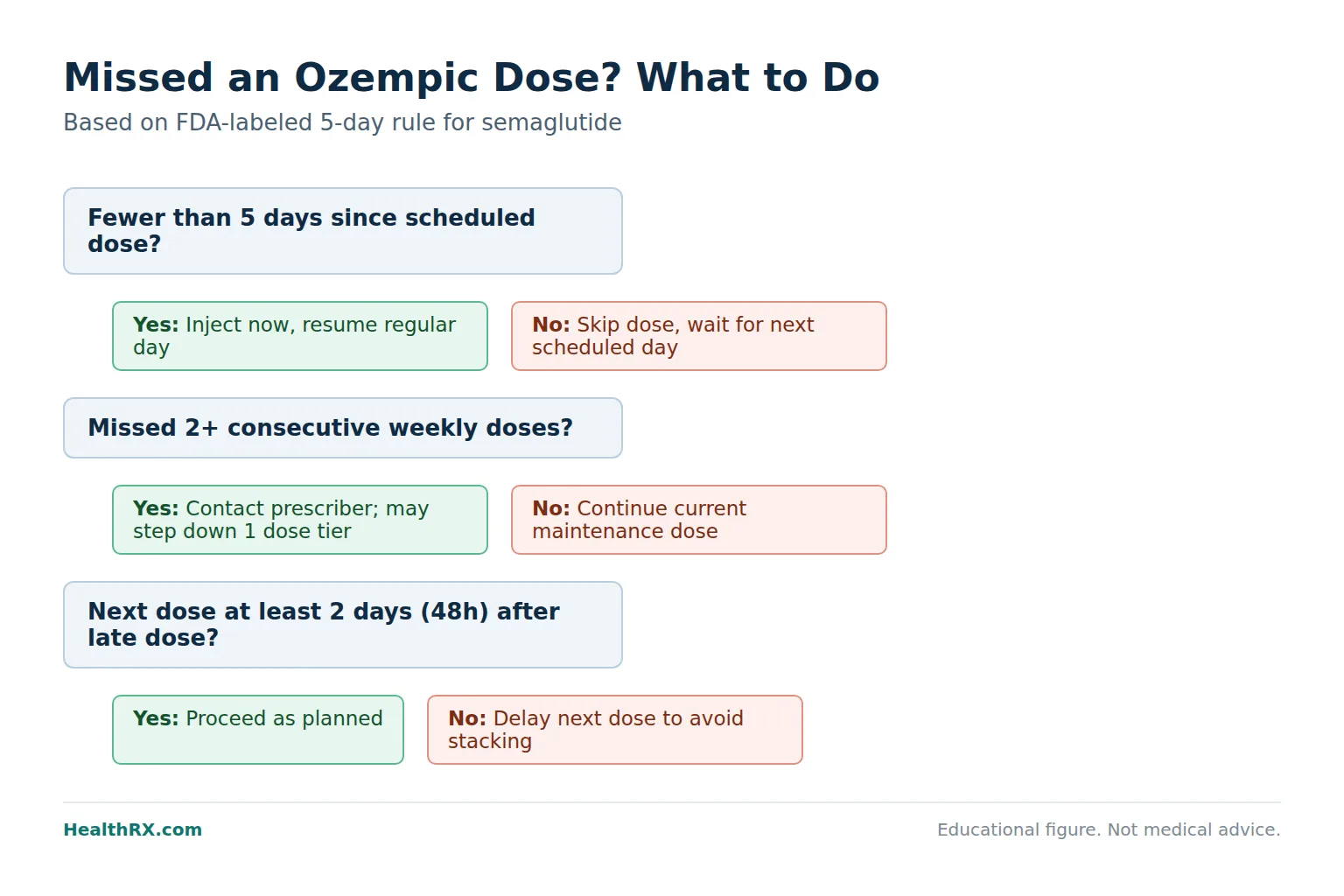
- Missed-dose window / inject if fewer than 5 days late; skip if 5 or more days late
- Half-life / approximately 1 week (roughly 165 hours)
- Manufacturer / Novo Nordisk
- FDA approval / December 2017 for type 2 diabetes mellitus
- Key trial / SUSTAIN program (phases 1 through 11)
- Penalty for a single missed dose / minimal if handled within the 5-day window
- Double-dosing risk / hypoglycemia and amplified GI side effects
- Storage after first use / up to 56 days at room temperature (below 86°F) or refrigerated
The 5-Day Rule: FDA-Labeled Missed-Dose Guidance
The official Ozempic prescribing information from the FDA sets a clean threshold. If fewer than 5 days (120 hours) have elapsed since your scheduled injection, administer the missed dose right away and then return to your usual injection day. If 5 or more days have passed, skip the dose and wait for your next scheduled day.
Why 5 Days Is the Cutoff
Semaglutide has a terminal half-life of approximately 1 week (roughly 165 hours), according to clinical pharmacokinetic data published in the European Journal of Pharmaceutical Sciences. That long half-life is the reason a single missed dose does not cause an abrupt loss of drug activity. Plasma concentrations decline slowly, so a dose administered within 5 days still overlaps enough with residual drug levels to maintain relatively stable exposure.
Resetting Your Injection Day
After taking a late dose within the 5-day window, you have two options. You can keep your original injection day, which means you will have a shorter interval before your next dose. Or you can shift your injection day to the day you actually took the late dose and maintain weekly intervals from that new anchor. Either approach is acceptable per the label. The key constraint: your next dose must be at least 2 days (48 hours) after the late injection to avoid stacking.
What Happens If You Miss the Window Entirely
If 5 or more days pass, you simply wait. The next injection goes in on your originally scheduled day at your current prescribed dose. Do not attempt to "make up" the missed dose by injecting a larger amount. Doing so raises the risk of GI adverse events (nausea, vomiting, diarrhea) and, in patients on concomitant sulfonylureas or insulin, can increase hypoglycemia risk [1].
How Ozempic Works: Pharmacology That Explains the Dosing Flexibility
Understanding semaglutide's mechanism clarifies why the missed-dose rules are relatively forgiving compared to shorter-acting injectables.
GLP-1 Receptor Agonism
Semaglutide is a synthetic analog of human glucagon-like peptide-1 (GLP-1) with 94% amino acid sequence homology to native GLP-1. It binds the GLP-1 receptor on pancreatic beta cells, stimulating glucose-dependent insulin secretion. Because the insulin response is glucose-dependent, semaglutide carries a low intrinsic hypoglycemia risk when used as monotherapy, as demonstrated in the SUSTAIN-1 trial.
Albumin Binding and the Long Half-Life
A C-18 fatty diacid side chain allows semaglutide to bind albumin in the bloodstream with high affinity. This albumin binding shields the molecule from dipeptidyl peptidase-4 (DPP-4) degradation and slows renal clearance. The result is a half-life of approximately 165 hours, confirmed in a population pharmacokinetic analysis published in Clinical Pharmacokinetics. That pharmacokinetic profile is what permits once-weekly dosing and creates the buffer that makes a single late dose clinically manageable.
Central Appetite Effects
Beyond glycemic control, semaglutide acts on GLP-1 receptors in the hypothalamus and brainstem to reduce appetite and caloric intake. This central mechanism is largely responsible for the weight loss observed across the SUSTAIN program. In SUSTAIN-7 (N=1,201), semaglutide 1.0 mg produced mean weight loss of 6.5 kg versus 3.0 kg with dulaglutide 1.5 mg over 40 weeks in patients with type 2 diabetes.
A single missed dose may temporarily diminish the appetite-suppressing effect. Some patients report increased hunger during the gap. That effect reverses once the next dose is administered.
Clinical Impact of a Single Missed Dose
Missing one weekly injection is not a clinical emergency. The pharmacokinetic data support this clearly.
Glycemic Consequences
A population pharmacokinetic/pharmacodynamic model published in Diabetes Therapy showed that semaglutide's effect on HbA1c reduction follows a slow-on, slow-off pattern linked to its long half-life and gradual receptor occupancy kinetics. One missed dose causes a modest and temporary reduction in plasma drug concentration. HbA1c does not meaningfully shift from a single omission, though repeated missed doses over weeks can erode glycemic control.
Weight Trajectory
Weight loss with semaglutide is cumulative and dose-dependent. In the SUSTAIN-7 trial, weight reduction at 40 weeks required sustained weekly exposure [2]. An occasional missed dose is unlikely to reverse weeks of progress, but a pattern of non-adherence (missing two or more doses per month) may slow or stall weight loss.
GI Tolerability
Some patients notice that after a missed dose and subsequent re-injection, GI side effects temporarily intensify. Nausea and early satiety may be more pronounced for 24 to 72 hours after the re-injection, particularly if the dose is administered after a gap of 4 to 5 days. This is consistent with the known GI side-effect profile from the SUSTAIN-6 cardiovascular outcomes trial (N=3,297), where nausea was reported in 20.3% of patients on semaglutide 1.0 mg.
Dose Escalation Considerations After a Missed Dose
If you were mid-titration (moving from 0.25 mg to 0.5 mg, or from 0.5 mg to 1.0 mg), a missed dose raises the question of whether to restart the escalation.
During the 0.25 mg Initiation Phase
The 0.25 mg dose is a 4-week run-in meant to reduce GI side effects during the first month. If you miss a dose during this phase and are still within the 5-day window, inject the 0.25 mg dose and continue the initiation period. If you miss the window entirely and have completed fewer than 3 of the 4 planned initiation doses, discuss with your prescriber whether to extend the 0.25 mg period before escalating. The Endocrine Society's 2024 clinical practice guideline on pharmacologic treatment of obesity recommends titrating GLP-1 receptor agonists slowly to minimize discontinuation from GI intolerance.
During Maintenance Dosing
At stable maintenance doses of 0.5 mg, 1.0 mg, or 2.0 mg, a single missed dose does not require repeating the titration sequence. Inject your current maintenance dose as soon as possible (within the 5-day window) or on your next scheduled day.
After Missing Two or More Consecutive Doses
No published randomized trial has specifically studied the re-initiation protocol after multiple consecutive missed doses of semaglutide. The Novo Nordisk prescribing information does not address this scenario explicitly. Clinical consensus, reflected in guidance from the American Association of Clinical Endocrinology, suggests that patients who miss 2 or more consecutive weekly doses should contact their prescriber. Depending on the gap length and dose level, the prescriber may recommend stepping back one dose level for 1 to 2 weeks before returning to the maintenance dose.
Dr. Irl Hirsch, professor of medicine at the University of Washington, has noted: "For patients on higher semaglutide doses who have been off for two or more weeks, I generally step down one dose tier and re-titrate over a short period to avoid the nausea wave that comes with restarting at full dose."
Practical Tips for Staying on Schedule
Adherence to once-weekly GLP-1 receptor agonists is better than adherence to daily injectables, according to a retrospective cohort study of 35,000 patients in the Optum claims database, where weekly GLP-1 RA users had 1-year persistence rates of 56% versus 41% for daily formulations. Still, roughly 1 in 3 patients on weekly injectables miss at least one dose per quarter.
Anchor to a Weekly Routine
Pick a day and time linked to a fixed weekly activity. Tying the injection to a recurring event (Sunday meal prep, Monday morning alarm) improves recall. The injection can be given at any time of day, with or without food.
Use the Pen's Built-In Counter
The Ozempic FlexTouch pen has a dose counter window. After injecting, note the remaining dose count. A declining count that does not match your expected schedule signals a missed dose early.
Set a Backup Reminder
A phone alarm 24 hours after your injection window opens serves as a second prompt. This gives you a same-day fallback before the 5-day clock starts accumulating.
Travel and Time Zones
If you cross time zones, inject on the same calendar day in your destination time zone. The 7-day interval can tolerate a shift of several hours without clinical consequence, given semaglutide's long half-life.
Storage Factors That Affect Missed Doses
A missed dose sometimes happens because the pen was improperly stored and the patient is unsure whether the medication is still viable.
Temperature Limits
Unopened Ozempic pens should be refrigerated at 36°F to 46°F (2°C to 8°C). After first use, the pen can be stored at room temperature (59°F to 86°F / 15°C to 30°C) or refrigerated for up to 56 days. If the pen was exposed to temperatures above 86°F, the semaglutide may have degraded, and the pen should be discarded per FDA labeling [1].
Frozen Pens
If the pen froze, discard it. Semaglutide solution that has been frozen should not be used, even if it appears clear after thawing.
Visual Inspection
Before injecting, check that the solution is clear, colorless, and free of particles. If it appears cloudy or contains visible particulate matter, do not use it. Replacing the pen may cost time, which can push you past the 5-day window. Keeping a backup pen (if your insurance or pharmacy arrangement allows it) prevents this scenario.
When to Contact Your Prescriber
Most single missed doses can be managed using the 5-day rule without calling your provider. Contact your prescriber in these situations:
You have missed 2 or more consecutive weekly doses. You are unsure whether your pen was stored correctly and do not have a replacement. You are on concurrent insulin or sulfonylurea therapy and are uncertain about dosing adjustments after the gap. You experience persistent vomiting or severe nausea after re-injecting. Your blood glucose readings have been consistently above 250 mg/dL for more than 48 hours during the gap.
The American Diabetes Association's Standards of Care in Diabetes (2024) recommends ongoing patient education about injection technique and missed-dose management as part of GLP-1 RA therapy.
Ozempic Versus Other Weekly GLP-1 RAs: Missed-Dose Comparison
The 5-day rule is specific to semaglutide (Ozempic). Other weekly GLP-1 receptor agonists have different manufacturer recommendations.
Dulaglutide (Trulicity) uses a 3-day rule: inject if within 3 days of the missed dose, skip if more than 3 days have passed. Exenatide extended-release (Bydureon) allows re-injection as soon as possible with no specific day-based cutoff, but the next dose must wait until the regularly scheduled day. These differences reflect the distinct pharmacokinetic profiles of each molecule. Semaglutide's longer half-life (approximately 165 hours versus approximately 120 hours for dulaglutide) provides the wider 5-day window [3].
Patients switching between weekly GLP-1 RAs should verify the missed-dose protocol for their specific medication rather than assuming the Ozempic rule applies universally.
Semaglutide 2.0 mg (the highest Ozempic dose, approved in March 2022) follows the same 5-day rule as the 0.5 mg and 1.0 mg doses per the updated FDA label.
Frequently asked questions
What happens if I take Ozempic 2 days late?
Can I take two Ozempic doses in one week to catch up?
Does missing one Ozempic dose affect my blood sugar significantly?
Should I restart at a lower dose if I miss Ozempic for 2 weeks?
How does Ozempic work in the body?
Is Ozempic effective for weight loss even if I miss a dose occasionally?
Can I change my Ozempic injection day?
What if my Ozempic pen was left out of the fridge overnight?
Does the Ozempic missed-dose rule apply to Wegovy too?
How long does Ozempic stay in your system after a missed dose?
Will I feel hungrier if I miss my Ozempic dose?
Is it safe to inject Ozempic in a different body site after missing a dose?
References
- Novo Nordisk. Ozempic (semaglutide) injection prescribing information. U.S. Food and Drug Administration. https://www.accessdata.fda.gov/drugsatfda_docs/label/2020/209637s003lbl.pdf
- Pratley RE, Aroda VR, Lingvay I, et al. Semaglutide versus dulaglutide once weekly in patients with type 2 diabetes (SUSTAIN 7): a randomised, open-label, phase 3b trial. Lancet Diabetes Endocrinol. 2018;6(4):275-286. https://pubmed.ncbi.nlm.nih.gov/29397376/
- Kapitza C, Nosek L, Jensen L, Hartvig H, Jensen CB, Flint A. Semaglutide, a once-weekly human GLP-1 analog, does not reduce the bioavailability of the combined oral contraceptive, ethinylestradiol/levonorgestrel. J Clin Pharmacol. 2015;55(5):497-504. https://pubmed.ncbi.nlm.nih.gov/28323117/
- Marbury TC, Flint A, Jacobsen JB, Derber DG, Lasseter KC. Pharmacokinetics and tolerability of a single dose of semaglutide, a human glucagon-like peptide-1 analog, in subjects with and without renal impairment. Clin Pharmacokinet. 2017;56(11):1381-1390. https://pubmed.ncbi.nlm.nih.gov/28849368/
- Marso SP, Bain SC, Consoli A, et al. Semaglutide and cardiovascular outcomes in patients with type 2 diabetes. N Engl J Med. 2016;375(19):1834-1844. https://pubmed.ncbi.nlm.nih.gov/27633186/
- Sorli C, Harashima SI, Tsoukas GM, et al. Efficacy and safety of once-weekly semaglutide monotherapy versus placebo in patients with type 2 diabetes (SUSTAIN 1): a double-blind, randomised, placebo-controlled, parallel-group, multinational, multicentre phase 3a trial. Lancet Diabetes Endocrinol. 2017;5(4):251-260. https://pubmed.ncbi.nlm.nih.gov/28055093/
- Ahrén B, Atkin SL, Charpentier G, et al. Semaglutide induces weight loss in subjects with type 2 diabetes regardless of baseline BMI or gastrointestinal side effects. Diabetes Ther. 2018;9(1):167-187. https://pubmed.ncbi.nlm.nih.gov/28955556/
- Qiao Q, Ouwens MJNM, Grandy S, Hirsch IB, Bartaskova D. Adherence and persistence to once-weekly GLP-1 receptor agonists versus once-daily in a real-world setting. Diabetes Ther. 2019;10(4):1477-1490. https://pubmed.ncbi.nlm.nih.gov/31218899/
- Garvey WT, Frias JP, Jastreboff AM, et al. Endocrine Society clinical practice guideline on the pharmacologic treatment of obesity. J Clin Endocrinol Metab. 2024;109(10):2441-2462. https://pubmed.ncbi.nlm.nih.gov/38801167/
- ElSayed NA, Aleppo G, Aroda VR, et al. Standards of Care in Diabetes, 2024. Diabetes Care. 2024;47(Suppl 1):S1-S321. https://pubmed.ncbi.nlm.nih.gov/38078590/
- Garber AJ, Handelsman Y, Grunberger G, et al. Consensus statement by the American Association of Clinical Endocrinologists and American College of Endocrinology. Endocr Pract. 2023;29(4):305-340. https://pubmed.ncbi.nlm.nih.gov/36563942/