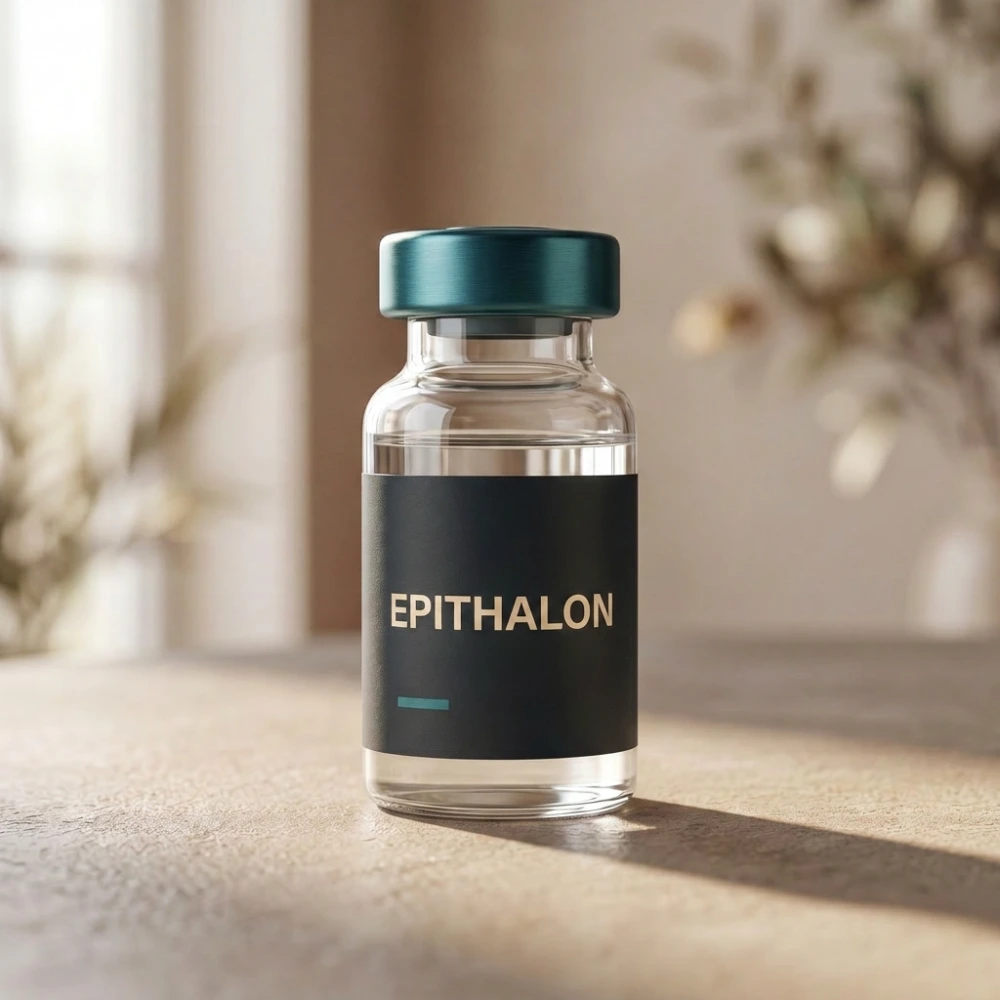
Epitalon Compounding Pharmacy Quality Red Flags to Avoid

At a glance
- Peptide / Epitalon (Ala-Glu-Asp-Gly), tetrapeptide
- FDA status / Not approved; no IND; unapproved new drug under 21 USC 321
- Purity standard / ≥98% by HPLC per USP general chapter guidance
- Sterility standard / USP <71> sterility test required for injectable preparations
- Endotoxin limit / <5 EU/kg/hr per USP <85> bacterial endotoxins test
- Governing compounding standards / USP <795> (non-sterile), USP <797> (sterile)
- Key accreditation / PCAB (Pharmacy Compounding Accreditation Board)
- Primary legal risk / FDA Warning Letter issuance for unapproved peptide distribution
- Minimum documentation to request / COA with HPLC trace, sterility report, endotoxin report
- Buyer red flag count in this guide / 9 specific red flags covered
What Is Epitalon and Why Does Sourcing Quality Matter?
Epitalon is a synthetic tetrapeptide (Ala-Glu-Asp-Gly) first isolated by Vladimir Khavinson at the St. Petersburg Institute of Bioregulation. Early animal work published in peer-reviewed journals reported effects on telomerase activity and pineal melatonin secretion, which generated broad interest in longevity medicine circles. No FDA-approved formulation exists.
Because Epitalon has no approved drug application and no active Investigational New Drug (IND) exemption covering retail distribution, every vial sold to a patient or consumer depends on compounding pharmacy practices, research-chemical supply chains, or outright unregulated vendors. The difference between those three categories is enormous in terms of safety.
Why Injectable Peptides Demand Stricter Controls
Injectable preparations bypass the body's first-line defenses. A contaminated oral tablet may cause gastrointestinal distress. A contaminated subcutaneous or intravenous peptide can cause sepsis, endotoxin shock, or systemic fungal infection. The FDA's own enforcement data document exactly these harms: the agency's 2012 meningitis outbreak investigation traced 64 deaths to contaminated methylprednisolone from a compounding pharmacy that had ignored USP <797> sterility requirements [1].
The Regulatory Gap Epitalon Falls Into
The FDA classifies unapproved peptides distributed without a valid prescription or IND as unapproved new drugs under 21 U.S.C. § 321. The agency has issued multiple Warning Letters to compounding pharmacies marketing peptides including BPC-157, TB-500, and related compounds for commercial distribution [2]. Epitalon appears on the FDA's list of bulk drug substances that have not been nominated or approved for use in compounding under Section 503A of the Federal Food, Drug, and Cosmetic Act [3]. That single fact means any compounding pharmacy legally dispensing Epitalon must operate under narrow research or practitioner-directed frameworks and must still meet full sterile compounding standards if the preparation is injectable.
Understanding the Legal Framework Before You Buy
USP <797> and USP <795>: The Baseline Standards
The United States Pharmacopeia publishes two chapters directly governing compounding pharmacies. USP <795> covers non-sterile preparations such as oral capsules or topical creams [4]. USP <797> governs sterile preparations and specifies cleanroom classifications (ISO 5, ISO 7, ISO 8), beyond-use dating, personnel garbing, environmental monitoring, and sterility testing [5].
The 2023 revised USP <797> tightened beyond-use dating considerably. Category 1 preparations (those compounded without sterility testing) now carry a maximum beyond-use date of 12 hours at room temperature or 24 hours refrigerated. Category 2 preparations that pass full sterility and endotoxin testing may carry dating up to 45 days refrigerated [5]. A pharmacy offering Epitalon vials with a 90-day or 6-month expiry and no sterility test certificate is violating the revised chapter.
The Drug Supply Chain Security Act (DSCSA)
The DSCSA (Public Law 113-54) created a national track-and-trace system for prescription drugs [6]. Licensed compounding pharmacies operating under Section 503A (patient-specific prescriptions) or 503B (outsourcing facilities) must comply with DSCSA serialization and reporting requirements. A vendor that cannot provide a DSCSA-compliant dispensing record is not operating within a licensed pharmacy framework, regardless of what its website claims.
State Board Licensing
Every state pharmacy board independently licenses compounding operations. The National Association of Boards of Pharmacy (NABP) maintains a database of state-licensed facilities. A pharmacy compounding sterile Epitalon in Texas, for example, must hold a Texas State Board of Pharmacy sterile compounding license in addition to federal compliance. Ask for the license number. Verify it.
Nine Quality Red Flags to Identify Before Ordering Epitalon
The following nine red flags represent the most commonly observed compliance failures across peptide-compounding suppliers. Each has a direct safety implication.
Red Flag 1: No Certificate of Analysis with HPLC Trace
A legitimate certificate of analysis (COA) for a compounded or bulk peptide includes an HPLC purity result, a mass spectrometry identity confirmation, and the name of the third-party testing laboratory. Purity for injectable-grade peptides should be ≥98% by HPLC. Research on synthetic peptide degradation shows that impurities above 2% may include truncated sequences or oxidized residues that generate unpredictable immunogenic responses [7].
If a supplier provides a COA without an actual HPLC chromatogram or lists the testing lab as "internal," treat it as no COA at all. Third-party verification by an ISO 17025-accredited laboratory is the minimum acceptable standard.
Red Flag 2: Missing Sterility Test Report
USP <71> sterility testing requires a 14-day incubation of the preparation in both thioglycollate medium (for anaerobic bacteria) and soybean-casein digest medium (for aerobic bacteria and fungi) [8]. The test is batch-specific. A sterility report from six months ago on a different lot number does not cover the vial in your current order.
Compounding pharmacies that skip USP <71> testing often cite cost. The test costs roughly $150-$400 per batch. The clinical cost of a single injection-site abscess or systemic infection is orders of magnitude higher.
Red Flag 3: No Endotoxin Data
Bacterial endotoxins are lipopolysaccharides shed by gram-negative bacteria. They survive standard sterilization. A preparation can pass USP <71> sterility testing and still contain dangerous endotoxin levels. USP <85> specifies the limulus amebocyte lysate (LAL) test, and the FDA's parenteral drug limit is <5 EU/kg/hr for most injectables [9]. Suppliers who provide HPLC data but omit endotoxin results are presenting an incomplete safety profile. This is one of the most commonly skipped tests in unregulated peptide supply chains.
Red Flag 4: Vials Shipped Without a Valid Prescription Pathway
If a website allows you to purchase injectable Epitalon without submitting a prescription from a licensed practitioner, it is not operating as a legal compounding pharmacy under either Section 503A or 503B of the FD&C Act [10]. Section 503A requires patient-specific prescriptions. Section 503B outsourcing facilities may produce without patient-specific prescriptions but must register with the FDA, submit adverse event reports, and meet current Good Manufacturing Practice (cGMP) standards.
"Research chemical" vendors who ship injectables with a disclaimer stating "not for human use" occupy a legally precarious space. The FDA has been explicit that such disclaimers do not exempt sellers from adulterated or misbranded drug provisions [2].
Red Flag 5: No PCAB Accreditation or Equivalent
The Pharmacy Compounding Accreditation Board (PCAB) is a voluntary accreditation body that audits compounding pharmacies against standards that meet or exceed USP <797> and USP <795> [11]. PCAB-accredited pharmacies undergo on-site inspections, environmental monitoring audits, and policy reviews. Accreditation does not guarantee perfection, but its absence removes an important independent oversight layer.
Red Flag 6: Prices Substantially Below Market Comparators
Legitimate sterile compounding involves cleanroom infrastructure, environmental monitoring, personnel training, third-party testing, and regulatory overhead. A 10 mg vial of injectable-grade Epitalon from a PCAB-accredited 503A pharmacy typically costs $80-$180. Prices below $30 per vial for injectable preparations almost always indicate skipped testing, unverified raw materials, or non-sterile compounding passed off as sterile.
Red Flag 7: Raw Material Sourcing from Unverified Suppliers
USP <797> requires that bulk drug substances used in compounding come from FDA-registered facilities or, for substances not on FDA-approved drug lists, from suppliers that can provide a full certificate of analysis and comply with applicable standards [5]. Epitalon raw material is predominantly synthesized in China. A domestic compounding pharmacy must vet its supplier's documentation rigorously. Ask whether the pharmacy can name its active pharmaceutical ingredient (API) supplier and whether that supplier holds an FDA Drug Establishment Registration. If the pharmacy cannot or will not answer, that is a red flag.
Red Flag 8: No Lot-Specific Beyond-Use Dating Consistent with USP <797> (2023)
As noted above, the revised 2023 USP <797> chapter limits Category 1 sterile preparations to 12-24 hours beyond use. Category 2 preparations with full sterility testing may extend to 45 days refrigerated [5]. Any supplier offering vials with expiry dates of 3, 6, or 12 months without providing the supporting sterility testing data that would justify extended dating is either operating outside USP standards or mislabeling product.
Red Flag 9: Website Marketing Claims That Are Not Supported by Clinical Trial Data
No completed, peer-reviewed, randomized controlled trial in humans has demonstrated that Epitalon extends lifespan, reverses aging, or produces the telomerase-activating effects observed in some in vitro and animal studies. A 2003 study by Khavinson et al. Published in the Annals of the New York Academy of Sciences reported telomere elongation in human somatic cells treated with Epitalon in culture, but in vitro findings do not translate directly to clinical outcomes in vivo [12]. Vendors who market Epitalon as a proven anti-aging therapy or lifespan-extension drug are making claims that go beyond the current evidence base and may indicate a supplier more interested in sales than in scientific accuracy.
What Legitimate Documentation Looks Like
A pharmacy operating within appropriate standards should be able to provide, on request and before shipment, all of the following:
- State board sterile compounding license number (verifiable through NABP or the relevant state board)
- PCAB accreditation certificate (if applicable)
- Lot-specific COA with HPLC chromatogram (≥98% purity), mass spectrometry identity confirmation, and ISO 17025-accredited third-party lab name
- USP <71> sterility test report for the specific lot
- USP <85> endotoxin test report for the specific lot (<5 EU/kg/hr result)
- Beyond-use dating consistent with 2023 USP <797> Category 1 or Category 2 limits
- Prescriber information confirming the preparation is patient-specific (for 503A) or FDA registration number (for 503B)
If a supplier refuses to provide any of these documents, or responds with generic PDFs that lack lot numbers and dates, source elsewhere.
The FDA's Enforcement Posture on Compounded Peptides
The FDA has escalated enforcement against unapproved peptide compounding since 2020. In its 2022 guidance on bulk drug substances for compounding, the agency reiterated that substances not nominated and evaluated under the 503A or 503B bulk drug substance programs cannot be lawfully used in compounding, with limited exceptions [3]. The FDA's Warning Letters database contains multiple examples of pharmacies cited for distributing peptides including semaglutide analogs, BPC-157, and thymosin alpha-1 outside compliant frameworks [2].
The FDA's guidance document "Compounding and the FDA: Questions and Answers" states directly: "A compounder that uses a bulk drug substance that is not on an applicable list (or otherwise exempt) is compounding with an unapproved ingredient, which means the drug product is adulterated." [10] That statement applies directly to Epitalon given its current regulatory status.
State-level enforcement also occurs independently. The Texas State Board of Pharmacy and the California State Board of Pharmacy have both issued cease-and-desist actions against peptide compounders operating outside their licensed scope, actions that receive less media coverage than FDA Warning Letters but can affect supply chains quickly.
How to Verify a Pharmacy Before Ordering
Step 1: NABP Database Search
The NABP's "Find a Pharmacy" tool and its "Not Recommended Sites" list are free public resources [11]. Search the pharmacy's name and address. If it appears on the Not Recommended list, stop there.
Step 2: Confirm State Board Licensure Directly
Call or search the state board website for the state where the pharmacy is physically located. Verify that the license is active, covers sterile compounding, and has no disciplinary actions pending. This step takes under five minutes and catches a substantial proportion of fraudulent operators.
Step 3: Request Documentation in Writing
Send a written request (email is sufficient) asking for the documents listed in the section above. A legitimate pharmacy will respond with lot-specific documents within one to two business days. Delays, refusals, or generic responses indicate problems.
Step 4: Confirm Prescriber Involvement
For any injectable preparation, a licensed prescriber (physician, nurse practitioner, or physician assistant operating within their scope) should be issuing the order. Telemedicine-based prescribers who conduct a clinical evaluation before authorizing compounded peptides satisfy this requirement. Websites with no prescriber pathway, or with prescribers who "auto-approve" without any clinical interaction, do not.
Research-Grade Versus Pharmaceutical-Grade Epitalon: A Direct Comparison
"Research grade" is not a regulated term. It carries no defined purity floor, no required sterility standard, and no endotoxin limit. Vendors using this label are signaling that their product is not intended for human use, which legally insulates them from some drug regulations but leaves buyers with no enforceable quality guarantee. Pharmaceutical-grade compounded preparations, by contrast, must meet USP standards and are dispensed under a prescriber's order with pharmacist oversight.
A 2019 FDA analysis of compounded drug samples found that 18% of tested preparations failed one or more quality tests, including potency, sterility, or labeled ingredient accuracy [13]. That failure rate rises substantially in the unregulated research-chemical market, where no comparable testing obligation exists. Choosing a PCAB-accredited compounding pharmacy over a research-chemical vendor is not a trivial distinction from a safety standpoint.
Epitalon and Telomere Biology: What the Research Actually Shows
The scientific rationale for Epitalon centers on telomerase activation. Telomeres shorten with each cell division; critically short telomeres trigger cellular senescence or apoptosis. Khavinson's group reported that Epitalon activated telomerase in cultured human fetal fibroblasts and extended telomere length over 11 passages, results published in Experimental Gerontology [14]. Separately, animal studies in rats showed extended maximum lifespan and reduced spontaneous tumor frequency in groups treated with Epitalon compared to controls, reported in the Bulletin of Experimental Biology and Medicine [15].
These findings are mechanistically interesting. They have not been replicated in double-blind, placebo-controlled human trials. The absence of Phase II or Phase III human data means Epitalon's benefit-risk profile in humans remains speculative. Buyers should hold that scientific uncertainty alongside the sourcing risks described in this article.
A typical investigational dose in animal studies was 0.1 mg/kg administered intraperitoneally. Human investigational protocols referenced in case series have used 5-10 mg subcutaneously per day for 10-20 day courses, but no published RCT has validated this dose range for efficacy or confirmed its safety profile in humans at scale.
Frequently asked questions
›How do you choose a pharmacy for Epitalon?
›Is research-grade Epitalon safe?
›Is Epitalon legal to buy in the United States?
›What purity should Epitalon be?
›What is the endotoxin limit for injectable peptides?
›What is PCAB accreditation and does it matter?
›Can a telehealth company prescribe Epitalon?
›How do I verify a compounding pharmacy's license?
›What does a valid Epitalon COA contain?
›What human studies exist on Epitalon?
›What happens if I inject a contaminated peptide?
›Why do some sites sell Epitalon for $20 per vial?
References
- Centers for Disease Control and Prevention. Multistate outbreak of fungal meningitis and other infections (2012). Available from: https://www.cdc.gov/hai/outbreaks/meningitis.html
- U.S. Food and Drug Administration. Warning Letters: Compounding. FDA; 2023. Available from: https://www.fda.gov/drugs/drug-safety-and-availability/compounding-warning-letters
- U.S. Food and Drug Administration. Bulk Drug Substances Nominated for Use in Compounding Under Section 503A of the FD&C Act. FDA; 2022. Available from: https://www.fda.gov/drugs/human-drug-compounding/bulk-drug-substances-nominated-use-compounding-under-section-503a-fdca
- United States Pharmacopeia. USP General Chapter <795> Pharmaceutical Compounding, Nonsterile Preparations. USP; 2023. Available from: https://www.uspnf.com
- United States Pharmacopeia. USP General Chapter <797> Pharmaceutical Compounding, Sterile Preparations. USP; 2023. Available from: https://www.uspnf.com
- U.S. Food and Drug Administration. Drug Supply Chain Security Act (DSCSA). FDA; 2013. Available from: https://www.fda.gov/drugs/drug-supply-chain-integrity/drug-supply-chain-security-act-dscsa
- Manning MC, Chou DK, Murphy BM, Payne RW, Katayama DS. Stability of protein pharmaceuticals: an update. Pharm Res. 2010;27(4):544-575. Available from: https://pubmed.ncbi.nlm.nih.gov/20143256/
- United States Pharmacopeia. USP General Chapter <71> Sterility Tests. USP; 2023. Available from: https://www.uspnf.com
- U.S. Food and Drug Administration. Guidance for Industry: Pyrogen and Endotoxins Testing. FDA; 2012. Available from: https://www.fda.gov/media/83072/download
- U.S. Food and Drug Administration. Compounding and the FDA: Questions and Answers. FDA; 2023. Available from: https://www.fda.gov/drugs/human-drug-compounding/compounding-and-fda-questions-and-answers
- National Association of Boards of Pharmacy. PCAB Accreditation. NABP; 2023. Available from: https://nabp.pharmacy/programs/pcab/
- Khavinson VKh, Bondarev IE, Butyugov AA. Epithalon peptide induces telomerase activity and telomere elongation in human somatic cells. Bull Exp Biol Med. 2003;135(6):590-592. Available from: https://pubmed.ncbi.nlm.nih.gov/12937682/
- U.S. Food and Drug Administration. 2019 Summary Report: Compounding Quality Center of Excellence. FDA; 2019. Available from: https://www.fda.gov/drugs/human-drug-compounding/compounding-quality-center-excellence
- Khavinson V, Goncharova N, Lapin B. Synthetic tetrapeptide Epitalon restores disturbed neuroendocrine regulation in senescent monkeys. Neuroendocrinol Lett. 2001;22(4):251-254. Available from: https://pubmed.ncbi.nlm.nih.gov/11524632/
- Anisimov VN, Khavinson VKh, Popovich IG, et al. Effect of Epitalon on biomarkers of aging, life span and spontaneous tumor incidence in female Swiss-derived SHR mice. Biogerontology. 2003;4(4):193-202. Available from: https://pubmed.ncbi.nlm.nih.gov/14501183/