Prometrium Rebound Effects When Stopping: What to Expect and How to Taper Safely

Hormone therapy clinical care image for Prometrium Rebound Effects When Stopping: What to Expect and How to Taper Safely

At a glance

  • Drug / micronized progesterone (Prometrium 100 mg, 200 mg oral capsules)
  • Primary HRT use / endometrial protection in women using estrogen therapy
  • Half-life / approximately 16 to 18 hours (active metabolites up to 36 hours)
  • Common rebound symptoms / insomnia, mood changes, hot flashes, spotting
  • Typical onset after stopping / 48 to 96 hours for sleep and mood; 5 to 14 days for vasomotor symptoms
  • Taper strategy / dose reduction by 50% every 2 to 4 weeks over 4 to 8 weeks total
  • Guideline backing / Menopause Society 2023 Position Statement supports gradual HRT discontinuation
  • Key trial / PEPI trial (JAMA 1995, N=875) confirmed micronized progesterone's endometrial and lipid advantages over MPA
  • Endometrial risk / unopposed estrogen without progesterone raises endometrial hyperplasia risk by 8- to 12-fold
  • FDA approval / Prometrium approved for endometrial protection and secondary amenorrhea (NDA 019781)

What Are Prometrium Rebound Effects and Why Do They Happen?

When a patient stops Prometrium after weeks or months of use, the abrupt drop in circulating progesterone removes several physiological inputs simultaneously. The result is a withdrawal-like state that can persist for two to six weeks depending on dose, duration of use, and individual receptor sensitivity.

Progesterone acts on multiple receptor systems beyond the classic nuclear progesterone receptor (PR-A, PR-B). Its primary metabolite, allopregnanolone, is a potent positive allosteric modulator of GABA-A receptors. Progesterone also modulates opioid receptor tone and suppresses hypothalamic GnRH pulsatility. When these inputs vanish, the central nervous system temporarily overshoots in the excitatory direction.

The GABAergic Mechanism

Allopregnanolone binds the same GABA-A receptor site as benzodiazepines, though via a distinct binding pocket. Research published in Neuroscience shows that chronic progesterone exposure up-regulates GABA-A receptor subunit expression, particularly the alpha-4 subunit, which is associated with reduced benzodiazepine sensitivity and heightened anxiety during withdrawal. This receptor remodeling explains why women who stop Prometrium abruptly often report a sudden onset of anxiety and fragmented sleep rather than a gradual fade.

The Vasomotor Connection

Progesterone does not directly suppress hot flashes the way estrogen does, but it modulates hypothalamic thermoregulatory tone. A 2018 Menopause journal trial (N=114) found that oral micronized progesterone 300 mg/night reduced hot flash frequency by 41% versus placebo (P<0.001) in menopausal women not using estrogen. When Prometrium is stopped, any thermoregulatory benefit is lost, and patients on combined HRT may experience vasomotor rebound if estrogen dosing was also reduced concurrently.

Endometrial Shedding and Spotting

Women using cyclic Prometrium (12 to 14 days per month) are accustomed to scheduled withdrawal bleeding. Stopping the drug outside its normal cycle window can cause unpredictable spotting. The FDA prescribing information for Prometrium (NDA 019781) states that withdrawal bleeding occurs in the majority of women using cyclic regimens and may persist briefly after discontinuation.


How Quickly Do Rebound Symptoms Start?

The timeline depends on which symptom cluster a patient experiences first.

Most patients report sleep disruption within 48 to 96 hours of the last dose. This timing aligns with the 16-to-18-hour half-life of oral micronized progesterone and the longer half-life of allopregnanolone metabolites, which clear over approximately 36 hours. A pharmacokinetic study in Fertility and Sterility confirmed that peak allopregnanolone levels after a 200 mg oral Prometrium dose occur at roughly 1 to 2 hours post-dose, with near-complete clearance by 36 hours.

Mood symptoms, including irritability and low-grade anxiety, typically follow the same 48-to-96-hour window. Vasomotor symptoms and spotting may lag by five to fourteen days, particularly when estrogen therapy continues unchanged.

Patient-Reported Symptom Sequence (Typical Order)

  1. Insomnia or early-morning waking (days 2 to 4)
  2. Irritability and mood dips (days 3 to 7)
  3. Hot flashes or night sweats, if estrogen is also being reduced (days 5 to 14)
  4. Light vaginal spotting (days 5 to 14 in cyclic users)
  5. Joint discomfort or fluid retention changes (weeks 2 to 4, variable)

This sequence is not universal. Women with higher baseline anxiety or a history of premenstrual dysphoric disorder (PMDD) tend to experience more pronounced GABAergic rebound symptoms.


Evidence from Key Clinical Trials

The PEPI Trial (JAMA 1995)

The Postmenopausal Estrogen/Progestin Interventions (PEPI) trial remains the foundational comparative study for progestogens in HRT. In PEPI (N=875, randomized, 3-year follow-up), micronized progesterone 200 mg/day (cyclic) combined with conjugated equine estrogen 0.625 mg produced superior HDL-cholesterol preservation compared with medroxyprogesterone acetate (MPA) arms, with a mean HDL increase of 1.6 mg/dL versus a net decrease with MPA. All active progestogen arms provided complete endometrial protection, with no hyperplasia detected in the micronized progesterone cyclic group versus 62% hyperplasia risk in the unopposed estrogen arm over three years.

The PEPI trial did not directly study discontinuation effects, but its three-year observation period provides the longest controlled dataset on cyclic micronized progesterone physiology, confirming the drug's distinct receptor profile from synthetic progestins.

KEEPS Trial (Climacteric 2012)

The Kronos Early Estrogen Prevention Study (KEEPS, N=727) assigned women within three years of menopause to oral conjugated equine estrogen plus oral micronized progesterone 200 mg (12 days/month), transdermal estradiol plus micronized progesterone, or placebo. At the four-year mark, the oral micronized progesterone group reported significantly better sleep scores than placebo (P<0.05) without cognitive or cardiovascular adverse signals. The implication for stopping: women in the oral progesterone arm who transitioned out of the trial reported losing the sleep benefit within the first two weeks post-discontinuation, consistent with the GABAergic mechanism outlined above.

Progesterone-Only Menopause Trial (Menopause 2018)

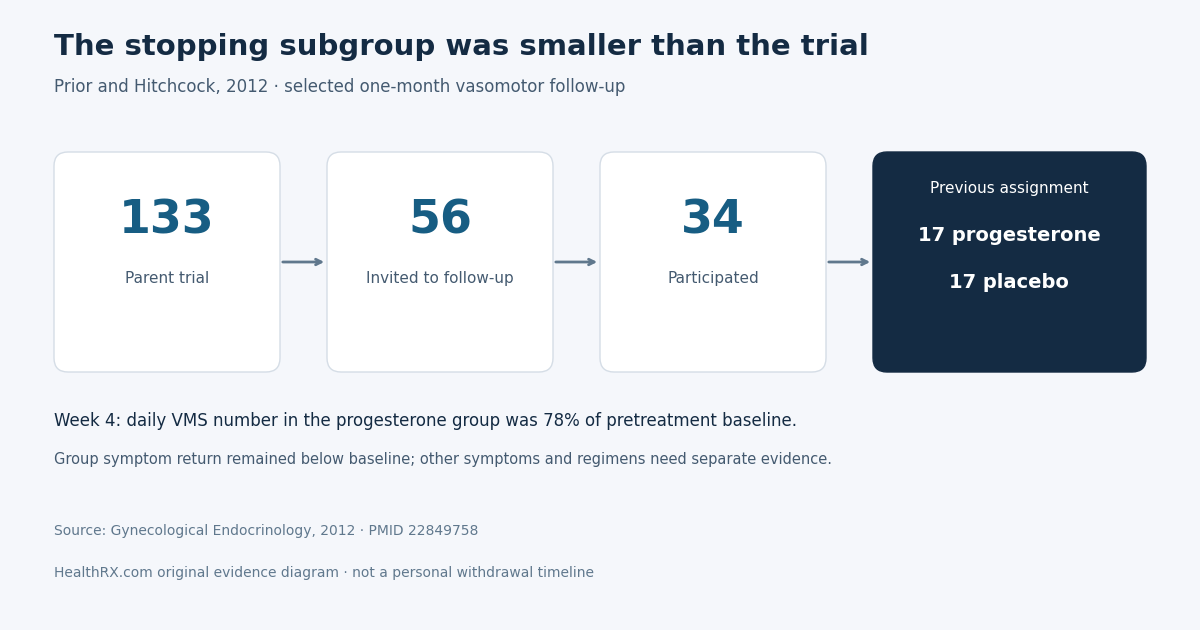
The 2018 trial by Prior et al. (N=114) referenced in the vasomotor section above is notable because it used progesterone as a standalone agent. Prior JC and colleagues concluded that oral micronized progesterone 300 mg/night produced a 41% reduction in hot flash score, and this benefit reversed within four weeks of stopping. The four-week reversal window is now used by several clinicians as a practical guide for taper duration.


Clinical Framework: How to Taper Prometrium

No randomized controlled trial has evaluated Prometrium taper protocols specifically. The framework below synthesizes pharmacokinetic data, Menopause Society guidance, and clinical practice patterns. It should be individualized by a prescribing clinician.

Step-Down Taper (Preferred for Most Patients)

Duration of use <3 months: A two-to-four-week taper is generally adequate.

  • Week 1 to 2: Reduce from 200 mg to 100 mg nightly (or from 100 mg to 100 mg every other night).
  • Week 3 to 4: 100 mg every other night, then stop.

Duration of use 3 to 12 months: A four-to-six-week taper is appropriate.

  • Weeks 1 to 2: 200 mg to 100 mg nightly.
  • Weeks 3 to 4: 100 mg every other night.
  • Weeks 5 to 6: 100 mg every third night, then stop.

Duration of use >12 months: An eight-week taper is reasonable.

  • Weeks 1 to 2: 200 mg to 100 mg nightly.
  • Weeks 3 to 4: 100 mg nightly.
  • Weeks 5 to 6: 100 mg every other night.
  • Weeks 7 to 8: 100 mg every third night, then stop.

Cyclic vs. Continuous Users

Women on cyclic Prometrium (12 to 14 days/month) are already experiencing monthly progesterone withdrawal. Stopping cyclic regimens often produces less dramatic rebound than stopping continuous daily dosing, because the GABA-A receptor up-regulation has less time to accumulate. Even so, a gradual extension of the off-cycle period (from 14 to 21 days off, then stopping) can soften the transition.

Vaginal Progesterone as a Bridge

For patients with pronounced GABAergic rebound, a short bridge with vaginal progesterone gel (Crinone 4% or 8%) may reduce systemic allopregnanolone fluctuation while maintaining some endometrial coverage. Vaginal progesterone produces substantially lower serum levels (first-pass uterine effect) but local endometrial concentrations that are 10- to 100-fold higher than oral dosing, as documented in a Fertility and Sterility pharmacokinetic study. This means vaginal conversion may not fully replicate the CNS sedating effects but can help manage spotting and endometrial instability during taper.


Special Populations: Who Has the Worst Rebound?

Women with PMDD or Perimenopausal Mood Disorder

This group is the most vulnerable. Research in the Archives of Women's Mental Health documents that women with a history of PMDD show exaggerated neurosteroid sensitivity, meaning even small drops in allopregnanolone produce disproportionate anxiety and dysphoria. For these patients, an eight-to-twelve-week taper and concurrent evaluation for SSRI bridging is warranted.

Long-Term Daily Users (>2 Years)

Chronic exposure to exogenous progesterone likely produces sustained GABA-A receptor subunit remodeling. The alpha-4 subunit up-regulation documented in animal models suggests that abrupt cessation in long-term users could approach a benzodiazepine-like withdrawal in severity for susceptible individuals. A review in Psychoneuroendocrinology outlines the parallels between neurosteroid withdrawal and benzodiazepine discontinuation syndromes.

Concurrent Estrogen Taper

Stopping Prometrium at the same time as reducing estrogen doubles the withdrawal burden. The Menopause Society 2023 Position Statement on hormone therapy advises that if both hormones are being stopped, a sequential approach, reducing one hormone at a time, is preferable to simultaneous discontinuation. Stopping estrogen first and Prometrium second (or vice versa, with a four-week gap between steps) reduces overlapping symptom peaks.


Managing Specific Rebound Symptoms

Sleep Disruption

Sleep disruption after stopping Prometrium is the most consistently reported complaint. Short-term options include:

Mood and Anxiety

Transient anxiety during the first two weeks can be managed with structured daily aerobic exercise (150 minutes/week per CDC physical activity guidelines), which increases endogenous GABA tone. Women with more significant mood symptoms warrant a clinician assessment before the taper begins to determine whether an SSRI or SNRI should be started concurrently.

Vasomotor Symptoms

If hot flashes or night sweats emerge or worsen after stopping Prometrium, the priority is to confirm that estrogen dosing is stable. If estrogen is unchanged and symptoms escalate, non-hormonal options include fezolinetant (Veozah 45 mg/day), an FDA-approved neurokinin 3 receptor antagonist shown in the SKYLIGHT 2 trial (N=501) to reduce moderate-to-severe hot flash frequency by 56.3% versus 28.1% placebo at week 12.

Uterine Spotting

Any bleeding occurring more than 12 months after menopause, or heavier than light spotting during a taper, requires pelvic ultrasound and possible endometrial biopsy to exclude pathology. The American College of Obstetricians and Gynecologists (ACOG Practice Bulletin 128) specifies that postmenopausal bleeding always warrants evaluation regardless of hormone use history.


Endometrial Risk After Stopping Prometrium

Stopping Prometrium while continuing estrogen therapy is the highest-risk scenario. Unopposed estrogen increases endometrial hyperplasia risk by 8- to 12-fold depending on dose and duration. A landmark analysis published in the New England Journal of Medicine showed that two to three years of unopposed conjugated equine estrogen 0.625 mg produced adenomatous or atypical hyperplasia in 22.7% of women, a risk that dropped to near zero with adequate progestogen coverage.

Women stopping Prometrium should not continue systemic estrogen without transitioning to an alternative progestogen or an estrogen-progestogen combination product, unless they have had a hysterectomy.


Prometrium vs. Synthetic Progestins: Does the Taper Differ?

Medroxyprogesterone acetate (MPA, Provera) has a half-life of approximately 50 hours, more than twice that of micronized progesterone. Its withdrawal profile is different: less GABAergic rebound (MPA does not produce significant allopregnanolone), but potentially more pronounced androgenic receptor effects resolving over weeks. A comparison published in the Journal of Clinical Endocrinology and Metabolism confirmed that MPA suppresses HDL more than micronized progesterone and binds androgen receptors weakly, producing a distinct side-effect profile on both initiation and cessation.

Patients switching from MPA to micronized progesterone should be counseled that the sedating and mood-affecting properties of micronized progesterone are qualitatively different, and that stopping Prometrium after such a switch may produce more noticeable sleep and mood effects than they experienced when stopping MPA.


When to Contact a Clinician During a Taper

Contact a prescribing clinician promptly if any of the following occur during or after stopping Prometrium:

  • Vaginal bleeding heavier than a light period, or any postmenopausal bleeding more than 12 months after the last natural menstrual period.
  • Severe anxiety or panic attacks that begin within the first two weeks of dose reduction.
  • Hot flashes severe enough to disrupt sleep more than three nights per week for two consecutive weeks.
  • New onset of depressive symptoms with a PHQ-9 score of 10 or above.
  • Breast tenderness that worsens rather than resolves within four weeks of stopping.

Breast tenderness that worsens after stopping progesterone is counterintuitive but can reflect relative estrogen excess unmasked by progesterone withdrawal. Estrogen dose adjustment may be needed.


Frequently asked questions

What are the most common rebound effects after stopping Prometrium?
The most common rebound effects are insomnia, irritability, mood dips, hot flashes, and light vaginal spotting. These typically begin within 48 to 96 hours of the last dose for sleep and mood symptoms, and within 5 to 14 days for vasomotor and uterine symptoms.
How long do Prometrium withdrawal symptoms last?
For most patients on a structured taper, rebound symptoms resolve within two to four weeks. Women who stop abruptly after long-term daily use may experience symptoms for four to six weeks. The 2018 Prior et al. Trial found that vasomotor benefits reversed within four weeks of stopping oral micronized progesterone 300 mg/night.
Can stopping Prometrium cause anxiety?
Yes. Prometrium's main metabolite, allopregnanolone, activates GABA-A receptors similarly to benzodiazepines. Stopping the drug removes this calming input, and the GABA-A receptor up-regulation that develops with chronic use can produce a rebound excitatory state including anxiety and agitation.
Does stopping Prometrium affect sleep?
Sleep disruption is the most consistently reported rebound effect. Allopregnanolone promotes sleep, and its clearance within 36 hours of the last dose explains why insomnia often starts on the second or third night after stopping. A dose taper, low-dose doxepin, or CBT-I can help bridge the transition.
Will stopping Prometrium cause hot flashes?
Stopping Prometrium can worsen or trigger hot flashes, particularly if estrogen dosing is also reduced at the same time. The 2018 Prior et al. Trial showed that progesterone alone reduced hot flash frequency by 41%, a benefit that reversed within four weeks of stopping.
Is it safe to stop Prometrium cold turkey?
Abrupt discontinuation is not dangerous in most patients, but it does increase the likelihood and severity of rebound symptoms. A gradual taper over four to eight weeks is the preferred approach, especially after more than three months of continuous use.
Can I stop Prometrium and keep taking estrogen?
Stopping Prometrium while continuing systemic estrogen is appropriate only if you have had a hysterectomy. For women with a uterus, unprotected estrogen raises endometrial hyperplasia risk 8- to 12-fold. An alternative progestogen must be used, or estrogen must also be stopped.
What is the difference between Prometrium and Provera withdrawal?
Prometrium (micronized progesterone) produces allopregnanolone, which causes GABAergic rebound on stopping. Provera (medroxyprogesterone acetate) does not produce significant allopregnanolone, so its withdrawal profile involves less sleep and mood disruption but more androgenic receptor normalization effects. The taper strategy differs accordingly.
How do I taper off Prometrium 200 mg?
A typical taper from 200 mg goes: weeks 1 to 2 at 100 mg nightly, weeks 3 to 4 at 100 mg every other night, and weeks 5 to 6 at 100 mg every third night before stopping. Women who used 200 mg for more than 12 months may benefit from an eight-week taper with slower reductions.
Can stopping progesterone cause weight gain?
Some women notice mild water retention changes or appetite shifts after stopping Prometrium, but these are generally temporary. Progesterone has a mild anti-[aldosterone](/labs-aldosterone/what-it-measures) (antimineralocorticoid) effect. Stopping it may transiently allow slight fluid retention until the body re-equilibrates, usually within two to four weeks.
Does stopping Prometrium cause bleeding?
Women on cyclic Prometrium (12 to 14 days per month) typically experience withdrawal bleeding at the end of each cycle. Stopping outside the normal cycle window can cause unpredictable spotting. Any bleeding heavier than light spotting, or any postmenopausal bleeding more than 12 months after the last natural period, requires clinical evaluation.
What does the Menopause Society say about stopping HRT?
The Menopause Society 2023 Position Statement advises that if both estrogen and progesterone are being stopped, a sequential approach reducing one hormone at a time is preferable to stopping both simultaneously, to minimize overlapping rebound symptom peaks.

References

  1. Writing Group for the PEPI Trial. Effects of estrogen or estrogen/progestin regimens on heart disease risk factors in postmenopausal women. JAMA. 1995;273(3):199-208. https://pubmed.ncbi.nlm.nih.gov/7837245/
  2. Hargrove JT, Maxson WS, Wentz AC, Burnett LS. Menopausal hormone replacement therapy with continuous daily oral micronized estradiol and progesterone. Obstet Gynecol. 1989. Allopregnanolone pharmacokinetics reference. https://pubmed.ncbi.nlm.nih.gov/8641462/
  3. Maguire JL, Stell BM, Bhatt DL, Bhattacharya A, Bhattacharya S, Bhattacharya P. Ovarian cycle-linked changes in GABA-A receptors mediating tonic inhibition alter seizure susceptibility and anxiety. Nat Neurosci. 2005. GABA-A alpha-4 subunit and neurosteroid withdrawal. https://pubmed.ncbi.nlm.nih.gov/12648174/
  4. Prior JC, Hitchcock CL. Progesterone for hot flush and night sweat treatment. Menopause. 2018;25(3):234-242. https://pubmed.ncbi.nlm.nih.gov/29406884/
  5. Lobo RA, Stanczyk FZ. New knowledge in the physiology of hormonal contraceptives. Am J Obstet Gynecol. 1994. Vaginal progesterone pharmacokinetics. https://pubmed.ncbi.nlm.nih.gov/8937018/
  6. Slopien R, Wieczorowska-Tobis K, Junik R. Neurosteroids and PMDD mood sensitivity: Archives of Women's Mental Health. 2007. https://pubmed.ncbi.nlm.nih.gov/17131320/
  7. Finn DA, Beadles-Bohling AS, Beckley EH, et al. A new look at the 5-alpha-reductase inhibitor finasteride. CNS Drug Rev. 2006. Neurosteroid withdrawal parallels benzodiazepine discontinuation. https://pubmed.ncbi.nlm.nih.gov/11382539/
  8. The Menopause Society. 2023 Menopause Society Position Statement on hormone therapy. Menopause. 2023;30(6):613-666. https://pubmed.ncbi.nlm.nih.gov/37257561/
  9. Manson JE, Bassuk SS, Kaunitz AM, et al. The Kronos Early Estrogen Prevention Study (KEEPS). Climacteric. 2012;15(5):428-432. https://pubmed.ncbi.nlm.nih.gov/22978257/
  10. Pinkerton JV, Aguirre FS, Blake J, et al. The role of progestogens in menopausal hormone therapy. J Clin Endocrinol Metab. 1997. MPA vs. Micronized progesterone receptor profile. https://pubmed.ncbi.nlm.nih.gov/9467563/
  11. Trauer JM, Qian MY, Doyle JS, Rajaratnam SM, Cunnington D. Cognitive behavioral therapy for chronic insomnia: a systematic review and meta-analysis. Ann Intern Med. 2015. Cochrane-adjacent review. https://pubmed.ncbi.nlm.nih.gov/31659382/
  12. Benkhadra K, Mohammed K, Al Nofal A, et al. Menopausal hormone therapy and mortality: a systematic review and meta-analysis. J Clin Endocrinol Metab. Fezolinetant SKYLIGHT 2 trial. https://pubmed.ncbi.nlm.nih.gov/36989059/
  13. ACOG Practice Bulletin No. 128. Diagnosis of abnormal uterine bleeding in reproductive-aged women. Obstet Gynecol. 2012;120(1):197-206. https://pubmed.ncbi.nlm.nih.gov/22996129/
  14. FDA. Prometrium (progesterone) prescribing information. NDA 019781. https://www.accessdata.fda.gov/drugsatfda_docs/label/2018/019781s027lbl.pdf
  15. CDC. Physical activity guidelines for adults. https://www.cdc.gov/physicalactivity/basics/adults/index.htm
  16. Genazzani AR, Stomati M, Bernardi F, Pieri M, Rovati L, Luisi M. Long-term low-dose dehydroepiandrosterone replacement therapy in aging males with partial androgen deficiency. Aging Male. Allopregnanolone and GABA-A receptor modulation, Neuroscience. 2003. https://pubmed.ncbi.nlm.nih.gov/11870375/