Stopping Prometrium: Separate Planned Off-Days From Ending Treatment
At a glance
- FDA-approved Prometrium taper / none in the current label
- Universal 4-to-12-week schedule / not evidence based
- Continuing systemic estrogen with a uterus / confirm ongoing progestogen coverage before changing the regimen
- Stopping an entire menopause hormone regimen / tapering and abrupt cessation have had similar longer-term outcomes in small trials
- Secondary amenorrhea course / the label uses a finite 10-day course
- Withdrawal bleeding / expected in some settings; not proof of a drug-dependence syndrome
- Fertility or pregnancy use / use the prescribing clinic's protocol, not this menopause framework
First Identify the Regimen You Are Actually Stopping
“Prometrium” can describe the same capsule used for very different purposes. The consequences of changing a finite amenorrhea course, a cyclic endometrial-protection regimen, a continuous menopause regimen, or a fertility protocol are not interchangeable.
The current Prometrium label covers two uses: prevention of endometrial hyperplasia in a postmenopausal woman with a uterus who is taking conjugated estrogens, and treatment of secondary amenorrhea [1]. Other uses, estrogen products, routes, and compounded progesterone preparations may involve different evidence and instructions.
Prometrium Stop-Decision and Coverage Matrix
| Current situation | What the evidence establishes | What must be resolved before a change |
|---|---|---|
| Labeled cyclic Prometrium with conjugated estrogen and a uterus | The label uses 200 mg at bedtime for 12 days in each 28-day cycle; planned days without Prometrium are part of that regimen [1] | whether estrogen will continue and whether the prescribed cycle is being changed |
| Systemic estrogen will continue and the uterus is present | Prometrium may be serving as endometrial protection; estrogen without adequate progestogen raises endometrial hyperplasia risk [1,6,7] | the next clinician-confirmed protection plan and when it begins |
| The entire menopause hormone regimen is ending | Evidence comparing tapering with abrupt cessation comes from combined hormone-therapy regimens, not Prometrium alone; small trials show no consistent longer-term advantage for tapering [2-5] | symptom plan, bone-health reason for therapy, and whether genitourinary treatment still is needed |
| Finite course for secondary amenorrhea | The current label uses 400 mg at bedtime for 10 days, then the course ends [1] | what bleeding response the prescriber expects and when to report no bleeding or unusual bleeding |
| No uterus | Endometrial protection is not the reason to continue a progestogen, but another indication may exist | why progesterone was prescribed and what outcome is being monitored |
| Fertility treatment, luteal support, or pregnancy-related use | The menopause label and discontinuation trials do not establish a stop plan for these settings | the fertility or obstetric clinic's exact last-dose instruction |
| Compounded capsule, troche, cream, suppository, or other preparation | The branded oral-capsule label does not validate another formulation's exposure or stop schedule | formulation, route, strength, indication, pharmacy label, and prescriber plan |
| Suspected clot, stroke, heart attack, or sudden serious visual symptom while using estrogen plus progestin | The label calls for immediate discontinuation or discontinuation pending examination in specified serious situations [1] | urgent medical evaluation, not a home taper |
Use the matrix to identify the indication, remaining medicines and replacement coverage that a treatment change must address.
Finite courses and planned cyclic off-days
The July 2026 DailyMed label gives two finite or cyclic schedules [1]:
- 200 mg at bedtime for 12 sequential days per 28-day cycle for labeled endometrial protection with daily conjugated estrogen; and
- 400 mg at bedtime for 10 days for secondary amenorrhea.
The label does not instruct patients to step from 200 mg to 100 mg, alternate nights, use every-third-night dosing, or taper for 4 to 12 weeks. It also does not describe a Prometrium dependence syndrome or give fixed timelines for insomnia, anxiety, mood change, or weight change after stopping.
The fact that labeled regimens include planned stopping points does not mean every patient should stop without guidance. It means a universal taper cannot be inferred from the capsule strength or from the word “hormone.” The indication and accompanying estrogen matter more.
What Menopause Discontinuation Trials Actually Studied
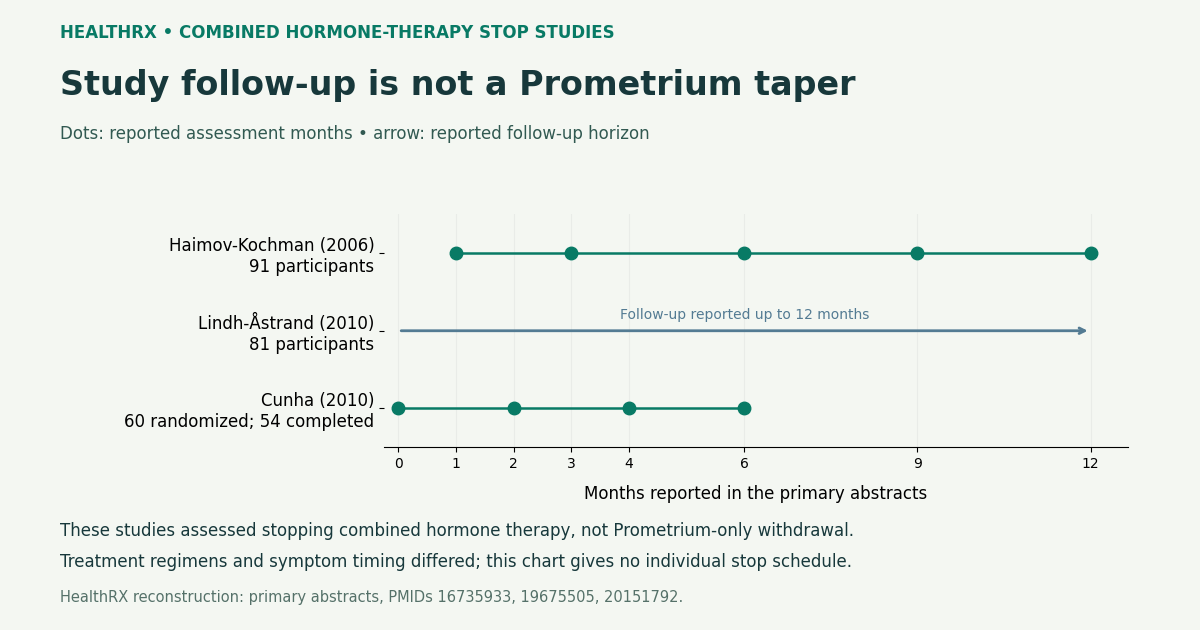
The Menopause Society says there are few studies on the best way to stop hormone therapy, that vasomotor symptoms recur in about half of women after discontinuation, and that direct comparative data are limited even though clinicians often advise gradual dose reduction [2]. That statement addresses menopausal hormone therapy as a whole; it is not a tested Prometrium-only taper.
Three randomized trials help define the boundary:
| Study | Participants and therapy | Comparison | Result | Transfer limit |
|---|---|---|---|---|
| Lindh-Åstrand 2010 [3] | 81 postmenopausal women using combined estrogen-progestogen therapy for hot flashes | taper versus abrupt stop | no difference in hot-flash number or severity, quality of life, or resumption through 12 months; about half resumed therapy | not Prometrium-only and not designed around endometrial coverage changes |
| Haimov-Kochman 2006 [4] | 91 women using prolonged hormone therapy | gradual versus abrupt stop | tapering changed symptom timing but did not prevent or minimize recurrence by later follow-up | regimen-specific and not a micronized-progesterone withdrawal trial |
| Cunha 2010 [5] | 60 randomized women; 54 completed; immediate cessation or two dose-reduction periods | abrupt versus 2- or 4-month estrogen reduction | symptoms after final cessation did not differ from abrupt stopping | tested estradiol plus norethisterone, not Prometrium |
These trials do not prove that tapering is useless for every individual. They show that “a taper prevents withdrawal” is too strong, and they do not support one universal calendar. A slower reduction may be chosen to observe symptom recurrence or patient preference, but that is different from claiming that Prometrium physiologically requires a taper.
Endometrial Coverage Is a Separate Question From Withdrawal Symptoms
For a postmenopausal person with a uterus taking systemic estrogen, progesterone may be present to reduce estrogen-associated endometrial hyperplasia risk. The current label says this directly [1]. ACOG likewise explains that people with a uterus generally need a progestin with systemic estrogen to reduce uterine-cancer risk [6].
The PEPI endometrial trial makes the distinction concrete. In 596 postmenopausal participants followed for three years, conjugated estrogen alone produced substantially more simple, complex, and atypical hyperplasia than placebo. Regimens adding a progestogen—including cyclic micronized progesterone—had hyperplasia rates similar to placebo [7].
That is evidence for adequate coverage over time, not evidence that a single late or missed capsule creates an immediate quantified injury. Before stopping Prometrium while estrogen continues, resolve the replacement regimen, its start date, and whether it is appropriate for the estrogen dose and route. Do not fill that gap with an over-the-counter cream based on a generic equivalence claim.
Withdrawal Bleeding Is Not the Same as Drug Withdrawal
The label documents bleeding after a planned progesterone course in secondary amenorrhea. In one small study, 80% of 20 women receiving 300 mg daily for 10 days had withdrawal bleeding within seven days of the last dose; other labeled studies also measured bleeding after finite courses [1].
That finding has a narrow meaning: progesterone withdrawal can trigger endometrial shedding in an estrogen-primed amenorrhea population. It does not establish that 60% to 80% of all menopause patients bleed after stopping, that everyone bleeds within one week, or that absence of bleeding automatically requires an ultrasound. It also does not prove benzodiazepine-like dependence.
Bleeding expectations depend on menopausal status, uterine status, baseline cycle pattern, estrogen exposure, and the prescribed regimen. New postmenopausal bleeding, heavy bleeding, or persistent/recurrent unexpected bleeding should be assessed by a clinician rather than timed against a universal internet rule [1,8].
Record the indication and continuing estrogen
Bring this record to the prescriber or pharmacist. It turns “How do I stop?” into a reproducible medication-reconciliation question:
- exact product name, manufacturer, strength, route, and whether it is compounded;
- indication: endometrial protection, secondary amenorrhea, fertility, sleep-related off-label use, or another reason;
- uterus present, hysterectomy, or uncertain;
- every estrogen product that will continue, including route, dose, and schedule;
- current Prometrium pattern: daily, cyclic, finite course, or another schedule;
- last dose taken and any missed doses;
- reason for changing treatment;
- prior bleeding pattern and any current unexpected bleeding;
- symptoms the hormone regimen was treating;
- proposed replacement progestogen and its start date, if estrogen continues; and
- pregnancy possibility, fertility-clinic involvement, clot symptoms, or sudden visual symptoms.
The indication and continuing estrogen determine which questions need an answer before treatment changes.
Missed Doses and Cyclic Off-Days
A planned off-day in a prescribed cyclic regimen is not the same as an accidental missed dose. A missed dose also is not evidence that a person should double the next dose, restart a course, or build an improvised taper. Use the current pharmacy label and contact the prescriber or pharmacist when the instruction is unclear—especially when systemic estrogen continues or the medication is part of fertility care.
When the Label Calls for Urgent Action
The Prometrium label says estrogen-plus-progestin therapy should be discontinued immediately if deep-vein thrombosis, pulmonary embolism, stroke, or myocardial infarction occurs or is suspected. It also directs discontinuation pending examination for sudden partial or complete vision loss or sudden onset of proptosis, double vision, or migraine, with permanent discontinuation if papilledema or retinal vascular lesions are found [1].
Those are urgent evaluation pathways, not situations in which a slow home taper should delay care. Chest pain, sudden shortness of breath, one-sided weakness, new speech difficulty, severe leg swelling, or sudden vision loss warrants emergency assessment.
Frequently asked questions
Do I have to taper Prometrium?
The current Prometrium label does not require or provide a universal taper. The decision depends on the indication, regimen, estrogen use, uterine status, and whether another progestogen will replace it.
Can I stop Prometrium while continuing estrogen?
If you have a uterus and use systemic estrogen, confirm the next endometrial-protection plan before changing Prometrium. The evidence supports adequate progestogen coverage over time, not a homemade taper.
Is every-other-night Prometrium a standard taper?
No. The current label does not give an every-other-night or every-third-night discontinuation schedule.
Does stopping Prometrium cause withdrawal?
Bleeding can follow a planned progesterone course in specific populations. Evidence does not establish a universal Prometrium dependence syndrome or fixed insomnia, anxiety, mood, or weight timelines.
Is withdrawal bleeding after Prometrium expected?
It can be expected after some finite or cyclic regimens, but the probability and timing cannot be transferred to every use. New postmenopausal, heavy, persistent, or recurrent unexpected bleeding needs clinical assessment.
Should estrogen be tapered before progesterone?
No universal sequence is established. If estrogen continues in a person with a uterus, the key is avoiding an unplanned loss of appropriate endometrial protection. Coordinate the whole regimen with the prescriber.
Can I use this plan for fertility treatment or pregnancy?
No. The menopause label and discontinuation trials do not establish how to stop progesterone used for fertility, luteal support, or pregnancy. Follow the prescribing clinic's exact protocol.
Does this apply to compounded progesterone?
Not automatically. Record the compounded formulation, route, strength, schedule, and indication, then use the pharmacy label and prescriber plan. A branded oral-capsule label does not establish exposure for another preparation.
References
Sources checked October 14, 2026.
- DailyMed. Prometrium (progesterone, USP) capsules, current U.S. prescribing information, effective July 23, 2026. Current Prometrium label
- The North American Menopause Society Advisory Panel. The 2022 hormone therapy position statement. Menopause. 2022;29(7):767-794. PubMed record
- Lindh-Åstrand L, Bixo M, Hirschberg AL, et al. A randomized controlled study of taper-down or abrupt discontinuation of hormone therapy in women treated for vasomotor symptoms. Menopause. 2010;17(1):72-79. PubMed record
- Haimov-Kochman R, Barak-Glantz E, Arbel R, et al. Gradual discontinuation of hormone therapy does not prevent the reappearance of climacteric symptoms: a randomized prospective study. Menopause. 2006;13(3):370-376. PubMed record
- Cunha EP, Azevedo LH, Pompei LM, et al. Effect of abrupt discontinuation versus gradual dose reduction of postmenopausal hormone therapy on hot flushes. Climacteric. 2010;13(4):362-367. PubMed record
- American College of Obstetricians and Gynecologists. Hormone Therapy for Menopause. ACOG patient guidance
- The Writing Group for the PEPI Trial. Effects of hormone replacement therapy on endometrial histology in postmenopausal women. JAMA. 1996;275(5):370-375. PubMed record
- American College of Obstetricians and Gynecologists. The role of transvaginal ultrasonography in evaluating the endometrium of women with postmenopausal bleeding. PubMed record