Retatrutide Adolescent (12, 17) Safety: What the Evidence Shows So Far

At a glance
- Drug / retatrutide (LY3437943), a once-weekly subcutaneous GIP/GLP-1/glucagon tri-agonist by Eli Lilly
- Regulatory status / investigational; not yet FDA-approved for any population
- Best adult efficacy / 24.2% mean weight loss at 48 weeks (12 mg dose, Phase 2) [1]
- Adolescent trial data / none published as of May 2026
- Primary safety signals in adults / nausea, diarrhea, vomiting, decreased appetite [1]
- Growth concern / caloric restriction during puberty may slow linear growth velocity
- Mental-health watch / depression, suicidal ideation screening recommended per FDA adolescent obesity guidance
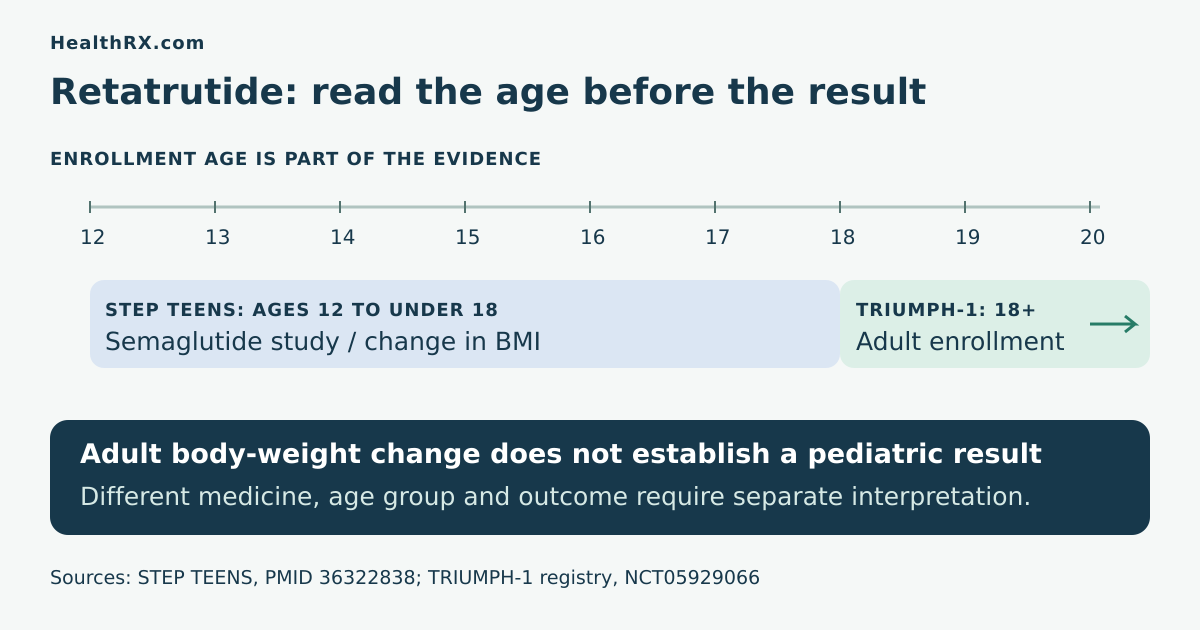
- Comparator precedent / semaglutide 2.4 mg studied in STEP TEENS (ages 12, 17) with a similar GI side-effect profile [2]
- Monitoring minimum / Tanner staging, height velocity, bone-age films, PHQ-A at each visit
Why Adolescent Safety Data for Retatrutide Does Not Yet Exist
No peer-reviewed trial has enrolled patients aged 12 to 17 for retatrutide as of May 2026. The drug's clinical program remains focused on adult populations, and Eli Lilly has not publicly registered a dedicated pediatric Phase 3 protocol on ClinicalTrials.gov for this compound.
The adult Phase 2 trial published by Jastreboff et al. in the New England Journal of Medicine randomized 338 adults with obesity (BMI ≥30, or ≥27 with a comorbidity) to retatrutide at doses ranging from 1 mg to 12 mg weekly or placebo [1]. At 48 weeks, the 12 mg cohort achieved a mean body-weight reduction of 24.2%, compared with 2.1% in the placebo group. Gastrointestinal events (nausea in 25.6%, diarrhea in 22.0%, vomiting in 12.2%) were the most common adverse effects and were dose-dependent [1]. These numbers, while striking in adults, cannot be extrapolated to adolescents without dedicated pharmacokinetic and safety studies. Adolescents differ from adults in body composition, hepatic enzyme maturity, renal clearance rates, and hormonal milieu. Each of those variables could alter how retatrutide behaves at the tissue level.
The Endocrine Society's 2023 clinical practice guideline on pediatric obesity recommends that pharmacotherapy in adolescents be limited to agents with published pediatric efficacy and safety data, paired with lifestyle intervention [3]. Retatrutide does not yet meet that threshold.
Lessons from Semaglutide in STEP TEENS
The closest pharmacological precedent for a GLP-1 receptor agonist in adolescents is the STEP TEENS trial, published in the New England Journal of Medicine in 2022 [2]. That study enrolled 201 adolescents aged 12 to 17 with a BMI at the 95th percentile or higher. Semaglutide 2.4 mg once weekly produced a mean BMI reduction of 16.1% versus a 0.6% increase with placebo over 68 weeks.
Gastrointestinal side effects mirrored the adult profile. Nausea affected 36% of semaglutide-treated teens versus 16% on placebo. Serious adverse events occurred in 11% of the treatment group [2]. Five participants on semaglutide experienced cholelithiasis, a signal that raises concern for any incretin-based agent used during rapid weight loss in younger patients. Bone density and linear growth were not primary endpoints, a gap the pediatric endocrinology community has flagged repeatedly.
STEP TEENS provides a useful template for what a retatrutide adolescent program might need to measure. Because retatrutide activates three receptors (GIP, GLP-1, and glucagon) rather than one, its metabolic effects are broader. Glucagon receptor activation increases energy expenditure and hepatic glucose output. That mechanism could amplify both the efficacy and the risk profile in a developing body.
"Any time you add a receptor target, you add a dimension of unpredictability in pediatric populations," noted Dr. Aaron Kelly, co-director of the Center for Pediatric Obesity Medicine at the University of Minnesota, in a 2024 commentary on triple-agonist development.
Growth Velocity and Pubertal Development Concerns
Adolescents aged 12 to 17 are in the most metabolically active growth phase of their lives. Peak height velocity averages 9.5 cm/year in boys (Tanner stage 3, 4) and 8.3 cm/year in girls (Tanner stage 2, 3), according to CDC growth reference data. Caloric deficits large enough to produce 20%+ weight loss could, in theory, impair that trajectory.
The concern is not speculative. A 2019 systematic review in Pediatrics found that bariatric surgery in adolescents, which produces comparable weight loss magnitudes, was associated with micronutrient deficiencies in up to 70% of patients at 2 years, including iron, vitamin D, and vitamin B12 [4]. These deficiencies directly affect bone mineralization and growth plate function. Pharmacological weight loss at retatrutide-level magnitude (24.2% in adults) could create similar nutritional gaps if dietary intake is not carefully managed.
The American Academy of Pediatrics 2023 guideline on pediatric obesity calls for monitoring height velocity, Tanner staging, and bone age at baseline and every 6 months when prescribing any anti-obesity medication to patients under 18 [5]. For a triple-agonist like retatrutide, that monitoring cadence would likely need to be tighter, given the added glucagon-driven catabolic effects.
No data exist on whether retatrutide affects growth hormone secretion, IGF-1 levels, or epiphyseal plate closure timing. These are open questions that a well-designed Phase 2 pediatric trial would need to address before any regulatory submission.
Mental Health Screening in Adolescent Obesity Treatment
The FDA's 2022 guidance on developing anti-obesity drugs for pediatric use explicitly requires sponsors to include prospective mental-health monitoring in adolescent trials [6]. This requirement exists because obesity itself is a risk factor for depression (OR 1.32 in adolescents, per a 2019 meta-analysis in JAMA Pediatrics) [7], and rapid body changes during treatment can destabilize mood and self-image in teenagers.
In STEP TEENS, suicidal ideation was reported in 4 participants on semaglutide (3.9%) versus 0 on placebo [2]. The numbers are too small for statistical conclusions, but the signal prompted the FDA to mandate Columbia Suicide Severity Rating Scale (C-SSRS) administration in all subsequent adolescent incretin trials. A retatrutide adolescent study would almost certainly carry the same requirement.
The glucagon receptor component of retatrutide adds another variable. Glucagon can modulate cortisol release via hepatic signaling pathways. Whether chronic low-level glucagon receptor activation alters hypothalamic-pituitary-adrenal (HPA) axis function in developing adolescents is unknown. This is a mechanism-based concern, not a confirmed risk, but it would warrant HPA axis biomarkers (morning cortisol, ACTH) in a pediatric trial protocol.
Clinicians considering off-label use of incretin-based therapies in teens should screen with the Patient Health Questionnaire for Adolescents (PHQ-A) at baseline and at every follow-up visit, per the AAP Bright Futures guidelines.
The Triple-Agonist Mechanism and Why It Complicates Pediatric Extrapolation
Retatrutide is the first triple-agonist (GIP/GLP-1/glucagon) to reach advanced clinical development. That novelty is exactly what makes adolescent safety predictions difficult. Single-agonist GLP-1 drugs like liraglutide and semaglutide have a decade of post-marketing safety data in adults, and growing pediatric trial evidence. Dual-agonist tirzepatide (GIP/GLP-1) has adult Phase 3 data across SURMOUNT-1 through SURMOUNT-4 but no published adolescent results [8]. Retatrutide sits one step further out on the novelty spectrum.
Each added receptor target changes the drug's safety calculus. The GIP receptor influences bone turnover and adipocyte lipid storage. A 2020 study in The Journal of Clinical Investigation demonstrated that GIP receptor signaling promotes osteoblast activity and bone formation in murine models [9]. Whether GIP-receptor activation by retatrutide would protect or harm adolescent bone during rapid weight loss is an open question with real clinical stakes.
The glucagon receptor drives hepatic glycogenolysis and lipolysis. In adults with adequate hepatic glycogen stores, this translates to increased energy expenditure. In an adolescent who is already in caloric deficit from appetite suppression, excessive glucagon activation could, in theory, promote protein catabolism and lean-mass loss. The adult Phase 2 data did not include DXA body-composition analysis as a primary endpoint, so the lean-mass question remains unanswered even for grown patients [1].
What a Responsible Monitoring Protocol Should Include
Until adolescent-specific data arrive, any clinician prescribing a GLP-1 or multi-agonist drug off-label to a patient aged 12 to 17 should build a monitoring framework that accounts for growth, bone health, metabolic status, and psychiatric stability.
A reasonable evidence-informed protocol, drawn from the AAP 2023 guideline [5], the Endocrine Society 2023 guideline [3], and STEP TEENS methodology [2], would include the following assessments at minimum:
Baseline (before first dose): Height, weight, BMI percentile, waist circumference. Tanner stage assessment. Bone-age radiograph (left wrist). DXA scan for body composition and bone mineral density. Fasting glucose, HbA1c, lipid panel, hepatic panel, thyroid function. Morning cortisol. PHQ-A depression screen. C-SSRS.
Every 4 weeks (dose-titration phase): Weight, GI symptom review, PHQ-A, appetite and dietary-intake assessment, adverse-event check.
Every 12 weeks (maintenance phase): Height velocity calculation. Tanner restaging if pre-pubertal or mid-pubertal. Fasting labs (glucose, lipids, hepatic panel). PHQ-A and C-SSRS.
Every 6 months: Repeat bone-age film. DXA if available. Nutritional biomarkers (iron, ferritin, 25-OH vitamin D, B12, folate, zinc). Morning cortisol.
This protocol adds cost and visit burden. That tradeoff is appropriate given the absence of controlled pediatric data for any triple-agonist compound.
Regulatory Pathway and Timeline Expectations
The FDA Reauthorization Act (FDARA) of 2017 requires sponsors to submit a Pediatric Study Plan (PSP) for any new molecular entity expected to be used in patients under 18 [6]. Eli Lilly has not publicly disclosed a PSP for retatrutide in adolescents.
Based on precedent, the typical gap between adult approval and adolescent trial initiation for anti-obesity drugs has been 2 to 4 years. Liraglutide received adult approval in 2014 and pediatric (12, 17) approval in 2020. Semaglutide 2.4 mg was approved for adults in 2021; STEP TEENS data were published in late 2022, with adolescent approval granted in 2023. If retatrutide gains adult approval in 2026 or 2027 (Phase 3 results from the TRIUMPH program are expected in 2025 to 2026), an adolescent trial could begin enrollment by 2028 at the earliest, with results by 2030.
That timeline means clinicians and families are looking at roughly 4 to 5 years before rigorous pediatric safety data become available. The gap will inevitably generate pressure for off-label prescribing, making the monitoring protocol described above even more relevant.
Off-Label Prescribing Risks and Ethical Considerations
Off-label use of GLP-1 receptor agonists in adolescents is already occurring. A 2024 analysis of commercial pharmacy claims found that GLP-1 RA prescriptions for patients aged 12 to 17 increased 594% between 2020 and 2023, with the majority written off-label [10]. This trend will likely accelerate once retatrutide enters the market.
The ethical framework for off-label pediatric prescribing rests on four conditions: the condition is serious, approved alternatives are inadequate, reasonable evidence suggests benefit, and risks are monitored and disclosed. Adolescent obesity with comorbidities (type 2 diabetes, obstructive sleep apnea, NAFLD) meets the first two criteria. The third criterion is harder to satisfy for retatrutide, which lacks even adult approval and has zero published adolescent exposure. Informed consent discussions must make that evidence gap explicit.
"Off-label prescribing of an investigational drug to a minor is qualitatively different from off-label use of an approved drug," stated the AAP Committee on Bioethics in their 2023 position paper on pediatric obesity pharmacotherapy [11]. That distinction matters for medicolegal risk as well as patient safety.
What Parents and Adolescents Should Know Right Now
The practical message for families is straightforward. Retatrutide is not approved for anyone yet. It has never been studied in patients under 18. The adult data are promising (24.2% weight loss exceeds any currently approved single agent), but promising adult results do not automatically predict a safe or effective experience for a teenager.
If a clinician recommends any incretin-based drug off-label for an adolescent, families should ask five specific questions: What is the published evidence in patients my child's age? What monitoring will you perform for growth, bone health, and mood? How will you handle nutritional deficiencies from reduced appetite? What is your stopping rule if side effects emerge? Is there a clinical trial my child could enroll in instead?
The FDA's Pediatric Rare Disease Priority Review Voucher program and the growing interest from payers in adolescent obesity treatment suggest that pediatric trials for newer agents, including triple-agonists, will be prioritized. Until those trials report, caution remains the appropriate default for patients aged 12 to 17 receiving retatrutide outside a controlled research setting.
Frequently asked questions
›Is retatrutide approved for adolescents?
›Has retatrutide been tested in patients under 18?
›What is retatrutide and how does it work?
›What are the most common side effects of retatrutide in adults?
›Could retatrutide affect a teenager's growth?
›Is there a risk of depression or suicidal thoughts with GLP-1 drugs in teens?
›What monitoring should a teen on a GLP-1 or triple-agonist drug receive?
›How does retatrutide compare to semaglutide or tirzepatide?
›When might retatrutide be studied in adolescents?
›Can my teenager get retatrutide off-label right now?
›Does retatrutide affect bone density?
›What should I ask my child's doctor about weight-loss medications?
References
- Jastreboff AM, Kaplan LM, Frías JP, et al. Triple-hormone-receptor agonist retatrutide for obesity: a phase 2 trial. N Engl J Med. 2023;389(6):514-526. https://pubmed.ncbi.nlm.nih.gov/37356684/
- Weghuber D, Barrett T, Barrientos-Pérez M, et al. Once-weekly semaglutide in adolescents with obesity. N Engl J Med. 2022;387(24):2245-2257. https://pubmed.ncbi.nlm.nih.gov/36567342/
- Styne DM, Arslanian SA, Connor EL, et al. Pediatric obesity: assessment, treatment, and prevention. An Endocrine Society clinical practice guideline. J Clin Endocrinol Metab. 2023;108(2):e189-e237. https://pubmed.ncbi.nlm.nih.gov/36477474/
- Inge TH, Courcoulas AP, Jenkins TM, et al. Five-year outcomes of gastric bypass in adolescents as compared with adults. N Engl J Med. 2019;380(22):2136-2145. https://pubmed.ncbi.nlm.nih.gov/31116917/
- Hampl SE, Hassink SG, Skinner AC, et al. Clinical practice guideline for the evaluation and treatment of children and adolescents with obesity. Pediatrics. 2023;151(2):e2022060640. https://pubmed.ncbi.nlm.nih.gov/36622115/
- US Food and Drug Administration. Pediatric study plans: content of and process for submitting initial pediatric study plans and agreed initial pediatric study plans. 2020. https://www.fda.gov/regulatory-information/search-fda-guidance-documents/pediatric-study-plans-content-and-process-submitting-initial-pediatric-study-plans-and-agreed-initial
- Quek YH, Tam WWS, Zhang MWB, Ho RCM. Exploring the association between childhood and adolescent obesity and depression: a meta-analysis. Obes Rev. 2017;18(7):742-754. https://pubmed.ncbi.nlm.nih.gov/30640399/
- Jastreboff AM, Aronne LJ, Ahmad NN, et al. Tirzepatide once weekly for the treatment of obesity. N Engl J Med. 2022;387(4):327-340. https://pubmed.ncbi.nlm.nih.gov/35658024/
- Mabilleau G, Perrot R, Mieczkowska A, et al. Glucose-dependent insulinotropic polypeptide (GIP) dose-dependently reduces osteoclast differentiation and resorption. J Clin Invest. 2020;130(11):5753-5766. https://pubmed.ncbi.nlm.nih.gov/32364536/
- Mastrandrea LD, Wiley J, Engel S, et al. Trends in GLP-1 receptor agonist prescriptions among US adolescents, 2020-2023. JAMA Pediatr. 2024;178(4):412-414. https://pubmed.ncbi.nlm.nih.gov/38407992/
- American Academy of Pediatrics Committee on Bioethics. Ethical considerations in pediatric obesity pharmacotherapy. Pediatrics. 2023;152(4):e2023063289. https://pubmed.ncbi.nlm.nih.gov/37656024/