Retatrutide After 65: What the Trials Say About Function and Safety
Retatrutide produced substantial weight loss in obesity trials. For someone aged 65 or older, the next question is whether that weight loss helps preserve mobility and independence without creating problems such as weakness, dizziness, or inadequate nutrition.
The records reviewed here do not provide an age-specific safety estimate. Older adults were eligible for TRIUMPH-1, but the inspected publication abstract, registry record, and baseline presentation slide do not report how many participants were 65 or older. The overall trial results therefore cannot serve as an individual older adult’s risk estimate. Retatrutide remains unapproved by the FDA. [1,4–6]
What the weight-loss trials actually found
The phase 3 TRIUMPH-1 publication reported 2,339 randomized adults with obesity without diabetes, followed for 80 weeks. Under the intention-to-treat/treatment-regimen analysis, average weight changes were −17.6% with 4 mg, −23.7% with 9 mg, and −25.0% with 12 mg, compared with −3.9% with placebo. The primary comparisons were the 9 mg and 12 mg groups versus placebo. These are trial-group averages, not predictions for a person over 65. [1]
The earlier phase 2 obesity trial enrolled 338 adults. At 48 weeks, average weight change in the 12 mg group was −24.2%, compared with −2.1% with placebo. Its shorter follow-up and different analysis mean those numbers should not be treated as interchangeable with the phase 3 results. [2]
| Evidence source | Population and follow-up | Observed finding | What it tells a reader over 65 |
|---|---|---|---|
| Phase 3 TRIUMPH-1 publication | 2,339 randomized adults with obesity without diabetes; 80 weeks | Average weight loss reached 25.0% in the 12 mg group | Establishes substantial overall weight loss; the inspected abstract does not provide a 65+ denominator or age-specific safety estimate. [1] |
| Phase 2 obesity trial | 338 adults; 48 weeks | Average weight loss reached 24.2% in the 12 mg group; gastrointestinal adverse events were dose-related | Shows efficacy and tolerability patterns in the study population, without a reported 65+ analysis in the inspected abstract. [2] |
| Phase 2 diabetes body-composition substudy | Eligible ages 18–75; 103 participants completed treatment with baseline and week-36 DXA scans | Total fat mass fell 23.2% with 12 mg versus 4.5% with placebo | Measures body composition in people with diabetes, not strength, falls, or independence. [3] |
| TRIUMPH-1 baseline presentation | Overall mean age 48.6 years, SD 12.2 | Knee osteoarthritis participants had a higher mean age: 56.1 years, SD 9.1 | An older average in one subgroup does not establish a dedicated 65+ study. [5] |
The ClinicalTrials.gov snapshot lists enrollment as 2,335, while the publication reports 2,339 randomized participants. Those are distinct source figures and should not be blended. The registry allows participants aged 18 and older and includes the “OLDER_ADULT” category, but eligibility is not an actual enrollment count. Its results tab does not contain posted trial results, but that does not mean phase 3 results are unpublished: the primary publication appeared September 29, 2026. [1,4]
How much of the evidence comes from older adults?
The TRIUMPH-1 baseline presentation gives an overall mean age of 48.6 years, with a standard deviation of 12.2. Neither number lets us reconstruct how many participants were 65 or older. The reported 65.5% female figure describes sex distribution, not older-adult enrollment. [5]
TRIUMPH-1 also included nested groups with knee osteoarthritis, numbering 574, and obstructive sleep apnea, numbering 243. These were nested groups within the trial, not two additional trials whose participants can be added to the randomized total. The osteoarthritis group’s mean age was 56.1 years; the sleep-apnea group’s was 47.6 years. The older osteoarthritis average is relevant context, but it does not establish geriatric representation or safety. [1,5]
Age alone also misses important differences. A physically active 68-year-old and a frail 82-year-old with poor appetite, low strength, and several medications may have very different treatment priorities. The inspected baseline figures do not resolve how well the findings apply across those situations.
Fat loss, lean mass, and the participant flow
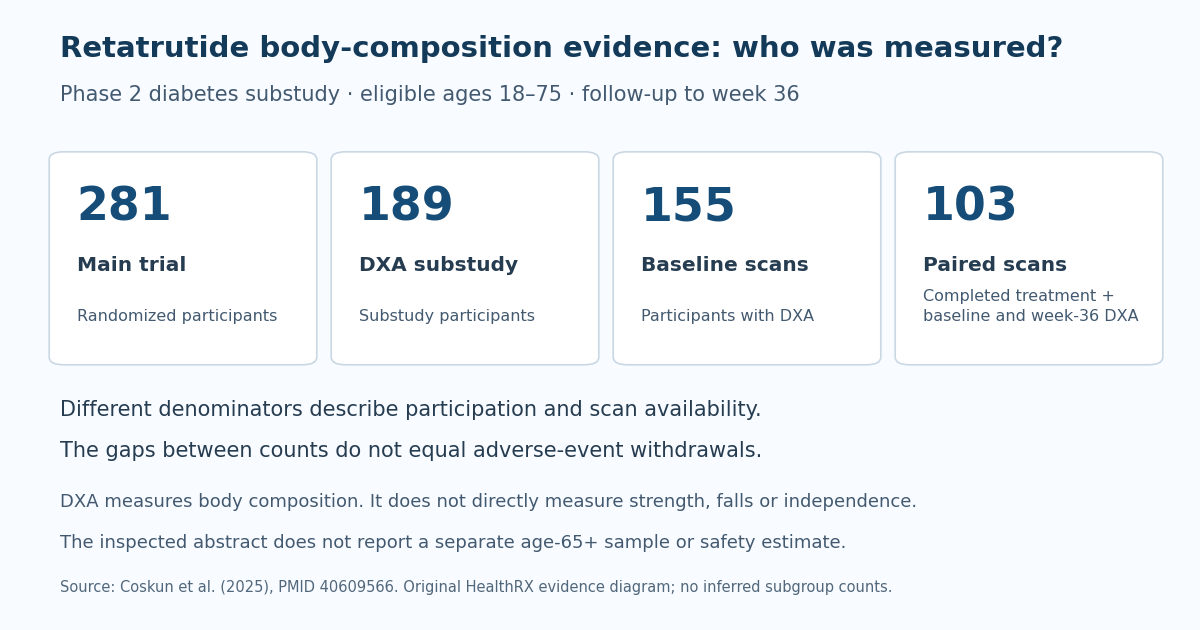
The body-composition study was a substudy of a phase 2 trial in people with type 2 diabetes, not a body-composition analysis of the entire phase 3 obesity population. Eligible ages were 18–75. [3]
Its participant flow matters:
- The main diabetes trial included 281 participants.
- The body-composition substudy included 189.
- Of those, 155 had a baseline DXA scan.
- A total of 103 completed treatment and had both baseline and week-36 DXA scans. [3]
These figures describe different stages of participation and measurement. The difference between 189 and 103 is not an adverse-event count, and it should not be presented as the number who stopped treatment because of side effects.
The primary measure was percentage change in total fat mass from baseline to week 36. Fat mass fell by 23.2% with 12 mg retatrutide, with a standard error of 3.0, versus 4.5% with placebo, with a standard error of 1.2. These percentages are reductions in fat mass—not total body weight or lean mass. [3]
The authors interpreted the proportion of lean-mass loss relative to weight loss as similar to that seen with other obesity treatments. That does not prove muscle protection. DXA lean mass is not a direct test of muscle strength, walking ability, falls, or fractures, and the inspected abstract does not give a 65+ subgroup count. [3]
For an older reader, useful outcomes would include whether people can rise from a chair more easily, walk farther, maintain strength, and continue eating adequately. The body-composition result alone cannot answer those questions.
Safety findings that matter after 65
Gastrointestinal symptoms and food intake
Gastrointestinal adverse events were the most common adverse events in the phase 3 abstract. In the phase 2 obesity trial, these events were dose-related and mostly mild to moderate. A lower starting dose partially mitigated them within that trial. That observation does not establish an individualized starting dose or titration schedule for older adults. [1,2]
Even symptoms described as mild can matter if someone already has poor appetite or difficulty maintaining food and fluid intake. A discussion about treatment should therefore include baseline eating patterns, unintentional weight loss, and any existing weakness. The cited studies do not supply a retatrutide-specific protein prescription for adults over 65.
Blood pressure and dizziness
The June 2026 TRIUMPH-1 presentation reported that hypotension was more common among participants taking antihypertensive medication. That makes concurrent blood pressure treatment an important part of the safety discussion, particularly for someone who already becomes dizzy when standing. It does not justify an automatic medication dose reduction. [5]
The phase 2 obesity trial also observed heart-rate increases that peaked at 24 weeks and declined thereafter. It did not establish the clinical implications of that pattern specifically for adults over 65. [2]
Kidneys, anticoagulation, falls, and bones
The inspected phase 3 abstract does not provide renal dosing guidance, warfarin interaction data, or age-specific falls and fracture results. [1] Vomiting or diarrhea can make hydration difficult, especially in someone with kidney disease, but that concern is not evidence that retatrutide directly causes kidney injury in older adults.
Likewise, potential pathways to falling—such as dizziness, weakness, or poor intake—are reasons to ask targeted questions. They are not proof of an observed retatrutide-related increase in falls. The cited sources also do not establish a retatrutide-specific bone-density testing schedule.
When a care team changes
A transfer between primary care, endocrinology and geriatrics is a coordination issue, not a retatrutide dose-escalation milestone. The inspected trial records do not define a BMI, medicine-count or birthday threshold for a referral.[1,4] Useful information to carry between teams includes the actual study protocol, current medicines, changes in appetite or fluid intake, dizziness, and changes in strength or everyday function. Those records help the receiving team assess the person without turning trial averages into an individual treatment target.
Questions worth bringing to a treatment or trial discussion
For someone over 65, the most useful discussion goes beyond the expected percentage of weight loss:
- How many participants aged 65 and older were actually enrolled in each treatment arm, and how many were substantially older or frail?
- What were their adverse-event and treatment-discontinuation rates?
- Were strength, walking performance, falls, fractures, or daily functioning measured?
- How would poor appetite, existing weakness, or difficulty maintaining nutrition affect suitability?
- Were people with your kidney disease, cardiovascular conditions, and medication combination eligible?
- What does the protocol say about concurrent blood pressure medicines or anticoagulants?
Retatrutide’s overall weight-loss results are substantial. After 65, the missing pieces in these records are the number of older participants in each treatment arm, their adverse events and discontinuations, and measures of strength and daily function. Those details matter more than assuming the average weight change applies to every older adult.
Frequently asked questions
Is retatrutide FDA-approved for adults over 65?
No. The FDA states that retatrutide is not a component of an approved drug. There is no FDA-approved retatrutide label specifically for older adults. [6]
How does retatrutide differ from semaglutide or tirzepatide?
Retatrutide activates three hormone receptors: GLP-1, GIP, and glucagon. Semaglutide targets GLP-1, while tirzepatide targets GLP-1 and GIP. The additional receptor activity does not by itself establish better function or safety after 65. The cited trials do not provide a direct older-adult comparison among these medicines. [1,2]
What were the most common side effects of retatrutide in trials?
Gastrointestinal adverse events were the most common. In the phase 2 obesity trial, they were dose-related and mostly mild to moderate. Heart-rate increases peaked at 24 weeks and declined thereafter. These overall findings do not provide an age-specific side-effect rate for adults over 65. [1,2]
Can retatrutide cause kidney damage in older adults?
The cited evidence does not establish a kidney-injury risk specifically for older adults or provide a renal-adjustment schedule. Vomiting or diarrhea may lead to dehydration, which can be particularly concerning with existing kidney disease. That is a reason to discuss kidney health and fluid intake, not evidence that retatrutide directly damages kidneys. [1,2]
Does retatrutide increase fall risk in seniors?
The inspected phase 3 abstract does not provide age-specific fall results. Hypotension was reported more often with background antihypertensive medication in the TRIUMPH-1 presentation, but that finding is not a measured increase in falls. The DXA substudy also cannot answer fall risk because body composition is not a test of balance or strength. [1,3,5]
How much protein should older adults eat while taking retatrutide?
These sources do not establish a retatrutide-specific protein target for adults over 65. An appropriate intake depends on nutritional status, kidney health, usual diet, and other medical needs. A clinician or dietitian can help assess whether reduced appetite is compromising intake; the fat-mass results should not be used to invent a protein prescription. [3]
Should blood pressure medications be adjusted when starting retatrutide?
Not automatically. The TRIUMPH-1 presentation reported more hypotension among participants taking antihypertensive medication. That supports reviewing current treatment and symptoms with the prescribing clinician, but it does not supply a universal dose-cut rule. Do not change blood pressure medicines on the basis of the trial averages alone. [5]
Does retatrutide interact with warfarin?
The inspected phase 3 abstract does not report warfarin interaction data. It therefore cannot establish either an interaction or its absence. Someone taking warfarin would need a medication-specific discussion with the anticoagulation clinician or trial team; these sources do not support a retatrutide-specific INR testing schedule. [1]
Is retatrutide safe for older adults with type 2 diabetes?
Retatrutide has been studied in people with type 2 diabetes, including a body-composition substudy eligible for ages 18–75. However, the inspected substudy abstract does not report the number aged 65 or older, and its DXA findings do not establish geriatric safety. TRIUMPH-1 enrolled adults without diabetes, so its results cannot directly settle this question. [1,3]
What bone density monitoring is recommended for seniors on retatrutide?
The cited sources do not establish a retatrutide-specific bone-density monitoring interval. The substudy used DXA to measure body composition; that does not create a clinical bone-density testing schedule. Decisions about bone-health assessment should reflect existing fracture risk and usual osteoporosis care. [3]
How fast should the dose be increased in older adults?
There is no FDA-approved retatrutide titration schedule for older adults. The phase 2 trial found that a lower starting dose partially mitigated gastrointestinal events, but its research regimens are not individualized prescribing instructions. For trial participants, dose changes are governed by the study protocol and trial team. [2,6]
Will Phase 3 trials include enough older adults to answer geriatric safety questions?
TRIUMPH-1 already has published phase 3 results, and its eligibility allowed older adults. However, the inspected abstract, registry record, and baseline slide do not report actual 65+ enrollment by treatment arm. A mean age of 48.6 years cannot answer whether older-adult representation was sufficient. That assessment requires age-specific participant counts, adverse events and discontinuations, plus relevant functional outcomes. [1,4,5]
Can retatrutide benefit cognition in older adults?
The inspected obesity trial abstract and diabetes DXA substudy do not test a cognitive endpoint.[1,3] Results involving another medicine or a different neurological condition cannot establish a cognitive benefit from retatrutide after 65. These records provide no basis for selecting it to prevent cognitive decline.
Is retatrutide safe for adults over 75?
The diabetes body-composition substudy allowed ages 18–75, so its measurements do not directly describe people older than 75.[3] TRIUMPH-1 allowed older adults, but the inspected registry and abstract do not provide actual enrollment or safety results for those over 75.[1,4] A broad adult eligibility category does not establish how a frail 80-year-old would fare.
Can retatrutide be used in older adults who have had bariatric surgery?
TRIUMPH-1 excluded people with prior or planned obesity surgery.[4] Its overall results therefore cannot answer the post-bariatric question. Subcutaneous administration alone does not establish equivalent nutrition, tolerability or outcomes after surgery. The study protocol and a person’s surgery history matter more than assuming an injection avoids every consequence of altered anatomy.
References
Sources checked October 14, 2026.
- Jastreboff AM, Kaplan LM, Davies MJ, et al. Retatrutide, a Triple Hormone Receptor Agonist, for Treatment of Obesity. 2026. Source record
- Jastreboff AM, Kaplan LM, Frías JP, et al. Triple-Hormone-Receptor Agonist Retatrutide for Obesity - A Phase 2 Trial. 2023. Source record
- Coskun T, Wu Q, Schloot NC, et al. Effects of retatrutide on body composition in people with type 2 diabetes: a substudy of a phase 2, double-blind, parallel-group, placebo-controlled, randomised trial. 2025. Source record
- ClinicalTrials.gov. TRIUMPH-1 registry record NCT05929066. 2026. Source record
- Jastreboff AM. The First Phase 3 Obesity Study of Retatrutide (TRIUMPH-1), ADA Scientific Sessions, June 6. 2026. Source record
- FDA. FDA’s Concerns with Unapproved GLP-1 Drugs Used for Weight Loss. 2026. Source record