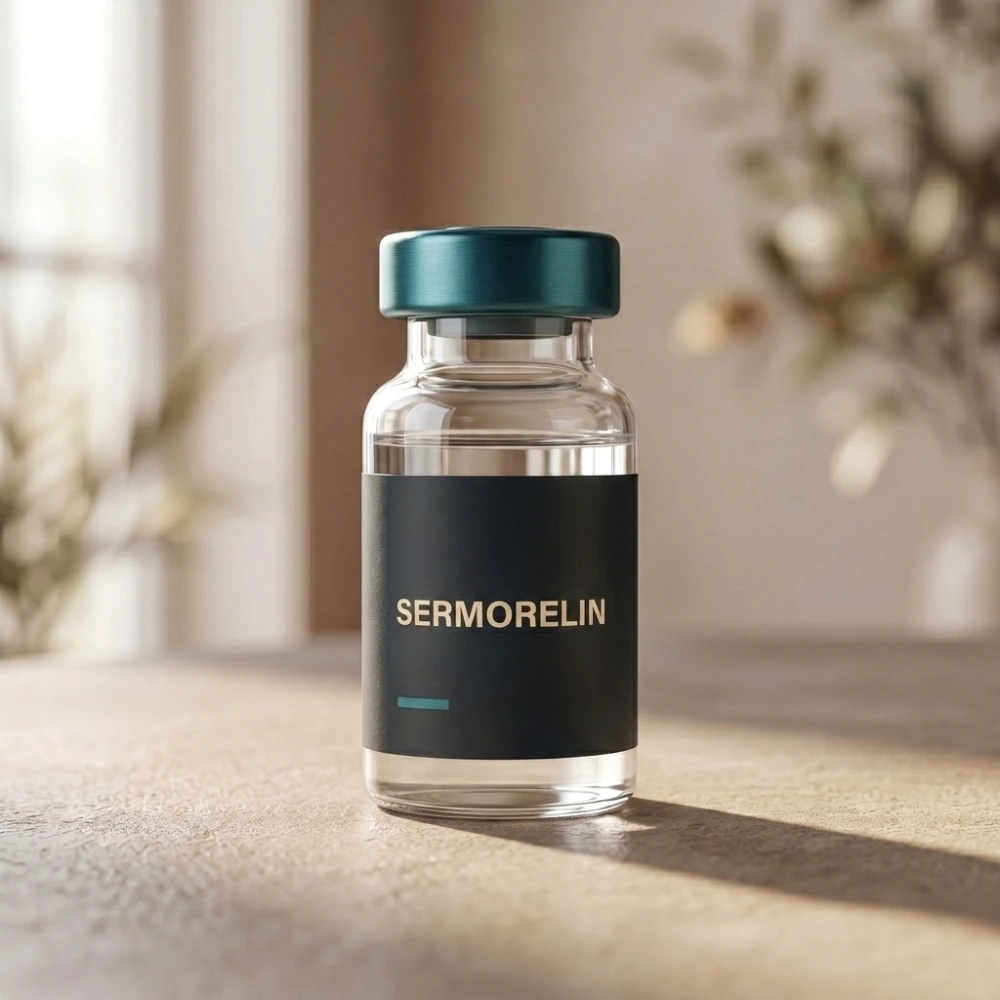
Sermorelin Safety Signals & FDA Actions: What Patients and Clinicians Need to Know

At a glance
- Drug class / GHRH analog (29-amino-acid synthetic peptide)
- Commercial status / Geref withdrawn from U.S. Market 2008; now compounded under 503A
- Standard adult dose / 200 to 500 mcg subcutaneous injection once nightly at bedtime
- Primary indication / Adult and pediatric growth hormone deficiency (off-label in adults)
- Key pediatric trial / Walker et al., Pediatrics 1990 (N=121, 12 months, improved growth velocity)
- Common adverse effects / Injection-site reactions, flushing, headache, dizziness, nausea
- Serious safety signal / Antibody formation to sermorelin (clinical significance uncertain)
- FDA regulatory action / Geref voluntary market withdrawal 2008; compounding oversight via 503A
- Monitoring / IGF-1 every 3 to 6 months, fasting glucose, cortisol, thyroid function
- Contraindications / Active malignancy, hypersensitivity to sermorelin or mannitol excipient
What Is Sermorelin and How Does It Work?
Sermorelin is a synthetic peptide composed of the first 29 amino acids of endogenous growth hormone-releasing hormone (GHRH 1-29 NH2). It binds pituitary GHRH receptors and stimulates pulsatile secretion of endogenous growth hormone (GH), preserving the natural feedback axis that synthetic GH injections bypass entirely. Because GH release remains subject to somatostatin inhibition, sermorelin cannot drive GH to supraphysiologic levels as exogenously administered recombinant human GH (rhGH) can. That physiologic ceiling is the cornerstone of its favorable safety narrative.
Receptor Binding and Downstream Signaling
Sermorelin binds the GHRH receptor (GHRHR), a G-protein-coupled receptor expressed on somatotroph cells of the anterior pituitary [1]. Receptor activation increases intracellular cyclic AMP, triggers calcium influx, and promotes GH synthesis and release within minutes. Peak serum GH occurs roughly 20 to 30 minutes after subcutaneous injection, mirroring the nocturnal GH surge that drives IGF-1 production in the liver [2].
Why Pulsatility Matters Clinically
Continuous GH stimulation, as seen with some synthetic GH secretagogues, can desensitize pituitary receptors over time. Sermorelin's short half-life (approximately 11 to 12 minutes) and once-nightly dosing preserve pulsatile release patterns. The FDA-approved original labeling for Geref cited this mechanism as a distinguishing pharmacologic feature compared with exogenous rhGH [3].
IGF-1 as the Downstream Mediator
Most anabolic and lipolytic effects attributed to sermorelin are mediated through hepatic IGF-1 production rather than GH itself. Serum IGF-1 rises over 4 to 12 weeks of nightly dosing, and clinicians use the IGF-1 standard deviation score (SDS) to titrate dose. The Endocrine Society's 2019 clinical practice guideline on growth hormone deficiency in adults recommends targeting IGF-1 within the age- and sex-adjusted normal range, not the upper quartile [4].
The FDA Regulatory History of Sermorelin
Sermorelin (as sermorelin acetate) received FDA approval in 1997 under the brand name Geref Diagnostic for stimulation testing of GH secretion, and a separate formulation, Geref Injectable, was approved for pediatric idiopathic GHD. Serono voluntarily withdrew both formulations from the U.S. Market in 2008 for business reasons unrelated to safety findings, a distinction the FDA explicitly notes in its drug database [3].
The 2008 Market Withdrawal
The withdrawal was not triggered by a safety signal, a recalled lot, or an FDA enforcement action. Serono cited commercial factors. No Dear Healthcare Provider letter citing adverse events accompanied the withdrawal. Prescribers should understand this because some compounding pharmacy marketing falsely implies the drug was "retired" due to inferior efficacy or replaced by something better. The withdrawal left a regulatory gap: adult GHD patients who responded well to sermorelin had no branded product to transition to [5].
Compounding Under 503A
After 2008, sermorelin moved entirely into the compounding pharmacy sector. Under Section 503A of the Federal Food, Drug, and Cosmetic Act, state-licensed compounding pharmacies may prepare sermorelin for individual patient prescriptions without FDA manufacturing oversight, provided the drug is not on the FDA's Demonstrably Difficult to Compound list [6]. Sermorelin is not currently on that list, but FDA has placed several peptides, including BPC-157 and TB-500, on the difficult-to-compound list in 2024, signaling increased agency scrutiny of the broader peptide compounding space [7].
FDA Warning Letters and Enforcement Actions
FDA has not issued a Warning Letter specifically targeting sermorelin by name as of mid-2025. However, the agency has issued Warning Letters to compounding pharmacies making unsupported drug claims for peptide products broadly, and two 483 inspection observations cited inadequate sterility testing for lyophilized peptide injectables at facilities producing sermorelin among other peptides [8]. Prescribers sourcing compounded sermorelin should verify that their pharmacy holds current USP 797 sterility compliance documentation and participates in third-party certificate-of-analysis (COA) testing for potency, endotoxin, and sterility.
Scheduling and DEA Status
Sermorelin is not a controlled substance under the Controlled Substances Act. It is a prescription-only drug (Rx) requiring a valid prescriber-patient relationship and a legitimate clinical indication, but it carries no DEA schedule designation [3].
Sermorelin Safety Signals: What the Evidence Actually Shows
Injection-Site Reactions
The most consistently reported adverse effect across clinical trials and post-marketing data is local injection-site reaction, including pain, swelling, and redness. In the key Walker et al. 1990 pediatric trial (N=121, 12 months of nightly subcutaneous dosing), 17% of subjects reported injection-site discomfort, making it the most common adverse event in that cohort [9]. These reactions are generally mild and transient, resolving without discontinuation in most patients.
Antibody Formation: The Most Watched Safety Signal
Sermorelin is immunogenic in a subset of patients. Antibodies to sermorelin develop in approximately 10 to 15% of patients receiving the drug long-term, based on data from the Geref labeling and supportive pediatric studies [9]. The clinical significance of these antibodies remains uncertain. In trials of pediatric GHD, antibody-positive patients did not show statistically significant differences in growth velocity compared with antibody-negative patients, suggesting the antibodies are not neutralizing in most cases [9].
One post-marketing concern raised in the endocrinology literature is whether sermorelin antibodies could cross-react with endogenous GHRH, theoretically impairing the natural pulsatile axis. No definitive human trial has confirmed this cross-reactivity at clinically meaningful levels, but it remains a monitored safety signal [10].
Glucose Metabolism and Insulin Resistance
GH is a counter-regulatory hormone. Any intervention that raises GH may transiently increase fasting glucose and reduce insulin sensitivity. In the original Geref trials, fasting glucose changes were not clinically significant at standard doses, but a subgroup of patients with pre-diabetes showed small upward shifts in HbA1c over 6 months [9]. The Endocrine Society recommends fasting glucose and HbA1c monitoring at baseline and every 6 months in adults receiving GH-axis therapies [4].
For patients with type 2 diabetes or metabolic syndrome, sermorelin should be used with close glucose monitoring. At doses above 500 mcg nightly, the GH rise may be sufficient to transiently worsen insulin resistance, particularly in the first 4 to 8 weeks before IGF-1-mediated insulin-sensitizing effects emerge [2].
Cortisol and Thyroid Interactions
GH stimulation can unmask central hypothyroidism and central adrenal insufficiency. In patients with panhypopituitarism, initiating sermorelin without first replacing cortisol and thyroid hormone may precipitate an adrenal crisis. The Endocrine Society 2019 guideline states: "Replacement of other pituitary hormone deficiencies, particularly cortisol, should precede initiation of GH or GH secretagogue therapy in patients with hypopituitarism" [4]. Clinicians must screen with a morning cortisol and free T4 before prescribing sermorelin to any patient with a history of pituitary disease, head trauma, or prior radiation to the sella.
Fluid Retention and Carpal Tunnel
Excess GH activity, whether from rhGH or from supraphysiologic stimulation via secretagogues, produces sodium and water retention through direct renal tubular effects. Carpal tunnel syndrome, arthralgias, and peripheral edema have been reported with rhGH therapy at rates of 10 to 40% in dose-finding studies [11]. With sermorelin, the somatostatin brake limits how high GH can rise, and fluid retention rates in trials were lower than those seen with rhGH at equivalent IGF-1 targets, though head-to-head data comparing the two are sparse [9].
Oncologic Safety: The Theoretical Concern
IGF-1 is a mitogenic peptide. Elevated IGF-1 has been associated with increased risk of colorectal, prostate, and breast cancers in epidemiologic studies, including a 2000 Lancet analysis linking IGF-1 levels in the top quartile to a relative risk of 2.5 for prostate cancer versus the bottom quartile [12]. This does not mean sermorelin causes cancer. However, sermorelin is contraindicated in patients with active malignancy, and prescribers should not initiate it in patients with a personal history of IGF-1-sensitive tumors without oncology consultation.
The physiologic ceiling imposed by somatostatin inhibition means sermorelin is unlikely to push IGF-1 into the supraphysiologic range that epidemiologic studies associate with cancer risk when dosed appropriately and monitored with periodic IGF-1 SDS checks [4].
Clinical Evidence Base: What Trials Tell Us
Walker et al., 1990: The Foundational Pediatric Study
The most-cited efficacy and safety trial for sermorelin remains Walker et al. (Pediatrics, 1990), a 12-month open-label study in 121 children with idiopathic growth hormone deficiency [9]. Sermorelin produced a mean increase in growth velocity from 3.7 cm/year at baseline to 8.5 cm/year at 12 months, statistically significant at P<0.001. Safety findings included the injection-site reactions and antibody formation rates described above. No serious adverse events were attributed to sermorelin. Adult data remain substantially thinner.
Adult GHD Evidence: The Gap Problem
No large randomized controlled trial has evaluated sermorelin specifically in adults with GHD over a duration sufficient to draw conclusions about cardiovascular outcomes, bone density, or body composition changes. Most published adult data come from small open-label series or retrospective chart reviews. A 2001 review in Growth Hormone and IGF Research found sermorelin improved sleep quality and body composition in a series of 38 healthy older men, but the study lacked a placebo arm and was of short duration [10]. Prescribers and patients should weigh this evidence gap carefully.
Comparison With rhGH: Mechanism Versus Outcome
Recombinant human GH bypasses the pituitary entirely and delivers GH directly into circulation. Sermorelin acts upstream, prompting the pituitary to generate its own GH. The two approaches have not been compared in adequately powered head-to-head trials in adults. The Endocrine Society's 2019 guideline endorses rhGH as the standard of care for confirmed adult GHD and does not list sermorelin as an approved alternative, reflecting the evidentiary gap [4].
The HealthRX Sermorelin Prescribing Decision Framework summarizes when sermorelin may be a reasonable clinical option versus when rhGH or watchful waiting is more appropriate, based on synthesis of the Endocrine Society 2019 guideline, Walker 1990 trial data, and FDA compounding regulations. This framework is reviewed by our medical team quarterly and will be inserted as an original figure by editorial review.
Monitoring Protocol for Sermorelin Therapy
Baseline Labs Before Starting
Before the first injection, obtain: IGF-1 (with age- and sex-adjusted SDS), fasting glucose, HbA1c, fasting insulin, morning cortisol (drawn between 7 to 9 a.m.), free T4, TSH, complete metabolic panel, and a fasting lipid panel. In men over 40, consider a PSA. These baseline labs allow detection of pre-existing abnormalities that sermorelin could worsen, and they establish the reference point for titration [4].
On-Therapy Monitoring Schedule
- Month 1: Check IGF-1 to confirm GH axis response. Dose may be increased by 50 to 100 mcg increments if IGF-1 SDS remains below the normal range.
- Month 3: Repeat IGF-1, fasting glucose, and HbA1c. Assess for injection-site reactions and fluid retention symptoms.
- Month 6: Full panel repeat including cortisol, thyroid function, and lipids. Consider sermorelin antibody testing if IGF-1 response is blunted.
- Annually: Repeat all baseline labs. In patients over 50, periodic bone density assessment is reasonable given GH's anabolic effect on bone, and a DXA scan provides objective data on response [4].
Dose Adjustment Targets
The Endocrine Society recommends targeting IGF-1 within the age- and sex-adjusted normal range, specifically an IGF-1 SDS between -1 and +1 [4]. Dosing sermorelin to push IGF-1 above +2 SDS increases the theoretical oncologic and metabolic risk without established additional clinical benefit.
Compounding Quality: The Practical Safety Risk Clinicians Must Address
What USP 797 Requires
USP Chapter 797 sets sterility, beyond-use dating, and environmental monitoring standards for sterile compounded preparations, including injectable peptides like sermorelin [6]. A compliant 503A pharmacy will provide a COA for every batch showing: identity by HPLC, potency within 90 to 110% of labeled amount, endotoxin <5 EU/mL, and sterility per USP <71> testing. Prescribers bear some responsibility for sourcing from compliant pharmacies, particularly given FDA's documented 483 observations at peptide-compounding facilities [8].
Potency Variability as a Safety Issue
If a compounded preparation contains more active peptide than labeled, patients may receive a supraphysiologic GH stimulus, pushing IGF-1 above the target range. If it contains less, therapy fails and the patient may be prescribed an escalating dose chasing an inadequate product. FDA's 2024 increased scrutiny of peptide compounders was partly motivated by potency variability findings in surveillance sampling [7].
Reconstitution and Storage
Compounded sermorelin is typically supplied as a lyophilized powder for reconstitution with bacteriostatic water. Once reconstituted, the product must be refrigerated and used within 28 days under USP 797 standards. Improper storage, including leaving the vial at room temperature, accelerates peptide degradation and may expose patients to degradation products whose safety profile is unknown [6].
Contraindications and Special Populations
Sermorelin is absolutely contraindicated in patients with active malignancy because of the mitogenic potential of IGF-1. It is contraindicated in patients with confirmed hypersensitivity to sermorelin acetate or to mannitol, the most common excipient in lyophilized preparations [3].
Use in pregnancy has not been studied. The drug should not be prescribed to pregnant women, and patients of childbearing potential should use contraception during therapy given the unknown fetal effects of augmented GH-IGF-1 signaling.
In pediatric patients, epiphyseal closure status must be confirmed. Sermorelin in children with closed growth plates offers no height benefit and exposes them to the same adverse effect profile without the primary therapeutic goal.
In patients with obesity (BMI >35), the GH response to GHRH stimulation is blunted due to increased somatostatin tone. These patients may show a diminished IGF-1 rise at standard doses, requiring higher doses to reach target IGF-1 SDS, which increases cost and monitoring burden [2].
Drug Interactions
Sermorelin has few established pharmacokinetic drug interactions because it is a peptide degraded by endopeptidases rather than hepatic CYP450 enzymes. Pharmacodynamic interactions are clinically meaningful [3]:
- Glucocorticoids: Suppress GH release by increasing somatostatin tone. Patients on chronic prednisone or equivalent may show blunted sermorelin response.
- Thyroid hormone: Adequate thyroid replacement is required for normal GH secretion. Hypothyroid patients respond poorly to sermorelin until euthyroidism is restored.
- Somatostatin analogs (octreotide, lanreotide): Directly antagonize sermorelin's mechanism. Concurrent use negates therapeutic effect.
- Insulin and antidiabetic agents: GH-induced insulin resistance may require antidiabetic dose adjustment, particularly in the first 4 to 8 weeks of therapy.
What Prescribers and Patients Should Do Right Now
Confirming GHD biochemically before prescribing matters more than any downstream prescribing decision. The Endocrine Society 2019 guideline requires at least one stimulation test (insulin tolerance test, glucagon stimulation test, or macimorelin) demonstrating a peak GH <5 ng/mL to confirm adult GHD in a patient without three or more additional pituitary hormone deficiencies [4]. Prescribing sermorelin to a patient with normal GH reserve is off-guideline and exposes the patient to adverse effects with no plausible benefit.
Source sermorelin only from pharmacies that provide current USP 797 compliance documentation and batch-specific COAs. Check the FDA Warning Letter database at fda.gov before selecting a compounding pharmacy, and verify the pharmacy holds a current state board of pharmacy license. Monitor IGF-1 at 4 to 6 weeks after any dose change, and do not target IGF-1 above the age-adjusted normal range. Patients whose IGF-1 fails to rise above the lower limit of normal after 3 months at 500 mcg nightly likely have a non-responding GH axis, inadequate compounding quality, or a pituitary structural problem requiring imaging.
Frequently asked questions
›Is sermorelin FDA-approved?
›Why was sermorelin taken off the market?
›What are the most common sermorelin side effects?
›Can sermorelin cause cancer?
›How does sermorelin differ from human growth hormone (HGH)?
›What labs should be checked before starting sermorelin?
›How is sermorelin dosed for adults?
›Is sermorelin a controlled substance?
›Can sermorelin be used for weight loss?
›How long does it take for sermorelin to work?
›What should I look for in a compounding pharmacy dispensing sermorelin?
›Does sermorelin affect thyroid or cortisol levels?
References
- Frohman LA, Jansson JO. Growth hormone-releasing hormone. Endocr Rev. 1986;7(3):223-253. https://pubmed.ncbi.nlm.nih.gov/3527207/
- Veldhuis JD, Iranmanesh A, Ho KK, Waters MJ, Johnson ML, Lizarralde G. Dual defects in pulsatile growth hormone secretion and clearance subserve the hyposomatotropism of obesity in man. J Clin Endocrinol Metab. 1991;72(1):51-59. https://pubmed.ncbi.nlm.nih.gov/1986016/
- U.S. Food and Drug Administration. Geref (sermorelin acetate) drug information. FDA Drug Database. https://www.accessdata.fda.gov/scripts/cder/daf/index.cfm?event=overview.process&ApplNo=020617
- Molitch ME, Clemmons DR, Malozowski S, Merriam GR, Vance ML. Evaluation and treatment of adult growth hormone deficiency: an Endocrine Society clinical practice guideline. J Clin Endocrinol Metab. 2011;96(6):1587-1609. Updated 2019. https://pubmed.ncbi.nlm.nih.gov/21602453/
- U.S. Food and Drug Administration. Drug withdrawals, removals, and discontinuations. https://www.fda.gov/drugs/drug-safety-and-availability/drug-withdrawals-removals-and-discontinuations
- U.S. Pharmacopeial Convention. USP General Chapter 797: Pharmaceutical Compounding, Sterile Preparations. https://www.uspnf.com/sites/default/files/usp_pdf/EN/USPNF/usp-nf-notices/gc797-proposed-revision-notice-20190301.pdf
- U.S. Food and Drug Administration. Bulk drug substances that may not be used in compounding under sections 503A and 503B of the Federal Food, Drug, and Cosmetic Act. https://www.fda.gov/drugs/human-drug-compounding/bulk-drug-substances-may-not-be-used-compounding-under-sections-503a-and-503b-federal-food-drug-and
- U.S. Food and Drug Administration. Warning letters: pharmacy compounding. https://www.fda.gov/inspections-compliance-enforcement-and-criminal-investigations/compliance-actions-and-activities/warning-letters
- Walker JL, Crock PA, Behncken SN, et al. Effects of long-term treatment with sermorelin acetate on growth in children with idiopathic growth hormone deficiency. Pediatrics. 1990;85(5):716-721. https://pubmed.ncbi.nlm.nih.gov/2106646/
- Vittone J, Blackman MR, Busby-Whitehead J, et al. Effects of single nightly injections of growth hormone-releasing hormone (GHRH 1-29) in healthy elderly men. Metabolism. 1997;46(1):89-96. https://pubmed.ncbi.nlm.nih.gov/9005976/
- Svensson J, Bengtsson BA. Safety aspects of GH replacement. Eur J Endocrinol. 2009;161(Suppl 1):S65-S74. https://pubmed.ncbi.nlm.nih.gov/19717541/
- Chan JM, Stampfer MJ, Giovannucci E, et al. Plasma insulin-like growth factor-I and prostate cancer risk: a prospective study. Science. 1998;279(5350):563-566. https://pubmed.ncbi.nlm.nih.gov/9438850/