
Sermorelin Self-Injection Technique: Step-by-Step Subcutaneous Guide
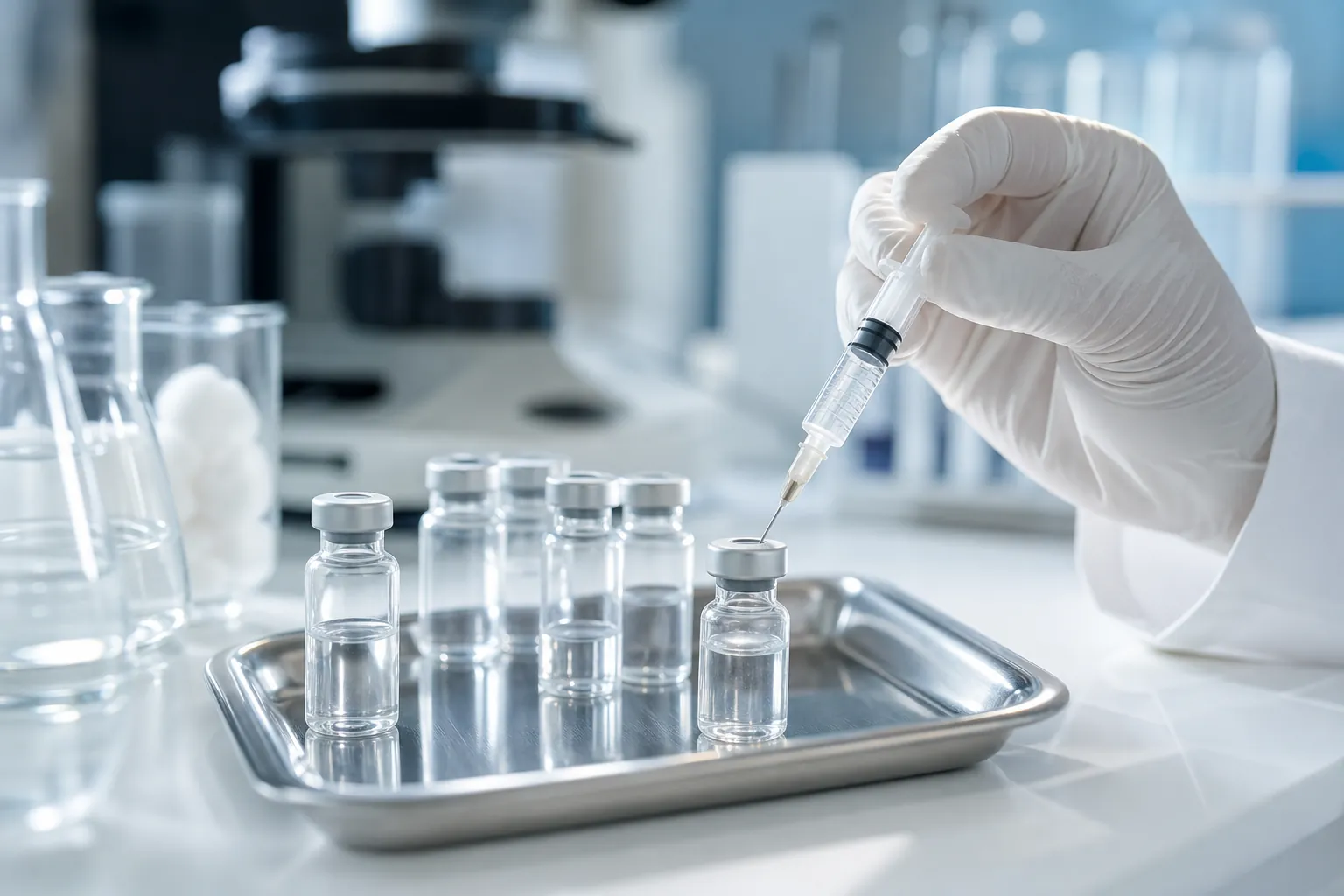
At a glance
- Route / subcutaneous injection into fat tissue
- Typical dose / 100 to 300 mcg per day (physician-directed)
- Timing / 30 to 60 minutes before sleep
- Needle gauge / 29 to 31 gauge, 0.5-inch insulin syringe
- Reconstitution / bacteriostatic water (0.9% benzyl alcohol)
- Storage after mixing / refrigerate at 2 to 8 °C, use within 28 days
- Injection sites / abdomen, outer thigh, posterior upper arm
- Onset of measurable IGF-1 change / 4 to 12 weeks
- Drug class / growth hormone-releasing hormone (GHRH) analogue
- Availability / compounded under section 503A by prescription only
How Sermorelin Works: Mechanism of Action
Sermorelin acetate is a peptide analogue of growth hormone-releasing hormone. It is intended to stimulate pituitary growth hormone release, but its clinical effects and safety can vary, and normal feedback mechanisms do not eliminate the risk of excessive growth hormone activity.
Published trials have not adequately characterized the benefits, dosing, or long-term outcomes of current sermorelin formulations in adults. Pediatric findings may not apply to adult treatment.
Timing matters. Endogenous GH secretion peaks within the first 90 minutes of slow-wave sleep [5]. Injecting sermorelin 30 to 60 minutes before bed aligns the exogenous GHRH stimulus with this natural secretory window, amplifying the pulse rather than creating an off-cycle spike.
Supplies You Need Before Your First Injection
Gather every item before you start. Rushing mid-procedure increases contamination risk.
You will need: one vial of lyophilized sermorelin acetate (typically 3 mg or 6 mg per vial), one vial of bacteriostatic water USP containing 0.9% benzyl alcohol, alcohol prep pads, a 1 mL insulin syringe with a fixed 29- to 31-gauge needle (0.5-inch length), and a sharps disposal container that meets your state's household medical waste rules. The CDC recommends using FDA-cleared sharps containers or, if unavailable, a heavy-duty plastic household container with a tight-fitting puncture-resistant lid [6].
Do not use sterile water for injection (SWFI) unless the vial will be used in a single dose. Bacteriostatic water contains benzyl alcohol, which inhibits microbial growth across the 28-day use window of a multi-dose vial [7]. SWFI lacks a preservative, meaning a multi-dose vial reconstituted with it becomes a contamination risk after the first needle entry.
How to Reconstitute Sermorelin: Mixing the Vial
Reconstitution is the step most patients get wrong on their first attempt. Go slowly.
Remove both the sermorelin vial and bacteriostatic water vial from the refrigerator. Let them reach room temperature for 5 to 10 minutes. Wipe each vial's rubber stopper with a fresh alcohol pad and let it air-dry for at least 10 seconds. Draw the prescribed volume of bacteriostatic water into the syringe. Your prescriber or pharmacist will specify the exact volume; a common convention for a 3 mg vial is 1 mL of bacteriostatic water, which yields a concentration of 3 mg/mL (3,000 mcg/mL) [7].
Insert the needle into the sermorelin vial at a slight angle through the rubber stopper. Inject the bacteriostatic water slowly, directing the stream against the glass wall of the vial rather than directly onto the lyophilized powder cake. Sermorelin is a fragile peptide. Aggressive mixing or vigorous shaking can denature the molecule, reducing bioactivity [8]. Gently roll the vial between your palms for 30 to 60 seconds until the powder dissolves completely. The solution should be clear and colorless. If it appears cloudy, contains visible particles, or has a yellow tint, do not use it.
Label the vial with the date of reconstitution. Refrigerate immediately. The reconstituted solution is stable for up to 28 days at 2 to 8 °C [7].
Step-by-Step Self-Injection Technique
The subcutaneous injection itself takes less than 30 seconds once you are comfortable with the process. The technique mirrors the approach used for insulin and other subcutaneous peptides, as described in the American Diabetes Association's injection-technique consensus guidelines [9].
Step 1: Calculate your dose. If your vial concentration is 3,000 mcg/mL and your prescribed dose is 300 mcg, you need 0.1 mL (10 units on a standard U-100 insulin syringe). Confirm this math with your prescribing provider.
Step 2: Draw the medication. Wipe the vial stopper with alcohol. Pull back the syringe plunger to the desired volume, filling the barrel with air. Insert the needle into the vial, inject the air (this equalizes pressure), invert the vial, and slowly draw the medication to the correct line. Tap the syringe barrel gently to move any air bubbles toward the needle hub, then push the plunger slightly to expel them.
Step 3: Choose and prepare the injection site. The three preferred sites for subcutaneous peptide injection are the abdomen (at least two inches from the navel), the outer mid-thigh, and the posterior upper arm [9]. Clean a two-inch area at the chosen site with an alcohol pad and let it dry completely.
Step 4: Pinch and inject. With your non-dominant hand, pinch a one- to two-inch fold of skin and fat. Hold the syringe like a pencil at a 45- to 90-degree angle. For patients with a body fat percentage above roughly 20%, a 90-degree angle with a 0.5-inch needle deposits the medication reliably in subcutaneous tissue [9]. Insert the needle in a single smooth motion. Release the skin pinch. Depress the plunger slowly and steadily over 5 to 10 seconds.
Step 5: Withdraw and dispose. After the plunger is fully depressed, wait 5 seconds with the needle still in the tissue, then withdraw straight out. Do not recap the needle. Place it directly into your sharps container [6].
Apply gentle pressure with a clean gauze pad or cotton ball if there is any bleeding. Do not massage the site; rubbing can accelerate local absorption unpredictably and may increase bruising.
Injection-Site Rotation: Why It Matters
Using the same spot repeatedly causes subcutaneous lipohypertrophy (localized fat thickening) or, less commonly, lipoatrophy (fat loss). Both conditions impair absorption. A systematic review by Blanco et al. (Diabetes & Metabolism, 2013) found that injection-site lipohypertrophy was present in 49.1% of insulin-using patients with poor rotation habits and was associated with a 10-fold increase in unexplained glycemic variability [10]. The same tissue-remodeling phenomenon applies to any subcutaneous peptide injected daily.
Rotate systematically. One practical approach: divide the abdomen into four quadrants (upper left, upper right, lower left, lower right) and assign each quadrant to one week of the month, spacing individual injections within that quadrant at least one inch apart. Alternatively, cycle abdomen, right thigh, left thigh, and posterior arm on a four-day rotation. Keep a simple written or app-based log. The pattern matters less than consistency.
Dose Timing and the Growth Hormone Pulse
Growth hormone secretion is pulsatile and often associated with sleep. Published trials have not established that bedtime sermorelin dosing improves clinical outcomes or identified an optimal dosing time.
Inject sermorelin on an empty stomach. GH release from GHRH stimulation is blunted by hyperglycemia and elevated free fatty acids [11]. The Endocrine Society recommends fasting for at least 90 minutes before GH-stimulation testing to avoid false-negative results [4]. While daily sermorelin dosing is not a diagnostic stimulation test, the same physiological principle applies: a post-meal insulin spike competes with the GHRH signal at the somatotroph. Eating a high-carbohydrate meal within an hour of injection may reduce the amplitude of the resulting GH pulse.
A practical rule: finish your last meal at least 90 minutes before injection, and inject 30 to 60 minutes before you plan to fall asleep.
Storage, Stability, and Handling Errors
Peptide degradation is the silent saboteur of treatment efficacy. Sermorelin in its lyophilized (freeze-dried) form is stable at controlled room temperature during shipping, but once reconstituted it must be refrigerated continuously at 2 to 8 °C [7]. Do not freeze reconstituted sermorelin. Freezing creates ice crystals that mechanically shear peptide bonds.
If a reconstituted vial is left at room temperature for more than four hours, its potency cannot be guaranteed. Discard it. The same applies if the solution changes color, develops cloudiness, or shows floating particulate matter. The USP General Chapter <797> standards for compounded sterile preparations set a beyond-use date of 28 days for multi-dose vials stored under refrigeration with a bacteriostatic diluent [12].
During travel, use an insulated medication travel case with a gel ice pack. Keep the vial upright and avoid direct contact between the ice pack and the glass vial (wrap a cloth barrier between them). TSA permits injectable medications in carry-on luggage when accompanied by a prescription label [6].
Monitoring: What Your Provider Should Track
Self-injection technique is only one variable. The clinical endpoint is a measurable change in GH-axis biomarkers. The Endocrine Society guideline recommends serum IGF-1 as the primary monitoring marker for GH-axis therapies, with the target being an IGF-1 level within the age-adjusted reference range (typically the upper-normal tertile) [4].
Laboratory monitoring should be individualized by the prescribing clinician and may include IGF-1 and metabolic markers. Published trials have not reliably defined an expected adult IGF-1 response, monitoring schedule, or timeframe for benefit with sermorelin.
Report new-onset joint pain, edema, or carpal tunnel symptoms to your provider immediately. These are signs of excessive GH activity and require dose reduction [4].
Common Mistakes and How to Avoid Them
Injecting too fast. Rapid plunger depression forces medication into a small tissue pocket, causing a burning sensation and local inflammation. Slow down to 5 to 10 seconds per injection.
Skipping the air-dry step after alcohol swabbing. Injecting through wet alcohol stings and can carry the antiseptic into subcutaneous tissue. Wait 10 seconds.
Using the wrong syringe. Standard 3 mL syringes with detachable needles waste 0.04 to 0.07 mL of medication in the dead space of the needle hub [9]. With a 300 mcg dose in a 3,000 mcg/mL concentration, that dead-space loss represents 120 to 210 mcg of wasted peptide per injection. Fixed-needle insulin syringes eliminate this problem.
Storing vials in the refrigerator door. Door compartments experience temperature swings of 3 to 5 °C every time the door opens. Store vials on a middle shelf toward the back, where temperature remains most stable.
Shaking the vial during reconstitution. Vigorous agitation introduces air bubbles and can denature the peptide through mechanical stress at the air-liquid interface [8]. Always roll gently.
When to Contact Your Provider
Call your prescriber if you notice persistent redness, swelling, or warmth at an injection site lasting more than 48 hours (possible cellulitis). Seek care for systemic symptoms such as fever after injection, which may indicate contamination of the vial. Contact your provider before resuming injections if you accidentally use an expired vial, a vial that has been at room temperature for an extended period, or a vial reconstituted with the wrong diluent volume (which alters concentration and dose accuracy).
Sermorelin is a prescription medication available through 503A compounding pharmacies. The FDA approved sermorelin (brand name Geref) in 1997 for diagnostic use, though the commercial product was later discontinued. Current clinical use relies on compounded formulations under the oversight of state boards of pharmacy and prescribing clinicians [13]. Your compounding pharmacy's beyond-use dating may differ from the general 28-day guideline. Follow the date printed on your specific vial label.
Frequently asked questions
Where is the best place to inject sermorelin?
What time of day should I inject sermorelin?
Do I need to refrigerate sermorelin after mixing?
What needle size should I use for sermorelin injections?
Can I eat before injecting sermorelin?
How does sermorelin work in the body?
How long does it take for sermorelin to start working?
What happens if I shake the sermorelin vial?
Is sermorelin the same as HGH?
What are the side effects of sermorelin injections?
Can I travel with sermorelin?
How do I know if my sermorelin has gone bad?
References
- Walker RF, Codd EE, Baird FC, et al. Stimulation of statural growth by recombinant growth hormone-releasing factor (GRF 1-29) in children with growth hormone deficiency. Pediatrics. 1990;86(5):709-715. https://pubmed.ncbi.nlm.nih.gov/2106646/
- Frohman LA, Downs TR, Chomczynski P. Regulation of growth hormone secretion. Front Neuroendocrinol. 1992;13(4):344-405. https://pubmed.ncbi.nlm.nih.gov/1281124/
- Vittone J, Blackman MR, Busby-Whitehead J, et al. Effects of single nightly injections of growth hormone-releasing hormone (GHRH 1-29) in healthy elderly men. Metabolism. 1997;46(1):89-96. https://pubmed.ncbi.nlm.nih.gov/9005976/
- Molitch ME, Clemmons DR, Malozowski S, et al. Evaluation and treatment of adult growth hormone deficiency: an Endocrine Society clinical practice guideline. J Clin Endocrinol Metab. 2011;96(6):1587-1609. https://pubmed.ncbi.nlm.nih.gov/21602453/
- Van Cauter E, Leproult R, Plat L. Age-related changes in slow wave sleep and REM sleep and relationship with growth hormone and cortisol levels in healthy men. JAMA. 2000;284(7):861-868. https://pubmed.ncbi.nlm.nih.gov/10938176/
- Centers for Disease Control and Prevention. Sharps disposal. https://www.cdc.gov/sharps-disposal/index.html
- U.S. Pharmacopeia. General Chapter <797> Pharmaceutical Compounding, Sterile Preparations. USP-NF. https://www.ncbi.nlm.nih.gov/books/NBK599577/
- Mahler HC, Friess W, Grauschopf U, Kiese S. Protein aggregation: pathways, induction factors and analysis. J Pharm Sci. 2009;98(9):2909-2934. https://pubmed.ncbi.nlm.nih.gov/18823031/
- Frid AH, Kreugel G, Grassi G, et al. New insulin delivery recommendations. Mayo Clin Proc. 2016;91(9):1231-1255. https://pubmed.ncbi.nlm.nih.gov/27594187/
- Blanco M, Hernández MT, Strauss KW, Amaya M. Prevalence and risk factors of lipohypertrophy in insulin-injecting patients with diabetes. Diabetes Metab. 2013;39(5):445-453. Prevalence and risk factors of lipohypertrophy in insulin-injecting patients with diabetes
- Jaffe CA, DeMott-Friberg R, Barkan AL. Endogenous growth hormone (GH)-releasing hormone is required for GH responses to pharmacological stimuli. J Clin Invest. 1996;97(4):934-940. Endogenous growth hormone (GH)-releasing hormone is required for GH responses to pharmacological stimuli
- U.S. Pharmacopeia. Pharmaceutical Compounding, Sterile Preparations <797>. Revision 2023. https://www.fda.gov/drugs/human-drug-compounding/usp-general-chapter-797
- U.S. Food and Drug Administration. Human drug compounding. https://www.fda.gov/drugs/human-drug-compounding