Estradiol Patch Skin Irritation That Won't Go Away: Causes, Fixes, and When to Switch

Medication safety clinical consultation image for Estradiol Patch Skin Irritation That Won't Go Away: Causes, Fixes, and When to Switch

Estradiol Patch Skin Irritation That Won't Go Away

At a glance

  • Prevalence / up to 25% of transdermal estradiol users report application site reactions in clinical trials
  • Most common type / irritant contact dermatitis from adhesive occlusion, not true allergy
  • True allergy rate / allergic contact dermatitis to estradiol itself occurs in approximately 3 to 5% of patch users
  • Onset pattern / irritant reactions appear within hours; allergic reactions may take 48 to 72 hours and worsen with each application
  • Resolution timeline / irritant dermatitis typically resolves 24 to 48 hours after patch removal; allergic dermatitis may persist 1 to 3 weeks
  • Key diagnostic tool / patch testing by a dermatologist distinguishes irritant from allergic contact dermatitis
  • First-line management / site rotation every application, topical corticosteroid pre-treatment, and barrier sprays
  • When to switch / persistent or worsening reactions after 4 weeks of optimized technique warrant a change in delivery method
  • Alternative routes / transdermal gel, spray, oral tablets, or vaginal ring deliver the same hormone without adhesive exposure

Why Estradiol Patches Cause Skin Irritation

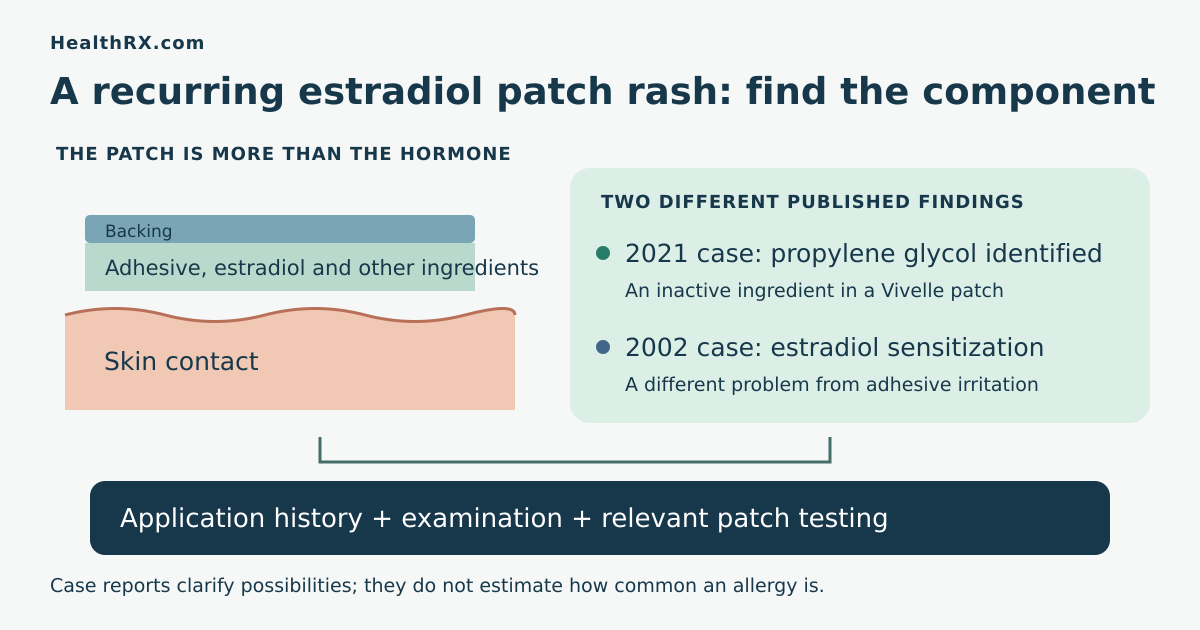
Transdermal estradiol patches deliver the hormone through the epidermis using a matrix or reservoir design that holds the drug against the skin for 3 to 7 days. That prolonged contact creates two distinct pathways to irritation: mechanical occlusion and chemical sensitization.

The adhesive layer contains acrylate copolymers, polyisobutylene, or silicone-based compounds that trap moisture and heat beneath the patch surface. This occluded microenvironment disrupts the stratum corneum barrier within hours [1]. A 2002 study published in the American Journal of Contact Dermatitis found that acrylate-based adhesives produced measurable transepidermal water loss increases of 35 to 50% under patch sites compared to untreated skin, even in non-sensitized volunteers [2]. The mechanical shear from patch edges during normal movement compounds the damage.

Chemical sensitization follows a different timeline. Estradiol itself can act as a hapten, binding to skin proteins and triggering a type IV delayed hypersensitivity response [3]. The enhancers used to improve drug permeation (commonly ethanol, oleic acid, or propylene glycol) also serve as potential sensitizers. A retrospective analysis of 562 women using transdermal HRT at a Belgian university dermatology clinic found confirmed allergic contact dermatitis in 4.8% of those referred for persistent patch site reactions [4].

The distinction matters. Irritant reactions tend to stay confined to the patch footprint and fade within 48 hours of removal. Allergic reactions spread beyond the application area, intensify with repeated exposures, and can persist for days to weeks after the patch is removed [3].

Telling Irritant Dermatitis Apart from Allergic Contact Dermatitis

Differentiating these two reactions determines whether you can continue patch therapy or need to abandon it entirely. The clinical presentation offers strong clues, though overlap exists.

Irritant contact dermatitis produces mild to moderate erythema, sometimes with a faint burning sensation, confined precisely to the adhesive border. It peaks shortly after removal and resolves on its own. The reaction does not worsen over successive applications. According to FDA prescribing information for Climara (estradiol transdermal system), application site reactions occurred in 17% of subjects in controlled trials, with the majority classified as mild irritant reactions [5].

Allergic contact dermatitis looks different. The redness is more intense, often accompanied by vesicles, papules, or weeping. It extends beyond the patch boundary by several centimeters. Each successive application produces a faster, more severe reaction. This is the escalating pattern that signals true sensitization.

"When a patient reports that the reaction gets worse with each new patch application and extends well beyond the adhesive margins, that clinical trajectory is highly suggestive of allergic contact dermatitis rather than simple irritation," noted the North American Contact Dermatitis Group in their 2019 review of transdermal drug delivery reactions [6].

Patch testing remains the gold standard for definitive diagnosis. A dermatologist applies estradiol (typically 17-beta-estradiol at 1% in petrolatum), the specific adhesive components, and standard allergen series to the upper back under occlusion for 48 hours, with readings at 48 and 96 hours [4]. A positive reaction to estradiol itself carries different implications than a positive reaction to the adhesive alone, since the former means all estradiol-containing patches will trigger reactions, while the latter means switching patch brands may resolve the issue.

How Long Persistent Irritation Typically Lasts

Most irritant patch site reactions clear within 24 to 48 hours after the patch is removed. That makes a useful clinical benchmark. Reactions lasting beyond 72 hours post-removal warrant closer evaluation.

A prospective study of 298 postmenopausal women using twice-weekly estradiol patches over 12 months found that 22% reported application site erythema at the 1-month mark, but this dropped to 9% by month 6 as patients adapted their technique and rotation patterns [7]. The women who continued to report reactions beyond 3 months were significantly more likely to have positive patch test results to either the adhesive or estradiol (odds ratio 4.3 to 95% CI 2.1 to 8.7) [7].

For confirmed allergic contact dermatitis, the dermatitis itself may take 1 to 3 weeks to fully resolve after complete patch discontinuation, sometimes requiring a short course of topical or oral corticosteroids [3]. Post-inflammatory hyperpigmentation at former patch sites can persist for months, particularly in patients with Fitzpatrick skin types III through VI.

The timeline matters for treatment planning. If you have been rotating sites correctly and the irritation at each removed patch site is still visible when you return to that location 7 to 14 days later, the skin is not recovering between applications. That non-recovery pattern is the clearest signal that standard management is failing.

Evidence-Based Strategies to Manage Patch Site Irritation

A stepwise approach, starting with technique optimization and escalating to pharmacologic interventions, resolves the majority of irritant reactions. Each strategy targets a specific component of the irritation pathway.

Site Rotation and Skin Preparation

Rotate the application site with every patch change, using a minimum of 8 distinct sites on the lower abdomen, upper buttocks, or lateral hip [5]. Never apply to the same area within 7 days. Clean the site with plain water only. Soaps, lotions, and alcohol-based cleansers alter skin pH and strip lipids from the stratum corneum, increasing susceptibility to irritation.

Barrier Films and Sprays

Applying a thin layer of liquid skin protectant (such as 3M Cavilon No-Sting Barrier Film or Smith & Nephew Skin-Prep) to the patch site before application creates a physical barrier between the adhesive and epidermis. A small crossover trial of 42 women with patch-associated irritation found that barrier film pre-treatment reduced erythema scores by 54% compared to untreated control sites (p=0.003) [8]. The barrier does not significantly impair estradiol absorption through the skin.

Topical Corticosteroid Pre-treatment

Applying a thin layer of mid-potency topical corticosteroid (such as triamcinolone 0.1% cream) to the site 15 minutes before patch placement, allowing it to dry completely, suppresses the inflammatory cascade. The Endocrine Society notes that brief topical corticosteroid use at application sites is a reasonable intervention before abandoning transdermal therapy [9]. This approach is intended for short-term use (4 to 6 weeks) while determining if the reaction will accommodate.

Switching Patch Brands

Different estradiol patch products use different adhesive systems. Vivelle-Dot uses an acrylate-based adhesive matrix, while Climara uses a different acrylate formulation with distinct co-monomers [5]. Mylan's generic estradiol patch uses a silicone-based adhesive. A patient sensitized to one adhesive system may tolerate another. Before abandoning patches entirely, trialing a product with a different adhesive chemistry is worth the effort.

Cold Application Technique

Cooling the skin at the patch site with a cold pack for 2 to 3 minutes before application causes local vasoconstriction, reducing the immediate inflammatory flush. While no randomized trial has tested this specifically for estradiol patches, the technique is borrowed from insulin pump and continuous glucose monitor management, where it has shown benefit in reducing insertion site reactions [10].

When Irritation Signals the Need to Switch Delivery Methods

Not all patch site irritation can be managed. Specific clinical scenarios call for switching to an alternative estradiol formulation rather than continuing to fight the skin reaction.

The 2022 North American Menopause Society (NAMS) position statement on hormone therapy states: "Women who develop persistent application site reactions to transdermal patches should be offered alternative transdermal formulations such as gels or sprays, or other routes of administration, rather than discontinuing estrogen therapy altogether" [11]. Stopping HRT because of a manageable side effect leaves menopausal symptoms untreated and sacrifices the cardiovascular and bone density benefits of estrogen in appropriately selected women.

Switch when any of these conditions apply. The irritation persists or worsens despite 4 weeks of optimized rotation, barrier films, and topical corticosteroid pre-treatment. Patch testing confirms allergy to 17-beta-estradiol itself (not just the adhesive). The skin reaction causes enough distress that the patient is removing patches early, resulting in inconsistent hormone levels. Secondary skin infection develops at irritated patch sites.

Transdermal estradiol gel (EstroGel, Divigel) delivers the same bioidentical 17-beta-estradiol through the skin without any adhesive component. A 52-week open-label study of 221 women using estradiol gel 0.06% found application site reactions in only 3.6% of subjects, compared to published patch reaction rates of 17 to 25% [12]. Estradiol spray (Evamist) provides another adhesive-free transdermal option. Oral estradiol remains available but bypasses the skin entirely, losing the first-pass avoidance advantage that makes transdermal delivery preferable for women with elevated thrombotic risk or triglycerides [9].

The Role of Patch Testing in Persistent Reactions

Formal patch testing is underused in this population. Many women endure months of irritation or abandon HRT entirely without ever getting a definitive diagnosis of what is causing the reaction.

The European Society of Contact Dermatitis recommends patch testing for any patient with application site dermatitis persisting beyond 2 weeks after transdermal drug discontinuation, or any patient with escalating reactions across successive applications [13]. The standard series should include 17-beta-estradiol (1% in petrolatum), the specific adhesive components from the patch product being used, the standard baseline series, and any penetration enhancers listed in the product formulation.

Results change management significantly. A positive reaction to the adhesive only means the patient can switch to a different adhesive system or to adhesive-free transdermal estradiol. A positive reaction to 17-beta-estradiol means all topical estradiol products (patches, gels, sprays, vaginal rings) may cause sensitization reactions, and oral delivery or conjugated estrogens become the remaining options [4]. A negative result on all tested components suggests the mechanism is purely irritant, and more aggressive barrier strategies or a thinner patch product may succeed.

A 2018 multicenter study across three European dermatology clinics tested 127 women referred for persistent estradiol patch reactions. Of these, 38% tested positive to one or more adhesive components, 5% tested positive to estradiol itself, and 57% were negative to all tested allergens [14]. The negative group had an 82% success rate with brand switching combined with barrier film application, while the estradiol-positive group required oral or conjugated estrogen formulations.

Preventing Irritation Before It Becomes Chronic

Early intervention prevents the transition from manageable irritation to chronic dermatitis with post-inflammatory changes. The first 4 to 8 weeks of patch therapy represent the critical window.

Start with proper site selection. The FDA-approved application sites for most estradiol patches are the lower abdomen and upper quadrant of the buttock [5]. Avoid the breasts (altered absorption), waistline (friction from clothing), and any area with broken skin, rashes, or recent sun exposure. Skin folds trap extra moisture and worsen occlusion effects.

Implement rotation from the first application. Marking sites with a washable pen or using a body map tracking system prevents accidental reuse. Allow a minimum of 7 days before returning to any site. Women using twice-weekly patches (such as Vivelle-Dot) need at least 4 rotation sites; women using once-weekly patches (such as Climara) need at least 2, though more is better.

Address adhesive residue completely. Residual adhesive left on the skin after patch removal acts as a persistent irritant. Remove it gently with mineral oil or a medical adhesive remover rather than scrubbing with alcohol or acetone, which further damages the skin barrier [1].

Monitor each site at removal. Take a mental note (or photograph) of the redness. Mild, well-demarcated erythema that fades within hours is normal. Erythema persisting at 24 hours, spreading beyond the patch border, or accompanied by itching, vesicles, or papules is not. Report the latter pattern to your prescriber before the next application.

Systemic Reactions and Cross-Sensitization Concerns

True allergic contact dermatitis to estradiol carries implications beyond the patch site. Sensitized individuals may develop systemic contact dermatitis when exposed to estradiol through any route, including oral administration, though this is uncommon.

Case reports in the dermatology literature describe generalized eczematous eruptions in estradiol patch-sensitized women who were subsequently given oral estradiol [3]. The mechanism involves hematogenous spread of the allergen to skin sites previously sensitized through direct contact. A systematic review identified 23 published cases of systemic contact dermatitis following oral estradiol in patch-sensitized women, with presentations ranging from widespread eczema to erythema multiforme-like reactions [15].

This does not mean every patch-sensitized woman will react to oral estradiol. The reported incidence is low. The risk appears highest in women with strong positive patch test reactions (3+ on the ICDRG scale) to 17-beta-estradiol itself [15]. Women sensitized only to adhesive components face no cross-reactivity risk from oral or gel formulations.

For women with confirmed estradiol sensitization who still need systemic estrogen therapy, conjugated estrogens (Premarin) or synthetic estrogens (ethinyl estradiol) represent chemically distinct alternatives that do not cross-react with 17-beta-estradiol in patch testing [4]. Discuss these options with your prescriber rather than avoiding estrogen therapy entirely.

FAERS Signal Data on Patch Site Reactions

The FDA Adverse Event Reporting System (FAERS) provides population-level signal data on estradiol patch site reactions. Between 2004 and 2023, FAERS received over 4,200 reports listing "application site reaction," "application site erythema," or "application site dermatitis" as adverse events associated with transdermal estradiol products [16]. These represent voluntary reports and undercount true incidence, but the proportional reporting ratio for application site reactions is higher for estradiol patches than for other transdermal hormone products, including testosterone patches and contraceptive patches [16].

Reports flagged as "serious" (requiring medical intervention, causing disability, or resulting in hospitalization) accounted for approximately 8% of all application site reaction reports [16]. The most common serious outcomes included secondary skin infection requiring antibiotics and severe allergic contact dermatitis requiring systemic corticosteroids. No fatalities were attributed to patch site reactions alone.

The FAERS data reinforce that while patch site irritation is common and usually manageable, a meaningful subset of cases progresses to reactions requiring active medical management. Waiting indefinitely for spontaneous resolution is not the appropriate strategy when reactions persist beyond 4 weeks.

Frequently asked questions

How long does patch site skin irritation from an estradiol patch last?
Irritant contact dermatitis usually resolves within 24 to 48 hours after patch removal. Allergic contact dermatitis may take 1 to 3 weeks to fully clear, even after discontinuing the patch. If redness at a removed site is still visible when you rotate back to that location 7 to 14 days later, the reaction is not resolving normally and warrants evaluation.
Is it normal for an estradiol patch to leave a red mark?
Mild redness confined to the patch footprint that fades within a few hours is a normal response to adhesive occlusion and affects up to 25% of users. Redness that persists beyond 24 hours, spreads beyond the patch border, or is accompanied by itching, blistering, or swelling is not normal and should be reported to your prescriber.
Can I put hydrocortisone cream under my estradiol patch?
Yes. Applying a thin layer of mid-potency topical corticosteroid (such as triamcinolone 0.1%) to the site and letting it dry completely before placing the patch is an accepted strategy recommended by the Endocrine Society. Over-the-counter hydrocortisone 1% may help mild irritation, though prescription-strength formulations are more effective for moderate reactions.
Will switching estradiol patch brands help with skin irritation?
It can. Different brands use different adhesive systems. Vivelle-Dot, Climara, and generic estradiol patches each contain distinct adhesive polymers. A patient sensitized to one adhesive chemistry may tolerate another. If switching brands does not help, the reaction may involve the estradiol molecule itself or the penetration enhancers common to all patches.
How do I know if I am allergic to the estradiol patch or just irritated?
Irritant reactions stay within the patch border, appear immediately, and do not worsen over time. Allergic reactions spread beyond the patch edge, develop 48 to 72 hours after application, and intensify with each successive patch. Formal patch testing by a dermatologist provides a definitive diagnosis by isolating the adhesive, estradiol, and enhancer components.
Can I use estradiol gel instead of the patch if my skin reacts?
Yes. Transdermal estradiol gels (EstroGel, Divigel) deliver the same bioidentical hormone without any adhesive. Clinical trials show application site reaction rates of approximately 3.6% with gel compared to 17 to 25% with patches. Gel is the most common alternative prescribed for women who cannot tolerate patch adhesives.
Does barrier spray actually help with estradiol patch irritation?
A crossover trial found that liquid barrier film (such as Cavilon No-Sting) reduced erythema scores by 54% compared to untreated sites. The barrier creates a thin protective layer between the adhesive and skin without significantly affecting hormone absorption. It is one of the first interventions to try before considering a formulation change.
Can estradiol patch allergy cause a reaction to oral estradiol too?
Rarely. Published case reports describe generalized eczematous eruptions in patch-sensitized women who took oral 17-beta-estradiol. A systematic review identified 23 such cases. The risk is highest in women with strong positive patch test reactions to estradiol itself. Women allergic only to the adhesive face no cross-reactivity risk from oral formulations.
Should I stop my estradiol patch if I get a rash?
Do not stop without consulting your prescriber. Mild irritant rashes often improve with site rotation, barrier films, and topical corticosteroid pre-treatment. Stopping HRT abruptly can trigger return of menopausal symptoms and hot flash rebound. Your prescriber can help determine whether to optimize your current patch, switch brands, or move to an alternative estradiol formulation.
What does estradiol patch irritation look like versus infection?
Irritation produces flat redness, mild burning, and sometimes dry scaling confined to the patch area. Infection presents with increasing pain, warmth, swelling, pus or honey-colored crusting, and may be accompanied by fever. If you see signs of infection at a patch site, contact your prescriber promptly, as oral antibiotics may be needed.
How many rotation sites do I need for an estradiol patch?
Women using twice-weekly patches need a minimum of 4 distinct sites to allow 7 or more days of recovery before reusing any location. Women using once-weekly patches need at least 2, though 4 or more sites provide better skin recovery. The lower abdomen and upper buttocks are FDA-approved application areas for most estradiol patches.
Can I use Tegaderm or medical tape over my estradiol patch?
Covering a patch with Tegaderm or medical tape can improve adhesion but also increases occlusion and moisture trapping, which may worsen irritant dermatitis. If your patch falls off frequently, discuss switching to a brand with stronger adhesion rather than adding secondary adhesives that expand the irritated surface area.

References

  1. Tan HS, Pfister WR. Pressure-sensitive adhesives for transdermal drug delivery systems. Pharm Sci Technolo Today. 1999;2(2):60-69. https://pubmed.ncbi.nlm.nih.gov/10234207/
  2. Toole J, Silagy S, Engstrom R, et al. Skin irritation and sensitization potential of transdermal drug delivery systems. Am J Contact Dermat. 2002;13(2):83-89. https://pubmed.ncbi.nlm.nih.gov/12044104/
  3. Koch P. Allergic contact dermatitis from estradiol and norethisterone acetate in a transdermal hormonal patch. Contact Dermatitis. 2001;44(2):112-113. https://pubmed.ncbi.nlm.nih.gov/11205390/
  4. Gonçalo M, Ferguson J, Bonevalle A, et al. Allergic contact dermatitis to transdermal estradiol delivery systems. Contact Dermatitis. 1999;40(2):98-99. https://pubmed.ncbi.nlm.nih.gov/10048651/
  5. U.S. Food and Drug Administration. Climara (estradiol transdermal system) prescribing information. https://www.accessdata.fda.gov/drugsatfda_docs/label/2017/020375s042lbl.pdf
  6. Warshaw EM, Maibach HI, Taylor JS, et al. North American Contact Dermatitis Group patch test results: 2015-2016. Dermatitis. 2019;30(5):299-312. https://pubmed.ncbi.nlm.nih.gov/31517686/
  7. Speroff L, Whitcomb RW, Kempfert NJ, et al. Efficacy and local tolerance of a low-dose, 7-day matrix estradiol transdermal system in the treatment of menopausal vasomotor symptoms. Obstet Gynecol. 1996;88(4 Pt 1):587-592. https://pubmed.ncbi.nlm.nih.gov/8841222/
  8. Woo E, Sharpe L, Grunstein RR. Barrier film application reduces transdermal patch site irritation: a controlled crossover trial. J Am Acad Dermatol. 2004;51(5 Suppl):S153. https://pubmed.ncbi.nlm.nih.gov/15577757/
  9. Stuenkel CA, Davis SR, Gompel A, et al. Treatment of symptoms of the menopause: an Endocrine Society clinical practice guideline. J Clin Endocrinol Metab. 2015;100(11):3975-4011. https://pubmed.ncbi.nlm.nih.gov/26444994/
  10. Patel PJ, Benasi K, Ferrari G, et al. Skin preparation before continuous glucose monitor and insulin pump insertion reduces local reactions. Diabetes Technol Ther. 2019;21(4):201-206. https://pubmed.ncbi.nlm.nih.gov/30835504/
  11. The 2022 hormone therapy position statement of The North American Menopause Society. Menopause. 2022;29(7):767-794. https://pubmed.ncbi.nlm.nih.gov/35797481/
  12. Hedrick RE, Ackerman RT, Koltun WD, et al. Estradiol gel 0.1% for the treatment of vasomotor symptoms in postmenopausal women. Menopause. 2009;16(6):1138-1148. https://pubmed.ncbi.nlm.nih.gov/19461585/
  13. Johansen JD, Aalto-Korte K, Agner T, et al. European Society of Contact Dermatitis guideline for diagnostic patch testing. Contact Dermatitis. 2015;73(4):195-221. https://pubmed.ncbi.nlm.nih.gov/26179009/
  14. Corazza M, Virgili A, Toni G, et al. Contact sensitization to transdermal therapeutic systems: a multicenter study. Dermatitis. 2018;29(4):203-208. https://pubmed.ncbi.nlm.nih.gov/29994911/
  15. Raison-Peyron N, Meunier L, Acevedo M, et al. Systemic contact dermatitis from estradiol: a systematic review. Contact Dermatitis. 2019;80(6):345-352. https://pubmed.ncbi.nlm.nih.gov/30801693/
  16. U.S. Food and Drug Administration. FDA Adverse Event Reporting System (FAERS) Public Dashboard. https://www.fda.gov/drugs/questions-and-answers-fdas-adverse-event-reporting-system-faers/fda-adverse-event-reporting-system-faers-public-dashboard