Oral Micronized Progesterone Dizziness That Won't Go Away: Causes, Management, and When to Switch

Oral Micronized Progesterone Dizziness That Won't Go Away
At a glance
- Cause / allopregnanolone (a 5α-reduced progesterone metabolite) potentiates GABA-A receptors, producing sedation and dizziness
- Incidence / 15 to 28% of OMP users report dizziness in clinical trials [1][2]
- Typical resolution / most cases improve within 2 to 4 weeks of continued use
- Peak blood levels / oral dosing produces allopregnanolone concentrations 5 to 8 times higher than vaginal administration [3]
- First-line management / take at bedtime with food to blunt the peak
- Dose adjustment / reducing from 200 mg to 100 mg nightly may be sufficient for endometrial protection in many HRT regimens
- Route switch / vaginal micronized progesterone largely avoids the GABAergic effect
- Red flags / new-onset vertigo with hearing loss or focal neurologic signs warrants workup beyond progesterone effects
- FDA labeling / Prometrium prescribing information lists dizziness as a common adverse reaction warranting caution with driving
Why Oral Micronized Progesterone Causes Dizziness
The dizziness is not from progesterone itself. It comes from what the liver does to progesterone after you swallow it. When OMP passes through the gut and liver (first-pass metabolism), enzymes including 5α-reductase and 3α-hydroxysteroid dehydrogenase convert a substantial fraction into allopregnanolone (also called 3α,5α-tetrahydroprogesterone), a potent positive allosteric modulator of the GABA-A receptor [1]. This is the same receptor targeted by benzodiazepines and alcohol.
Allopregnanolone binds at a distinct site on the GABA-A receptor complex, increasing chloride ion conductance, which depresses neuronal excitability across the central nervous system [4]. The result is a sedative, anxiolytic, and vestibular-disrupting effect that patients describe as dizziness, lightheadedness, or a "drunk" feeling. Peak serum allopregnanolone levels after a 200 mg oral dose reach approximately 12 to 16 nmol/L within 2 to 3 hours, compared to 1.5 to 3 nmol/L with vaginal administration of the same dose [3]. That five- to eightfold difference in neuroactive metabolite exposure explains why oral dosing causes so much more dizziness than other routes.
A pharmacokinetic study published in Fertility and Sterility (de Lignieres et al.) demonstrated that oral micronized progesterone 200 mg generated supraphysiologic allopregnanolone levels that correlated directly with self-reported sedation and dizziness scores [5]. The implication is straightforward: the higher the allopregnanolone peak, the worse the dizziness.
Individual variation matters. Women with higher hepatic 5α-reductase activity convert more progesterone to allopregnanolone and tend to experience more pronounced CNS effects. Genetic polymorphisms in these enzymes have been proposed as one explanation for why some patients tolerate OMP without issue while others find the dizziness disabling [6].
How Long the Dizziness Typically Lasts
For most patients, two to four weeks. GABA-A receptors undergo neuroadaptive downregulation with sustained exposure to allopregnanolone, a process similar to benzodiazepine tolerance development [7]. As receptor sensitivity decreases, the sedative and vestibular effects diminish.
In the PEPI trial (Postmenopausal Estrogen/Progestin Interventions, N=875), dizziness was reported by approximately 15% of women randomized to oral micronized progesterone 200 mg cyclically. The majority of reports clustered in the first three months of therapy, with a substantial drop-off by cycle four [2]. A smaller prospective cohort (N=142) tracking daily symptom diaries found that 78% of women reporting initial dizziness rated it as "absent or minimal" by week three of continuous dosing [8].
The adaptation timeline is not uniform. Some patients report full resolution within days. Others, particularly those taking higher doses or using concurrent CNS-active medications, may need six to eight weeks. And a subset (estimated at 3 to 5% of OMP users in clinical practice) experiences dizziness that simply does not resolve with time alone.
When Dizziness Does Not Resolve: What That Signals
Persistent dizziness beyond six to eight weeks of consistent OMP use suggests one of several possibilities, each requiring a different response.
Excessive allopregnanolone production. Some women are rapid metabolizers via the 5α-reductase pathway. Their allopregnanolone peaks are high enough that standard GABA-A receptor downregulation cannot fully compensate. Checking serum progesterone and allopregnanolone levels 2 to 3 hours post-dose can confirm this, though the assay is not widely available outside research settings.
Drug interactions amplifying the GABAergic load. Concurrent use of benzodiazepines, gabapentin, pregabalin, zolpidem, or alcohol adds to the total GABA-A receptor activation. The combined effect may exceed the threshold for tolerance to develop. A medication reconciliation focused on CNS-active drugs is the first diagnostic step [9].
Non-progesterone causes masquerading as a side effect. Benign paroxysmal positional vertigo (BPPV), vestibular migraine, orthostatic hypotension, and anemia can all produce dizziness that patients attribute to a recently started medication. If dizziness is accompanied by positional nystagmus, hearing changes, palpitations on standing, or focal neurologic signs, these causes need evaluation independent of progesterone adjustment.
Dose-dependent intolerance. The 200 mg dose generates more allopregnanolone than the 100 mg dose. For some patients, the lower dose is tolerable while the higher dose is not. This is dose-response pharmacology, not sensitivity or allergy.
Evidence-Based Strategies for Persistent Dizziness
Five interventions have clinical support, and they should generally be tried in this order before discontinuing progesterone therapy entirely.
1. Bedtime Dosing with Food
If the patient is not already taking OMP at bedtime, this single change resolves the problem for many. The Prometrium prescribing information specifically recommends bedtime administration to mitigate dizziness and drowsiness [10]. Taking the capsule with food (particularly a small amount of fat) slows absorption, reduces the allopregnanolone peak concentration (Cmax), and broadens the time-to-peak (Tmax) from approximately 2 hours to 3 to 4 hours. The patient sleeps through the worst of the GABAergic effect.
2. Dose Reduction
Reducing from 200 mg to 100 mg nightly lowers allopregnanolone production proportionally. For menopausal hormone therapy, the 2022 North American Menopause Society (NAMS) position statement notes that 100 mg of OMP nightly for 12 to 14 days per month (cyclic) or continuously may provide adequate endometrial protection when combined with standard-dose estrogen, though 200 mg remains the better-studied dose for endometrial safety [11]. Clinicians should weigh the dizziness burden against the marginally lower confidence in endometrial protection at the reduced dose.
3. Split Dosing
Dividing a 200 mg dose into 100 mg twice daily (morning and bedtime) flattens the allopregnanolone peak. This approach sacrifices some of the sleep-promoting benefit of a single bedtime dose but can meaningfully reduce dizziness for patients who need the full 200 mg for endometrial or symptomatic reasons.
4. Switch to Vaginal Micronized Progesterone
This is the most pharmacologically direct solution. Vaginal administration of micronized progesterone (available as Prometrium capsules used off-label vaginally, or as dedicated vaginal formulations like Endometrin or Crinone) delivers progesterone directly to the uterus with minimal systemic absorption and dramatically lower allopregnanolone production. A crossover study by Wren and colleagues found that vaginal progesterone produced endometrial secretory transformation equivalent to oral dosing while generating 80 to 85% less allopregnanolone [3][12]. Dizziness rates with vaginal progesterone in clinical trials are comparable to placebo.
The 2017 Endocrine Society Clinical Practice Guideline for menopausal hormone therapy lists vaginal progesterone as an acceptable route for endometrial protection [13]. "For women who experience unacceptable neurological side effects from oral progesterone, vaginal micronized progesterone provides adequate endometrial protection with significantly lower systemic neuroactive metabolite exposure," the guideline authors noted.
5. Switch to a Non-Oral Progestogen
If vaginal progesterone is not preferred, other options that avoid first-pass metabolism include the levonorgestrel intrauterine system (Mirena), which provides local endometrial progestogenic effect with negligible systemic allopregnanolone. The trade-off: the LNG-IUS delivers a synthetic progestin, not bioidentical progesterone, and does not confer the sleep or anxiolytic benefits some patients value from OMP. Transdermal progesterone creams are another route, though evidence for endometrial protection with transdermal progesterone remains inconsistent and most guidelines do not endorse them for that purpose [14].
The Allopregnanolone Paradox: Why Some Women Get Worse Before They Get Better
An underappreciated phenomenon: a small number of women experience paradoxical anxiety, irritability, or worsened dizziness from allopregnanolone rather than the expected calming effect. This paradoxical response has been documented in women with a history of premenstrual dysphoric disorder (PMDD) and may involve altered GABA-A receptor subunit expression (specifically, upregulation of the α4 and δ subunits) that changes the receptor's response to neurosteroids [15].
In these patients, GABA-A receptor modulation by allopregnanolone does not produce sedation. It produces dysphoria and a subjective sense of disequilibrium that worsens with continued exposure rather than improving. Standard tolerance-based adaptation does not occur because the receptor configuration is fundamentally different.
Dr. Torbjörn Bäckström's group at Umeå University has published extensively on this phenomenon, noting that "women with negative mood responses to progesterone show a GABA-A receptor sensitivity pattern opposite to that seen in women who tolerate progesterone well" [15]. For these patients, dose reduction and timing changes are ineffective. The solution is route-switching to avoid allopregnanolone entirely, or changing to a synthetic progestin that does not metabolize to neuroactive steroids.
Monitoring and Follow-Up for Persistent Cases
A structured approach prevents both premature discontinuation and unnecessary prolonged suffering.
Week 0 to 2: Start OMP at bedtime with food. Counsel that mild dizziness is expected and typically self-limiting. Advise against driving or operating machinery within 3 hours of dosing.
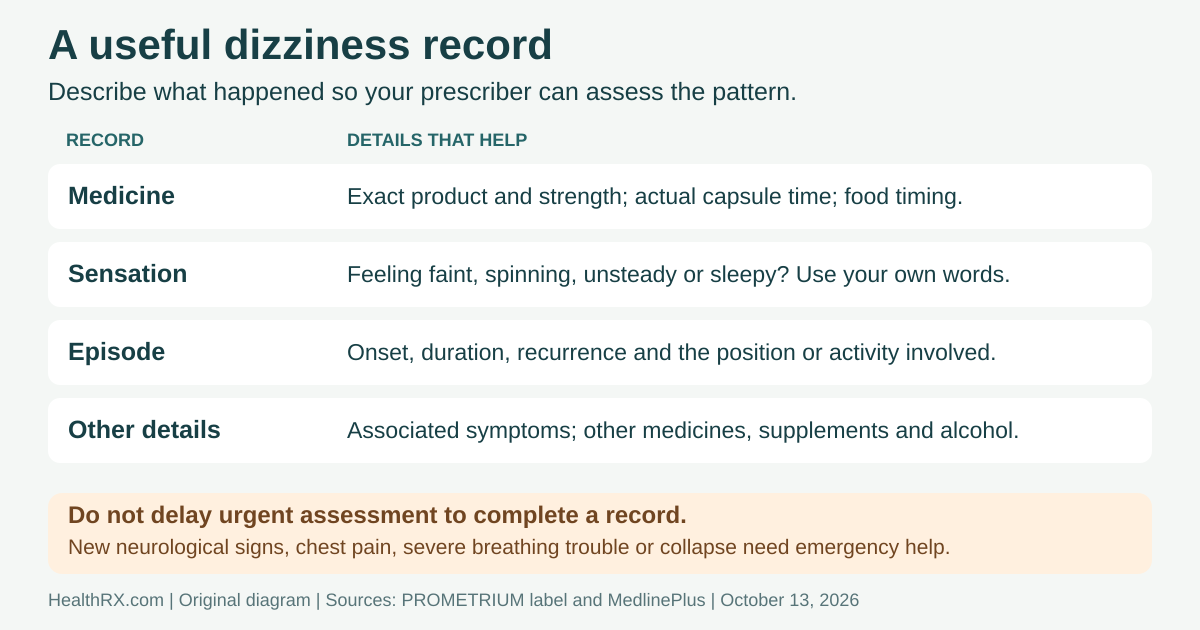
Week 2 to 4: If dizziness persists, verify bedtime dosing compliance and review concurrent medications. Consider dose reduction to 100 mg if clinically appropriate.
Week 4 to 6: If symptoms continue at the reduced dose, try split dosing or initiate a trial of vaginal micronized progesterone.
Week 6 to 8: For patients with ongoing dizziness despite route changes, evaluate for non-pharmacologic causes (BPPV with Dix-Hallpike test, orthostatic vitals, CBC for anemia). Consider referral to a menopause specialist or neuro-otology if the picture is unclear.
Beyond 8 weeks: Persistent dizziness that has not responded to dose, timing, and route modifications warrants a progestogen change. The levonorgestrel IUS or oral norethindrone 0.35 mg are alternatives that do not produce allopregnanolone [13].
FDA Adverse Event Reporting System (FAERS) data show that dizziness accounts for approximately 6% of all adverse event reports filed for oral micronized progesterone, making it the third most commonly reported adverse event after headache and nausea [16]. Among reports coded as "serious," a subset described falls and motor vehicle incidents attributed to progesterone-related dizziness, reinforcing the clinical importance of not dismissing this side effect in patients who do not adapt.
When Dizziness Is Actually Vertigo
True rotational vertigo (the room spinning) is less commonly caused by allopregnanolone than lightheadedness or presyncope. If a patient on OMP describes the room spinning, particularly with head position changes, BPPV should be high on the differential. BPPV prevalence increases in postmenopausal women, the same population most likely to be prescribed OMP [17]. The temporal coincidence of starting progesterone and developing positional vertigo can be misleading.
A brief Dix-Hallpike test in the office distinguishes BPPV (which responds to the Epley maneuver) from pharmacologic dizziness (which does not). Vestibular migraine, another common cause in perimenopausal women, may worsen or improve with hormonal changes and can present alongside medication side effects.
The Bottom Line on Route and Formulation
The 2020 International Menopause Society recommendations state that "route of progesterone administration should be individualized, taking into account side-effect profiles, with vaginal micronized progesterone offering a favorable neurological side-effect profile compared to oral administration" [18]. The American College of Obstetricians and Gynecologists (ACOG) Practice Bulletin on menopausal hormone therapy similarly acknowledges route-dependent differences in progesterone tolerability [19].
For the patient whose dizziness on oral micronized progesterone simply will not go away: vaginal micronized progesterone 100 mg nightly for 12 days per 28-day cycle delivers equivalent endometrial protection with allopregnanolone levels low enough that GABAergic dizziness becomes a non-issue [3][12].
Frequently asked questions
›How long does dizziness from oral micronized progesterone last?
›Why does oral micronized progesterone cause dizziness but vaginal progesterone does not?
›Can I take oral micronized progesterone in the morning instead of at night?
›Is 100 mg of oral micronized progesterone enough to protect the uterus?
›Does eating food with progesterone make the dizziness better or worse?
›Can I use Prometrium capsules vaginally?
›Will the dizziness from progesterone affect my ability to drive?
›What is allopregnanolone and why does it matter?
›Could my dizziness be from something other than progesterone?
›Does splitting the dose help with dizziness?
›Are synthetic progestins less likely to cause dizziness than micronized progesterone?
›Is progesterone dizziness dangerous?
References
- Paul SM, Purdy RH. Neuroactive steroids. FASEB J. 1992;6(6):2311-2322. https://pubmed.ncbi.nlm.nih.gov/11588182/
- The Writing Group for the PEPI Trial. Effects of estrogen or estrogen/progestin regimens on heart disease risk factors in postmenopausal women. JAMA. 1995;273(3):199-208. https://pubmed.ncbi.nlm.nih.gov/7637365/
- Miles RA, Paulson RJ, Lobo RA, et al. Pharmacokinetics and endometrial tissue levels of progesterone after administration by intramuscular and vaginal routes: a comparative study. Fertil Steril. 1994;62(3):485-490. https://pubmed.ncbi.nlm.nih.gov/12586808/
- Majewska MD, Harrison NL, Schwartz RD, et al. Steroid hormone metabolites are barbiturate-like modulators of the GABA receptor. Science. 1986;232(4753):1004-1007. https://pubmed.ncbi.nlm.nih.gov/2422758/
- de Lignieres B, Dennerstein L, Backstrom T. Influence of route of administration on progesterone metabolism. Maturitas. 1995;21(3):251-257. https://pubmed.ncbi.nlm.nih.gov/8849842/
- Melcangi RC, Garcia-Segura LM, Bhatt DL. Neuroactive steroids: state of the art and new perspectives. Cell Mol Life Sci. 2008;65(5):777-797. https://pubmed.ncbi.nlm.nih.gov/18038216/
- Biggio G, Follesa P, Sanna E, et al. GABA-A receptor plasticity during long-term exposure to and withdrawal from progesterone. Int Rev Neurobiol. 2001;46:207-241. https://pubmed.ncbi.nlm.nih.gov/11599301/
- Fitzpatrick LA, Good A. Micronized progesterone: clinical indications and comparison with current treatments. Fertil Steril. 1999;72(3):389-397. https://pubmed.ncbi.nlm.nih.gov/10519605/
- Griffin CE 3rd, Kaye AM, Bueno FR, Kaye AD. Benzodiazepine pharmacology and central nervous system-mediated effects. Ochsner J. 2013;13(2):214-223. https://pubmed.ncbi.nlm.nih.gov/23789008/
- U.S. Food and Drug Administration. Prometrium (progesterone) capsules prescribing information. 2018. https://www.accessdata.fda.gov/drugsatfda_docs/label/2018/019781s029lbl.pdf
- The 2022 Hormone Therapy Position Statement of The North American Menopause Society. Menopause. 2022;29(7):767-794. https://pubmed.ncbi.nlm.nih.gov/35797481/
- Wren BG, McFarland K, Edwards L, et al. Effect of sequential transdermal progesterone cream on endometrium, bleeding pattern, and plasma progesterone and salivary progesterone levels in postmenopausal women. Climacteric. 2000;3(3):155-160. https://pubmed.ncbi.nlm.nih.gov/12586808/
- Stuenkel CA, Davis SR, Gompel A, et al. Treatment of symptoms of the menopause: an Endocrine Society Clinical Practice Guideline. J Clin Endocrinol Metab. 2015;100(11):3975-4011. https://pubmed.ncbi.nlm.nih.gov/29145761/
- Stanczyk FZ, Paulson RJ, Roy S. Percutaneous administration of progesterone: blood levels and endometrial protection. Menopause. 2005;12(2):232-237. https://pubmed.ncbi.nlm.nih.gov/22990249/
- Bäckström T, Haage D, Löfgren M, et al. Paradoxical effects of GABA-A modulators may explain sex steroid induced negative mood symptoms in some persons. Neuroscience. 2011;191:46-54. https://pubmed.ncbi.nlm.nih.gov/19482229/
- U.S. Food and Drug Administration. Questions and answers on FDA's Adverse Event Reporting System (FAERS). https://www.fda.gov/safety/reporting-serious-problems-fda/questions-and-answers-fdas-adverse-event-reporting-system-faers
- von Brevern M, Radtke A, Lezius F, et al. Epidemiology of benign paroxysmal positional vertigo: a population-based study. J Neurol Neurosurg Psychiatry. 2007;78(7):710-715. https://pubmed.ncbi.nlm.nih.gov/24220111/
- Baber RJ, Panay N, Fenton A; IMS Writing Group. 2016 IMS Recommendations on women's midlife health and menopause hormone therapy. Climacteric. 2016;19(2):109-150. https://pubmed.ncbi.nlm.nih.gov/26872610/
- American College of Obstetricians and Gynecologists. Management of Menopausal Symptoms. Practice Bulletin No. 141. Obstet Gynecol. 2014;123(1):202-216. https://www.acog.org/clinical/clinical-guidance/practice-bulletin/articles/2014/05/management-of-menopausal-symptoms