Persistent Testosterone Injection Pain: Describe the Change, Then Seek the Right Care
Pain that keeps returning after testosterone injections, remains troublesome, or changes deserves attention. The useful starting point is its trajectory: is it easing, staying similar, or worsening? Then separate symptoms affecting your whole body from changes at the injection site and reactions that recur after particular exposures. These patterns help a clinician decide what needs examination and what to review before another injection.
First, choose the right level of care
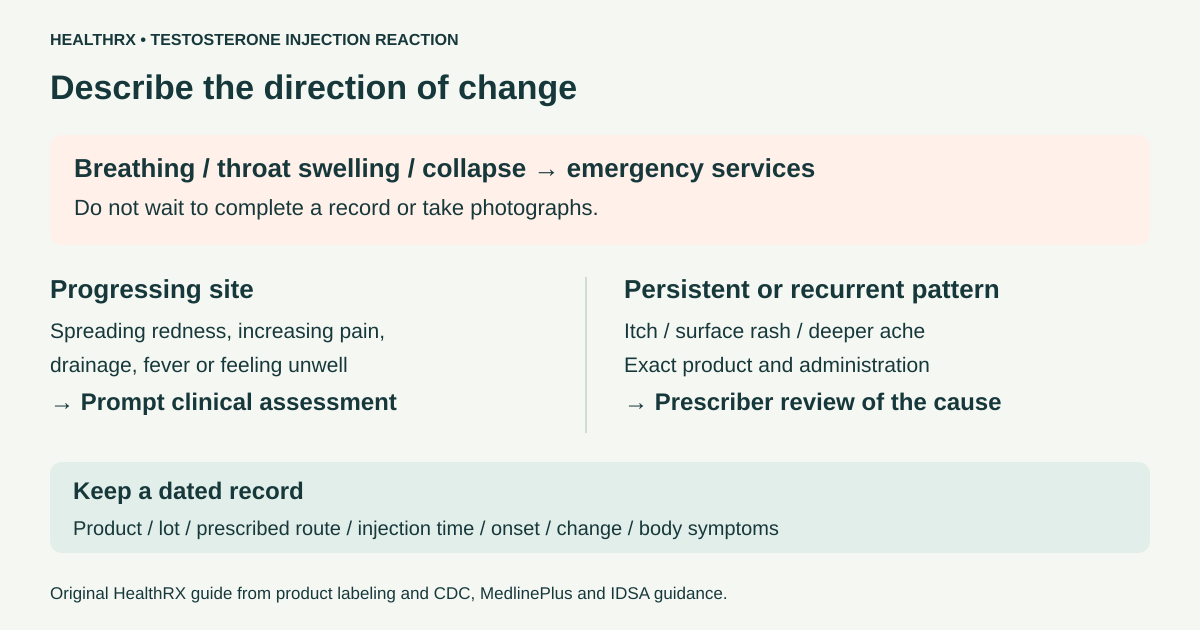
Do not delay emergency care to finish a record or take photographs. Breathing difficulty, throat or tongue swelling, wheezing, collapse, or a rapidly developing reaction involving several body systems can signal anaphylaxis. Call 911 or your local emergency number. Skin changes may be absent; antihistamines alone are not adequate treatment. CDC guidance describes this recognition in a vaccine context, not testosterone-specific reaction rates.[2]
| Symptom pattern | Action |
|---|---|
| Breathing trouble, throat or tongue swelling, collapse, or a rapid whole-body reaction | Call emergency services immediately. |
| Increasing local pain, spreading redness or warmth, drainage, fever, or chills | Seek prompt medical assessment; severe or disproportionate pain or marked illness warrants urgent care. |
| A stable but troublesome lump, persistent ache, or recurring itch or rash | Contact the prescriber for assessment and review before continuing the same pattern. |
An injection site's appearance cannot establish whether infection is present. Progressive tenderness, swelling, warmth, and redness can occur with cellulitis; drainage or feeling unwell adds concern.[3] Avoid another injection into the affected site and contact your prescriber for an actual next-dose plan. Do not improvise a new injection location or route.
Make a trajectory-and-exposure record
A useful record connects what you received, how it was administered, and what changed afterward. Keep it factual and short enough to share. Missing information should be marked “unknown,” rather than reconstructed from memory as certainty.
Copy these fields into a note:
- Product name, manufacturer or dispensing pharmacy, strength, lot number if available, and prescribed route.
- Actual injection date and time, anatomical site, amount administered as recorded, and who administered it.
- Equipment and method actually used, including any differences from your training or prescription; bring the supplies or their packaging if helpful.
- Symptom onset, followed by dated observations: improving, unchanged, or worsening; itch or surface rash versus deeper ache; lump, warmth, redness, swelling, or drainage.
- Body symptoms, including fever, chills, faintness, breathing symptoms, or symptoms away from the site.
- Current medicines, relevant allergies, and anything that changed between injections, such as product, supplies, or skin preparation.
For recurrent symptoms, compare episodes without assuming a cause. Did itching follow every injection, only one product, or a change in skin preparation? Did deeper pain occur at the same site? These are leads for assessment, not proof of an ingredient allergy. If you choose to take photographs, use consistent lighting and record dates. Pictures supplement an examination; they cannot prove sterility or diagnose a collection.
What your clinician needs to distinguish
The Depo-Testosterone label lists injection-site pain and inflammation and specifies intramuscular administration. It contains cottonseed oil, benzyl alcohol, and benzyl benzoate. That information does not establish which ingredient caused a reaction or provide a universal recovery timetable.[1]
A lump is not automatically a sterile abscess. A collection of pus and diffuse cellulitis may require different treatment. Clinicians may drain an abscess and obtain a culture; routine cultures are not necessary for every typical cellulitis case.[4] Examination guides whether imaging or other testing would help. Do not puncture, squeeze, or drain a lump yourself, or use leftover antibiotics.
Ask the prescriber to review your actual product, prescribed route, administration training, and recurring symptom pattern. Pain relief alone can obscure whether the underlying problem is continuing. Repeatedly needing medication to tolerate injections is a reason to revisit the cause.
Discuss changes without treating them as guaranteed fixes
Evidence about injection comfort has limits. A systematic review of intramuscular techniques found substantial heterogeneity and risk of bias; warming injectate did not reduce pain. It was not a testosterone-specific persistent-pain protocol.[6]
Small studies in adult transgender men reported favorable experiences with subcutaneous testosterone, but their designs do not establish a universally safer or painless route.[7,8] An intramuscular product label does not automatically authorize subcutaneous use. Any change needs product-specific prescribing and training review.
Other formulations may be worth discussing. Guideline-based choices weigh preferences, pharmacokinetics, adverse effects, treatment burden, and cost, with monitoring of response.[5] Bring your record so the discussion addresses the problem you are actually experiencing.
Frequently asked questions
How long should testosterone cypionate injection-site pain last?
There is no universal recovery clock in the Depo-Testosterone label.[1] Describe whether pain is improving, unchanged, or worsening, and whether it recurs after each injection. Persistent or troublesome symptoms deserve prescriber review.
Should I worry if pain lasts more than 72 hours?
The 72-hour mark alone does not distinguish an uncomplicated reaction from a problem needing treatment. Increasing pain, spreading redness, drainage, fever, or feeling ill warrants prompt assessment; do not wait for a time threshold.[3]
Is a persistent lump a sterile abscess?
A persistent lump cannot be labeled a sterile abscess from duration or a photograph. Examination may help distinguish inflammation, a collection, or another cause. Abscesses and cellulitis do not necessarily receive the same treatment.[4]
Can I aspirate or massage a persistent lump?
Do not aspirate, puncture, squeeze, or drain it yourself. Avoid trying to massage an unexplained persistent lump away. Ask for assessment; drainage, when needed, is a clinician procedure.[4]
Should I switch carrier oils?
Do not assume the carrier oil is responsible. Record the exact product and whether itch, rash, or pain followed a product change. Depo-Testosterone contains several ingredients, so identifying an allergy requires assessment rather than an oil-only explanation.[1]
Can I switch to subcutaneous testosterone?
Discuss it with your prescriber rather than changing routes yourself. Wilson's open-label crossover pilot involved 14 adult transgender men and found lower reported pain with substantial individual variability.[7] Spratt's retrospective study involved 63 adult transgender men; nine had minor transient local reactions.[8] Neither establishes a painless route for everyone, and an intramuscular label does not automatically clear subcutaneous administration.[1]
Should I warm the vial or use a smaller needle?
Have your clinician review the equipment and technique you actually use against your product and training. A systematic review of intramuscular techniques did not find pain reduction from warming injectate and was not a testosterone-specific persistent-pain protocol.[6] It does not justify a do-it-yourself equipment change.
Can I take ibuprofen before every injection?
Routine pre-dosing is not a solution to unexplained recurring pain. Ibuprofen labeling includes heart attack, stroke, stomach bleeding, kidney-related precautions, anticoagulant interactions, and allergy concerns.[9] Ask whether it is appropriate with your health history and medicines; repeated need should prompt review of the cause.
What does an infected injection site look like?
Spreading redness, warmth, tenderness, swelling, or drainage can raise concern, especially with fever or chills.[3] Appearance alone cannot confirm infection. Seek prompt care for progression, and get urgent assessment for severe or disproportionate pain or significant illness.[4]
When might ultrasound be used?
A clinician may consider ultrasound when examination leaves uncertainty about a deeper collection or another explanation for swelling. It is not mandatory for every lump, and an image does not by itself establish the cause. The question is whether imaging would change care.
What should I document for my prescriber?
Record the exact product, strength, lot if known, prescribed route, actual injection date and time, site, and equipment and method used. Add symptom onset and dated changes, distinguishing itch from deep ache. Include drainage, body symptoms, medicines, and exposure changes. Mark unknowns honestly; emergency care comes first.
Does switching to gel or nasal testosterone solve everything?
No formulation guarantees freedom from adverse effects. Gel or nasal treatment may avoid injection-site problems, but each has its own administration burden and risks. Discuss preferences, cost, formulation-specific effects, and monitoring with your prescriber.[5]
References
- DailyMed. Depo-Testosterone—testosterone cypionate injection, solution. Pharmacia & Upjohn Company LLC. Label updated August 21, 2026. Prescribing information.
- CDC. Preventing and Managing Adverse Reactions. Vaccine best-practice guidance. Guidance.
- MedlinePlus Medical Encyclopedia. Cellulitis. Article.
- Infectious Diseases Society of America. Practice Guidelines for the Diagnosis and Management of Skin and Soft Tissue Infections: 2014 Update. Guideline.
- Bhasin S, et al. Testosterone Therapy in Men With Hypogonadism: An Endocrine Society Clinical Practice Guideline. 2018. PMID: 29562364. PubMed.
- Ayinde O, et al. The effect of intramuscular injection technique on injection associated pain: a systematic review and meta-analysis. 2021. PMID: 33939726. PubMed.
- Wilson DM, et al. Pharmacokinetics, safety, and patient acceptability of subcutaneous versus intramuscular testosterone injection for gender-affirming therapy: a pilot study. 2018. PMID: 29367424. PubMed.
- Spratt DI, et al. Subcutaneous Injection of Testosterone Is an Effective and Preferred Alternative to Intramuscular Injection: Demonstration in Female-to-Male Transgender Patients. 2017. PMID: 28379417. PubMed.
- DailyMed. Ibuprofen 200 mg—Drug Facts labeling. Label.